Acute Agitation Aggression Treatment Market Outlook 2026–2034: Emerging Therapies, Growth Drivers, Leading Companies, and Future Opportunities
The Acute Agitation and Aggression Treatment Market is expected to grow from $ 7.47 billion in 2026 to $ 11.34 billion by 2034, registering a CAGR of 5.37%.
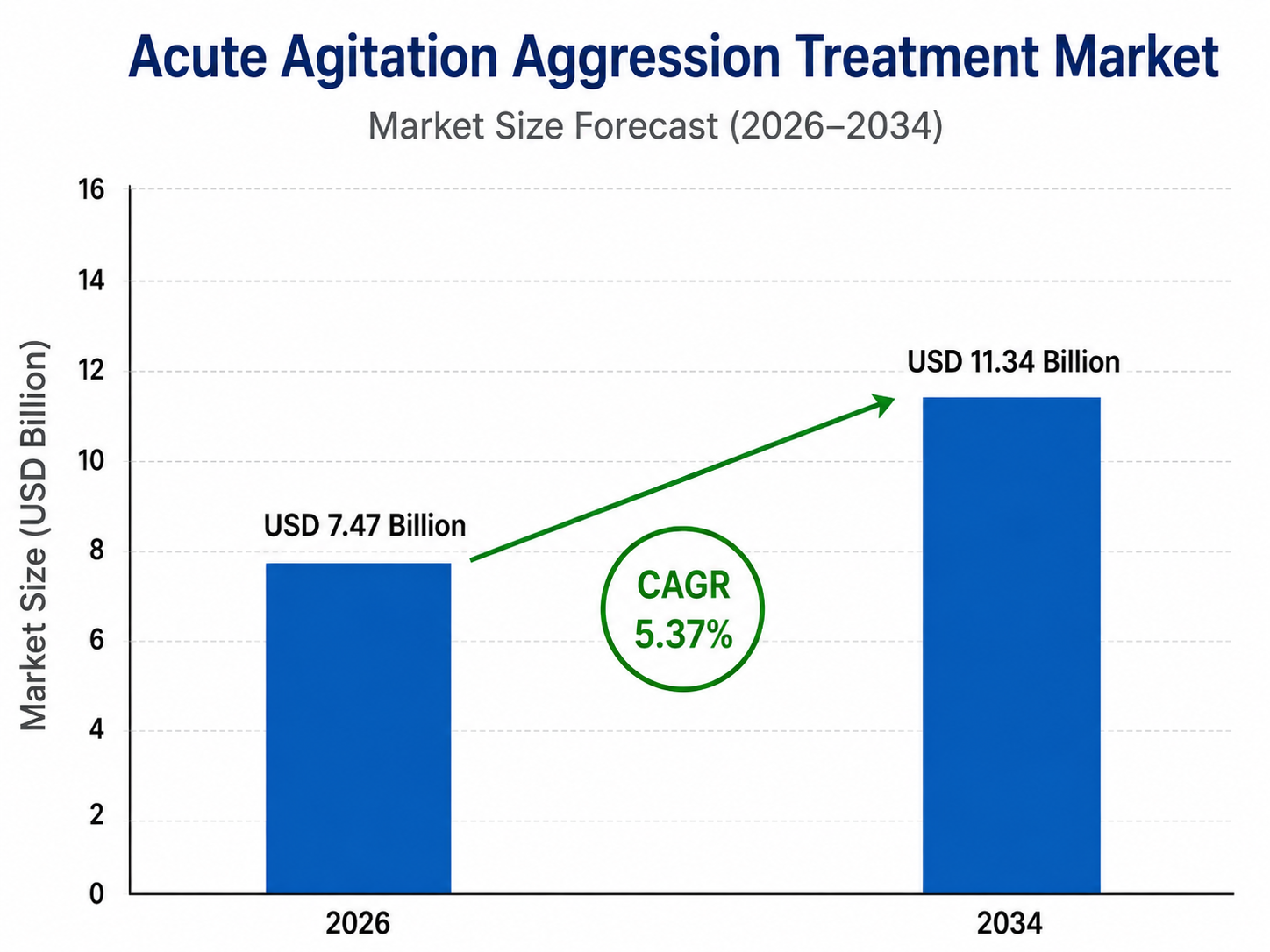
During the forecast period. The market includes a broad range of pharmacological and non-pharmacological interventions designed to rapidly manage symptoms such as restlessness, irritability, hostility, verbal and physical aggression, and behavioral escalation. These symptoms are commonly associated with conditions including schizophrenia, bipolar disorder, dementia, delirium, substance intoxication, autism spectrum disorder, traumatic brain injury, and other psychiatric emergencies. Market growth is being driven by the increasing prevalence of mental health disorders, rising emergency department admissions, expanding geriatric care for dementia patients, and a growing emphasis on safe and effective de-escalation strategies in healthcare settings. Hospitals, emergency departments, psychiatric units, long-term care facilities, and behavioral health centers remain the primary end users. In addition, ongoing innovation in faster-acting therapies, non-invasive drug delivery methods, treatments with reduced risk of oversedation, and advanced patient safety monitoring technologies is expected to support continued market expansion throughout the forecast period.
1. What is the latest trend in the Acute Agitation Aggression Treatment Market?
The latest trend is the shift toward faster-acting, less invasive, and easier-to-administer treatment options.
Sublingual films, orally disintegrating tablets, inhaled therapies, and targeted therapies for dementia-related agitation are gaining attention.
Healthcare providers are also emphasizing verbal de-escalation, trauma-informed care, and reduced use of physical restraints.
Digital monitoring and behavioral-risk assessment tools are emerging in psychiatric and long-term care settings.
2. What are the key challenges in the Acute Agitation Aggression Treatment Market?
Key challenges include safety risks, oversedation, delayed onset of action, staff injury, patient refusal, and difficulty identifying the underlying cause of agitation.
Many patients present in emergency conditions where psychiatric, medical, toxicological, and neurological causes must be quickly differentiated.
Treatment must calm the patient without compromising respiration, cardiovascular stability, or diagnostic assessment.
Regulatory scrutiny, black-box warnings, and limited approved indication coverage also influence prescribing decisions.
3. What is the major driving factor for the Acute Agitation Aggression Treatment Market?
The major driving factor is the increasing demand for rapid behavioral stabilization across emergency, psychiatric, and geriatric care settings.
Rising prevalence of dementia, schizophrenia, bipolar disorder, substance-use disorders, and acute psychiatric crises is expanding treatment need.
Hospitals and care facilities require protocols that protect patients, caregivers, clinicians, and nearby individuals.
Greater awareness of agitation as a treatable clinical symptom is also supporting market expansion.
4. What is the major segment in the Acute Agitation Aggression Treatment Market and why?
Antipsychotic drugs represent a major treatment segment because they are widely used to manage agitation linked to psychosis, bipolar disorder, and dementia-related behavioral symptoms.
Injectable, oral, and orally disintegrating formulations support use across different clinical situations.
Their broad availability, clinician familiarity, and inclusion in emergency psychiatry protocols sustain demand.
However, newer non-injectable and non-antipsychotic options are creating differentiated growth opportunities.
5. Which application or end-user is driving more demand?
Emergency departments, inpatient psychiatric units, long-term care facilities, and dementia-care centers are driving strong demand.
These settings frequently manage acute agitation associated with psychiatric illness, delirium, dementia, intoxication, or medical instability.
Hospitals need rapid interventions that reduce escalation while allowing safe evaluation and treatment.
Long-term care facilities are increasingly seeking safer options for agitation in elderly and cognitively impaired patients.
6. Which region offers the highest growth potential and why?
North America remains a leading market due to high diagnosis rates, advanced emergency psychiatry infrastructure, and availability of newer branded therapies.
The United States has strong demand from hospitals, psychiatric facilities, nursing homes, and dementia-care programs.
Asia Pacific offers strong growth potential as mental health awareness, geriatric care, and hospital infrastructure continue to expand.
Europe also remains important due to structured psychiatric care systems and growing dementia-treatment demand.
7. What strategies are major companies adopting in the market?
Major companies are focusing on novel delivery formats, faster onset, improved tolerability, dementia-related agitation indications, and hospital-focused commercialization.
They are developing sublingual, inhaled, oral, and long-acting products that may reduce reliance on injectable emergency medications.
Clinical trials, label expansion, physician education, and payer access are central to growth strategies.
Companies are also emphasizing safer use, reduced restraint dependence, and differentiation from older sedating therapies.
8. What are the leading companies in the Acute Agitation Aggression Treatment Market?
Leading companies include Otsuka Pharmaceutical, Lundbeck, BioXcel Therapeutics, Axsome Therapeutics, Eli Lilly, Johnson & Johnson, Pfizer, Teva Pharmaceutical, Viatris, Hikma Pharmaceuticals, Sandoz, Sun Pharmaceutical, and Dr. Reddy’s Laboratories.
These companies participate through branded antipsychotics, sublingual therapies, antidepressant-combination products, injectables, and generic psychiatric medicines.
Competitive positioning depends on approved indications, onset of action, safety profile, route of administration, and hospital access.
Companies with differentiated products for schizophrenia, bipolar disorder, and Alzheimer’s-related agitation are gaining strategic relevance.
9. Why is acute agitation aggression treatment strategically important for healthcare providers?
Effective treatment helps prevent injury, reduce emergency escalation, support diagnostic evaluation, and improve patient and staff safety.
Rapid stabilization can reduce restraint use, shorten crisis duration, and improve care coordination across emergency and psychiatric teams.
For long-term care providers, better agitation management can reduce caregiver burden and avoid unnecessary transfers.
Strategic protocols also support quality improvement, regulatory compliance, and safer behavioral health operations.
10. What is the future outlook for the Acute Agitation Aggression Treatment Market?
The market outlook remains positive as demand grows for safer, faster, and more patient-friendly agitation management options.
Future growth will be supported by dementia-related therapies, non-invasive formulations, digital behavioral monitoring, and expanded psychiatric care access.
Treatment standards are expected to move toward personalized protocols based on cause, severity, patient age, and safety risk.
Companies offering clinically validated, easy-to-administer, and lower-risk therapies are expected to gain market share
Browse Related Reports:
https://www.oganalysis.com/industry-reports/blood-gas-and-electrolyte-analyzer-market
https://www.oganalysis.com/industry-reports/diabetes-care-devices-market
https://www.oganalysis.com/industry-reports/healthcare-3d-printing-market
https://www.oganalysis.com/industry-reports/cosmetic-implants-market
https://www.oganalysis.com/industry-reports/implantable-loop-recorders-market
