Artificial Intelligence (AI) in Energy and Power Market Outlook 2026–2034: Grid Optimization, Growth Drivers, Leading Companies, and Future Opportunities
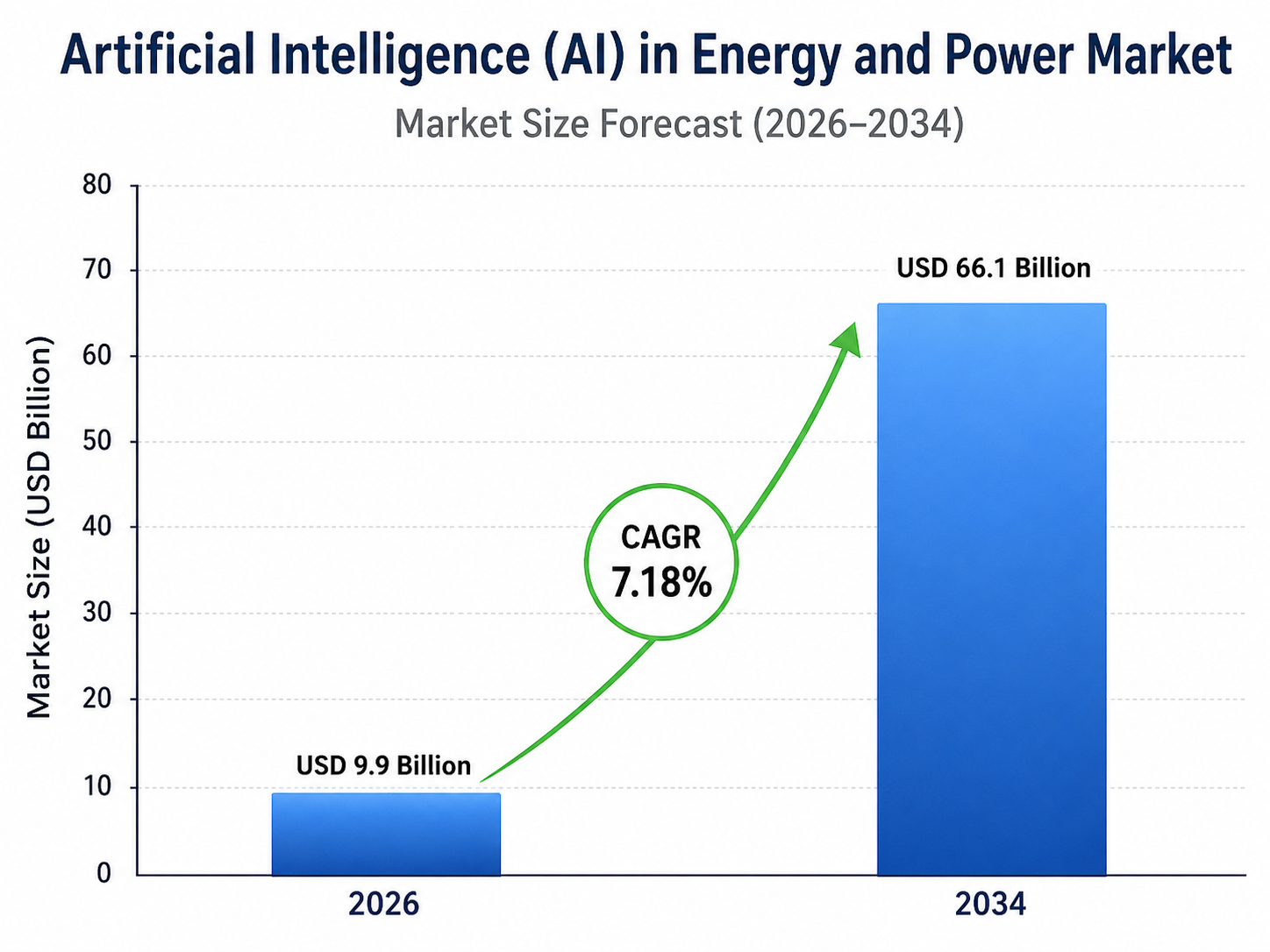
The Artificial Intelligence (AI) in Energy and Power Market is estimated to be valued at $ 9.9 billion in 2026 and is projected to reach $ 66.1 billion by 2034, expanding at a CAGR of 7.18% from 2026 to 2034.
AI in energy and power includes machine learning, predictive analytics, digital twins, computer vision, optimization algorithms, and automation platforms used across power generation, transmission, distribution, energy trading, storage, and consumption management. These solutions help utilities, grid operators, renewable developers, oil and gas companies, industrial users, and energy retailers improve forecasting, asset performance, reliability, and efficiency. Market growth is supported by grid modernization, renewable energy integration, rising electricity demand, distributed energy resources, smart meters, and the need to reduce operating costs. As energy systems become more decentralized and data-intensive, AI is becoming a strategic tool for resilient, efficient, and low-carbon power operations.
1. What is the latest trend in the Artificial Intelligence (AI) in Energy and Power Market?
The latest trend is the use of AI for real-time grid optimization, renewable energy forecasting, and autonomous energy management.
Utilities are deploying AI to analyze smart meter, weather, grid sensor, and asset-performance data for faster operational decisions.
Generative AI and digital twins are also being explored for grid planning, outage response, maintenance workflows, and operator support.
This is shifting the market from basic analytics toward intelligent, predictive, and self-optimizing energy systems.
2. What are the key challenges in the Artificial Intelligence (AI) in Energy and Power Market?
Key challenges include poor data quality, cybersecurity risks, legacy grid infrastructure, lack of interoperability, and shortage of AI-skilled energy professionals.
Utilities require explainable, reliable, and secure AI because power systems are critical infrastructure.
Integration with existing SCADA, EMS, DMS, DERMS, and asset-management systems can be complex and costly.
Regulatory uncertainty and conservative procurement practices may also slow large-scale deployment.
3. What is the major driving factor for the Artificial Intelligence (AI) in Energy and Power Market?
The major driving factor is the need to manage increasingly complex power systems with higher renewable energy penetration and distributed energy resources.
AI improves demand forecasting, renewable output prediction, grid balancing, and outage detection.
It also helps reduce equipment downtime through predictive maintenance and asset-health monitoring.
Rising electricity demand from electrification, data centers, EV charging, and industrial activity is further strengthening adoption.
4. What is the major segment in the Artificial Intelligence (AI) in Energy and Power Market and why?
Software and analytics platforms represent a major segment because most AI value is delivered through forecasting, optimization, automation, and decision-support tools.
These platforms process large volumes of operational data from grids, meters, turbines, substations, batteries, and customer systems.
Utilities and energy companies rely on AI software to improve reliability, reduce losses, and optimize asset utilization.
Services remain important because implementation, model training, integration, and ongoing monitoring are critical for successful deployment.
5. Which application or end-user is driving more demand?
Grid management, demand forecasting, predictive maintenance, renewable integration, and energy management are driving strong demand.
Utilities and grid operators are major end users because they need real-time visibility and reliability across generation, transmission, and distribution networks.
Renewable energy developers use AI to forecast solar and wind output and improve project performance.
Industrial and commercial users are adopting AI to reduce energy costs, optimize consumption, and meet sustainability targets.
6. Which region offers the highest growth potential and why?
North America remains a leading market due to advanced utility digitization, smart grid investment, renewable integration, and strong AI technology ecosystems.
The United States is seeing growing demand for AI-enabled grid resilience, energy storage optimization, and data-center power planning.
Asia Pacific offers strong growth potential due to rising electricity demand, urbanization, smart city programs, and renewable capacity expansion.
Europe is also important due to decarbonization policies, energy efficiency goals, and advanced grid modernization initiatives.
7. What strategies are major companies adopting in the market?
Major companies are focusing on AI-powered grid software, digital twins, predictive maintenance, demand response, and cloud-based energy platforms.
They are integrating AI with IoT sensors, smart meters, distributed energy resources, EV charging networks, and storage systems.
Partnerships with utilities, grid operators, cloud providers, and industrial customers are central to market expansion.
Companies are also emphasizing cybersecurity, explainable AI, regulatory compliance, and scalable deployment models.
8. What are the leading companies in the Artificial Intelligence (AI) in Energy and Power Market?
Leading companies include Schneider Electric, Siemens, GE Vernova, ABB, Honeywell, IBM, Microsoft, Google Cloud, Oracle, C3.ai, Hitachi Energy, Emerson Electric, Eaton, Itron, Landis+Gyr, Uplight, AutoGrid, Stem, GridPoint, and BrainBox AI.
These companies compete through AI platforms, grid software, energy analytics, automation systems, cloud infrastructure, and domain expertise.
Large industrial technology providers benefit from established utility and power-sector relationships.
Software-focused companies compete through predictive models, demand response, energy optimization, and faster platform deployment.
9. Why is AI strategically important for energy and power companies?
AI is strategically important because it helps energy companies improve reliability, efficiency, resilience, and decarbonization performance.
It supports better decisions across forecasting, dispatch, maintenance, outage response, customer engagement, and energy trading.
For utilities, AI can reduce operational costs while improving grid stability and service quality.
For power producers and energy users, it supports asset optimization, emissions reduction, and more intelligent energy consumption.
10. What is the future outlook for the Artificial Intelligence (AI) in Energy and Power Market?
The market outlook remains strong as power systems become more digital, decentralized, renewable-heavy, and data-driven.
Future growth will be supported by AI-enabled grid orchestration, autonomous energy management, virtual power plants, and predictive asset intelligence.
Energy storage, EV charging, demand response, and data-center power optimization are expected to create new opportunities.
Companies offering secure, interoperable, explainable, and utility-grade AI solutions are expected to gain market share.
Browse Related Reports:
https://www.oganalysis.com/industry-reports/machine-vision-system-market
https://www.oganalysis.com/industry-reports/data-center-asset-management-market
https://www.oganalysis.com/industry-reports/hydrophone-market
https://www.oganalysis.com/industry-reports/surging-wireless-access-point-controller-market
https://www.oganalysis.com/industry-reports/ip-multimedia-subsystem-ims-market
