Autopilot System Market Outlook 2026–2034: Key Trends, Growth Drivers, Leading Companies, and Future Opportunities
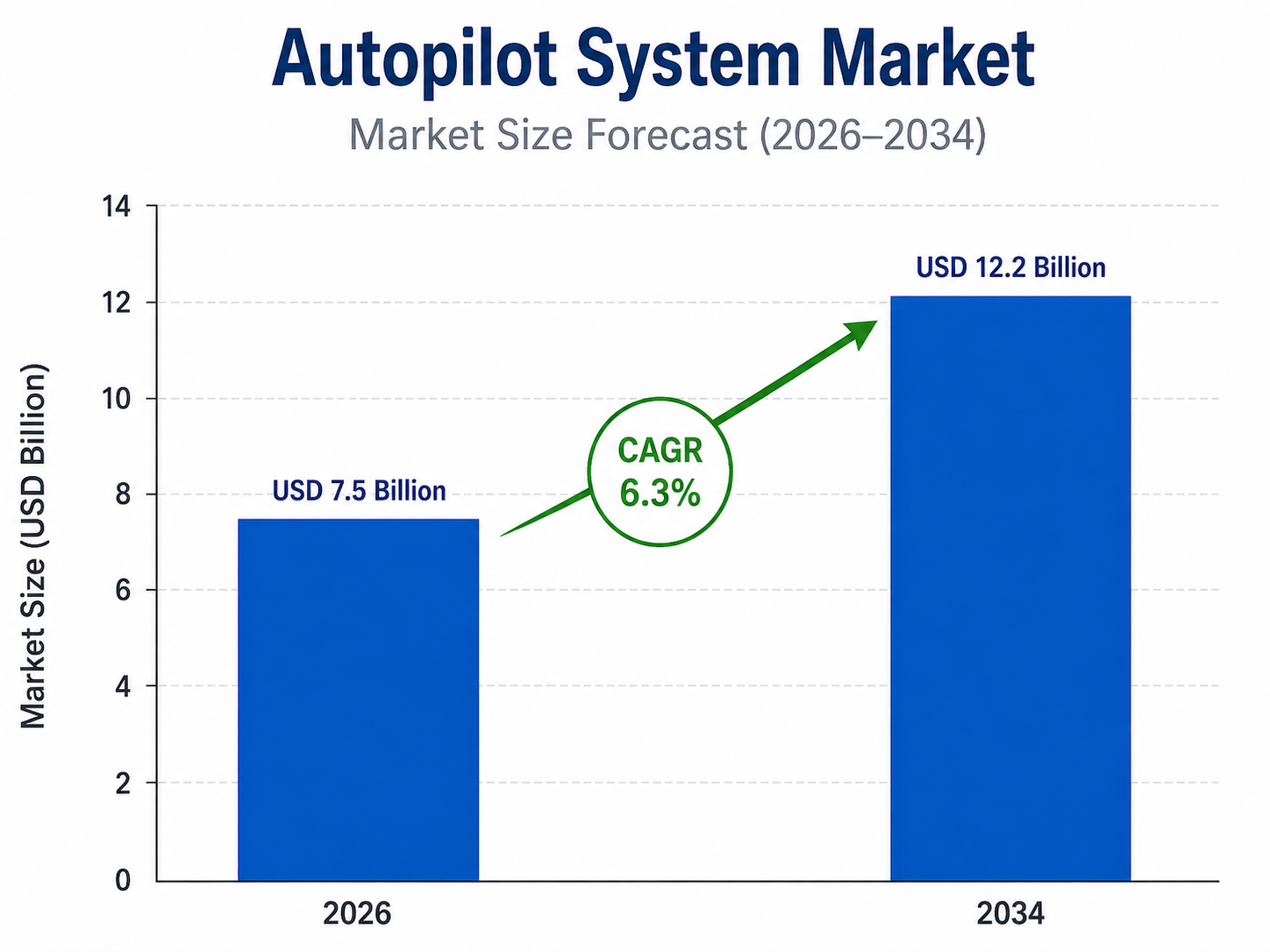
The Autopilot System Market is expected to grow from $7.5 billion in 2026 to $ 12.2 billion by 2034, registering a CAGR of 6.3% during the forecast period.
Autopilot systems are designed to automate navigation and operational tasks across aircraft, marine vessels, unmanned aerial vehicles (UAVs), and other mobility platforms by integrating advanced technologies such as flight computers, sensors, actuators, communication systems, and intelligent control software. These solutions help manage functions including route navigation, altitude and speed control, stability, collision avoidance, and mission execution, improving both safety and operational efficiency. Market growth is being fueled by increasing aircraft production, the expanding use of UAVs, rising adoption of automated marine navigation, ongoing defense modernization programs, and the growing need for safer and more efficient transportation. At the same time, continuous advancements in artificial intelligence, sensor fusion, satellite navigation, digital flight controls, and autonomous technologies are enabling more capable and reliable autopilot systems, creating new opportunities across commercial, defense, and industrial applications.
1. What is the latest trend in the Autopilot System Market?
The latest trend is the integration of artificial intelligence, sensor fusion, computer vision, and real-time data analytics into autopilot platforms.
Manufacturers are developing systems capable of adaptive navigation, automated route optimization, collision avoidance, and increasingly autonomous mission execution.
Cloud connectivity, digital flight controls, and software-defined functions are also gaining importance.
These developments are expanding autopilot capabilities across aircraft, drones, ships, and unmanned platforms.
2. What are the key challenges in the Autopilot System Market?
Key challenges include high development costs, strict safety certification, cybersecurity risks, system integration complexity, and dependence on reliable sensors and communication networks.
Autopilot failures can have significant safety consequences, requiring extensive testing, redundancy, and regulatory approval.
Interoperability between legacy platforms and modern digital controls can also slow adoption.
Manufacturers must balance greater autonomy with human oversight, reliability, and operational accountability.
3. What is the major driving factor for the Autopilot System Market?
The major driving factor is rising demand for safer, more efficient, and increasingly autonomous transportation and mission systems.
Autopilot technologies reduce operator workload, improve navigation accuracy, optimize fuel consumption, and support longer-duration operations.
Growth in commercial aviation, UAVs, maritime transport, defense platforms, and autonomous mobility is strengthening demand.
Increasing labor constraints and pressure to improve operational efficiency provide additional market support.
4. What is the major segment in the Autopilot System Market and why?
Airborne autopilot systems represent a major segment due to their extensive use in commercial aircraft, military platforms, business jets, helicopters, and UAVs.
Aircraft depend on autopilot systems for altitude control, heading management, route following, approach assistance, and flight stability.
Strict aviation safety requirements and rising aircraft deliveries sustain replacement and original-equipment demand.
UAV growth is also expanding the market for compact and advanced flight-control systems.
5. Which application or end-user is driving more demand?
Commercial aviation, defense, unmanned aerial vehicles, and maritime transportation are driving significant demand for autopilot systems.
Airlines use these systems to improve flight safety, fuel efficiency, navigation accuracy, and pilot workload management.
Defense organizations require advanced autopilots for surveillance, reconnaissance, tactical UAVs, and autonomous missions.
Commercial shipping and recreational marine users also contribute through automated steering and route-control applications.
6. Which region offers the highest growth potential and why?
Asia Pacific offers strong growth potential due to expanding air travel, rising aircraft procurement, defense modernization, commercial shipping, and UAV adoption.
China, India, Japan, South Korea, and Southeast Asia are investing in aviation infrastructure and autonomous technologies.
North America remains a major established market due to its aerospace, defense, UAV, and marine technology ecosystem.
Europe also benefits from advanced aircraft manufacturing, maritime automation, and strict transportation safety standards.
7. What strategies are major companies adopting in the Autopilot System Market?
Major companies are focusing on AI-enabled navigation, compact control systems, cybersecurity, software upgrades, and integration with advanced sensors.
They are expanding solutions for commercial aircraft, UAVs, defense platforms, autonomous vessels, and recreational marine applications.
Partnerships with aircraft OEMs, shipbuilders, defense agencies, and unmanned-system developers are central to market expansion.
Companies are also pursuing certifications, acquisitions, and modular product architectures to accelerate deployment.
8. What are the leading companies in the Autopilot System Market?
Leading companies include Honeywell International, Collins Aerospace, Garmin, Thales, BAE Systems, Lockheed Martin, MicroPilot, Trimble, Kongsberg Maritime, Furuno Electric, ABB, Raymarine, Navico, and Tokyo Keiki.
These companies compete through navigation accuracy, platform compatibility, reliability, certification expertise, software functionality, and global service networks.
Aerospace leaders benefit from established aircraft OEM relationships and certified flight-control portfolios.
Marine and UAV specialists compete through application-focused, compact, and increasingly autonomous systems.
9. Why are autopilot systems strategically important for transportation and defense operators?
Autopilot systems improve safety, operational consistency, route precision, fuel efficiency, and asset utilization while reducing operator workload.
They enable aircraft, vessels, and unmanned systems to perform complex or long-duration missions with greater accuracy.
For defense organizations, autopilot technology supports remote operations and autonomous mission capabilities.
For commercial operators, it is becoming central to automation, cost control, and digital fleet management.
10. What is the future outlook for the Autopilot System Market?
The market outlook remains positive as transportation platforms become more connected, digitally controlled, and autonomous.
Growth will be supported by UAV proliferation, next-generation aircraft, autonomous shipping, AI navigation, and defense modernization.
Future systems are expected to offer greater decision support, predictive control, and integration with traffic-management networks.
Companies combining certified hardware, intelligent software, cybersecurity, and platform-specific expertise are likely to gain advantage.
Browse Related Reports:
https://www.oganalysis.com/industry-reports/offshore-mooring-systems-market
https://www.oganalysis.com/industry-reports/satellite-based-augmentation-systems-market
https://www.oganalysis.com/industry-reports/border-security-market
https://www.oganalysis.com/industry-reports/military-vetronics-market
https://www.oganalysis.com/industry-reports/antitank-missile-market
