Ball Valves Market Outlook 2026–2034: Smart Valve Technologies, Energy Infrastructure Demand, Leading Companies, and Growth Opportunities
The Ball Valves Market is estimated to be valued at $ 13.35 billion in 2026 and is projected to reach $ 17.96 billion by 2034, expanding at a CAGR of 3.78% from 2026 to 2034.
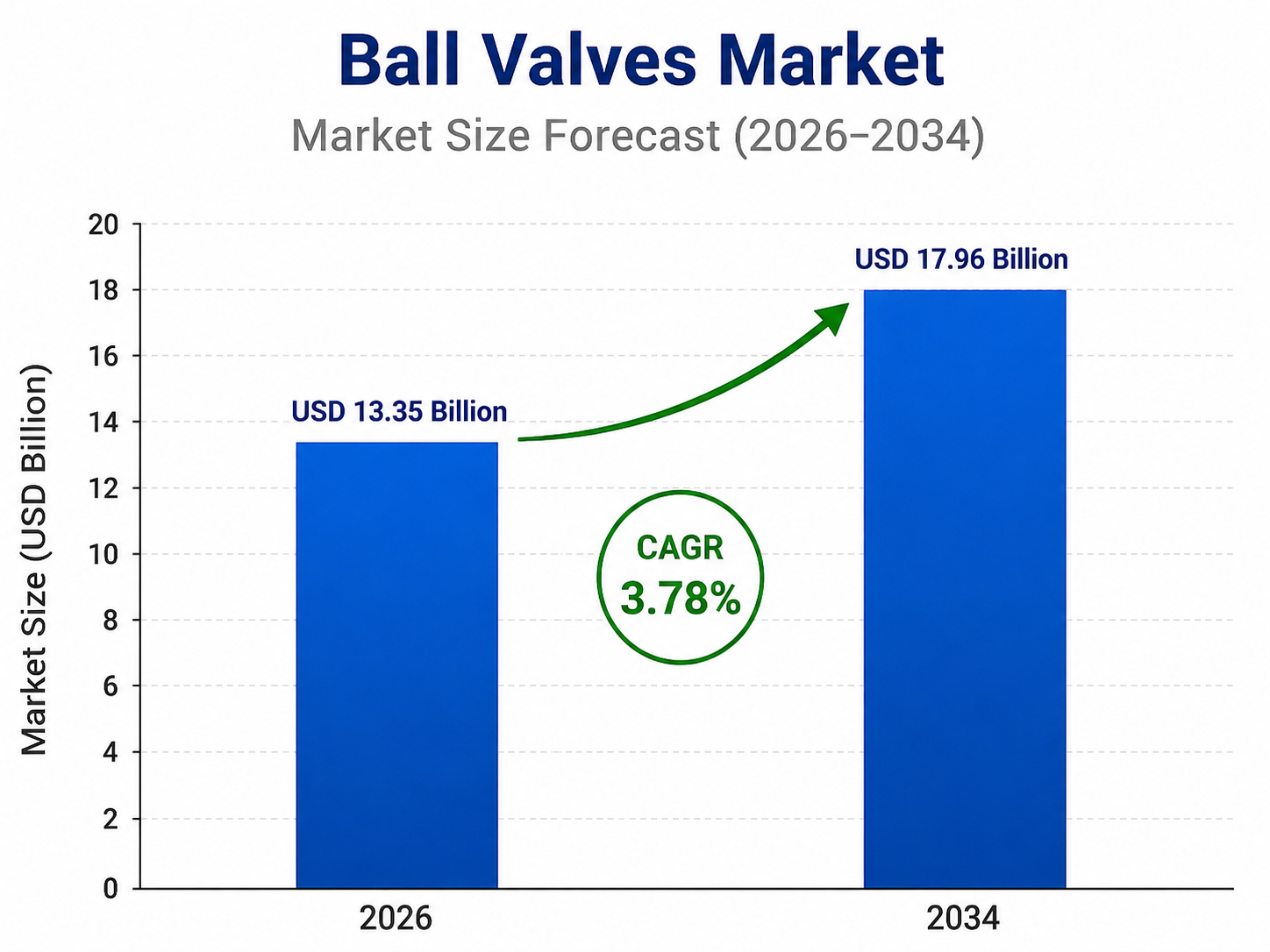
Ball valves are quarter-turn flow-control devices used to start, stop, isolate, or regulate liquids and gases across industrial piping systems. Major products include floating, trunnion-mounted, rising-stem, segmented, multi-port, and severe-service ball valves. Market growth is supported by oil and gas infrastructure, water and wastewater investment, industrial automation, chemical processing, power generation, and expanding hydrogen and LNG projects. Manufacturers are increasingly developing digitally connected, low-emission, corrosion-resistant, and high-pressure valve solutions that improve plant safety, operating efficiency, and predictive maintenance.
1. What is the latest trend in the Ball Valves Market?
The latest trend is the integration of smart actuators, position sensors, digital controllers, and IIoT-based condition monitoring with ball valves.
Manufacturers are also developing low-emission, hydrogen-compatible, cryogenic, and severe-service designs for emerging energy applications.
Predictive maintenance systems help operators monitor leakage, torque, cycle count, and valve health remotely.
These developments are transforming conventional valves into intelligent flow-control assets.
2. What are the key challenges in the Ball Valves Market?
Key challenges include fluctuating steel and alloy prices, fugitive-emission requirements, seal degradation, cavitation, and complex product certification.
Valves used in high-pressure, corrosive, abrasive, or cryogenic services require specialized materials and engineering.
Low-cost regional competition can also place pressure on established manufacturers and aftermarket margins.
End users increasingly demand longer service life, near-zero leakage, and lower maintenance without significant cost increases.
3. What is the major driving factor for the Ball Valves Market?
The major driving factor is growing investment in reliable and automated fluid-control infrastructure across process industries.
Oil and gas, chemicals, power, water, mining, and pharmaceutical facilities require dependable isolation and shut-off systems.
Industrial automation is increasing demand for actuated valves that can be controlled and monitored remotely.
Water security projects, LNG capacity, and energy-transition infrastructure provide additional market support.
4. What is the major segment in the Ball Valves Market and why?
Stainless steel ball valves represent a major material segment because they offer corrosion resistance, strength, cleanliness, and long service life.
They are widely used in chemicals, oil and gas, pharmaceuticals, food processing, water treatment, and marine applications.
Stainless steel valves can withstand demanding temperatures, pressures, and aggressive process media.
Their reliability and broad application compatibility support sustained market demand.
5. Which application or end-user is driving more demand?
Oil and gas is a major end-use sector because ball valves are extensively used in upstream, midstream, refining, LNG, and storage infrastructure.
They provide rapid shut-off, tight sealing, low pressure drop, and dependable operation in high-pressure pipelines.
Water and wastewater, chemicals, power generation, and pharmaceuticals also generate substantial demand.
Hydrogen, carbon capture, and renewable-fuel projects are creating emerging application opportunities.
6. Which region offers the highest growth potential and why?
Asia Pacific offers strong growth potential due to industrialization, energy infrastructure investment, urban water projects, and manufacturing expansion.
China, India, Japan, South Korea, and Southeast Asia are investing in refining, chemicals, LNG, power, and wastewater treatment.
The region also benefits from a large valve-manufacturing and engineering supply base.
North America and the Middle East remain important through oil, gas, petrochemical, and energy-transition projects.
7. What strategies are major companies adopting in the market?
Major companies are focusing on smart valves, severe-service engineering, low-emission certification, and application-specific material development.
They are expanding actuator, controller, software, and diagnostic capabilities to offer integrated flow-control packages.
Acquisitions, distributor expansion, localization, and aftermarket service contracts are strengthening geographic coverage.
Manufacturers are also developing solutions for hydrogen, LNG, carbon capture, and high-purity processing.
8. What are the leading companies in the Ball Valves Market?
Leading companies include Emerson, Flowserve, SLB through Cameron, KITZ Corporation, IMI, Valmet, Crane Company, Curtiss-Wright, Velan, Bürkert, and MOGAS Industries.
These companies compete through product reliability, material expertise, certifications, customization, and global service networks.
Large suppliers provide complete valve, actuator, control, and lifecycle-service portfolios.
Specialized manufacturers compete in severe-service, sanitary, cryogenic, and high-pressure applications.
9. Why are ball valves strategically important for industrial operators?
Ball valves provide fast isolation, tight shut-off, low flow resistance, and dependable operation across critical process systems.
Their performance directly affects plant safety, emissions, product quality, maintenance costs, and production continuity.
Automated ball valves support remote operation and reduce personnel exposure in hazardous environments.
For asset owners, valve reliability is central to operational risk and lifecycle-cost management.
10. What is the future outlook for the Ball Valves Market?
The market outlook remains positive as industries modernize infrastructure and adopt more automated, efficient, and lower-emission flow-control systems.
Future demand will be supported by smart factories, water treatment, LNG, hydrogen, carbon capture, and chemical capacity expansion.
Digital diagnostics and predictive maintenance will become increasingly important in valve selection and aftermarket services.
Companies offering certified, intelligent, durable, and application-specific solutions are expected to gain market share.
Browse Related Reports
https://www.oganalysis.com/industry-reports/process-safety-services-market
https://www.oganalysis.com/industry-reports/trailer-sprayer-market
https://www.oganalysis.com/industry-reports/immersion-wash-system-market
https://www.oganalysis.com/industry-reports/immersion-wash-system-market https://www.oganalysis.com/industry-reports/elevators-and-escalators-market
LinkedIn | Twitter
