Bismuth-Based High-Temperature Superconductor Market Growth Outlook 2026–2034: Trends, Applications, Leading Companies, and Regional Opportunities
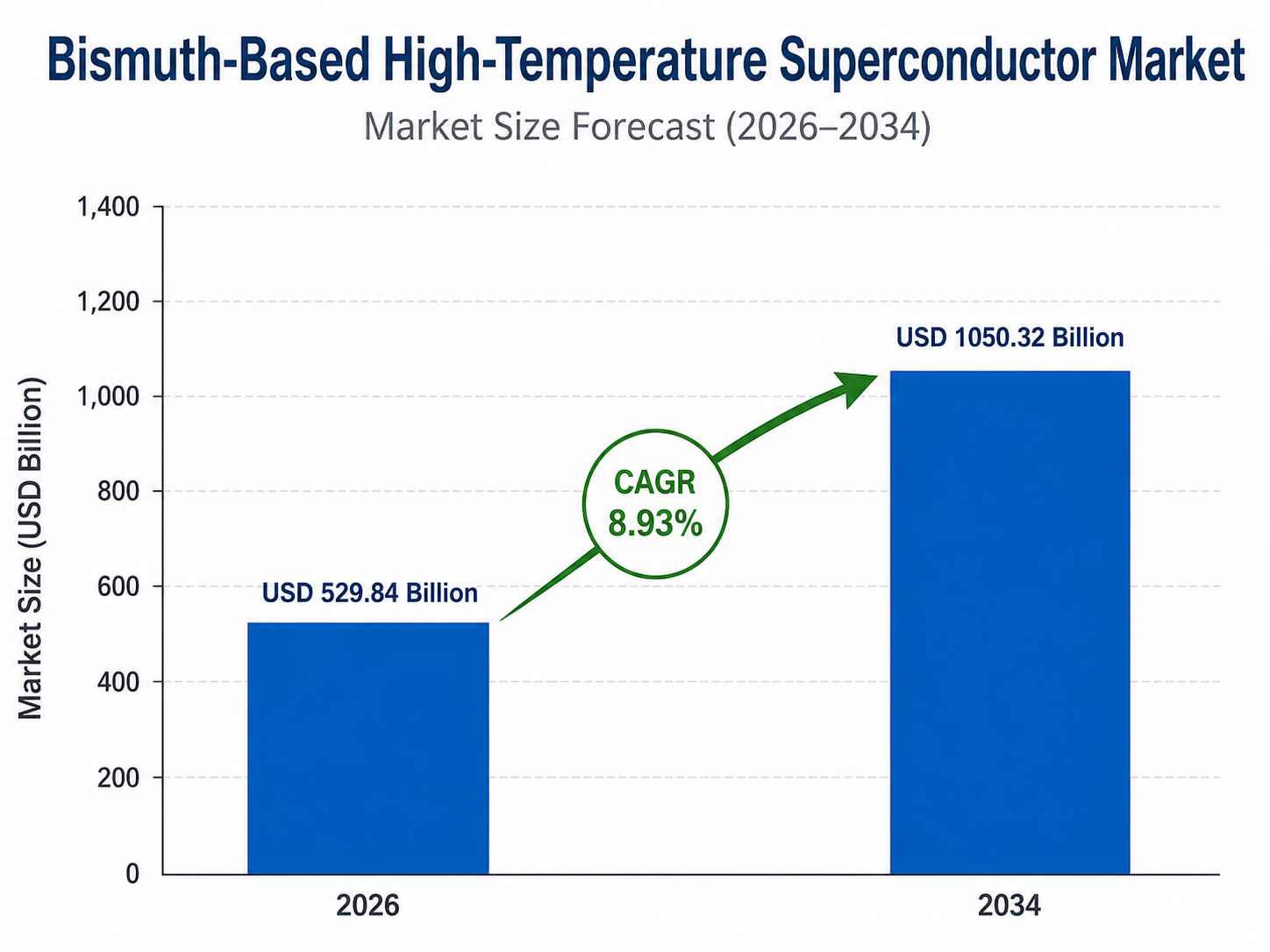
The Bismuth-Based High-Temperature Superconductor Market is estimated to be valued at $ 529.84 billion in 2026 and is projected to reach $ 1050.32 billion by 2034, expanding at a CAGR of 8.93% from 2026 to 2034.
Bismuth-based high-temperature superconductors are emerging as a key technology for the future of energy and advanced electronics. These materials can carry electricity with minimal energy loss, making them highly valuable for efficient power transmission, high-field magnets, medical imaging systems, scientific research equipment, and next-generation transportation technologies.
Growing investments in power grid modernization, clean energy infrastructure, advanced healthcare systems, and high-performance electrical devices are driving demand for bismuth-based superconductors. While challenges such as manufacturing complexity and production costs remain, continuous advancements in superconducting tapes, wires, and coil technologies are improving performance and expanding commercial opportunities. As industries seek greater efficiency, reliability, and energy savings, bismuth-based superconductors are gaining attention as a promising solution for future technological innovation.
1. What is the latest trend in the Bismuth-Based High-Temperature Superconductor Market?
The latest trend is the improvement of Bi-2212 and Bi-2223 wire and tape manufacturing for high-field magnets, power cables, and advanced current-carrying applications.
Manufacturers are focusing on higher critical current density, better mechanical stability, and longer defect-free conductor lengths.
Research is also moving toward more reliable coil winding, cryogenic performance optimization, and application-specific conductor designs.
This trend is helping bismuth-based superconductors move closer to broader commercial deployment.
2. What are the key challenges in the Bismuth-Based High-Temperature Superconductor Market?
Key challenges include high manufacturing cost, ceramic brittleness, limited mechanical flexibility, and complex cryogenic operating requirements.
Producing long, uniform, high-performance superconducting wires and tapes remains technically demanding.
Competition from other superconducting materials, especially yttrium-based superconductors, can limit adoption in some applications.
Commercial users also require strong reliability, lifecycle economics, and proven field performance before large-scale deployment.
3. What is the major driving factor for the Bismuth-Based High-Temperature Superconductor Market?
The major driving factor is rising demand for efficient power transmission, high-field magnets, and advanced electrical systems.
Bismuth-based superconductors can support high current flow with reduced electrical losses when operated under suitable cryogenic conditions.
Grid modernization, renewable energy integration, medical imaging upgrades, and scientific research infrastructure are supporting demand.
The need for compact, efficient, and high-capacity electrical components is strengthening long-term market potential.
4. What is the major segment in the Bismuth-Based High-Temperature Superconductor Market and why?
Electric power applications represent a major segment because superconducting cables and current leads can improve transmission efficiency and power density.
Bi-2223 tapes are particularly relevant in power cable and grid-related applications due to their relatively established development history.
Utilities and infrastructure developers are exploring superconducting technologies to reduce losses and support high-load urban power networks.
However, high-field magnet applications using Bi-2212 are also gaining attention in research and advanced medical systems.
5. Which application or end-user is driving more demand?
Power utilities, medical imaging providers, research laboratories, and advanced electronics manufacturers are key demand contributors.
Power transmission and current lead applications are important because they address energy efficiency and grid-capacity requirements.
Medical imaging and research magnet applications are also driving demand where high magnetic fields and compact system designs are needed.
Demand is strongest in applications where performance benefits justify higher material and cooling costs.
6. Which region offers the highest growth potential and why?
Asia Pacific offers strong growth potential due to investments in power infrastructure, advanced manufacturing, medical imaging, and research facilities.
Japan, China, South Korea, and India are important opportunity markets due to industrial technology development and grid modernization needs.
North America and Europe remain important due to strong research funding, medical technology demand, and advanced superconducting magnet programs.
Regional growth will depend on utility adoption, government support, and commercialization of reliable HTS-based systems.
7. What strategies are major companies adopting in the market?
Major companies are focusing on improving conductor performance, reducing production defects, enhancing wire and tape length, and developing application-specific products.
They are investing in R&D for higher current density, better mechanical reinforcement, and improved cryogenic compatibility.
Partnerships with power utilities, research institutions, medical equipment companies, and magnet system developers are becoming important.
Companies are also targeting niche high-value applications before broader commercial expansion.
8. What are the leading companies in the Bismuth-Based High-Temperature Superconductor Market?
Leading companies and key ecosystem participants include Sumitomo Electric Industries, Bruker, American Superconductor, Fujikura, Furukawa Electric, Japan Superconductor Technology, SuperPower, SuperOx, THEVA, and Nexans.
These players compete through conductor quality, current-carrying performance, production scalability, application expertise, and customer partnerships.
Specialized companies with proven experience in superconducting wires, tapes, cables, and magnet systems hold competitive advantage.
Market leadership is closely linked to technical reliability, manufacturing know-how, and successful demonstration in real-world applications.
9. Why are bismuth-based high-temperature superconductors strategically important?
Bismuth-based superconductors are strategically important because they enable high-efficiency electrical systems, compact magnets, and advanced energy infrastructure.
They support applications where conventional conductors face limitations in current capacity, space efficiency, or magnetic field performance.
For utilities, medical technology providers, and research institutions, these materials offer performance advantages in specialized use cases.
For manufacturers, they represent a high-value advanced materials market with long-term growth potential.
10. What is the future outlook for the Bismuth-Based High-Temperature Superconductor Market?
The market outlook remains positive, supported by grid modernization, high-field magnet development, medical imaging demand, and advanced research applications.
Commercial growth will depend on reducing production costs, improving mechanical durability, and proving system-level reliability.
Bi-2212 and Bi-2223 technologies are expected to remain important in applications requiring high current density and strong magnetic performance.
Companies that combine material innovation, manufacturing scale, and end-use partnerships are expected to gain long-term advantage.
Browse Related Reports
https://www.oganalysis.com/industry-reports/electrofused-magnesia-market
https://www.oganalysis.com/industry-reports/steel-roofing-market
https://www.oganalysis.com/industry-reports/aluminum-doors-and-windows-market
https://www.oganalysis.com/industry-reports/aluminum-curtain-wall-market
https://www.oganalysis.com/industry-reports/silica-sand-market
