Breast Pumps Market Outlook 2026–2034: Wearable Technology, Growth Drivers, Leading Companies, and Future Opportunities
The Breast Pumps Market is expected to grow from $ 1.87 billion in 2026 to $ 4.15 billion by 2034, registering a CAGR of 10.54%.
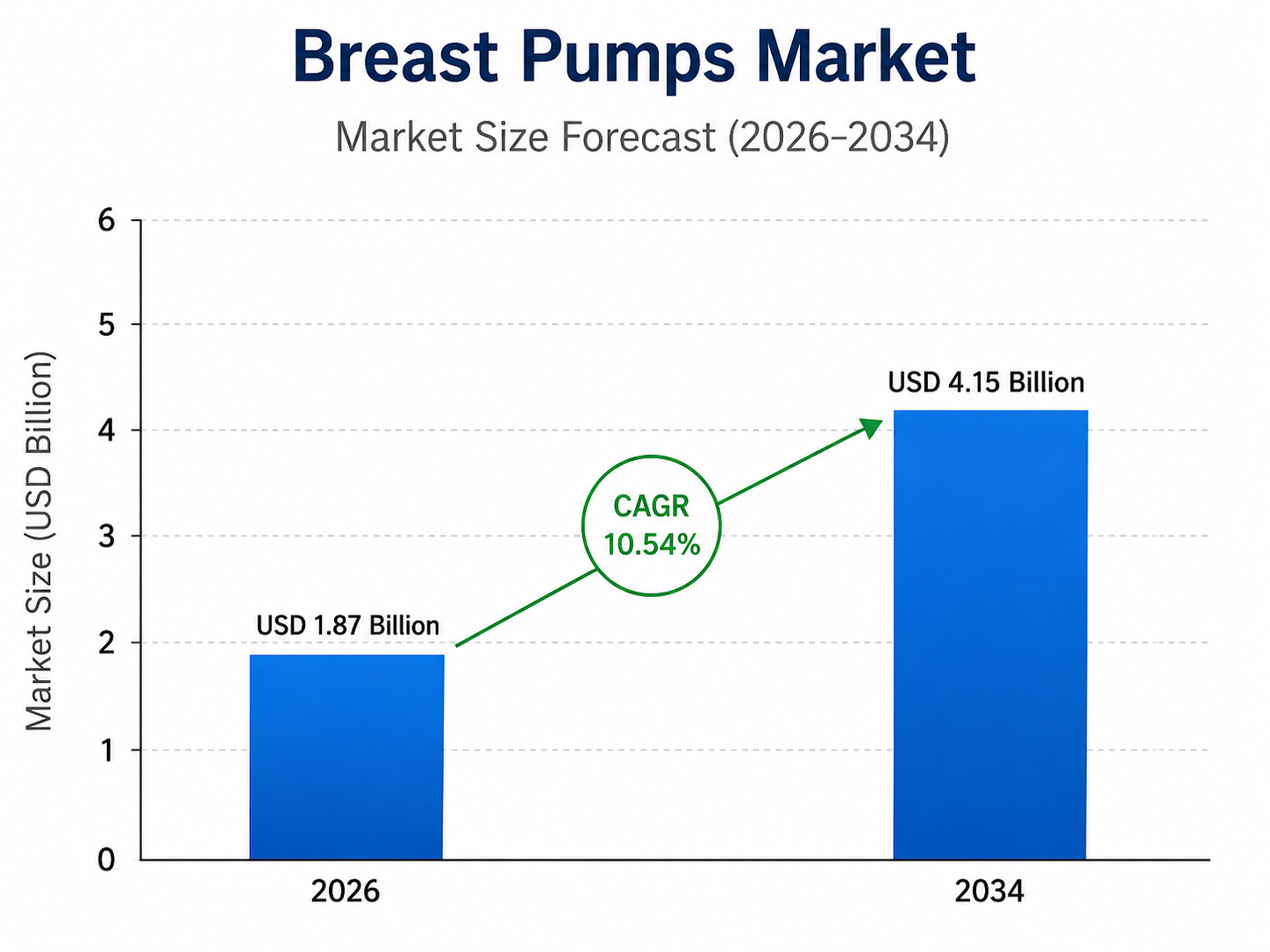
During the forecast period. Breast pumps are designed to help nursing mothers express and store breast milk efficiently, offering a practical solution for breastfeeding at home, at work, or while traveling. The market includes manual, battery-operated, and electric breast pumps, as well as single and double pumps, hospital-grade systems, wearable devices, and accessories such as collection bottles, storage containers, valves, and milk collection cups. Market growth is being driven by increasing awareness of the benefits of breastfeeding, the growing number of working mothers, improved access to maternity and postnatal care services, and rising demand for convenient home-based lactation solutions. Hospitals, maternity centers, lactation consultants, rental service providers, pharmacies, specialty retailers, and individual consumers remain the primary end users. In addition, manufacturers are introducing advanced products with hands-free operation, quieter motors, enhanced portability, smartphone connectivity, customizable suction settings, and closed-system designs that improve hygiene and simplify cleaning, further supporting market expansion.
1. What is the latest trend in the Breast Pumps Market?
The latest trend is the rapid adoption of wearable, hands-free, and app-connected electric breast pumps.
Manufacturers are developing quieter, lighter, and more discreet devices that can be worn inside a nursing bra.
Smart controls allow users to adjust suction, track pumping sessions, and monitor milk volume through mobile applications.
Cordless designs and rechargeable batteries are improving convenience for working and mobile consumers.
2. What are the key challenges in the Breast Pumps Market?
Key challenges include high prices for premium wearable devices, discomfort from poor flange fit, cleaning complexity, and inconsistent milk-output measurement.
Battery life, motor reliability, suction performance, and replacement-part availability can affect customer satisfaction.
Connected products must also address mobile-app reliability and personal-data privacy concerns.
Limited breastfeeding support and low awareness may restrict adoption in underserved markets.
3. What is the major driving factor for the Breast Pumps Market?
The major driving factor is growing demand for convenient breast-milk expression among working parents and users separated from their infants.
Breast pumps support milk storage, feeding flexibility, lactation maintenance, and continued breastfeeding after returning to work.
Improving maternity benefits, workplace lactation facilities, and hospital breastfeeding programs are supporting adoption.
Rising awareness of maternal and infant nutrition is further strengthening product demand.
4. What is the major segment in the Breast Pumps Market and why?
Electric breast pumps represent a major segment because they provide faster, more consistent, and less labor-intensive milk expression than manual devices.
Double electric pumps allow milk to be expressed from both breasts simultaneously, reducing overall pumping time.
Adjustable suction levels and expression modes improve comfort and support individualized pumping routines.
Wearable and portable electric models are further expanding the segment’s consumer appeal.
5. Which application or end-user is driving more demand?
Personal-use and homecare consumers generate the largest recurring demand for breast pumps and related accessories.
Working parents, exclusive pumpers, and users managing temporary separation or feeding difficulties are important customer groups.
Hospitals and maternity centers also require hospital-grade pumps for initiation and clinical lactation support.
Retail, pharmacy, insurance, rental, and e-commerce channels are expanding product accessibility.
6. Which region offers the highest growth potential and why?
Asia Pacific offers strong growth potential due to rising disposable income, urbanization, female workforce participation, and expanding maternity-care infrastructure.
China, India, Japan, South Korea, and Southeast Asia are important markets for personal-use and portable breast pumps.
North America remains a leading established market because of strong product awareness and broad wearable-pump adoption.
Europe also benefits from supportive parental policies and mature maternal-care systems.
7. What strategies are major companies adopting in the Breast Pumps Market?
Major companies are focusing on wearable technology, quieter motors, personalized suction, lightweight collection cups, and improved battery performance.
They are expanding direct-to-consumer sales, insurance-supported access, hospital partnerships, and lactation-consultant education.
Product ecosystems increasingly include milk-storage products, feeding accessories, mobile applications, and replacement components.
Companies are also using premium, value, and rental models to reach different consumer groups.
8. What are the leading companies in the Breast Pumps Market?
Leading companies include Medela, Philips Avent, Spectra Baby USA, Lansinoh Laboratories, Willow Innovations, Elvie, Ameda, Pigeon Corporation, Ardo Medical, Evenflo Feeding, Momcozy, Hygeia Health, and Tommee Tippee.
These companies compete through comfort, suction performance, portability, noise level, hygiene, and product reliability.
Established brands benefit from hospital relationships and lactation expertise, while newer companies emphasize wearable technology.
Distribution reach, customer support, insurance access, and accessory availability are important competitive factors.
9. Why are breast pumps strategically important for maternal-care providers?
Breast pumps help maternal-care providers support lactation when direct breastfeeding is delayed, interrupted, or medically difficult.
They are particularly important for premature infants, neonatal intensive care, low milk supply, and parent–infant separation.
Access to appropriate pumps can support feeding continuity and individualized lactation plans.
For hospitals, pumps form part of broader maternity, neonatal, and breastfeeding-support services.
10. What is the future outlook for the Breast Pumps Market?
The market outlook remains positive as consumers prioritize mobility, convenience, discretion, and personalized pumping experiences.
Future growth will be supported by wearable systems, quieter components, better fit options, smart monitoring, and improved battery technology.
Affordable devices and wider distribution will be important for growth in emerging and underserved markets.
Companies combining clinical credibility, consumer-friendly design, hygiene, and dependable after-sales support are expected to gain share.
Browse Related Reports:
https://www.oganalysis.com/industry-reports/disposable-mixing-bag-market
https://www.oganalysis.com/industry-reports/iliac-stent-market
https://www.oganalysis.com/industry-reports/orthopedic-biomaterial-market
https://www.oganalysis.com/industry-reports/neurostimulation-devices-market
https://www.oganalysis.com/industry-reports/neurovascular-catheters-market
