Bulk Petroleum and Chemical Storage Market Outlook 2026–2034: Tank Terminal Expansion, Energy Logistics Demand, Growth Drivers, Leading Companies, and Future Opportunities
The Bulk Petroleum and Chemical Storage Market is estimated to be valued at $ 39.3 billion in 2026 and is projected to reach $ 70.5 billion by 2034, expanding at a CAGR of 7.6% from 2026 to 2034.
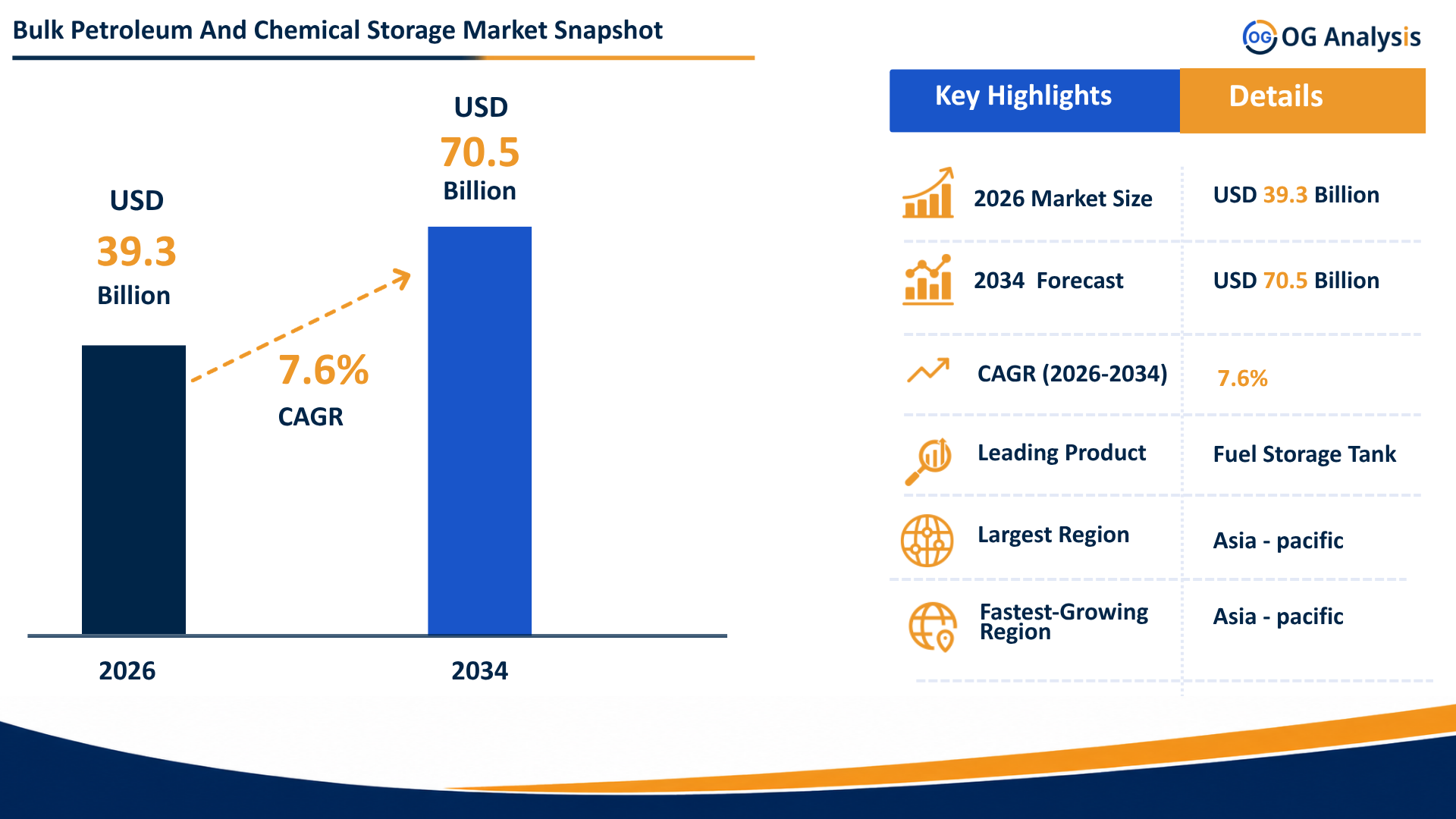
Bulk petroleum and chemical storage involves large-scale tank terminals, depots, and storage infrastructure used to store crude oil, refined fuels, petrochemicals, industrial chemicals, specialty chemicals, biofuels, LNG, LPG, and other liquid bulk commodities. Market growth is supported by rising energy trade, chemical production, refinery logistics, strategic petroleum reserves, import-export terminals, and demand for flexible storage capacity near ports, pipelines, refineries, and industrial hubs. Tank terminals play a critical role in supply security, blending, distribution, inventory management, and commodity trading. Demand is also being shaped by stricter safety standards, digital tank monitoring, automation, emission control, and investments in storage infrastructure for cleaner fuels and chemical value chains.
Get Your Free Sample Report for In-Depth Market Insights :
https://www.oganalysis.com/industry-reports/bulk-petroleum-and-chemical-storage-market
Get Your Free Sample Report for In-Depth Market Insights :
https://www.oganalysis.com/industry-reports/bulk-petroleum-and-chemical-storage-market/free-sample
1. What is the latest trend in the Bulk Petroleum and Chemical Storage Market?
The latest trend is the modernization of tank terminals with digital monitoring, automation, safety systems, and improved operational efficiency.
Terminal operators are investing in tank-gauging systems, leak detection, vapor recovery, fire safety, remote monitoring, and predictive maintenance.
Storage demand is also shifting toward petrochemicals, biofuels, LNG/LPG, and low-carbon fuel infrastructure alongside conventional petroleum products.
Recent activity such as Vopak’s Thailand terminal expansion for U.S. ethane imports reflects continued investment in specialized chemical and gas-related storage capacity.
2. What are the key challenges in the Bulk Petroleum and Chemical Storage Market?
Key challenges include high capital investment, strict safety regulations, environmental compliance, land availability, permitting delays, and operational risk.
Storage terminals must manage fire hazards, spills, corrosion, vapor emissions, tank integrity, hazardous chemical handling, and emergency response systems.
Commodity price volatility and changing refinery utilization can affect storage demand and terminal occupancy.
Operators also face pressure to reduce emissions, improve safety performance, and adapt infrastructure for cleaner fuels and specialty chemicals.
3. What is the major driving factor for the Bulk Petroleum and Chemical Storage Market?
The major driving factor is rising demand for secure, flexible, and strategically located storage infrastructure for petroleum and chemical supply chains.
Refiners, traders, chemical producers, distributors, and industrial users require storage terminals to manage supply-demand imbalances and logistics timing.
Global trade in crude oil, refined products, petrochemicals, and specialty liquids is increasing the need for port-based and pipeline-connected storage.
Strategic reserves, energy security planning, and fuel distribution networks further support market demand.
4. What is the major segment in the Bulk Petroleum and Chemical Storage Market and why?
Petroleum product storage is a major segment because crude oil, gasoline, diesel, jet fuel, fuel oil, and other refined products require large-volume terminal capacity.
These products are stored near refineries, ports, airports, distribution hubs, and pipeline networks to support supply continuity.
Chemical storage is also growing due to rising trade in petrochemicals, solvents, acids, alcohols, and specialty industrial liquids.
Floating-roof tanks, fixed-roof tanks, pressure tanks, refrigerated tanks, and specialty-lined tanks are used depending on product characteristics.
5. Which application or end-user is driving more demand?
Oil and gas companies, chemical manufacturers, commodity traders, refiners, fuel distributors, logistics providers, and industrial users are driving demand.
Refineries and fuel marketers need storage for crude intake, intermediate products, blending, finished fuels, and outbound distribution.
Chemical producers require specialized tanks for hazardous, corrosive, temperature-sensitive, or high-purity liquids.
Ports, import terminals, and export hubs are key demand centers because bulk liquids often move through marine logistics.
6. Which region offers the highest growth potential and why?
Asia Pacific offers strong growth potential due to expanding refining capacity, petrochemical production, fuel consumption, and port-based liquid bulk trade.
China, India, Southeast Asia, Japan, and South Korea are important markets because of large industrial bases and growing chemical logistics needs.
North America remains important due to oil production, refined-product exports, pipeline infrastructure, and petrochemical investments.
The Middle East is also significant due to crude oil exports, downstream integration, petrochemical expansion, and strategic terminal development.
7. What strategies are major companies adopting in the market?
Major companies are focusing on terminal expansion, digital operations, safety upgrades, tank modernization, and specialized storage for chemicals and cleaner fuels.
They are investing in port connectivity, pipeline links, blending facilities, truck and rail loading systems, and integrated logistics services.
Operators are also improving environmental performance through vapor control, leak detection, corrosion management, and emission-reduction systems.
Strategic partnerships with refiners, chemical producers, traders, and energy companies are helping secure long-term storage contracts.
8. What are the leading companies in the Bulk Petroleum and Chemical Storage Market?
Leading companies include VTTI, Royal Vopak, Oiltanking, Kinder Morgan, Buckeye Partners, NuStar Energy, Inter Pipeline, Plains All American Pipeline, Enterprise Products Partners, Magellan Midstream, Sunoco Logistics, Sinochem Group, CST Industries, Containment Solutions, Superior Tank, and Snyder Industries.
These companies compete through storage capacity, terminal location, safety performance, product-handling capability, connectivity, customer contracts, and operational reliability.
Market coverage identifies VTTI, Royal Vopak, Buckeye Partners, Kinder Morgan, Oiltanking, Magellan Midstream, NuStar Energy, Inter Pipeline, Plains All American Pipeline, and Enterprise Products Partners among major participants.
9. Why is bulk petroleum and chemical storage strategically important for energy and chemical supply chains?
Bulk petroleum and chemical storage is strategically important because it provides buffer capacity between production, transportation, trading, and end-use demand.
Storage terminals improve supply security, reduce logistics disruption, support blending, and help manage seasonal or market-driven inventory changes.
For chemical producers, proper storage protects product quality, safety, and regulatory compliance.
For energy markets, storage capacity supports refinery operations, fuel distribution, emergency reserves, and international trade flows.
10. What is the future outlook for the Bulk Petroleum and Chemical Storage Market?
The market outlook remains positive as energy trade, petrochemical production, fuel logistics, and industrial liquid handling continue to require reliable storage infrastructure.
Future growth will be supported by chemical storage, biofuels, LNG/LPG, hydrogen-adjacent infrastructure, digital tank farms, and safer terminal operations.
Demand for petroleum storage will remain important, while growth opportunities will increasingly come from specialty chemicals and cleaner fuel supply chains.
Companies offering strategic locations, strong safety systems, flexible tank configurations, digital operations, and integrated logistics services are expected to gain market share.
Browse Related Reports
https://www.oganalysis.com/industry-reports/bioenergy-market
https://www.oganalysis.com/industry-reports/refined-petroleum-products-market
https://www.oganalysis.com/industry-reports/lng-bunkering-market
https://www.oganalysis.com/industry-reports/oily-sludge-treatment-system-market
https://www.oganalysis.com/industry-reports/fire-and-gas-monitoring-and-control-system-market
Stay Connected With Us
