Capecitabine Market Outlook 2026–2034: Generic Expansion, Oncology Demand, Leading Companies, and Growth Opportunities
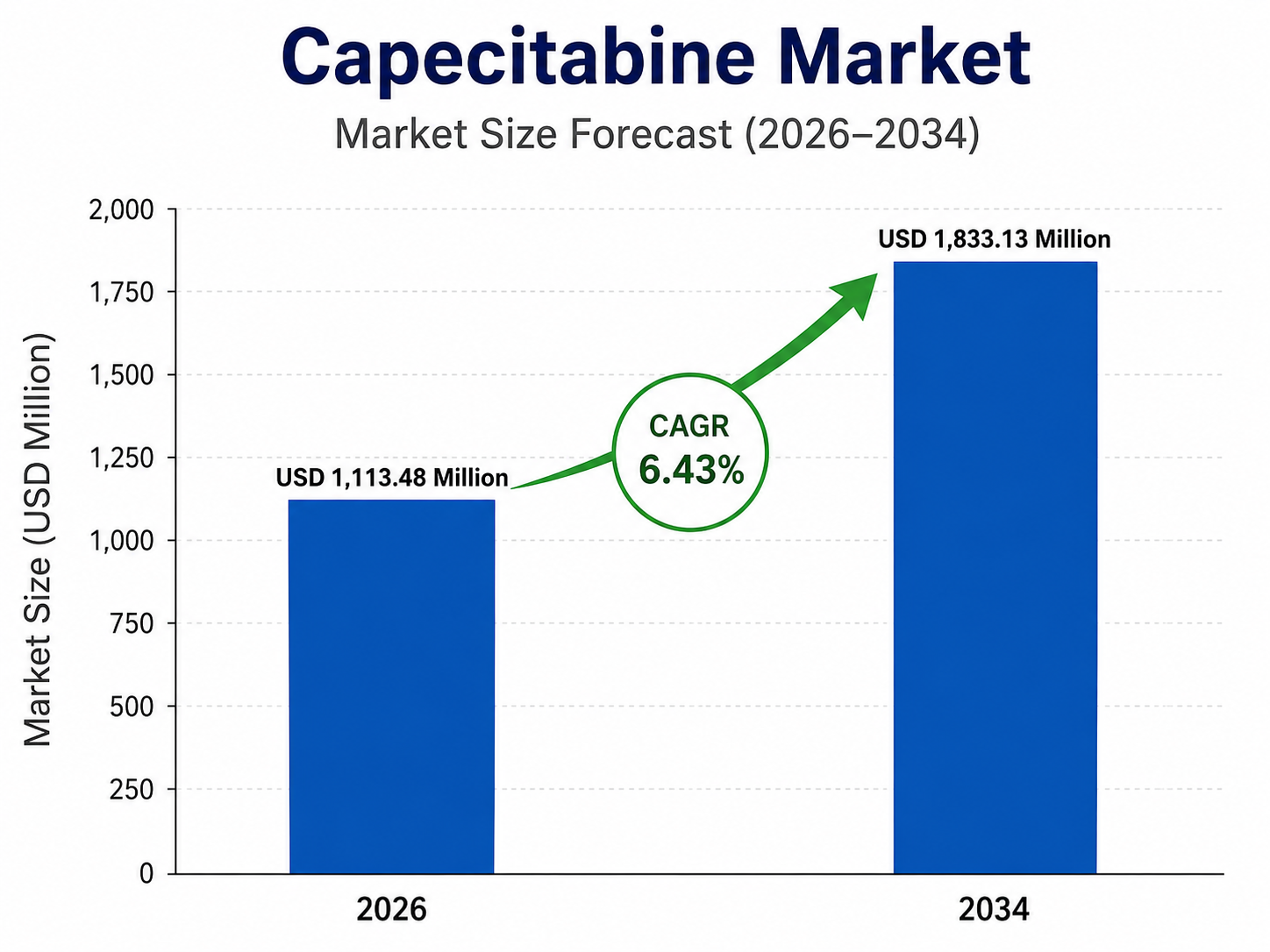
The Capecitabine Market is estimated to be valued at $ 1113.48 million in 2026 and is projected to reach $ 1833.13 million by 2034, expanding at a CAGR of 6.43% from 2026 to 2034.
Capecitabine is an orally administered fluoropyrimidine chemotherapy medicine converted in the body into 5-fluorouracil. It is used independently or in combination regimens for colorectal, breast, gastric, pancreatic, and other cancers. Market growth is supported by rising cancer incidence, expanding access to oral oncology treatment, increasing generic availability, and continued use in established chemotherapy protocols. Manufacturers are focusing on affordable generics, supply reliability, regulatory expansion, patient-support programs, and improved safety management.
1. What is the latest trend in the Capecitabine Market?
The latest trend is the increasing use of capecitabine within personalized and combination oncology regimens.
Greater attention is being placed on DPD-deficiency screening, dose optimization, toxicity monitoring, and treatment adherence.
Generic competition is expanding access in cost-sensitive healthcare systems.
Home-based oral treatment and digital patient monitoring are also becoming more important.
2. What are the key challenges in the Capecitabine Market?
Key challenges include adverse effects, treatment discontinuation, drug interactions, dosing complexity, and risks in patients with DPD deficiency.
Hand-foot syndrome, gastrointestinal toxicity, and hematologic complications may require dose adjustment or interruption.
Strong generic competition places downward pressure on pricing and manufacturer margins.
Patient adherence can also be difficult because capecitabine is taken outside supervised infusion facilities.
3. What is the major driving factor for the Capecitabine Market?
The major driving factor is the growing burden of colorectal, breast, gastric, and pancreatic cancers worldwide.
Capecitabine offers the convenience of oral administration and can reduce reliance on repeated intravenous treatment visits.
Its established role in adjuvant, metastatic, and combination regimens supports recurring clinical demand.
Improving oncology access in emerging markets is further strengthening medicine consumption.
4. What is the major segment in the Capecitabine Market and why?
Colorectal cancer represents a major application segment because capecitabine is widely used in adjuvant and metastatic treatment settings.
It is administered as monotherapy or as part of combination regimens involving other anticancer medicines and radiotherapy.
The large colorectal cancer patient population supports sustained prescription volumes.
Established clinical familiarity and broad generic availability reinforce the segment’s market position.
5. Which dosage form or distribution channel is driving more demand?
Oral tablets represent the principal dosage form, with commonly marketed strengths supporting flexible dose calculation.
Hospital pharmacies are an important distribution channel because treatment is initiated and monitored by oncology specialists.
Retail and specialty pharmacies also support repeat dispensing during outpatient treatment cycles.
Online and home-delivery models are becoming more relevant for eligible patients receiving long-term therapy.
6. Which region offers the highest growth potential and why?
Asia Pacific offers strong growth potential due to its large patient population, improving cancer diagnosis, and expanding generic pharmaceutical industry.
China, India, Japan, South Korea, and Southeast Asia are increasing oncology treatment capacity and medicine access.
North America remains a leading established market because of advanced cancer care and broad treatment availability.
Europe also maintains substantial demand through mature oncology systems and generic medicine adoption.
7. What strategies are major companies adopting in the market?
Major companies are focusing on generic launches, competitive pricing, regulatory approvals, supply-chain reliability, and geographic expansion.
Manufacturers are strengthening active-ingredient sourcing and production capacity to maintain uninterrupted oncology supply.
Patient education, pharmacovigilance, and adherence-support programs are becoming more important.
Companies also pursue additional strengths, packaging formats, and registrations across emerging markets.
8. What are the leading companies in the Capecitabine Market?
Prominent companies include Roche, Teva Pharmaceutical Industries, Sun Pharmaceutical Industries, Dr. Reddy’s Laboratories, Cipla, Viatris, Accord Healthcare, Hikma Pharmaceuticals, Apotex, and Natco Pharma.
Roche established the branded Xeloda franchise, while generic manufacturers compete through affordability and geographic reach.
Indian pharmaceutical companies hold a strong position in generic manufacturing and export supply.
Competition is based on regulatory coverage, pricing, product availability, quality, and distribution strength.
9. Why is capecitabine strategically important for oncology providers and manufacturers?
Capecitabine provides an oral alternative to certain fluoropyrimidine-based intravenous treatment approaches.
It can support outpatient care, reduce infusion-center burden, and provide greater treatment flexibility for appropriate patients.
For manufacturers, it is an established oncology molecule with recurring generic demand across several cancer indications.
Its strategic value depends on affordability, reliable supply, safety monitoring, and patient adherence.
10. What is the future outlook for the Capecitabine Market?
The market outlook remains positive but highly competitive as cancer incidence and generic access continue to increase.
Future growth will be supported by emerging-market penetration, combination regimens, personalized dosing, and improved toxicity management.
Greater use of pharmacogenetic screening may strengthen treatment safety and patient selection.
Companies offering affordable, compliant, and reliably supplied products are expected to maintain competitive advantage.
Browse Related Reports
https://www.oganalysis.com/industry-reports/sports-health-supplements-market
https://www.oganalysis.com/industry-reports/human-papillomavirus-vaccines-market
https://www.oganalysis.com/industry-reports/recombinant-vaccines-market
https://www.oganalysis.com/industry-reports/chatbots-for-mental-health-and-therapy-market
https://www.oganalysis.com/industry-reports/chemotherapy-at-home-services-market
