Clinical Trial Management System Market Outlook 2026–2034: Cloud-Based CTMS Adoption, Decentralized Trial Management, Growth Drivers, Leading Companies, and Future Opportunities
The Clinical Trial Management System Market is estimated to be valued at $ 3.06 billion in 2026 and is projected to reach $ 8.16 billion by 2034, expanding at a CAGR of 13.01% from 2026 to 2034.
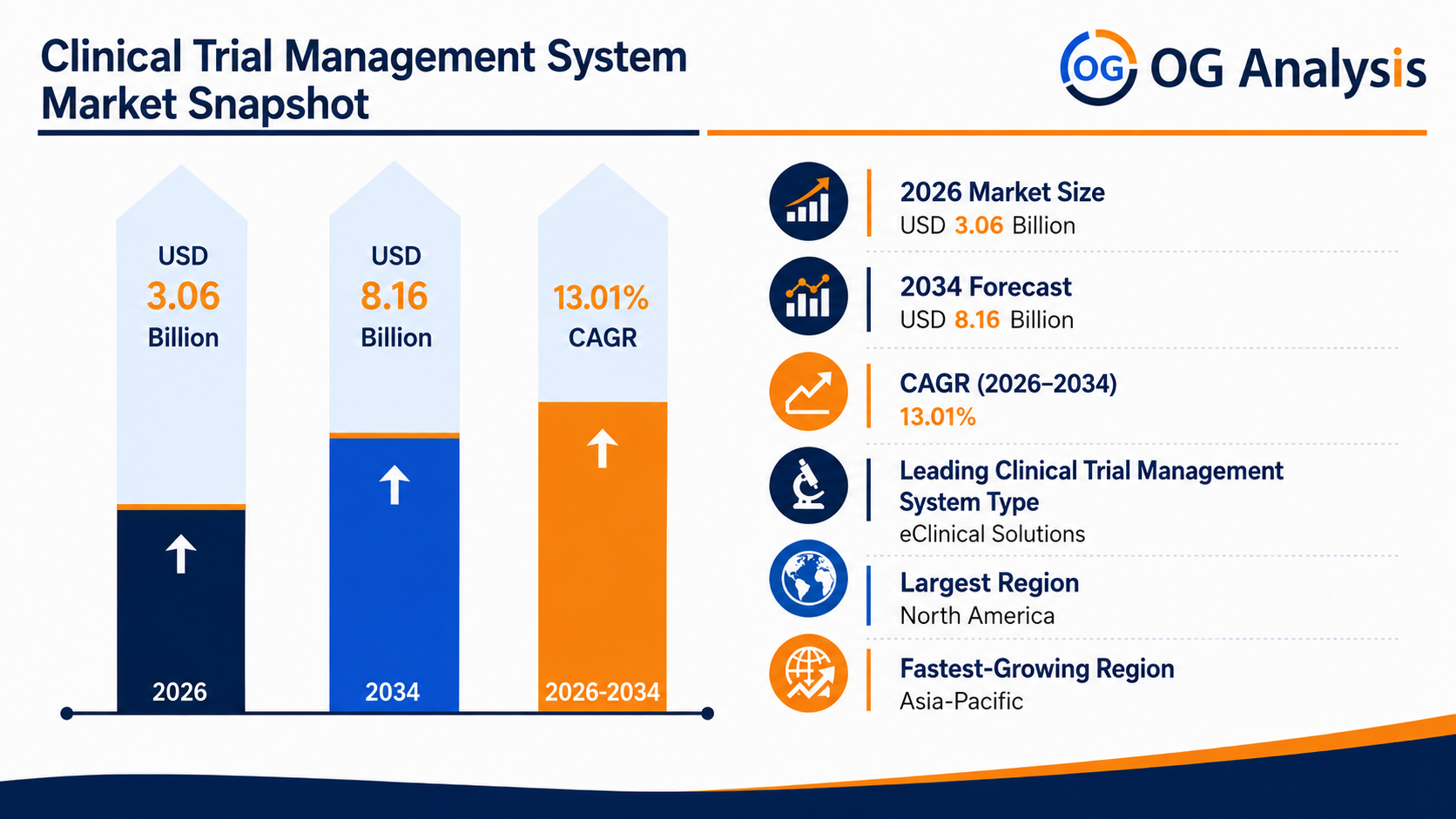
A clinical trial management system is a software platform used to plan, track, manage, and monitor clinical trials across study sites, sponsors, CROs, investigators, and regulatory stakeholders. CTMS platforms support study startup, site management, patient enrollment tracking, monitoring visits, document workflows, budget management, grant management, investigator payments, milestone tracking, reporting, and compliance oversight. Market growth is supported by rising clinical trial complexity, growth in decentralized and hybrid trial models, increasing R&D spending by pharmaceutical and biotechnology companies, and the need for real-time trial visibility. Cloud-based CTMS adoption is increasing because sponsors and CROs require scalable, connected, and globally accessible systems that integrate with eTMF, EDC, eConsent, RTSM, safety, analytics, and regulatory platforms. Medidata describes CTMS as a connected solution for planning, tracking, and overseeing studies, while Veeva positions CTMS within a broader clinical operations suite linked with eTMF, Study Startup, Payments, and EDC workflows.
Get Your Free Sample Report for In-Depth Market Insights :
https://www.oganalysis.com/industry-reports/clinical-trial-management-system-market
1. What is the latest trend in the Clinical Trial Management System Market?
The latest trend is the shift toward cloud-based, AI-enabled, and integrated CTMS platforms that connect clinical operations data across sponsors, CROs, sites, and vendors.
Companies are moving away from fragmented spreadsheets and standalone systems toward unified platforms for study oversight, site monitoring, enrollment tracking, payments, and compliance.
Decentralized and hybrid clinical trials are increasing demand for systems that support remote monitoring, digital workflows, and real-time study visibility.
AI-enabled analytics, risk-based monitoring, automation, and eClinical platform integration are becoming important competitive differentiators.
2. What are the key challenges in the Clinical Trial Management System Market?
Key challenges include system integration complexity, data migration issues, user adoption barriers, configuration cost, and compliance with global clinical research regulations.
CTMS platforms must connect with EDC, eTMF, eConsent, RTSM, safety databases, investigator payment systems, and regulatory tools without disrupting trial workflows.
Sponsors and CROs also face challenges related to data quality, site training, cybersecurity, audit readiness, and role-based access control.
Small and mid-sized research organizations may find enterprise CTMS implementation costly and resource-intensive.
3. What is the major driving factor for the Clinical Trial Management System Market?
The major driving factor is the increasing complexity of clinical trials and the need for better operational control across global study networks.
Modern trials involve multiple countries, sites, vendors, patient populations, protocols, amendments, and regulatory requirements.
CTMS platforms help sponsors and CROs monitor trial progress, site performance, enrollment status, milestones, budgets, and compliance in a centralized environment.
Demand is also supported by rising trial volume in oncology, rare diseases, vaccines, biologics, cell and gene therapies, and medical devices.
4. What is the major segment in the Clinical Trial Management System Market and why?
Cloud-based CTMS is a major growth segment because it enables faster deployment, remote access, scalable operations, and easier collaboration across global trial teams.
Cloud systems also support integration with broader eClinical ecosystems and reduce dependence on local IT infrastructure.
Enterprise CTMS remains important for large pharmaceutical companies and CROs managing complex global portfolios.
Site-based CTMS is also growing as research sites seek better tools for scheduling, budgeting, invoicing, document management, and sponsor coordination.
5. Which application or end-user is driving more demand?
Pharmaceutical and biotechnology companies are leading demand because they manage large clinical trial pipelines and require strong oversight across therapeutic areas and regions.
CROs are also major users as outsourced trial operations continue to expand and clients demand transparent reporting, milestone tracking, and operational efficiency.
Medical device companies use CTMS platforms to manage clinical investigations, post-market studies, and regulatory evidence requirements.
Hospitals, academic medical centers, and research sites are increasingly adopting CTMS to improve study coordination and reduce manual administrative work.
6. Which region offers the highest growth potential and why?
North America remains a leading region due to strong pharmaceutical R&D activity, high clinical trial volume, advanced healthcare IT adoption, and presence of major CTMS vendors.
Europe is supported by strong clinical research infrastructure, regulatory compliance needs, and multinational trial activity across large pharma and CRO networks.
Asia Pacific offers strong growth potential due to expanding clinical trials in China, India, South Korea, Japan, Australia, and Southeast Asia.
Growth in the region is supported by cost-efficient trial operations, large patient pools, digital health adoption, and increasing participation of local CROs and biotech companies.
7. What strategies are major companies adopting in the market?
Major companies are focusing on cloud-native platforms, AI-enabled trial oversight, analytics dashboards, workflow automation, and tighter integration with eClinical tools.
They are strengthening connections between CTMS, eTMF, EDC, study startup, payments, safety, and regulatory systems to reduce duplicate data entry.
Vendors are also investing in user-friendly interfaces, configurable workflows, mobile access, role-based reporting, and compliance-ready audit trails.
Partnerships with pharma companies, CROs, research sites, and technology providers are helping vendors expand adoption across the clinical trial ecosystem.
8. What are the leading companies in the Clinical Trial Management System Market?
Leading companies include Oracle, Veeva Systems, Medidata Solutions, IQVIA, Clario, Advarra, RealTime Software Solutions, SimpleTrials, Florence Healthcare, Castor, Mednet, WCG, Suvoda, Medrio, Calyx, and ArisGlobal.
These companies compete through platform integration, regulatory compliance, usability, analytics, implementation support, scalability, and relationships with sponsors, CROs, and research sites.
Veeva provides CTMS as part of its clinical operations suite, while Medidata offers CTMS as a connected clinical and operational activity platform.
The market is also seeing consolidation and strategic investment, including Thermo Fisher’s agreement to acquire Clario to strengthen its digital health and clinical trial research capabilities.
9. Why is CTMS strategically important for clinical research organizations?
CTMS is strategically important because it gives trial teams a centralized view of study progress, site performance, enrollment, monitoring, budgets, and compliance.
It reduces manual tracking, improves operational transparency, and supports faster decision-making across sponsors, CROs, and sites.
For large trial portfolios, CTMS helps standardize workflows and improve coordination across regions, vendors, and therapeutic areas.
For research sites, CTMS can improve scheduling, document control, billing accuracy, and sponsor communication.
10. What is the future outlook for the Clinical Trial Management System Market?
The market outlook remains positive as clinical trials become more digital, decentralized, data-intensive, and globally distributed.
Future growth will be supported by cloud-based CTMS, AI-enabled monitoring, risk-based trial oversight, automated payments, site-facing platforms, and interoperability with eClinical systems.
Demand will continue to expand across pharma, biotech, CROs, medical device companies, hospitals, and academic research networks.
Companies offering scalable platforms, strong integrations, compliance-ready workflows, and advanced analytics are expected to gain market share.
Browse Related Reports
https://www.oganalysis.com/industry-reports/clinical-decision-support-systems-market
https://www.oganalysis.com/industry-reports/healthcare-supply-chain-management-market
https://www.oganalysis.com/industry-reports/laboratory-information-management-system-market
https://www.oganalysis.com/industry-reports/digital-health-market
https://www.oganalysis.com/industry-reports/clinical-trial-imaging-market
Stay Connected With Us
