Cone Beam Computed Tomography Market Outlook 2026–2034: Digital Dentistry Trends, Growth Drivers, Leading Companies, and Future Opportunities
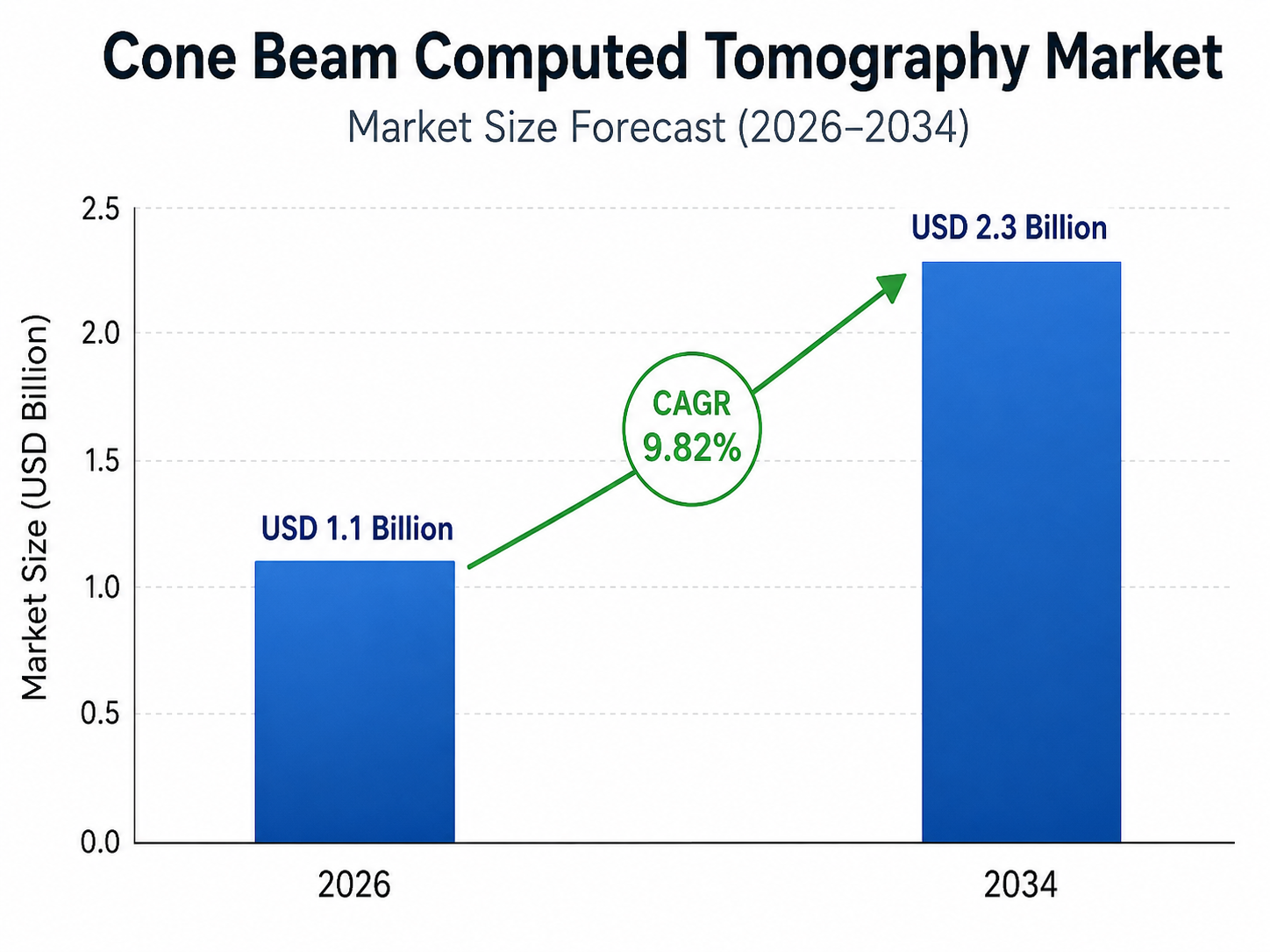
The Cone Beam Computed Tomography Market is estimated to be valued at $1.1 billion in 2026 and is projected to reach $ 2.3 billion by 2034, expanding at a CAGR of 9.82% from 2026 to 2034.
Cone beam computed tomography, or CBCT, is a 3D imaging technology widely used in dentistry, maxillofacial surgery, orthodontics, implantology, ENT, orthopedics, and image-guided treatment planning. CBCT systems provide detailed volumetric images with lower radiation exposure and lower cost than many conventional CT applications, making them attractive for outpatient and specialty-clinic use. Market growth is supported by rising dental implant procedures, digital dentistry adoption, orthodontic treatment planning, oral surgery demand, and increasing use of AI-based imaging software. Manufacturers are focusing on compact systems, low-dose protocols, larger field-of-view options, faster scan times, improved image reconstruction, and integrated treatment-planning platforms.
1. What is the latest trend in the Cone Beam Computed Tomography Market?
The latest trend is the integration of CBCT with digital dentistry, AI-based image analysis, intraoral scanning, and guided implant workflows.
Clinics are using CBCT data for 3D diagnosis, surgical guides, orthodontic planning, airway evaluation, and endodontic assessment.
Compact and low-dose systems are gaining attention among dental clinics and specialty centers.
Software-driven reconstruction, automated segmentation, and cloud-based image sharing are also becoming important differentiators.
2. What are the key challenges in the Cone Beam Computed Tomography Market?
Key challenges include high equipment cost, radiation-safety concerns, reimbursement limitations, and the need for trained imaging professionals.
Clinics must justify CBCT scans based on clinical need, field of view, and patient radiation exposure.
Image artifacts from metal restorations, patient movement, and limited soft-tissue contrast can affect diagnostic interpretation.
Smaller practices may also face barriers related to installation, maintenance, software licensing, and workflow integration.
3. What is the major driving factor for the Cone Beam Computed Tomography Market?
The major driving factor is the growing demand for accurate 3D imaging in dental implantology, orthodontics, oral surgery, and endodontics.
CBCT helps clinicians visualize bone structure, tooth position, nerve canals, sinus anatomy, impacted teeth, and complex root morphology.
Rising dental implant adoption and digital treatment planning are strengthening demand.
The shift toward chairside diagnosis and specialty-clinic imaging is further supporting market expansion.
4. What is the major segment in the Cone Beam Computed Tomography Market and why?
Dental applications represent the major segment because CBCT is widely used for implant planning, orthodontics, endodontics, periodontics, and oral surgery.
Dental clinics benefit from 3D imaging that improves diagnosis, treatment planning, surgical precision, and patient communication.
Medium and small field-of-view systems are especially popular for localized dental and maxillofacial imaging.
ENT and orthopedic applications are growing, but dentistry remains the most established commercial use area.
5. Which application or end-user is driving more demand?
Dental clinics, orthodontic centers, oral and maxillofacial surgery practices, and implantology clinics are driving the highest demand.
Hospitals and diagnostic imaging centers also use CBCT for specialized craniofacial, ENT, and musculoskeletal imaging applications.
Demand is strongest among providers adopting digital workflows that combine CBCT, intraoral scanning, CAD/CAM, and guided surgery.
Specialty practices value CBCT because it supports faster diagnosis and more predictable treatment planning.
6. Which region offers the highest growth potential and why?
Asia Pacific offers strong growth potential due to expanding dental infrastructure, rising implant procedures, growing medical tourism, and increasing private dental-clinic investment.
China, India, Japan, South Korea, and Southeast Asia are important markets for dental imaging and digital dentistry adoption.
North America remains a leading established market due to high dental technology penetration and strong specialty-care infrastructure.
Europe also benefits from advanced dental care systems, implantology adoption, and demand for low-dose imaging technologies.
7. What strategies are major companies adopting in the market?
Major companies are focusing on compact CBCT systems, wider field-of-view options, low-dose imaging, AI-assisted software, and digital workflow integration.
They are strengthening links between CBCT imaging, implant planning, orthodontic simulation, surgical guides, and CAD/CAM systems.
Partnerships with dental software providers, distributors, and clinic networks are central to market expansion.
Companies are also emphasizing training, service support, financing options, and cloud-based image-management platforms.
8. What are the leading companies in the Cone Beam Computed Tomography Market?
Leading companies include Dentsply Sirona, Planmeca, Carestream Dental, Vatech, J. Morita, NewTom, Acteon, PreXion, Genoray, Owandy Radiology, FONA Dental, Cefla, CurveBeam AI, and large imaging technology suppliers.
These companies compete through image quality, field-of-view flexibility, dose reduction, software ecosystem, reliability, service support, and pricing.
Large dental technology firms benefit from integrated digital dentistry platforms and established distribution networks.
Specialized CBCT providers compete through advanced imaging features, compact designs, and application-specific workflow tools.
9. Why is CBCT strategically important for dental and healthcare providers?
CBCT is strategically important because it improves diagnostic confidence and supports more precise treatment planning for complex cases.
It enables clinicians to visualize anatomy in three dimensions, improving implant placement, orthodontic planning, and surgical risk assessment.
For clinics, in-house CBCT can improve patient retention, reduce external referrals, and support premium treatment offerings.
For manufacturers, CBCT is a key platform in the broader transition toward fully digital dental and surgical workflows.
10. What is the future outlook for the Cone Beam Computed Tomography Market?
The market outlook remains positive as digital dentistry, dental implants, orthodontics, and image-guided treatment planning continue to expand.
Future growth will be supported by AI-based segmentation, low-dose protocols, cloud imaging, automated diagnostics, and integration with intraoral scanning.
Compact and affordable CBCT systems are expected to improve adoption among smaller dental practices and emerging markets.
Companies offering high image quality, low radiation dose, workflow integration, and strong clinical support are expected to gain market share.
Browse Related Reports
https://www.oganalysis.com/industry-reports/electron-microscopy-and-sample-preparation-market
https://www.oganalysis.com/industry-reports/biopharmaceutical-process-analytical-technology-market
https://www.oganalysis.com/industry-reports/head-and-neck-cancer-diagnostics-market
https://www.oganalysis.com/industry-reports/internet-of-medical-things-iomt-market
https://www.oganalysis.com/industry-reports/digital-health-market
