Consumer Genomics Market Outlook 2026–2034: Whole-Genome Sequencing Trends, Growth Drivers, Leading Companies, and Future Opportunities
The Consumer Genomics Market is expected to grow from $ 6.64 billion in 2026 to $ 20.8 billion by 2034, registering a CAGR of 17.71%.
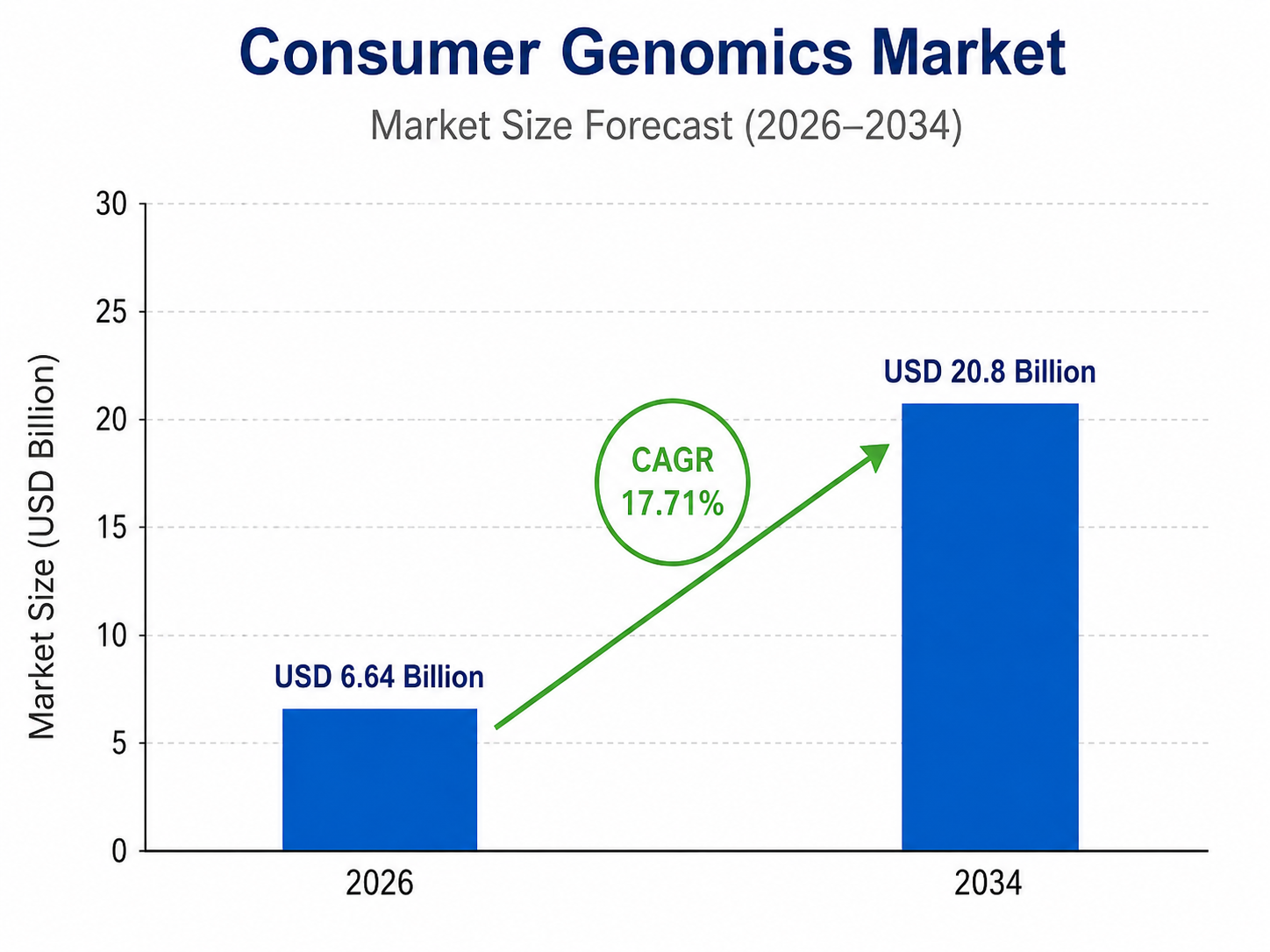
During the forecast period. Consumer genomics enables individuals to access genetic insights through direct-to-consumer DNA testing services, offering information related to ancestry, health risks, carrier status, pharmacogenomics, inherited traits, nutrition, and whole-genome sequencing. Typically, consumers provide a saliva or cheek-swab sample and receive personalized reports through secure online platforms or mobile applications. Market growth is being driven by declining DNA sequencing costs, growing interest in personalized healthcare, expanding genealogy databases, and increasing awareness of preventive health management. In addition, ongoing advancements in whole-genome sequencing, polygenic risk scoring, AI-powered genetic interpretation, subscription-based report updates, and integration with family health history are enhancing the value of consumer genomics services. At the same time, ensuring genetic data privacy, improving result interpretation, maintaining regulatory compliance, and increasing the diversity of genomic databases remain key priorities for the long-term growth of the market.
1. What is the latest trend in the Consumer Genomics Market?
The latest trend is the transition from limited SNP-based genotyping toward whole-genome sequencing and more comprehensive DNA analysis.
Companies are using AI, polygenic risk models, and continuously updated databases to generate deeper ancestry, trait, and health insights.
Subscription models are enabling consumers to receive new reports as scientific knowledge develops.
Integration with digital health platforms and family-history services is also expanding.
2. What are the key challenges in the Consumer Genomics Market?
Key challenges include genetic-data privacy, cybersecurity, uncertain report interpretation, regulatory scrutiny, and limited representation of some populations.
Health-risk estimates may vary depending on reference databases, analytical methods, and available scientific evidence.
Consumers may also misunderstand probabilistic results as definite medical diagnoses.
Companies must strengthen informed consent, data control, security, transparency, and access to genetic counseling.
3. What is the major driving factor for the Consumer Genomics Market?
The major driving factor is growing consumer interest in ancestry, preventive health, inherited traits, and personalized wellness.
Declining DNA-testing and sequencing costs are making advanced genomic information available to broader consumer groups.
Digital platforms allow users to receive and explore results without visiting conventional laboratory facilities.
Media awareness, family-history research, and interest in personalized healthcare are further supporting adoption.
4. What is the major segment in the Consumer Genomics Market and why?
Ancestry and genealogy analysis represents a major segment because it offers broad consumer appeal and does not require an existing medical condition.
Large DNA databases improve relative matching, geographic-origin estimates, migration insights, and family-tree discovery.
Ancestry products also serve as an entry point for additional trait, wellness, and health-report services.
Whole-genome health analysis is emerging as a higher-value and faster-developing segment.
5. Which application or end-user is driving more demand?
Ancestry research, health-risk assessment, wellness planning, carrier screening, and pharmacogenomics are major demand applications.
Health-conscious consumers increasingly use genomic reports to understand inherited risks, traits, nutrition, and medication-response factors.
Genealogy users seek biological relatives, ethnic-origin estimates, and family-history connections.
Research organizations and pharmaceutical companies also benefit from consented, aggregated genomic datasets.
6. Which region offers the highest growth potential and why?
Asia Pacific offers strong growth potential due to its large population, expanding middle class, improving laboratory infrastructure, and rising preventive-health awareness.
China, India, Japan, South Korea, Singapore, and Australia are important markets for ancestry and health-focused testing.
North America remains the leading established market because of large consumer databases and strong digital-health adoption.
Europe also offers opportunities, although data-protection and genetic-testing regulations vary across countries.
7. What strategies are major companies adopting in the market?
Major companies are investing in whole-genome sequencing, larger reference databases, AI interpretation, subscription services, and mobile platforms.
They are expanding ancestry regions, health reports, pharmacogenomic insights, and personalized wellness recommendations.
Partnerships with laboratories, research institutions, healthcare providers, and pharmaceutical companies support product development.
Privacy controls, transparent consent processes, and customer-managed data deletion are becoming important competitive differentiators.
8. What are the leading companies in the Consumer Genomics Market?
Leading participants include Ancestry, 23andMe, MyHeritage, FamilyTreeDNA, Nebula Genomics, Sequencing.com, Nucleus Genomics, Living DNA, CircleDNA, and Dante Labs.
These companies compete through database size, sequencing depth, report breadth, geographic coverage, privacy protections, and subscription features.
Ancestry-focused companies benefit from large family-history networks and relative-matching capabilities.
Whole-genome providers compete through comprehensive health analysis, data access, and advanced interpretation tools.
9. Why is consumer genomics strategically important for healthcare and wellness companies?
Consumer genomics creates opportunities for personalized prevention, nutrition, fitness, medication-response insights, and long-term digital engagement.
It can help individuals initiate informed discussions with healthcare professionals about inherited risks and family history.
For companies, genomic platforms support subscriptions, research partnerships, and customized health-service ecosystems.
Clinical boundaries must remain clear because consumer reports do not automatically replace diagnostic testing or medical consultation.
10. What is the future outlook for the Consumer Genomics Market?
The market outlook remains positive as whole-genome sequencing becomes more affordable and consumers demand deeper personalized insights.
Future growth will be supported by AI interpretation, multi-omics integration, pharmacogenomics, digital health, and regularly updated reports.
Privacy governance, clinical validation, population diversity, and regulatory clarity will strongly influence consumer confidence.
Companies offering secure, understandable, scientifically supported, and actionable genomic services are expected to gain market share.
Browse Related Reports
https://www.oganalysis.com/industry-reports/process-safety-services-market
https://www.oganalysis.com/industry-reports/trailer-sprayer-market
https://www.oganalysis.com/industry-reports/immersion-wash-system-market
https://www.oganalysis.com/industry-reports/heavy-construction-equipment-market
https://www.oganalysis.com/industry-reports/elevators-and-escalators-market
