Digital Badges Market Outlook 2026–2034: Micro-Credential Trends, Skills-Based Learning, Growth Drivers, Leading Platforms, and Future Opportunities
The Digital Badges Market is estimated to be valued at $ 832.11 million in 2026 and is projected to reach $ 3922 million by 2034, expanding at a CAGR of 21.38% from 2026 to 2034.
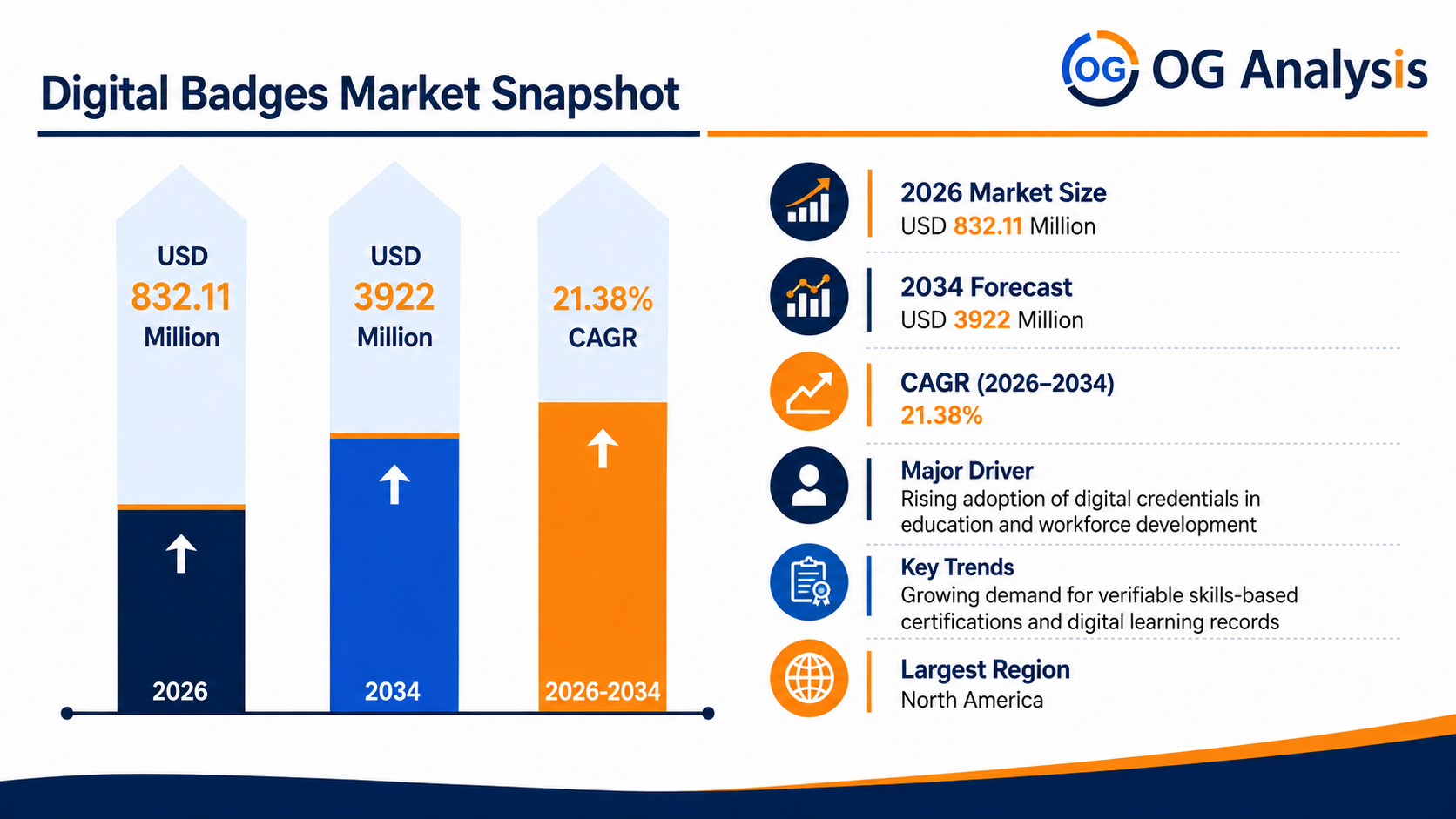
Digital badges are verifiable online credentials used to recognize skills, certifications, achievements, training completion, professional development, and learning milestones. These badges can be shared across social media, résumés, learning platforms, professional networks, employer portals, and digital wallets. Market growth is supported by rising adoption of online education, corporate learning, skills-based recruitment, micro-credentials, certification programs, and lifelong learning models. Universities, training providers, enterprises, associations, government agencies, and EdTech platforms are increasingly using digital badges to validate competencies and improve learner engagement. Demand is also supported by the need for portable, tamper-resistant, shareable, and data-rich credentials that help employers verify skills more efficiently.
Get Your Free Sample Report for In-Depth Market Insights :
https://www.oganalysis.com/industry-reports/respiratory-disposables-market
1. What is the latest trend in the Digital Badges Market?
The latest trend is the rapid adoption of micro-credentials and skill-based digital badges across higher education, corporate training, and professional certification programs.
Organizations are using badges to represent specific skills instead of relying only on traditional degrees or paper certificates.
Open Badge standards, digital wallets, blockchain-enabled verification, and LMS integrations are becoming important technology trends.
AI-driven learning platforms are also using badges to track learner progress, personalize learning paths, and support skills mapping.
2. What are the key challenges in the Digital Badges Market?
Key challenges include credential standardization, employer recognition, badge quality control, data privacy, and interoperability across platforms.
The market also faces concerns around badge inflation, where too many low-value badges can reduce trust and credibility.
Issuers must ensure that each badge is backed by clear assessment criteria, verified evidence, and transparent metadata.
Adoption can also be slowed by integration complexity with LMS, HR systems, talent platforms, and institutional databases.
3. What is the major driving factor for the Digital Badges Market?
The major driving factor is the shift toward skills-based hiring and continuous workforce upskilling.
Employers increasingly need quick and reliable ways to verify technical, professional, and role-specific skills.
Digital badges provide portable proof of learning outcomes, certification completion, and competency achievement.
This makes them valuable for employees, job seekers, students, training providers, and employers managing talent development.
4. What is the major segment in the Digital Badges Market and why?
The education and training segment is a major market segment because universities, online course providers, and certification bodies use badges to validate learning outcomes.
Digital badges help institutions recognize short courses, professional development, technical training, and competency-based learning.
Corporate learning is also growing strongly as companies use badges for employee development, compliance training, leadership programs, and technical certifications.
Skill badges are becoming especially important because they directly align with employability and career progression.
5. Which application or end-user is driving more demand?
Corporate training, online learning platforms, higher education institutions, professional associations, and certification providers are driving strong demand.
Enterprises use digital badges to recognize internal training, product certifications, compliance programs, and workforce capability development.
Universities and EdTech platforms use badges to improve learner engagement and make achievements more visible to employers.
Professional bodies use them to modernize certification programs and improve credential verification.
6. Which region offers the highest growth potential and why?
North America remains a leading market due to strong adoption of EdTech, corporate learning platforms, professional certification programs, and skills-based hiring practices.
Asia Pacific offers strong growth potential due to expanding online education, digital transformation, government upskilling initiatives, and large young workforces.
Europe is supported by lifelong learning initiatives, digital education strategies, and rising acceptance of micro-credentials.
Growth is strongest in regions where employers, universities, and governments are aligning learning credentials with workforce development needs.
7. What strategies are major companies adopting in the market?
Major companies are focusing on verifiable credential platforms, LMS integrations, analytics dashboards, digital wallets, and Open Badge compatibility.
They are improving badge design tools, automated issuing workflows, recipient sharing features, and employer verification capabilities.
Partnerships with universities, certification bodies, corporations, and training providers are central to market expansion.
Companies are also investing in blockchain verification, API integrations, learner engagement tools, and skills intelligence features.
8. What are the leading companies in the Digital Badges Market?
Leading companies include Credly, Accredible, Canvas Credentials, Sertifier, BadgeCert, Certifier, Open Badge Factory, BCdiploma, Acreditta, Virtualbadge.io, Parchment, Coursera, edX, Udemy Business, LinkedIn Learning, and Skillsoft.
These companies compete through credential verification, platform integrations, user experience, analytics, scalability, security, and institutional partnerships.
Credentialing platforms focus on badge issuing, management, verification, and sharing, while learning platforms use badges to strengthen course completion and certification value.
Vendors with strong LMS, HR, and professional-network integrations are better positioned to support large-scale adoption.
9. Why are digital badges strategically important for education and workforce development?
Digital badges are strategically important because they make skills more visible, portable, and verifiable.
They help learners showcase specific competencies gained through formal education, online learning, workplace training, and professional certification.
For employers, badges support faster skill verification, internal mobility, talent development, and workforce planning.
For education providers, they improve learner engagement and create new pathways for modular, stackable learning.
10. What is the future outlook for the Digital Badges Market?
The market outlook remains positive as education and employment systems continue shifting toward skills-based recognition.
Future growth will be supported by micro-credentials, digital wallets, AI-enabled learning pathways, verified skill records, and employer-recognized certifications.
Interoperability, quality assurance, and trust will become critical as badge adoption expands across institutions and industries.
Companies offering secure, verifiable, standards-based, and easy-to-integrate credentialing platforms are expected to gain market share.
Browse Related Reports
https://www.oganalysis.com/industry-reports/healthcare-education-market
https://www.oganalysis.com/industry-reports/business-process-management-bpm-market
https://www.oganalysis.com/industry-reports/military-simulation-virtual-training-market
https://www.oganalysis.com/industry-reports/thin-client-market
https://www.oganalysis.com/industry-reports/webcam-market
Stay Connected With Us
