Digital Gift Card Market Outlook 2026–2034: Mobile Wallet Integration, Corporate Rewards Growth, Leading Companies, and Future Opportunities
The Digital Gift Card Market is valued at $ 665.0 billion in 2026 and is projected to grow at a CAGR of 17.1% to reach $ 2,351.2 billion by 2034.
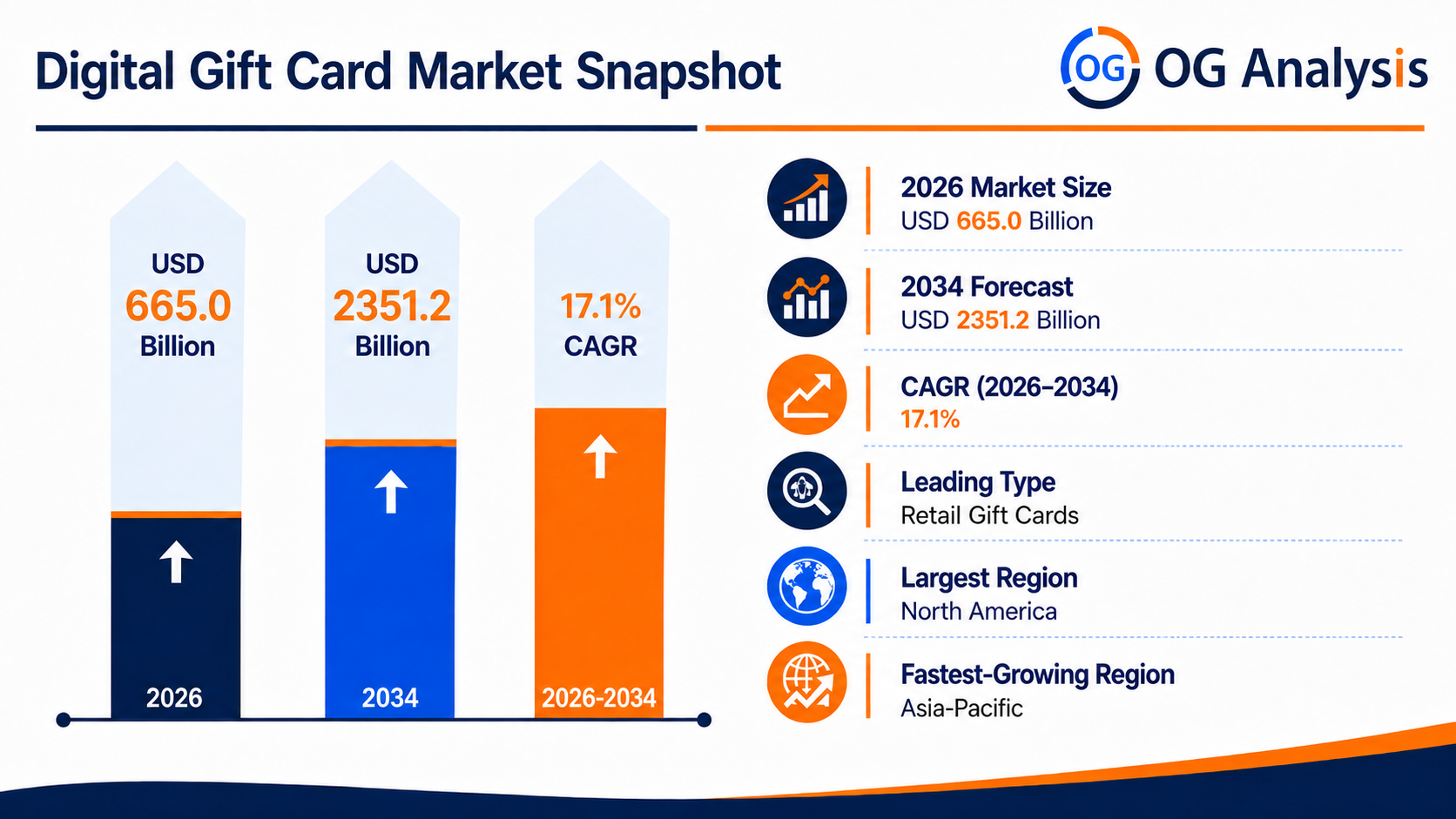
Digital gift cards, also known as e-gift cards or virtual gift cards, are prepaid digital instruments delivered through email, mobile apps, SMS, websites, digital wallets, reward platforms, and enterprise incentive systems. They are widely used for consumer gifting, employee rewards, customer loyalty, promotional campaigns, cashback redemption, gaming, entertainment, travel, food delivery, retail shopping, and corporate payouts. Market growth is supported by e-commerce expansion, mobile payment adoption, instant gifting, omnichannel retailing, loyalty programs, and growing demand for flexible digital payment experiences.
Get Your Free Sample Report for In-Depth Market Insights :
https://www.oganalysis.com/industry-reports/digital-gift-card-market/free-sample
1. What is the latest trend in the Digital Gift Card Market?
The latest trend is the integration of digital gift cards with mobile wallets, online marketplaces, loyalty apps, and AI-enabled shopping journeys.
Retailers are improving personalization, delivery scheduling, balance visibility, and redemption flexibility to improve user experience.
Digital gift cards are also being used more widely in corporate rewards, employee recognition, customer acquisition, and promotional campaigns.
Instant delivery and app-based redemption are making e-gift cards more convenient than physical cards.
2. What are the key challenges in the Digital Gift Card Market?
Key challenges include fraud risk, phishing scams, account takeover, unauthorized resale, regulatory compliance, and customer trust issues.
Retailers and platforms must ensure secure issuance, activation, delivery, redemption, balance tracking, and refund management.
Cross-border usage can be complicated by currency rules, tax treatment, expiry regulations, and payment network requirements.
Intense competition, discounting pressure, and platform fees can also affect margins for issuers and distributors.
3. What is the major driving factor for the Digital Gift Card Market?
The major driving factor is the rapid growth of e-commerce, digital payments, mobile wallets, and online consumer gifting.
Consumers prefer digital gift cards because they are fast, flexible, easy to send, and suitable for last-minute gifting.
Businesses use them for incentives, rewards, loyalty, promotions, refunds, and employee engagement.
The shift toward cashless payments and omnichannel shopping is further increasing digital gift card adoption.
4. What is the major segment in the Digital Gift Card Market and why?
Closed-loop digital gift cards represent a major segment because retailers, restaurants, entertainment brands, and online platforms use them to retain spending within their own ecosystems.
These cards help brands drive repeat purchases, customer engagement, prepaid revenue, and loyalty program participation.
Open-loop digital gift cards are also important because they provide broader acceptance through payment networks.
Corporate rewards and incentive cards are gaining strong momentum as businesses shift from physical rewards to instant digital payouts.
5. Which application or end-user is driving more demand?
Consumer gifting, corporate rewards, employee incentives, loyalty programs, online retail, gaming, entertainment, food delivery, and travel are driving demand.
Retailers use digital gift cards to increase customer retention, seasonal sales, and omnichannel engagement.
Corporates use them for employee rewards, channel partner incentives, survey rewards, customer compensation, and promotional payouts.
Gaming, streaming, app stores, and digital entertainment platforms are also major demand generators.
6. Which region offers the highest growth potential and why?
North America remains a leading market due to strong e-commerce penetration, mature payment infrastructure, retail loyalty programs, and high adoption of prepaid digital products.
Asia Pacific offers the highest growth potential due to rapid digital payment adoption, mobile commerce, young consumers, app-based retailing, and expanding online marketplaces.
Europe is supported by strong retail digitization, cross-border e-commerce, and regulatory emphasis on secure digital payments.
Latin America and the Middle East are emerging as digital wallets, fintech platforms, and online retail ecosystems expand.
7. What strategies are major companies adopting in the market?
Major companies are focusing on digital wallet integration, API-based gift card distribution, omnichannel redemption, personalization, and fraud prevention.
Retailers are using digital gift cards to strengthen loyalty programs, drive repeat purchases, and improve customer lifetime value.
Gift card platforms are expanding B2B reward networks, multi-brand catalogs, instant delivery, and global redemption capabilities.
Payment companies are enhancing open-loop prepaid solutions, security controls, and enterprise payout infrastructure.
8. What are the leading companies in the Digital Gift Card Market?
Leading companies include Amazon, Apple, Walmart, Target, Starbucks, Blackhawk Network, InComm Payments, Mastercard, Visa, PayPal, Fiserv, American Express, Givex, Runa, Prezzee, Tango, Giftbit, and Raise.
These companies compete through brand reach, digital distribution, mobile wallet compatibility, merchant acceptance, security, and enterprise reward capabilities.
Large retailers benefit from strong customer ecosystems and repeat purchase behavior.
Specialist platforms compete through API connectivity, global catalogs, corporate reward tools, and digital-first delivery models.
9. Why are digital gift cards strategically important?
Digital gift cards are strategically important because they combine prepaid revenue, customer engagement, loyalty, and payment flexibility.
For retailers, they help attract new customers, increase repeat visits, support promotional campaigns, and capture seasonal demand.
For businesses, they provide a fast and scalable tool for rewards, recognition, incentives, and customer compensation.
For consumers, they offer convenience, choice, instant delivery, and easy redemption across digital and physical channels.
10. What is the future outlook for the Digital Gift Card Market?
The market outlook remains highly positive as digital commerce, mobile payments, loyalty ecosystems, and instant gifting continue to expand.
Future growth will be driven by AI-assisted shopping, embedded gift card marketplaces, wallet-based redemption, cross-border digital gifting, and corporate reward automation.
Security, personalization, redemption flexibility, and omnichannel acceptance will remain key success factors.
Companies offering trusted, convenient, secure, and globally scalable digital gift card solutions are expected to gain market share.
Browse Related Reports
https://www.oganalysis.com/industry-reports/cloud-analytics-market
https://www.oganalysis.com/industry-reports/digital-workplace-market
https://www.oganalysis.com/industry-reports/saasbased-expense-management-market
https://www.oganalysis.com/industry-reports/sales-tech-market
https://www.oganalysis.com/industry-reports/casino-management-system-market
Stay Connected With Us
