DTF and DTG Digital Textile Printing Market Outlook 2026–2034: Print-on-Demand Trends, Growth Drivers, Leading Companies, and Future Opportunities
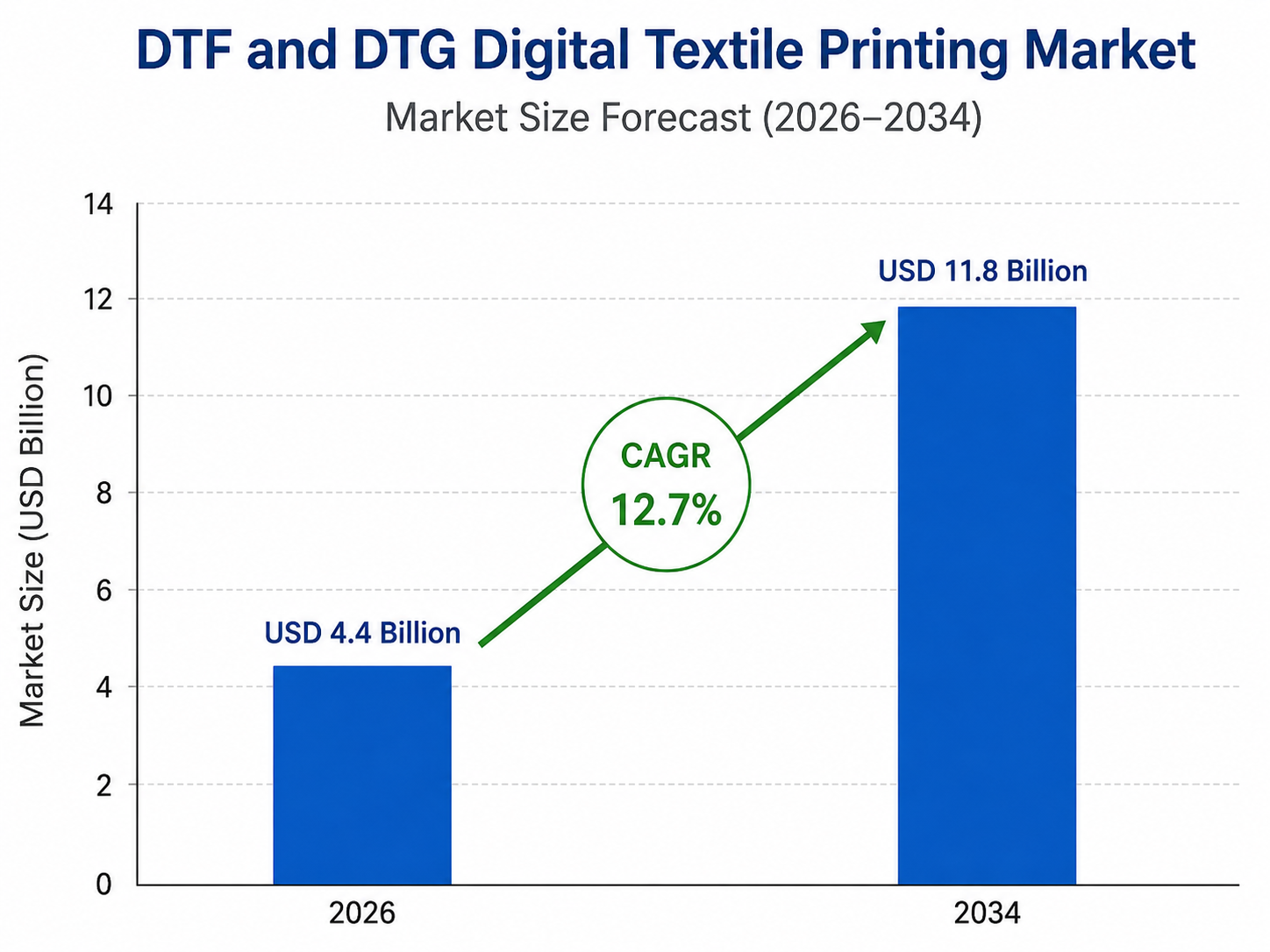
The DTF and DTG Digital Textile Printing Market is estimated to be valued at $ 4.4 billion in 2026 and is projected to reach $ 11.8 billion by 2034, expanding at a CAGR of 12.7% from 2026 to 2034.
Direct-to-film and direct-to-garment printing technologies enable digital decoration of apparel, textiles, accessories, sportswear, promotional products, and customized merchandise. DTG printing applies ink directly onto fabric, while DTF printing transfers printed designs from film to garments using adhesive powder and heat pressing. Market growth is supported by rising demand for personalized apparel, short-run production, e-commerce merchandise, fashion customization, lower inventory risk, and faster design-to-delivery cycles. Print shops, fashion brands, online sellers, promotional product companies, sportswear suppliers, and textile manufacturers are adopting DTF and DTG systems to improve flexibility, reduce minimum order requirements, and support on-demand production.
1. What is the latest trend in the DTF and DTG Digital Textile Printing Market?
The latest trend is the rapid growth of DTF printing because it supports vibrant designs, broad fabric compatibility, and efficient transfer-based production.
DTG printing is evolving through faster machines, improved pretreatment, better white-ink management, and automated workflows.
Print-on-demand and e-commerce sellers are increasingly using both technologies to reduce inventory and fulfill customized orders quickly.
AI-assisted design tools, web-to-print platforms, and automated order routing are also becoming important market trends.
2. What are the key challenges in the DTF and DTG Digital Textile Printing Market?
Key challenges include ink cost, print durability concerns, color consistency, pretreatment quality, machine maintenance, and operator skill requirements.
DTF users must manage film quality, adhesive powder application, curing, transfer temperature, and wash performance.
DTG users face challenges with fabric compatibility, white ink clogging, pretreatment marks, and productivity on dark garments.
Intense competition among small print shops can also pressure margins and pricing.
3. What is the major driving factor for the DTF and DTG Digital Textile Printing Market?
The major driving factor is rising demand for personalized, short-run, and on-demand apparel production.
Consumers and brands increasingly want customized T-shirts, hoodies, sportswear, uniforms, merchandise, and event-based products.
DTF and DTG printing reduce the need for screens, plates, large inventories, and long setup times.
This makes them attractive for small batches, rapid product launches, online stores, and localized manufacturing.
4. What is the major segment in the DTF and DTG Digital Textile Printing Market and why?
DTF printing is becoming a major growth segment because it works across cotton, polyester, blends, performance fabrics, and many colored garments.
It is suitable for small shops and high-volume transfer producers because designs can be printed, stored, shipped, and applied later.
DTF also offers strong flexibility for complex graphics, gradients, and multi-color artwork.
DTG remains important for premium cotton garments, soft hand feel, and direct print-on-demand workflows.
5. Which application or end-user is driving more demand?
Custom apparel, e-commerce merchandise, promotional products, sportswear, uniforms, and fashion customization are driving strong demand.
Small print shops, online sellers, fashion startups, decorators, and fulfillment centers are key users of DTF and DTG systems.
Brands use these technologies to test designs, launch limited collections, and serve niche communities without large inventory commitments.
Demand is strongest where speed, customization, low minimum orders, and design flexibility are important.
6. Which region offers the highest growth potential and why?
Asia Pacific offers strong growth potential due to its large textile manufacturing base, expanding apparel exports, and rising adoption of digital printing.
China, India, Bangladesh, Vietnam, Japan, and South Korea are important markets for garment production and digital textile equipment.
North America and Europe remain important due to e-commerce customization, print-on-demand businesses, and nearshore apparel production.
Growth is also supported by demand for faster fulfillment and reduced supply-chain dependence.
7. What strategies are major companies adopting in the market?
Major companies are focusing on faster print speeds, better white-ink circulation, improved color management, and lower maintenance requirements.
They are developing integrated systems that combine printers, inks, powders, films, dryers, pretreatment, software, and workflow automation.
Partnerships with apparel brands, print-service providers, and e-commerce platforms are becoming increasingly important.
Companies are also investing in sustainable inks, lower waste processes, training programs, and service support.
8. What are the leading companies in the DTF and DTG Digital Textile Printing Market?
Leading companies include Kornit Digital, Epson, Brother Industries, Mimaki Engineering, Roland DG, Ricoh, Aeoon Technologies, Polyprint, ColDesi, DTG Digital, Mutoh, Hanrun Paper, Atexco, and EFI Reggiani.
These companies compete through print quality, productivity, ink performance, reliability, software integration, service networks, and total operating cost.
Kornit, Epson, Brother, Mimaki, and Roland are strongly associated with professional DTG, DTF, and textile-printing equipment.
Suppliers with complete hardware, ink, consumables, and workflow ecosystems are gaining competitive advantage.
9. Why are DTF and DTG technologies strategically important for apparel brands and print providers?
DTF and DTG printing help brands reduce inventory risk, shorten production cycles, and respond faster to changing fashion demand.
They support personalization, limited editions, influencer merchandise, event-based products, and localized manufacturing.
For print providers, these technologies create opportunities across retail, corporate merchandise, sports teams, schools, and online stores.
They also allow businesses to serve fragmented demand without the setup costs of traditional screen printing.
10. What is the future outlook for the DTF and DTG Digital Textile Printing Market?
The market outlook remains positive as apparel production shifts toward faster, more flexible, and lower-inventory business models.
Future growth will be supported by automation, sustainable inks, improved wash durability, faster printers, and integrated web-to-print workflows.
DTF is expected to expand strongly due to fabric versatility, while DTG will remain important for premium direct-to-garment applications.
Companies offering reliable machines, consistent consumables, strong software, and responsive technical support are expected to gain market share.
Browse Related Reports:
https://www.oganalysis.com/industry-reports/waterresistant-paint-market
https://www.oganalysis.com/industry-reports/sodium-lauryl-sulphate-sls-market
https://www.oganalysis.com/industry-reports/acid-alkali-resistant-coating-market
https://www.oganalysis.com/industry-reports/uvsnap-cure-adhesives-market
https://www.oganalysis.com/industry-reports/fire-protection-coating-for-steel-market
