Electron Microscopy and Sample Preparation Market Outlook 2026–2034: Cryo-EM Trends, Growth Drivers, Leading Companies, and Future Opportunities
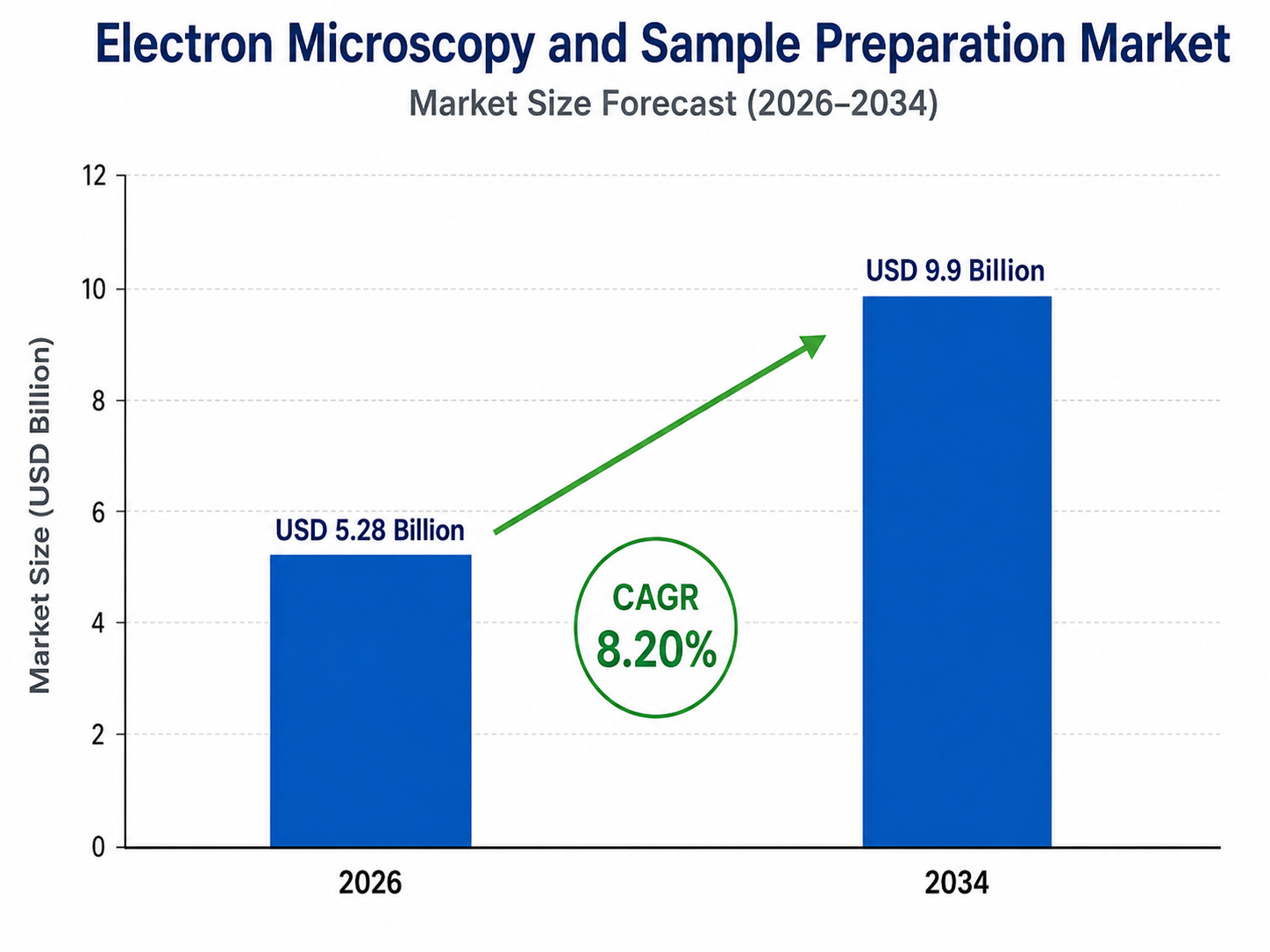
The Electron Microscopy and Sample Preparation Market is estimated to be valued at $ 5.28 billion in 2026 and is projected to reach $ 9.9 billion by 2034, expanding at a CAGR of 8.20% from 2026 to 2034.
Electron microscopy and sample preparation include scanning electron microscopes, transmission electron microscopes, focused ion beam systems, cryo-electron microscopy platforms, ultramicrotomes, sputter coaters, ion mills, plasma cleaners, grids, stains, resins, holders, and related consumables. These technologies enable nanoscale imaging, structural analysis, defect inspection, and material characterization across semiconductors, life sciences, nanotechnology, pharmaceuticals, metals, polymers, and advanced materials. Market growth is supported by semiconductor miniaturization, biologics research, battery development, nanomaterials innovation, and rising demand for high-resolution analytical tools. As imaging workflows become more data-intensive, automation, AI-based image analysis, and reproducible sample preparation are becoming critical differentiators.
1. What is the latest trend in the Electron Microscopy and Sample Preparation Market?
The latest trend is the growing adoption of cryo-EM, FIB-SEM, automated sample preparation, and AI-assisted image processing.
Life-science researchers are using cryo-EM for structural biology, protein complexes, and drug discovery workflows.
Semiconductor users are relying on FIB-SEM and advanced sample prep for defect analysis and advanced packaging inspection.
Automation is improving repeatability, throughput, and usability across complex microscopy workflows.
2. What are the key challenges in the Electron Microscopy and Sample Preparation Market?
Key challenges include high instrument cost, skilled-operator shortages, long training requirements, and complex maintenance needs.
Sample preparation can be time-consuming, technique-sensitive, and highly dependent on material type or biological condition.
Artifacts from fixation, coating, staining, sectioning, ion milling, or freezing can affect image quality and interpretation.
Laboratories also face challenges in data storage, image analysis, contamination control, and workflow standardization.
3. What is the major driving factor for the Electron Microscopy and Sample Preparation Market?
The major driving factor is rising demand for nanoscale imaging and precise material characterization across research and industrial applications.
Semiconductor manufacturing, battery R&D, nanotechnology, biologics, and advanced materials increasingly require high-resolution structural information.
Electron microscopy helps identify defects, morphology, interfaces, particles, crystals, cells, and subcellular structures.
Growing investment in R&D infrastructure and quality-control laboratories is further supporting market expansion.
4. What is the major segment in the Electron Microscopy and Sample Preparation Market and why?
Scanning electron microscopy represents a major instrument segment because it is widely used for surface imaging, morphology analysis, failure analysis, and quality inspection.
SEM platforms offer broad applicability across materials science, electronics, life sciences, forensics, and industrial laboratories.
Their relative usability, large sample compatibility, and high-resolution surface imaging support widespread adoption.
TEM and cryo-EM are gaining importance where atomic-scale structure and biological macromolecule analysis are required.
5. Which application or end-user is driving more demand?
Semiconductor and electronics applications are driving strong demand due to advanced-node manufacturing, wafer inspection, failure analysis, and packaging complexity.
Life sciences and pharmaceutical research also generate significant demand through structural biology, pathology, cell biology, and drug-discovery applications.
Academic and government research institutions remain major buyers of advanced microscopy infrastructure.
Battery, nanomaterials, metals, polymers, and additive manufacturing users are expanding adoption for materials characterization.
6. Which region offers the highest growth potential and why?
Asia Pacific offers strong growth potential due to semiconductor manufacturing, electronics production, academic research investment, and expanding biotechnology activity.
China, Japan, South Korea, Taiwan, India, and Singapore are important demand centers for microscopy instruments and sample-preparation tools.
North America remains a leading established market due to strong life-science research, semiconductor R&D, and advanced materials innovation.
Europe also benefits from strong academic networks, industrial research, and precision instrumentation expertise.
7. What strategies are major companies adopting in the market?
Major companies are focusing on automation, integrated sample-preparation workflows, AI image analysis, cryo-EM platforms, and application-specific systems.
They are improving ease of use, throughput, resolution, contamination control, and compatibility with digital laboratory workflows.
Partnerships with universities, semiconductor companies, pharma firms, and research institutes support product development and validation.
Companies are also strengthening service contracts, training programs, consumables portfolios, and software ecosystems.
8. What are the leading companies in the Electron Microscopy and Sample Preparation Market?
Leading companies include Thermo Fisher Scientific, JEOL, Hitachi High-Tech, ZEISS, TESCAN, Bruker, Oxford Instruments, Leica Microsystems, Gatan/Ametek, Quorum Technologies, Delong Instruments, Nion, Protochips, Raith, and E.A. Fischione Instruments.
These companies compete through resolution, system stability, workflow integration, automation, sample-preparation quality, and application expertise.
Large players benefit from broad instrument portfolios covering SEM, TEM, FIB-SEM, cryo-EM, and analytical accessories.
Specialized suppliers compete through consumables, holders, coating systems, sectioning tools, ion milling, and niche workflow solutions.
9. Why is electron microscopy and sample preparation strategically important for research and industry?
Electron microscopy enables organizations to see structures and defects that are not visible through conventional optical techniques.
It supports product development, failure analysis, regulatory research, nanomaterial characterization, and scientific discovery.
Reliable sample preparation is strategically important because image quality and analytical accuracy depend heavily on specimen condition.
For companies and research institutes, microscopy capability can shorten development cycles and improve technical decision-making.
10. What is the future outlook for the Electron Microscopy and Sample Preparation Market?
The market outlook remains positive as demand grows for nanoscale analysis in semiconductors, batteries, biotechnology, nanomaterials, and advanced manufacturing.
Future growth will be supported by cryo-EM, automated FIB workflows, AI-based segmentation, correlative microscopy, and high-throughput sample preparation.
Integrated systems that reduce operator dependence and improve reproducibility are expected to gain wider adoption.
Companies offering advanced imaging, reliable preparation tools, strong software, and application support are expected to gain market share.
Browse Related Reports
https://www.oganalysis.com/industry-reports/cone-beam-computed-tomography-market
https://www.oganalysis.com/industry-reports/electron-microscopy-and-sample-preparation-market
https://www.oganalysis.com/industry-reports/biopharmaceutical-process-analytical-technology-market
https://www.oganalysis.com/industry-reports/head-and-neck-cancer-diagnostics-market
https://www.oganalysis.com/industry-reports/internet-of-medical-things-iomt-market
