Far-Field Speech and Voice Recognition Market Outlook 2026–2034: AI Innovation, Smart Device Demand, Leading Companies, and Growth Opportunities
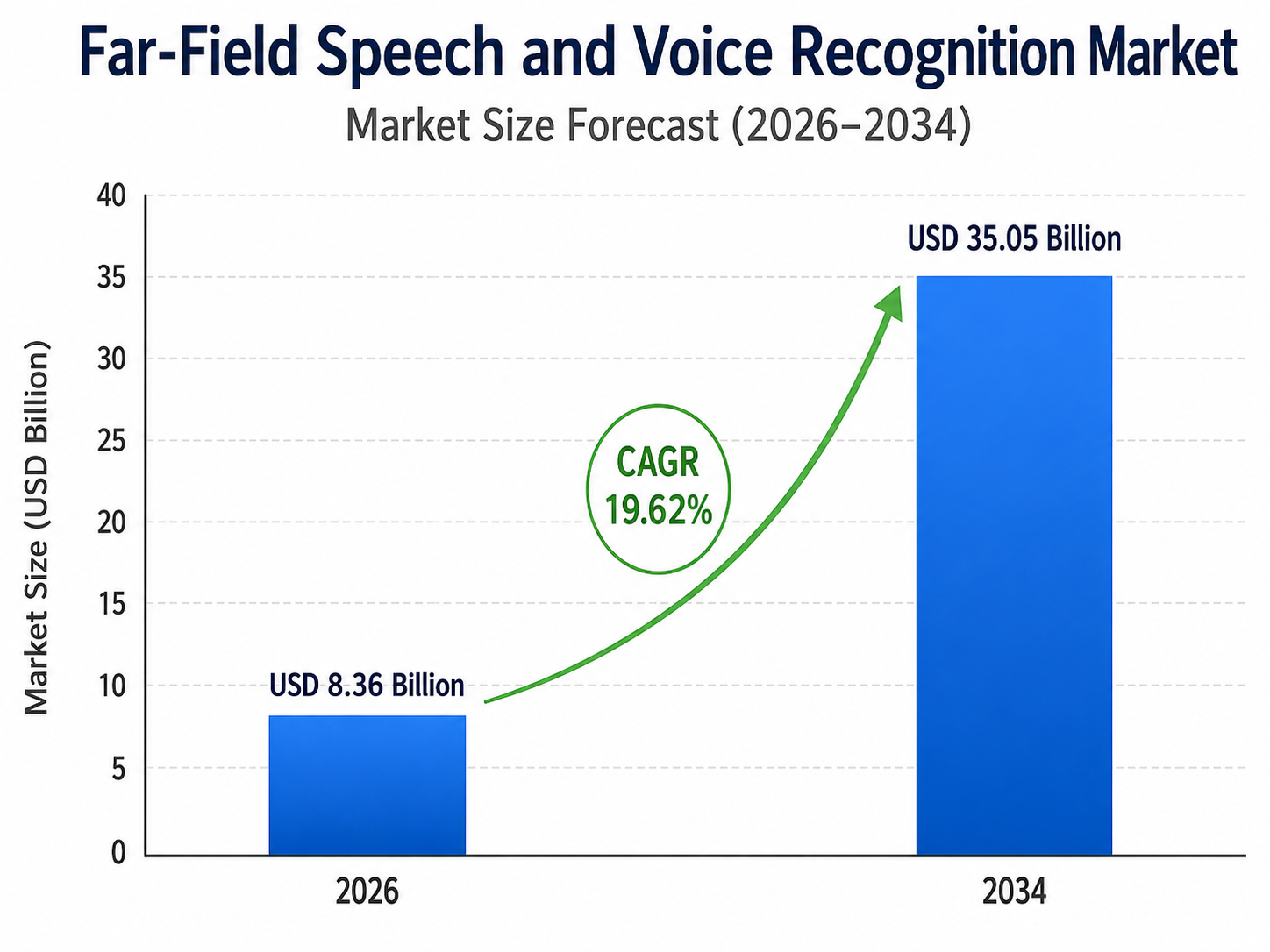
The Far-Field Speech and Voice Recognition Market is estimated to be valued at $ 8.36 billion in 2026 and is projected to reach $ 35.05 billion by 2034, expanding at a CAGR of 19.62% from 2026 to 2034.
Far-field voice systems capture and interpret speech from several meters away through microphone arrays, beamforming, noise suppression, acoustic echo cancellation, digital signal processors, and automatic speech-recognition software. These technologies are used in smart speakers, televisions, vehicles, conferencing systems, home appliances, robots, healthcare devices, and industrial equipment. Market growth is driven by conversational AI, smart-home adoption, connected vehicles, hands-free interfaces, and demand for natural human–machine interaction. Manufacturers are increasingly combining edge AI, multilingual recognition, speaker identification, and privacy-focused local processing.
1. What is the latest trend in the Far-Field Speech and Voice Recognition Market?
The latest trend is the integration of generative AI, neural beamforming, and contextual voice assistants into far-field recognition systems.
Devices are becoming capable of understanding conversational commands, multiple speakers, accents, and follow-up questions.
On-device processing is also gaining importance for lower latency, improved privacy, and offline functionality.
Multimodal systems combining voice, vision, and presence sensing are emerging across smart spaces.
2. What are the key challenges in the Far-Field Speech and Voice Recognition Market?
Key challenges include background noise, room reverberation, overlapping speakers, accent diversity, privacy concerns, and false wake-word detection.
Recognition accuracy can decline in vehicles, large rooms, industrial areas, and spaces with loud music or multiple sound sources.
Always-listening devices may also create consumer concerns regarding data collection and cloud processing.
Developers must balance accuracy, power consumption, latency, hardware cost, and data security.
3. What is the major driving factor for the market?
The major driving factor is rising demand for convenient, hands-free, and natural interaction with connected devices.
Consumers increasingly use voice to control entertainment, appliances, navigation, communication, and smart-home functions.
Businesses are adopting voice interfaces for meetings, customer service, healthcare, and industrial automation.
Advances in AI and acoustic processing are making recognition more accurate across challenging environments.
4. What is the major segment in the market and why?
Microphones represent a major component segment because accurate voice capture is the first requirement for far-field speech recognition.
Single microphones are used in cost-sensitive devices, while multi-microphone arrays enable source localization, beamforming, and noise reduction.
Higher-performance systems combine microphones with DSPs and specialized voice-processing software.
Demand is increasing for compact, low-power microphone modules designed for embedded devices.
5. Which application or end-user is driving more demand?
Smart-home and consumer-electronics applications are driving significant demand through smart speakers, televisions, appliances, and home-control hubs.
Automotive systems are also expanding rapidly as manufacturers integrate voice control into infotainment, navigation, and cabin functions.
Conference rooms, healthcare devices, robots, and industrial equipment create additional demand.
Applications requiring hands-free operation and continuous accessibility offer the strongest adoption potential.
6. Which region offers the highest growth potential and why?
Asia Pacific offers strong growth potential due to its large consumer-electronics base, smart-device manufacturing, automotive production, and AI investment.
China, Japan, South Korea, India, and Southeast Asia are expanding smart-home, connected-vehicle, and voice-enabled appliance adoption.
North America remains an established market because of strong technology platforms and smart-speaker penetration.
Europe also generates demand through automotive, enterprise collaboration, and privacy-focused voice solutions.
7. What strategies are major companies adopting in the market?
Major companies are focusing on neural noise suppression, beamforming, edge processing, multilingual models, and low-power voice activation.
They are developing reference designs combining microphones, processors, connectivity, and speech-recognition software.
Partnerships with device manufacturers, automakers, appliance brands, and cloud-platform providers are central to expansion.
Companies are also investing in privacy controls, custom wake words, and application-specific acoustic tuning.
8. What are the leading companies in the market?
Leading companies include Qualcomm, Synaptics, NXP Semiconductors, Infineon Technologies, STMicroelectronics, Knowles, Cirrus Logic, Analog Devices, Harman, Sensory, CEVA, Alango Technologies, and Meeami Technologies.
Amazon, Google, Apple, and Microsoft also influence demand through voice assistants and AI ecosystems.
Companies compete through recognition accuracy, noise resilience, processing efficiency, hardware integration, and developer support.
Suppliers with complete microphone-to-software platforms hold a strong competitive position.
9. Why is far-field voice recognition strategically important for device manufacturers?
Far-field voice recognition enables users to interact with devices without touching screens, controls, or handheld equipment.
It improves accessibility, convenience, product differentiation, and engagement across homes, vehicles, workplaces, and public environments.
For manufacturers, voice interfaces can support recurring services, ecosystem integration, and richer user data.
It is becoming a core interface for AI-enabled and ambient-computing products.
10. What is the future outlook for the market?
The market outlook remains strong as voice interfaces become more intelligent, conversational, embedded, and context-aware.
Future systems will increasingly combine generative AI, speaker verification, emotion detection, and multimodal environmental awareness.
Edge AI and privacy-preserving recognition are expected to expand adoption in vehicles, healthcare, and enterprise settings.
Companies offering accurate, low-latency, secure, and multilingual solutions are likely to gain market share.
Browse Related Reports
https://www.oganalysis.com/industry-reports/ultra-short-throw-projector-screen-market
https://www.oganalysis.com/industry-reports/automotive-heads-up-display-market
https://www.oganalysis.com/industry-reports/mobile-computer-market
https://www.oganalysis.com/industry-reports/4k-set-top-box-market
https://www.oganalysis.com/industry-reports/interactive-kiosk-market
