Frozen Finger Chips Market Outlook 2026–2034: QSR Demand, Convenience Food Trends, Leading Companies, and Future Opportunities
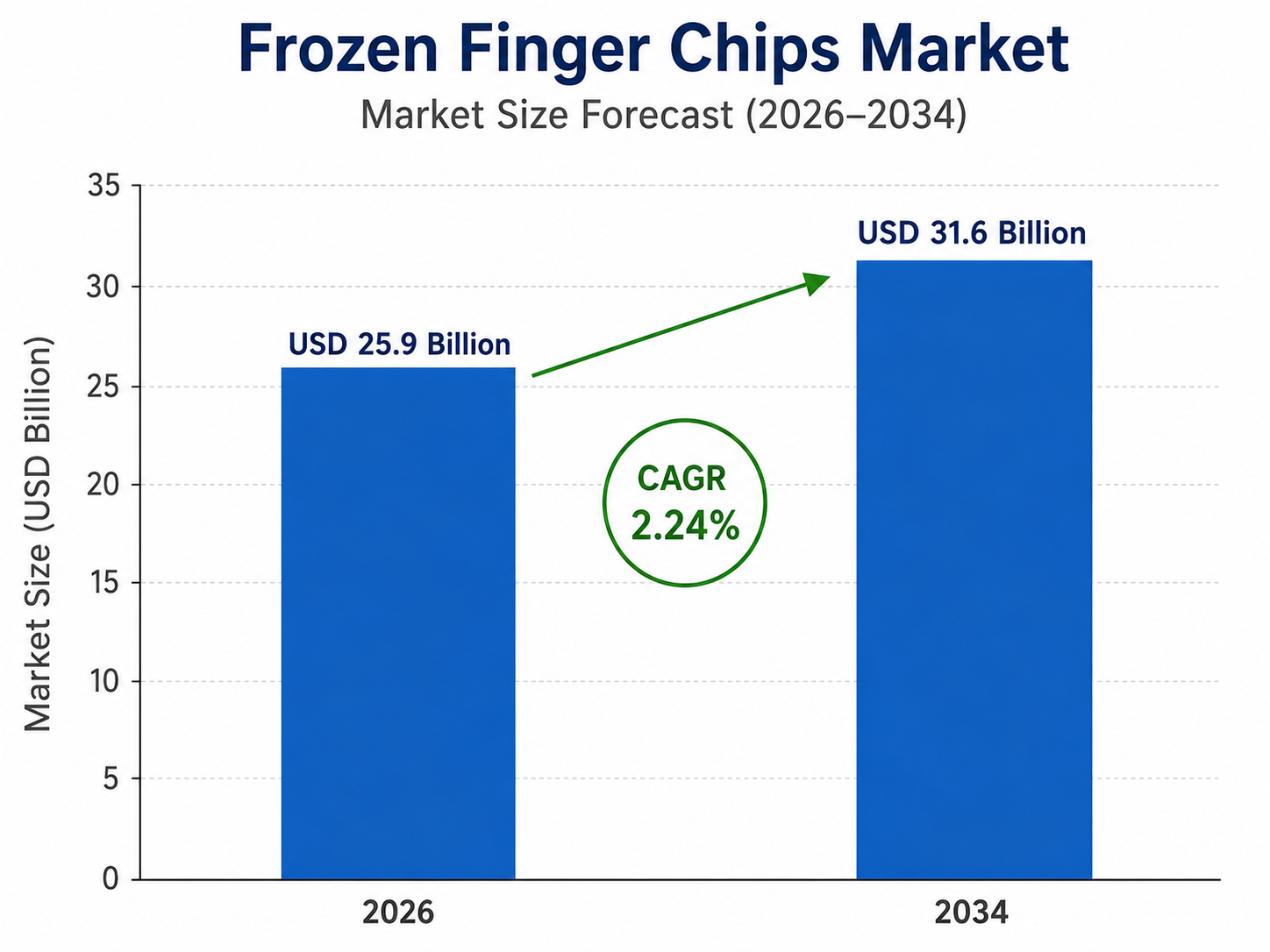
The Frozen Finger Chips Market is estimated to be valued at $ 25.9 billion in 2026 and is projected to reach $ 31.6 billion by 2034, expanding at a CAGR of 2.24% from 2026 to 2034.
Frozen finger chips, also known as frozen French fries, are ready-to-cook potato products supplied to quick-service restaurants, hotels, cafés, institutional kitchens, retail stores, online grocery platforms, and household consumers. Market growth is supported by rising demand for convenience foods, expansion of QSR chains, growth in frozen-food retailing, and increasing consumption of Western-style snacks and side dishes. Product innovation is focused on crispy coatings, flavored variants, air-fryer-ready formats, healthier oils, reduced sodium, premium potato cuts, and longer shelf-life packaging. Foodservice remains a major demand channel because restaurants require consistent taste, texture, portion control, and fast preparation.
1. What is the latest trend in the Frozen Finger Chips Market?
The latest trend is the launch of premium, extra-crispy, flavored, and air-fryer-friendly frozen finger chips.
Brands are introducing coated fries, skin-on fries, crinkle cuts, shoestring fries, wedges, and seasoned variants to attract retail and foodservice customers.
Demand is also rising for products with clean-label positioning, lower oil absorption, and consistent texture after baking or air frying.
E-commerce and quick-commerce platforms are making frozen fries more accessible to household consumers.
2. What are the key challenges in the Frozen Finger Chips Market?
Key challenges include potato price volatility, cold-chain dependency, energy costs, freight expenses, and quality consistency across batches.
Manufacturers must manage texture, color, moisture, frying performance, and shelf life from processing to final cooking.
Retail growth depends on freezer infrastructure, while foodservice growth depends on reliable bulk supply.
Health concerns related to fried foods, sodium, and calorie intake can also influence consumer perception.
3. What is the major driving factor for the Frozen Finger Chips Market?
The major driving factor is rising demand for ready-to-cook and convenience food products among urban households and foodservice operators.
Frozen finger chips reduce preparation time, minimize kitchen labor, and provide consistent taste and portion control.
Expansion of QSR chains, cafés, cloud kitchens, and casual dining outlets is strengthening bulk procurement.
Growing home snacking and party-food consumption further supports retail demand.
4. What is the major segment in the Frozen Finger Chips Market and why?
Foodservice represents a major end-use segment because restaurants, QSR chains, hotels, and cafés require large-volume, standardized frozen fries.
Operators prefer frozen finger chips because they offer consistent size, frying quality, storage convenience, and faster service.
Bulk packs and customized cuts are widely used for menus built around burgers, fried chicken, sandwiches, and snack platters.
Retail packs are growing steadily as consumers seek restaurant-style fries at home.
5. Which application or end-user is driving more demand?
Quick-service restaurants and foodservice outlets are driving significant demand due to high-volume usage of fries as side dishes and snacks.
Cloud kitchens, cafés, hotels, institutional canteens, and catering companies are also important buyers.
Retail consumers increasingly purchase frozen finger chips for home cooking, air frying, and quick meal preparation.
Demand is strongest where consumers seek convenient, affordable, and familiar snack-food options.
6. Which region offers the highest growth potential and why?
Asia Pacific offers strong growth potential due to urbanization, young consumer demographics, QSR expansion, and rising frozen-food adoption.
India, China, Southeast Asia, Japan, and South Korea are seeing increasing demand for Western-style snacks and convenience foods.
North America and Europe remain mature markets with strong frozen potato consumption and established cold-chain infrastructure.
Middle East markets are also growing through foodservice demand and fast-food penetration.
7. What strategies are major companies adopting in the market?
Major companies are expanding processing capacity, strengthening cold-chain distribution, and developing products tailored to QSR and retail channels.
They are launching seasoned, coated, air-fryer-ready, premium, and private-label variants to widen customer reach.
Partnerships with QSR chains, distributors, supermarkets, and online grocery platforms remain central to growth.
Companies are also investing in potato sourcing, sustainability, packaging efficiency, and consistent frying performance.
8. What are the leading companies in the Frozen Finger Chips Market?
Leading companies include McCain Foods, Lamb Weston, J.R. Simplot, Aviko, Farm Frites, Agristo, Agrarfrost, Cavendish Farms, Himalaya Food Company, Iscon Balaji Foods, Bart’s Potato Company, and regional frozen potato processors.
These companies compete through product quality, potato sourcing, processing scale, foodservice relationships, cold-chain reach, and retail brand strength.
Large global players benefit from established QSR partnerships and broad product portfolios.
Regional suppliers compete through localized pricing, faster delivery, private-label supply, and customized product formats.
9. Why are frozen finger chips strategically important for food companies?
Frozen finger chips are strategically important because they sit at the intersection of convenience foods, foodservice staples, and home snacking.
They generate repeat demand across restaurants, retail freezers, quick-commerce platforms, and institutional kitchens.
The category supports product extensions into flavored fries, premium cuts, healthier variants, and ready-to-cook meal accompaniments.
For manufacturers, it offers scale advantages through potato procurement, processing automation, and long-term foodservice contracts.
10. What is the future outlook for the Frozen Finger Chips Market?
The market outlook remains positive as frozen-food consumption, QSR expansion, and home convenience cooking continue to rise.
Future growth will be supported by air-fryer-compatible products, premium potato cuts, improved coatings, sustainable packaging, and stronger cold-chain networks.
Retail and online grocery channels are expected to increase household penetration, especially in emerging markets.
Companies offering consistent quality, reliable supply, product innovation, and strong foodservice-retail distribution are expected to gain market share.
Browse Related Reports
https://www.oganalysis.com/industry-reports/frozen-finger-chips-market
https://www.oganalysis.com/industry-reports/normal-and-specialty-fats-market
https://www.oganalysis.com/industry-reports/plantbased-butter-market
https://www.oganalysis.com/industry-reports/oilseeds-market
https://www.oganalysis.com/industry-reports/functional-oils--fats-market
