Gantry Industrial Robots Market Outlook 2026–2034: Smart Automation, Heavy-Payload Applications, Leading Companies, and Growth Opportunities
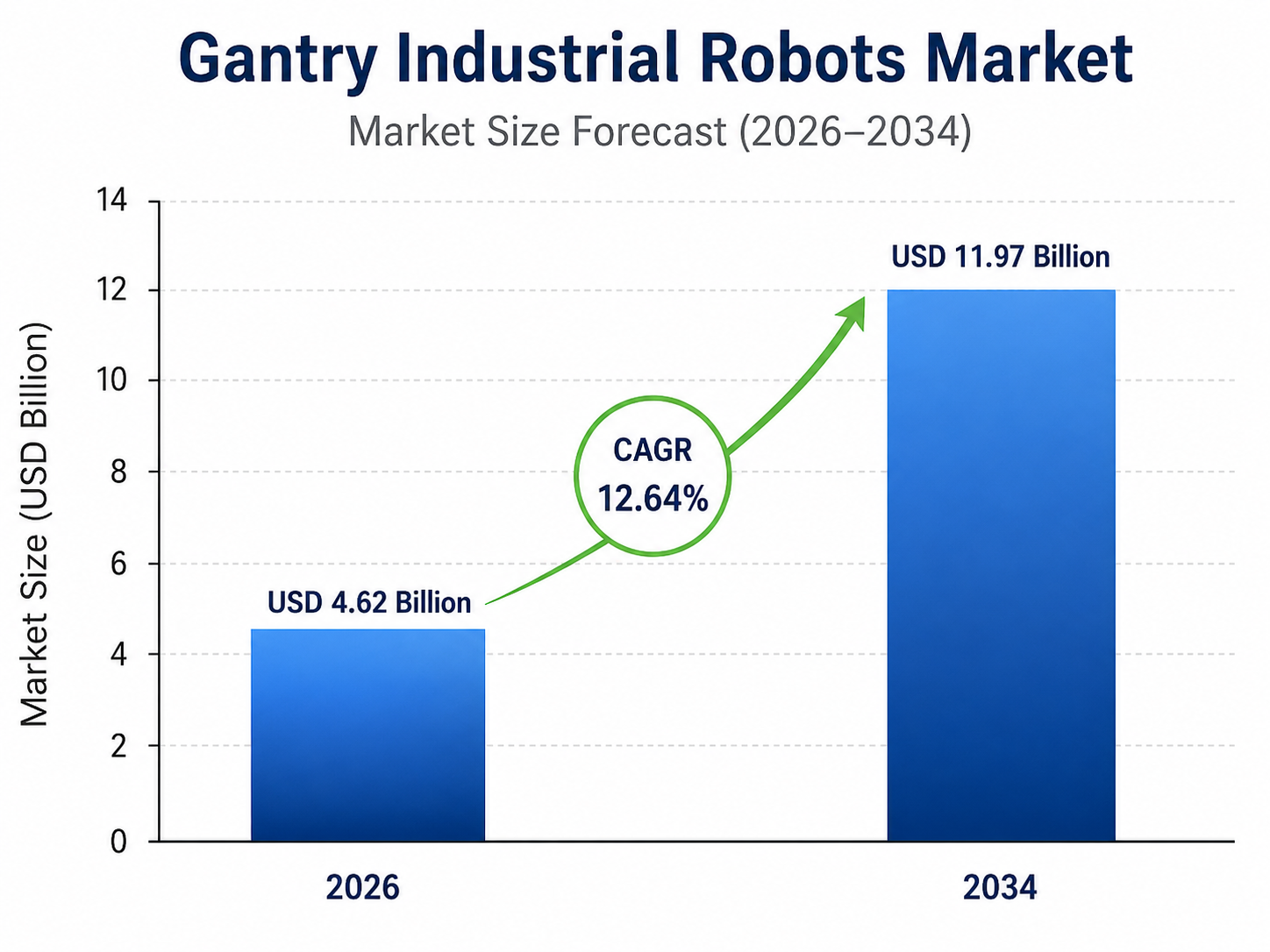
The Gantry Industrial Robots Market is estimated to be valued at $ 4.62 billion in 2026 and is projected to reach $ 11.97 billion by 2034, expanding at a CAGR of 12.64% from 2026 to 2034.
Gantry industrial robots, also known as Cartesian or linear robots, move along two or more perpendicular axes to perform precise handling, positioning, loading, assembly, dispensing, welding, inspection, and palletizing operations. These robots are widely deployed across automotive, aerospace, electronics, metals, plastics, food processing, pharmaceuticals, logistics, and battery manufacturing. Market growth is supported by factory automation, labor shortages, rising production volumes, and demand for accurate handling of large or heavy components. Manufacturers are increasingly offering modular axes, digital configuration tools, intelligent controls, machine vision, predictive maintenance, and application-specific end effectors to improve flexibility and reduce integration time.
1. What is the latest trend in the Gantry Industrial Robots Market?
The latest trend is the integration of machine vision, AI-based motion planning, digital twins, and intelligent control software into gantry systems.
Manufacturers are developing modular robots that can be configured rapidly for different payloads, reaches, speeds, and production layouts.
Battery handling, warehouse automation, and flexible manufacturing are emerging as important deployment areas.
Remote diagnostics and predictive maintenance are also improving system availability and lifecycle performance.
2. What are the key challenges in the Gantry Industrial Robots Market?
Key challenges include high initial investment, integration complexity, large installation footprints, and the need for customized structural engineering.
Long-span systems require accurate alignment, strong support structures, and coordinated motion across multiple axes.
Programming, maintenance, safety validation, and end-effector design can increase project cost and deployment time.
Small manufacturers may also struggle to justify automation where product volumes or production layouts change frequently.
3. What is the major driving factor for the Gantry Industrial Robots Market?
The major driving factor is increasing demand for high-speed, accurate, and repeatable material handling across automated production environments.
Gantry robots can move heavy or oversized components while preserving valuable floor space beneath the working envelope.
Labor shortages and pressure to improve throughput are accelerating investment in machine loading, palletizing, and parts transfer.
Industry 4.0 programs and smart-factory expansion provide additional market support.
4. What is the major segment in the Gantry Industrial Robots Market and why?
Three-axis gantry robots represent a major configuration segment because they provide coordinated movement across the X, Y, and Z axes.
This configuration supports complex pick-and-place, loading, dispensing, assembly, inspection, and palletizing operations.
Three-axis systems offer greater working-area coverage and flexibility than single- or two-axis designs.
Their modular architecture also enables adaptation to different production layouts and payload requirements.
5. Which application or end-user is driving more demand?
Material handling is driving strong demand through machine tending, palletizing, storage and retrieval, parts transfer, and production-line feeding.
Automotive manufacturers use gantry robots for engines, castings, body components, batteries, and other heavy parts.
Logistics, aerospace, metalworking, plastics, and electronics producers also represent important users.
Demand is strongest where high payload, long travel, repeatable positioning, and continuous operation are required.
6. Which region offers the highest growth potential and why?
Asia Pacific offers strong growth potential due to its large manufacturing base, expanding automation investment, and growing automotive and electronics production.
China, Japan, South Korea, India, and Southeast Asia are increasing adoption across factories, warehouses, and battery plants.
The region also benefits from established robot, motion-control, and machine-building supply chains.
Europe and North America remain important through advanced manufacturing, reshoring, and labor-saving automation.
7. What strategies are major companies adopting in the market?
Major companies are focusing on modular designs, higher payload capacity, longer travel ranges, faster motion, and simplified system configuration.
They are integrating controls, drives, linear axes, safety systems, software, and end effectors into ready-to-install packages.
Partnerships with system integrators and machine builders are helping suppliers address application-specific requirements.
Companies are also expanding local engineering, commissioning, training, and aftermarket service capabilities.
8. What are the leading companies in the Gantry Industrial Robots Market?
Leading companies include Güdel Group, Liebherr, ABB, KUKA, FANUC, Yamaha Motor, Parker Hannifin, Bosch Rexroth, Yaskawa Electric, IAI, Shibaura Machine, Omron, and Mitsubishi Electric.
These companies compete through payload range, positioning accuracy, speed, modularity, controls, and application-engineering support.
Specialized gantry suppliers benefit from expertise in long-travel and heavy-load systems.
Large automation groups compete through integrated robots, drives, software, safety, and service portfolios.
9. Why are gantry industrial robots strategically important for manufacturers?
Gantry robots improve productivity, repeatability, safety, and space utilization across high-volume manufacturing operations.
They can automate heavy, hazardous, or repetitive tasks while reducing manual handling and production variability.
Their overhead or machine-integrated configuration allows other operations to continue beneath the working area.
For manufacturers, these systems support capacity expansion, cost control, and more consistent product quality.
10. What is the future outlook for the Gantry Industrial Robots Market?
The market outlook remains positive as manufacturers adopt more flexible, connected, and digitally engineered automation systems.
Future demand will be supported by electric vehicle batteries, intralogistics, advanced machining, aerospace, and smart warehousing.
Gantry robots are expected to become easier to configure, program, monitor, and integrate with vision and AI platforms.
Companies offering scalable, application-ready, and service-supported systems are likely to gain market share.
Browse Related Reports
https://www.oganalysis.com/industry-reports/tractor-transmission-system-market
https://www.oganalysis.com/industry-reports/nonwoven-abrasives-market
https://www.oganalysis.com/industry-reports/printed-signage-market
https://www.oganalysis.com/industry-reports/industrial-fasteners-market
https://www.oganalysis.com/industry-reports/industrial-machinery-market-
