Gas Generators Market Outlook 2026–2034: Cleaner Backup Power Trends, Distributed Energy Demand, Growth Drivers, Leading Companies, and Future Opportunities
The Gas Generators Market is estimated to be valued at $ 7.5 billion in 2026 and is projected to reach $ 12.5 billion by 2034, expanding at a CAGR of 6.2% from 2026 to 2034.
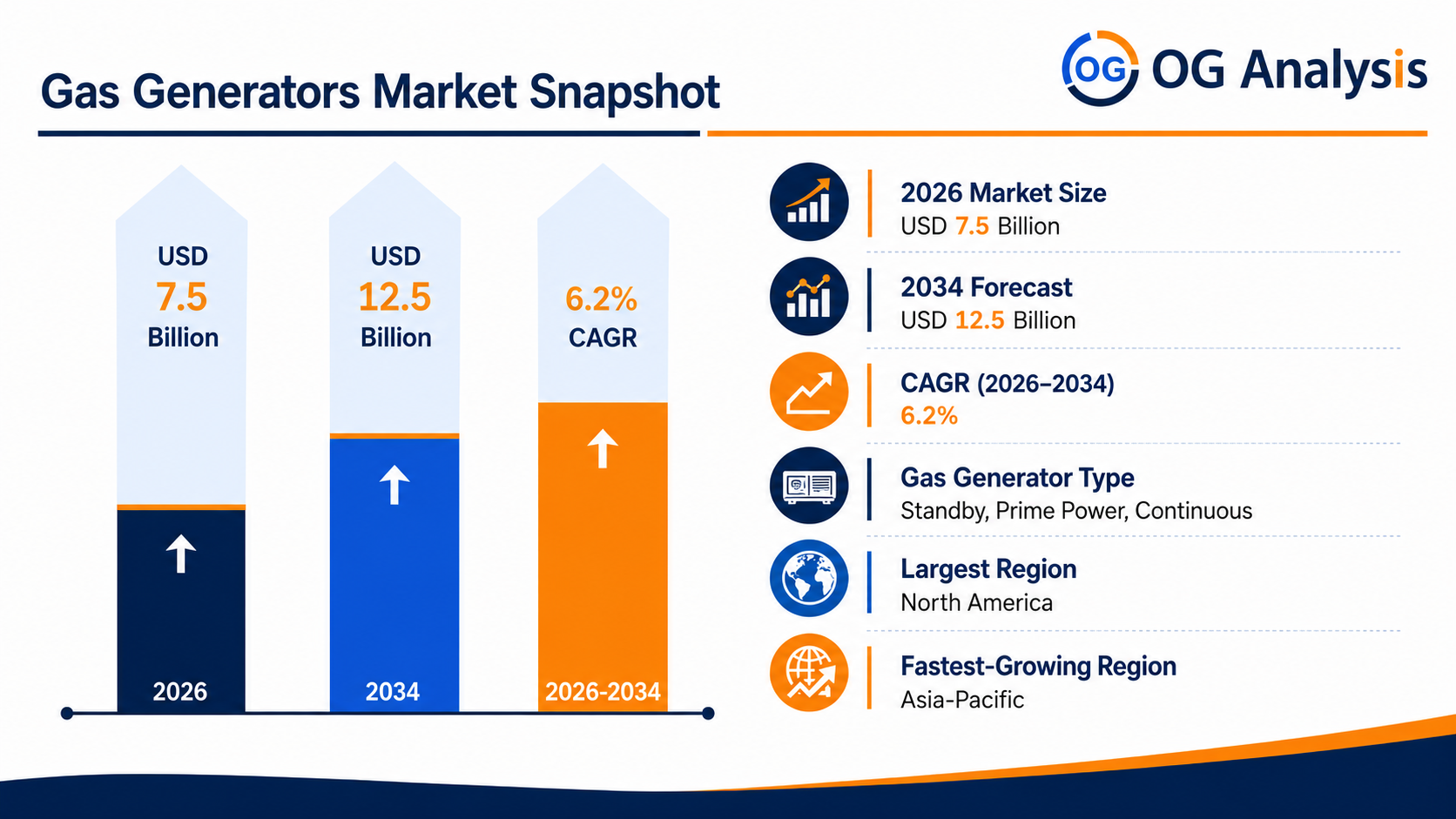
Gas generators are power-generation systems that use natural gas, biogas, LPG, propane, or other gaseous fuels to produce electricity for standby, prime, continuous, and peak-load applications. These generators are widely used across residential buildings, commercial complexes, hospitals, data centers, telecom towers, manufacturing plants, oil and gas facilities, utilities, and remote power applications. Market growth is supported by rising demand for reliable backup power, increasing grid instability, expansion of distributed energy systems, and preference for cleaner alternatives to diesel generators. Gas generators offer lower emissions, quieter operation, fuel availability through pipeline infrastructure, and suitability for combined heat and power applications. Demand is also increasing from data centers and industrial users that require resilient, scalable, and lower-emission on-site power solutions.
Get Your Free Sample Report for In-Depth Market Insights :
https://www.oganalysis.com/industry-reports/gas-generators-market
1. What is the latest trend in the Gas Generators Market?
The latest trend is the rising use of natural-gas generators for backup power, distributed generation, and data center power applications.
Users are shifting toward lower-emission generator systems with improved fuel efficiency, remote monitoring, and smart control panels.
Hybrid systems combining gas generators with batteries, solar, or grid-management platforms are gaining attention.
Biogas and renewable gas-compatible generators are also emerging as sustainability becomes a stronger purchasing factor.
2. What are the key challenges in the Gas Generators Market?
Key challenges include high initial installation cost, gas pipeline dependence, fuel-price volatility, permitting requirements, and emissions compliance.
Gas generators require proper site planning, ventilation, safety systems, fuel-pressure management, and skilled maintenance.
In remote areas without reliable gas infrastructure, diesel generators may remain more practical.
Customers also evaluate noise limits, load response, fuel availability, and total lifecycle cost before adoption.
3. What is the major driving factor for the Gas Generators Market?
The major driving factor is growing demand for reliable and cleaner backup power across residential, commercial, and industrial users.
Power outages, grid constraints, extreme weather events, and rising electricity dependence are increasing the need for standby generation.
Gas generators provide a lower-emission alternative to diesel systems in many applications.
Commercial buildings, hospitals, data centers, telecom networks, and factories are adopting gas generators to maintain operational continuity.
4. What is the major segment in the Gas Generators Market and why?
Natural gas generators represent a major segment because natural gas is widely available in many urban and industrial regions.
They offer lower particulate emissions, reduced fuel storage requirements, and lower operating noise compared with many diesel systems.
Standby power remains a major application because homes, offices, healthcare facilities, and commercial buildings need reliable outage protection.
High-capacity gas generators are also expanding as data centers and industrial users seek scalable on-site power solutions.
5. Which application or end-user is driving more demand?
Commercial and industrial users are driving strong demand, especially data centers, hospitals, manufacturing plants, telecom infrastructure, and utility facilities.
Residential demand is supported by home standby generators used during power outages and extreme weather events.
Industrial users require gas generators for prime power, backup power, combined heat and power, and emergency operations.
Data centers are becoming a high-growth demand area due to rising digital infrastructure and grid-connection challenges.
6. Which region offers the highest growth potential and why?
Asia Pacific offers strong growth potential due to rapid industrialization, urbanization, power reliability concerns, and expanding commercial infrastructure.
China, India, Southeast Asia, Japan, South Korea, and Australia are important markets for industrial, commercial, and backup power applications.
North America remains a key market due to residential standby demand, data center expansion, and natural gas infrastructure.
Europe is supported by distributed energy systems, industrial backup power, and demand for lower-emission generator technologies.
7. What strategies are major companies adopting in the market?
Major companies are focusing on fuel-efficient engines, lower-emission generator sets, remote monitoring, digital controls, and modular power systems.
They are expanding gas generator portfolios across residential, commercial, industrial, and high-capacity applications.
Manufacturers are also developing systems compatible with biogas, hydrogen blends, and combined heat and power applications.
Partnerships with energy service providers, data center operators, distributors, and EPC contractors are becoming important for market expansion.
8. What are the leading companies in the Gas Generators Market?
Leading companies include Caterpillar, Cummins, Generac, Kohler, Rolls-Royce Power Systems/mtu, INNIO Group, 2G Energy, Wärtsilä, Mitsubishi Heavy Industries, Siemens Energy, MAN Energy Solutions, Yanmar, Himoinsa, Atlas Copco, Baudouin, and John Deere Power Systems.
These companies compete through power range, fuel efficiency, reliability, emissions performance, service network, digital monitoring, and lifecycle cost.
Large generator manufacturers benefit from strong global distribution and after-sales service.
Specialized gas engine suppliers compete through high-efficiency systems, CHP capability, and application-specific solutions.
9. Why are gas generators strategically important for power reliability?
Gas generators are strategically important because they provide dependable on-site electricity when grid supply is unavailable or insufficient.
They help protect critical operations in hospitals, data centers, telecom networks, industrial plants, and commercial buildings.
Compared with many conventional diesel systems, gas generators can offer lower emissions and continuous fuel access where pipelines are available.
They also support distributed energy, microgrids, and combined heat and power strategies.
10. What is the future outlook for the Gas Generators Market?
The market outlook remains positive as power reliability, grid resilience, data center growth, and cleaner backup power demand continue to rise.
Future growth will be supported by natural gas generators, biogas-ready systems, hybrid power solutions, digital monitoring, and lower-emission engine technologies.
Demand will increase across residential standby power, commercial facilities, industrial users, utilities, and digital infrastructure.
Companies offering reliable equipment, flexible fuel capability, strong service support, and regulatory-compliant systems are expected to gain market share.
Browse Related Reports
https://www.oganalysis.com/industry-reports/switchgear-for-power-transmission-market
https://www.oganalysis.com/industry-reports/absorbent-glass-mat-agm-battery-market
https://www.oganalysis.com/industry-reports/industrial-burner-market
https://www.oganalysis.com/industry-reports/biomass-power-generation-market
https://www.oganalysis.com/industry-reports/uninterruptible-power-supply-ups-market
Stay Connected With Us
