Genetically Modified Crops Market Outlook 2026–2034: Biotech Seed Innovation, Stacked Trait Adoption, Growth Drivers, Leading Companies, and Future Opportunities
The Genetically Modified Crops Market is estimated to be valued at $ 23.4 billion in 2026 and is projected to reach $ 36.2 by 2034, expanding at a CAGR of 5.6% from 2026 to 2034.
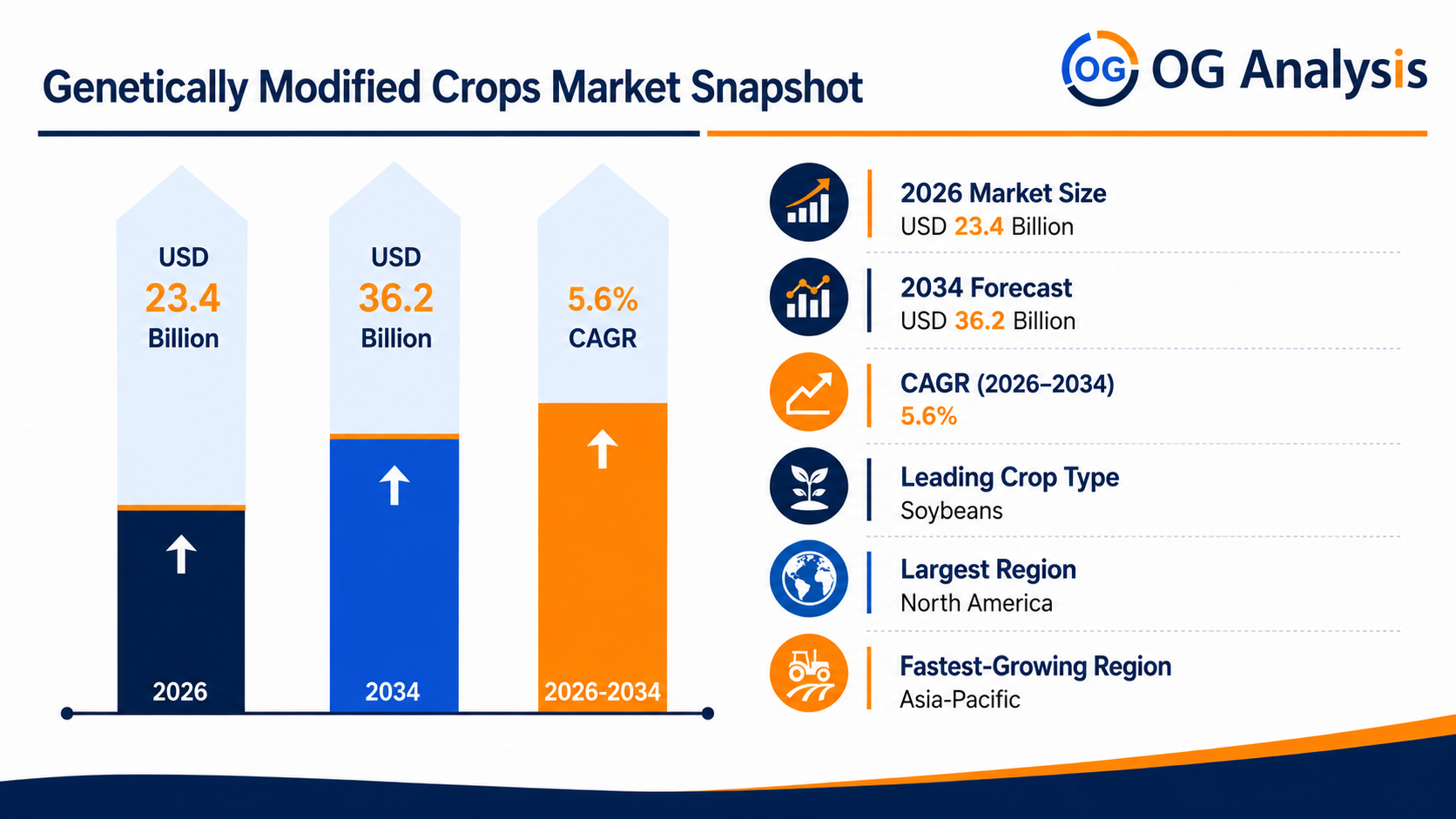
Genetically modified crops are developed using biotechnology to introduce traits such as herbicide tolerance, insect resistance, drought tolerance, disease resistance, improved yield, enhanced nutritional profile, and better crop quality. These crops are widely used across soybean, corn, cotton, canola, alfalfa, sugar beet, and other commercial crop categories.Market growth is supported by rising food demand, pressure to improve farm productivity, climate-related crop stress, pest resistance management, and the need to reduce crop losses. Farmers adopt GM crops to improve yield stability, simplify weed and pest control, reduce input intensity in selected applications, and increase profitability. The market is also influenced by regulatory approvals, biosafety policies, consumer acceptance, seed pricing, intellectual property control, and trade restrictions across importing and exporting countries.
Get Your Free Sample Report for In-Depth Market Insights :
https://www.oganalysis.com/industry-reports/genetically-modified-crops-market
1. What is the latest trend in the Genetically Modified Crops Market?
The latest trend is the expansion of stacked-trait crops that combine herbicide tolerance, insect resistance, and stress-tolerance characteristics.
Seed companies are focusing on traits that improve yield protection, pest control, weed management, and climate resilience.
Gene editing and next-generation biotechnology are also influencing product pipelines, although regulatory treatment varies by country.
Demand is increasing for crop varieties that support higher productivity with better resource efficiency.
2. What are the key challenges in the Genetically Modified Crops Market?
Key challenges include regulatory delays, consumer resistance, biosafety concerns, export-market restrictions, and labeling requirements.
Farmers also face issues such as seed cost, trait licensing fees, herbicide resistance, and dependence on selected technology providers.
Environmental concerns around biodiversity, cross-pollination, and resistance management remain important discussion points.
Market growth depends heavily on transparent regulation, stewardship practices, and acceptance by food processors and consumers.
3. What is the major driving factor for the Genetically Modified Crops Market?
The major driving factor is the need to improve agricultural productivity while managing pests, weeds, diseases, and climate stress.
Growing population, rising food consumption, and limited arable land are increasing pressure on farmers to produce more from existing farmland.
GM crops help reduce yield losses caused by insects and weed competition in several large-scale farming systems.
This makes biotechnology an important tool for commercial agriculture, especially in high-acreage crops.
4. What is the major segment in the Genetically Modified Crops Market and why?
Soybean and corn represent major crop segments because they are widely cultivated, heavily traded, and strongly linked to animal feed, food processing, biofuels, and industrial uses.
Herbicide-tolerant and insect-resistant traits are highly adopted in these crops due to their commercial value and farm-level productivity benefits.
Cotton is also an important segment because insect-resistant varieties support pest management and fiber yield protection.
Stacked-trait seeds are gaining importance because they offer multiple agronomic benefits in a single crop variety.
5. Which application or end-user is driving more demand?
Commercial farming is the largest demand driver, especially across soybean, corn, cotton, and canola production.
Large-scale growers adopt GM crops to improve operational efficiency, reduce crop losses, and simplify weed and pest control programs.
Animal feed, food processing, textile, biofuel, and oilseed industries indirectly support demand through crop output requirements.
Demand is strongest where farmers face high pest pressure, labor constraints, and the need for consistent yields.
6. Which region offers the highest growth potential and why?
Asia Pacific offers strong long-term growth potential due to rising food demand, large farming populations, and increasing interest in crop productivity improvement.
China, India, Southeast Asia, and Australia are important markets due to their agricultural scale and biotechnology research activity.
North America remains a leading mature market due to high adoption of biotech corn, soybean, cotton, and canola.
Latin America is also significant, supported by large-scale soybean and corn cultivation in Brazil and Argentina.
7. What strategies are major companies adopting in the market?
Major companies are investing in stacked traits, gene editing, climate-resilient seeds, digital farming support, and regional regulatory approvals.
They are expanding seed portfolios to address pest resistance, herbicide tolerance, drought stress, and yield optimization.
Partnerships with research institutions, seed distributors, and agri-input companies are helping improve market reach.
Companies are also focusing on stewardship programs to manage resistance and support responsible use of biotechnology.
8. What are the leading companies in the Genetically Modified Crops Market?
Leading companies include Bayer CropScience, Corteva Agriscience, Syngenta Group, BASF, KWS SAAT, Groupe Limagrain, Nufarm, UPL, DLF, Longping High-Tech, and Dabeinong.
These companies compete through seed genetics, trait platforms, regulatory approvals, farmer networks, R&D capabilities, and crop-specific portfolios.
Large multinational players benefit from strong biotechnology pipelines and global distribution.
Regional companies compete through local crop adaptation, pricing, and farmer relationships.
9. Why are genetically modified crops strategically important for agriculture?
Genetically modified crops are strategically important because they help improve crop protection, yield stability, and farming efficiency.
They support large-scale food, feed, fiber, and biofuel supply chains by reducing selected pest and weed-related production risks.
For farmers, GM crops can reduce operational complexity and improve field-level productivity when used with proper stewardship.
For governments, biotech crops are increasingly considered in discussions around food security, climate adaptation, and agricultural competitiveness.
10. What is the future outlook for the Genetically Modified Crops Market?
The market outlook remains positive, but growth will depend on regulatory acceptance, consumer trust, trade policies, and responsible technology use.
Future demand will be supported by stacked traits, climate-resilient crops, improved seed genetics, and biotechnology-enabled yield protection.
Gene editing may create new opportunities in crops beyond traditional GM soybean, corn, cotton, and canola.
Companies with strong R&D, regulatory expertise, farmer support, and region-specific crop portfolios are expected to gain market share.
Browse Related Reports
https://www.oganalysis.com/industry-reports/sowing-and-planting-equipment-market
https://www.oganalysis.com/industry-reports/biofertilizers-market
https://www.oganalysis.com/industry-reports/plant-growth-regulators-market
https://www.oganalysis.com/industry-reports/biological-seed-treatment-market
https://www.oganalysis.com/industry-reports/agricultural-biologicals-market
Stay Connected With Us
