Healthcare Education Market Outlook 2026–2034: Digital Learning Transformation, Medical Simulation Growth, Leading Companies, and Future Opportunities
The Healthcare Education Market is estimated to be $146.2 billion in 2026 and is expected to grow to $323.5 billion by 2034, registering a CAGR of 9.23%.
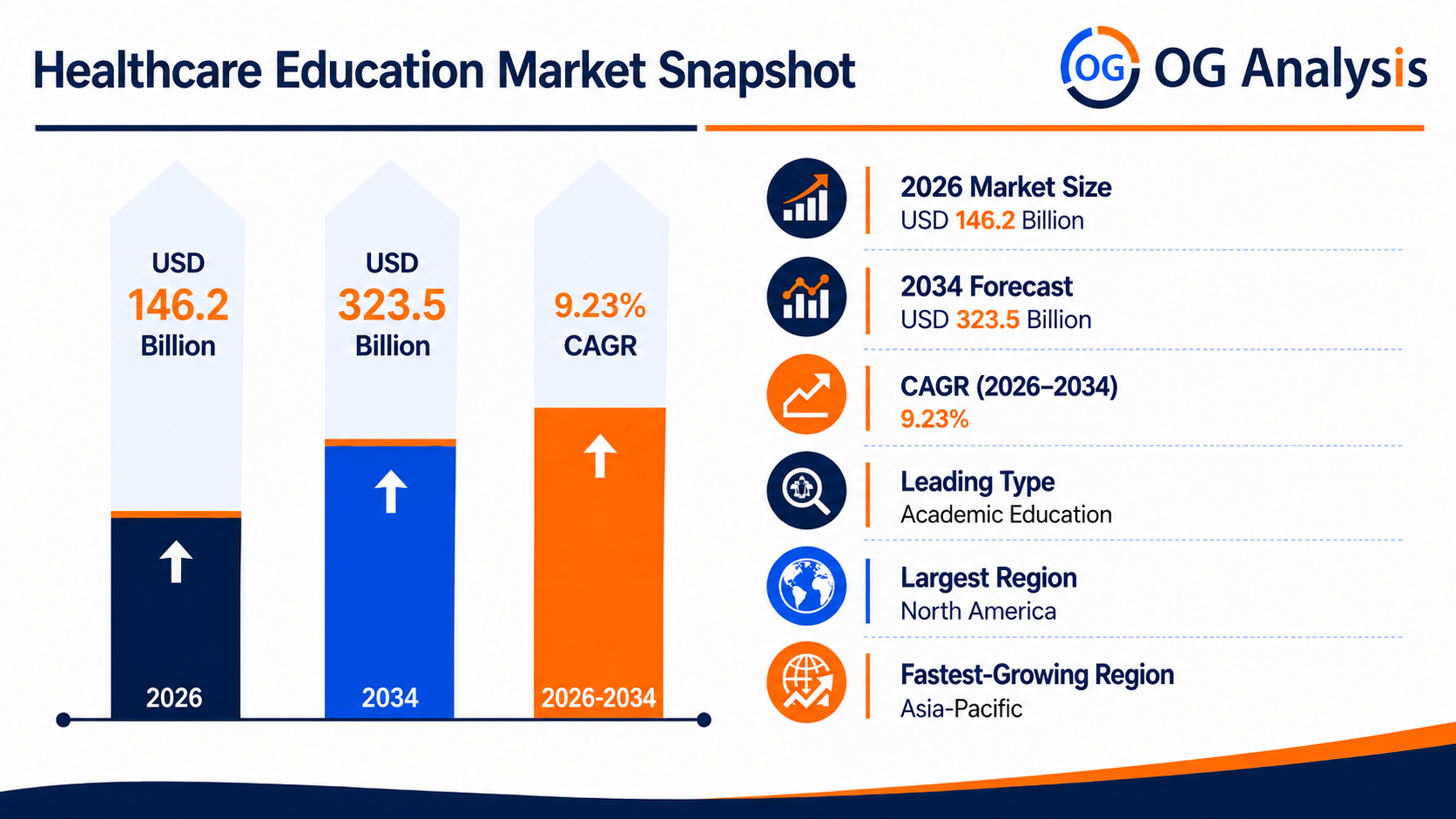
Healthcare education includes academic medical education, nursing education, continuing medical education, clinical skills training, medical simulation, digital learning platforms, learning management systems, certification programs, hospital-based training, and professional upskilling for physicians, nurses, technicians, pharmacists, administrators, and allied health professionals. The market is expanding due to rising demand for trained healthcare workers, rapid medical technology adoption, digital learning, regulatory training requirements, clinical specialization, and the need for continuous skill development across hospitals, universities, diagnostic centers, medtech companies, and pharmaceutical organizations.
Get Your Free Sample Report for In-Depth Market Insights :
https://www.oganalysis.com/industry-reports/healthcare-education-market/free-sample
1. What is the latest trend in the Healthcare Education Market?
The latest trend is the rapid adoption of digital learning, AI-enabled training, simulation-based education, and hybrid medical education models.
Healthcare institutions are using online platforms, virtual classrooms, digital anatomy tools, VR simulation, and learning management systems to improve training access.
AI-based learning tools are also being explored for clinical case practice, feedback, assessment, and personalized learning pathways.
Simulation-based learning is gaining importance because it allows healthcare professionals to practice clinical procedures in controlled environments.
2. What are the key challenges in the Healthcare Education Market?
Key challenges include high training costs, shortage of qualified instructors, unequal access to digital tools, curriculum standardization, and accreditation complexity.
Medical and clinical education requires frequent updates because diagnostics, devices, therapies, regulations, and care protocols continue to evolve.
Simulation labs, VR platforms, and advanced training technologies can require significant capital investment.
Data privacy, content quality, regulatory compliance, and learner assessment reliability are also important concerns.
3. What is the major driving factor for the Healthcare Education Market?
The major driving factor is the growing need for skilled healthcare professionals and continuous clinical upskilling.
Hospitals, universities, medical device companies, and healthcare systems require trained personnel to manage advanced procedures, digital health tools, and complex patient care.
Rising demand for nurses, physicians, technicians, and allied health workers is strengthening education and training investments.
Preventive care, chronic disease management, and specialty care expansion are also increasing demand for professional training.
4. What is the major segment in the Healthcare Education Market and why?
Universities and academic institutions represent a major segment because they provide foundational medical, nursing, pharmacy, dental, and allied health education.
These institutions support degree programs, clinical rotations, research training, certification pathways, and professional development.
Continuing medical education and professional training platforms are also expanding as healthcare workers need regular skill updates.
Medical simulation providers form a high-growth segment due to demand for procedure training, patient safety, and competency-based learning.
5. Which application or end-user is driving more demand?
Students, trainees, physicians, nurses, surgeons, technicians, pharmacists, and non-physician healthcare professionals are driving demand.
Hospitals and healthcare organizations are investing in staff training to improve clinical quality, patient safety, compliance, and operational efficiency.
Medical universities and academic centers continue to support large-scale demand for structured education programs.
Pharmaceutical and medical device companies also use healthcare education platforms for product training and clinical education.
6. Which region offers the highest growth potential and why?
North America remains a leading market due to advanced healthcare infrastructure, strong academic institutions, continuing education requirements, and high adoption of digital learning tools.
The region benefits from established medical schools, hospital networks, training centers, simulation labs, and professional certification systems.
Asia Pacific offers strong growth potential due to expanding healthcare infrastructure, rising medical student enrollment, digital education adoption, and growing demand for trained healthcare workers.
Europe also maintains steady growth through university-led medical education, public healthcare training systems, and professional development programs.
7. What strategies are major companies adopting in the market?
Major companies are focusing on digital platforms, simulation-based training, AI-enabled learning tools, certification content, and specialty-specific education programs.
Education providers are expanding online modules, mobile learning, virtual labs, and blended learning formats to reach more learners.
Medical technology companies are developing procedure-based training for imaging, surgery, diagnostics, robotics, and device operation.
Strategic partnerships between hospitals, universities, edtech platforms, medtech companies, and professional associations are becoming increasingly important.
8. What are the leading companies in the Healthcare Education Market?
Leading companies include Siemens Healthineers, GE HealthCare, Elsevier, Wolters Kluwer, HealthStream, Coursera, Udemy, Laerdal Medical, CAE Healthcare, 3D Systems, Philips Healthcare, Medtronic, Johnson & Johnson, Intuitive Surgical, Osso VR, SimX, and Adtalem Global Education.
These companies compete through clinical content, digital platforms, simulation systems, medical device training, certification programs, and healthcare workforce development solutions.
Medical simulation and VR companies are strengthening procedural and skills-based training.
Large healthcare technology and publishing companies are expanding education through digital libraries, clinical decision tools, and professional learning platforms.
9. Why is healthcare education strategically important?
Healthcare education is strategically important because it directly supports clinical quality, patient safety, workforce readiness, and healthcare system efficiency.
Well-trained professionals are essential for accurate diagnosis, safe procedures, effective treatment, infection control, and regulatory compliance.
For hospitals and healthcare providers, continuous education helps reduce errors, improve outcomes, and support new technology adoption.
For medtech and pharmaceutical companies, education improves product understanding, physician engagement, and clinical adoption.
10. What is the future outlook for the Healthcare Education Market?
The market outlook remains strong as healthcare systems invest in workforce development, digital education, and clinical skill modernization.
Future growth will be supported by AI-enabled learning, simulation labs, VR training, remote education, specialty certifications, and continuing professional development.
Demand will continue to rise from hospitals, universities, medical device companies, pharmaceutical firms, and healthcare professionals seeking upskilling.
Companies offering scalable, accredited, interactive, and outcome-focused education solutions are expected to gain market share.
Browse Related Reports
https://www.oganalysis.com/industry-reports/operator-training-simulator-market
https://www.oganalysis.com/industry-reports/clinical-trial-management-system-market
https://www.oganalysis.com/industry-reports/vendor-neutral-archive-vna--pacs-market
https://www.oganalysis.com/industry-reports/hospital-information-system-market
https://www.oganalysis.com/industry-reports/healthcare-supply-chain-management-market
Stay Connected With Us
