Industrial Gearbox Market Outlook 2026–2034: Smart Monitoring, Automation Demand, Leading Companies, and Growth Opportunities
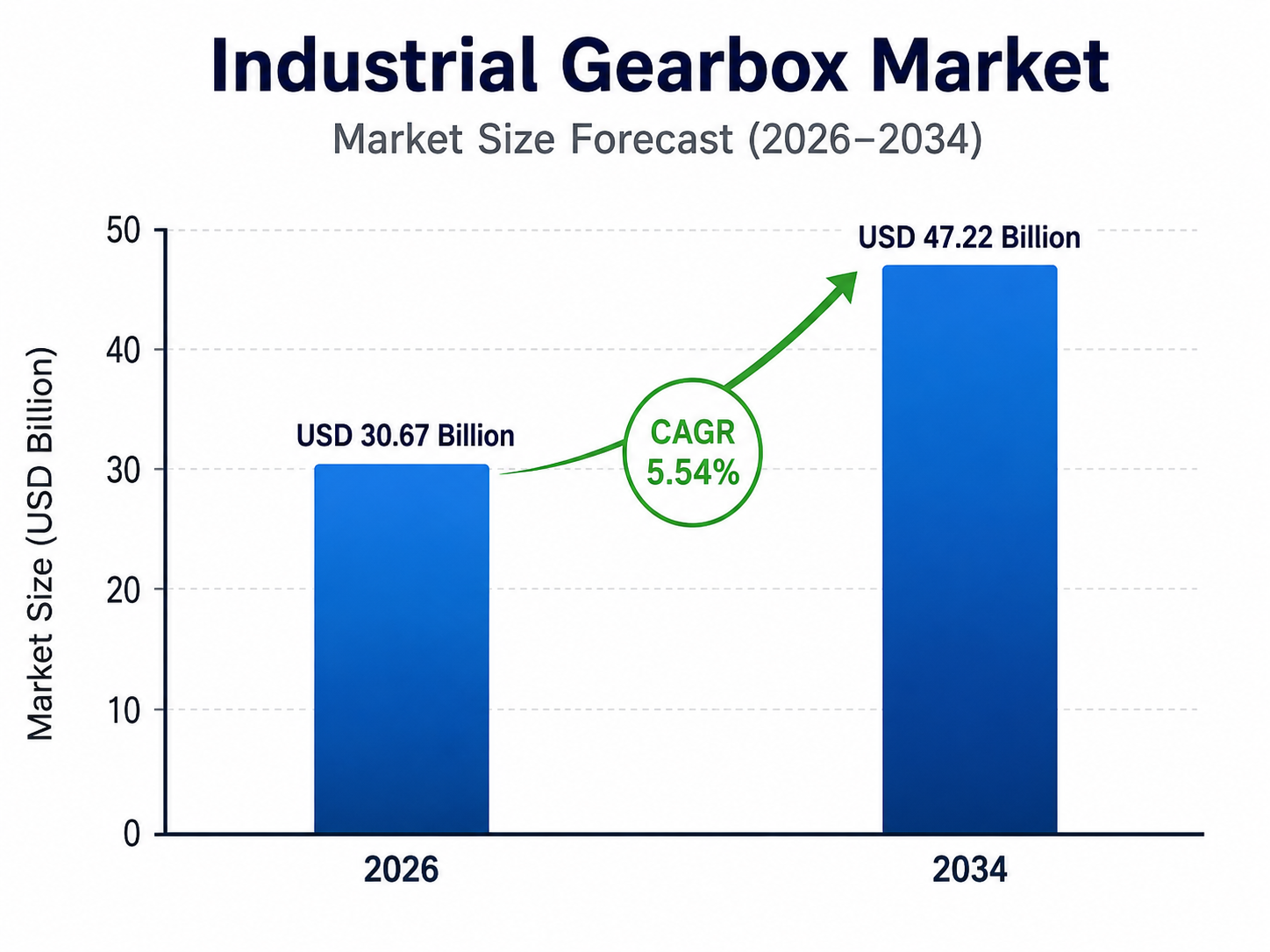
The Industrial Gearbox Market is estimated to be valued at $ 30.67 billion in 2026 and is projected to reach $ 47.22 billion by 2034, expanding at a CAGR of 5.54% from 2026 to 2034.
Industrial gearboxes are mechanical power-transmission systems that modify motor speed, torque, rotational direction, and load characteristics across industrial equipment. Major product categories include helical, planetary, bevel, worm, spur, and shaft-mounted gearboxes. These systems are used in conveyors, crushers, mixers, pumps, compressors, turbines, mills, material-handling equipment, and automated production lines. Market growth is supported by industrial automation, manufacturing capacity expansion, mining activity, infrastructure development, renewable energy, and demand for energy-efficient transmission systems. Manufacturers are increasingly integrating condition-monitoring sensors, predictive-maintenance software, advanced lubrication, modular components, and high-efficiency gear designs.
1. What is the latest trend in the Industrial Gearbox Market?
The latest trend is the integration of vibration sensors, temperature monitoring, connected controls, and predictive-maintenance analytics into industrial gearboxes.
Operators are using real-time data to identify wear, lubrication problems, misalignment, and bearing damage before equipment failure occurs.
Digital twins and remote diagnostics are also gaining adoption in critical production environments.
These technologies help reduce unplanned downtime and improve gearbox lifecycle management.
2. What are the key challenges in the Industrial Gearbox Market?
Key challenges include high maintenance costs, lubrication failure, gear wear, vibration, overheating, and unexpected equipment downtime.
Gearboxes used in mining, cement, metals, and wind power operate under heavy loads and demanding environmental conditions.
Fluctuating steel and alloy prices can increase manufacturing costs and place pressure on supplier margins.
Long lead times for customized gearboxes and replacement components can also disrupt industrial operations.
3. What is the major driving factor for the Industrial Gearbox Market?
The major driving factor is increasing demand for efficient and reliable power transmission across automated industrial operations.
Manufacturers require gearboxes to control speed and torque while operating conveyors, mixers, crushers, pumps, and production machinery.
Industrial automation and factory modernization are increasing the installed base of motor-driven equipment.
Expansion in mining, infrastructure, renewable energy, and material handling provides additional market support.
4. What is the major segment in the Industrial Gearbox Market and why?
Helical gearboxes represent a major product segment because they provide high efficiency, smooth operation, strong load capacity, and relatively low noise.
Their angled teeth create gradual engagement, reducing vibration and improving power-transmission performance.
Helical systems are widely used in conveyors, elevators, mixers, crushers, and general manufacturing machinery.
Their versatility across parallel-shaft and right-angle configurations supports broad industrial adoption.
5. Which application or end-user is driving more demand?
Manufacturing and material-handling industries are driving strong demand through conveyors, assembly lines, packaging equipment, mixers, and automated machinery.
Mining, metals, cement, chemicals, and power generation also require heavy-duty gearboxes for continuous high-load operations.
Wind-energy installations create specialized demand for high-torque turbine gearboxes and maintenance services.
Demand is strongest where equipment reliability and uninterrupted production are operational priorities.
6. Which region offers the highest growth potential and why?
Asia Pacific offers strong growth potential due to rapid industrialization, manufacturing expansion, infrastructure development, and renewable-energy investment.
China, India, Japan, South Korea, and Southeast Asia operate extensive machinery, automotive, mining, metals, and material-handling industries.
The region also benefits from an established base of motors, gearboxes, bearings, and industrial-equipment manufacturers.
North America and Europe remain important through automation, equipment replacement, and energy-efficiency upgrades.
7. What strategies are major companies adopting in the market?
Major companies are focusing on high-efficiency gear designs, modular platforms, intelligent monitoring, and application-specific engineering.
They are combining gearboxes with motors, drives, couplings, sensors, and control software to offer integrated power-transmission solutions.
Localization of manufacturing, spare-parts inventories, and service centers is helping reduce customer lead times.
Acquisitions and partnerships are also strengthening renewable-energy, automation, and aftermarket capabilities.
8. What are the leading companies in the Industrial Gearbox Market?
Leading companies include Flender, SEW-Eurodrive, Bonfiglioli, Sumitomo Drive Technologies, NORD Drivesystems, Regal Rexnord, Dana Brevini, David Brown Santasalo, Elecon Engineering, Rossi, ABB, and ZF Wind Power.
These companies compete through torque range, efficiency, durability, customization, digital monitoring, and service coverage.
Large manufacturers benefit from integrated motors, drives, gearboxes, and lifecycle-service portfolios.
Specialized suppliers compete through heavy-duty, wind-energy, mining, and application-specific gearbox expertise.
9. Why are industrial gearboxes strategically important for manufacturers?
Industrial gearboxes enable equipment to operate at the correct speed and torque while protecting motors and driven machinery from excessive loads.
Their reliability directly affects production availability, energy consumption, maintenance expense, and product quality.
Efficient gearbox systems can lower power losses and improve overall equipment performance.
For plant operators, gearbox selection is therefore central to productivity and lifecycle-cost management.
10. What is the future outlook for the Industrial Gearbox Market?
The market outlook remains positive as manufacturers invest in automation, renewable energy, infrastructure, and more efficient industrial equipment.
Future gearboxes will increasingly include embedded sensors, intelligent lubrication, digital twins, and predictive-maintenance capabilities.
Demand for compact, high-torque, low-noise, and energy-efficient products is expected to strengthen.
Companies offering reliable products, rapid aftermarket support, and digitally enabled services are likely to gain market share.
Browse Related Reports
https://www.oganalysis.com/industry-reports/process-safety-services-market
https://www.oganalysis.com/industry-reports/trailer-sprayer-market
https://www.oganalysis.com/industry-reports/immersion-wash-system-market
https://www.oganalysis.com/industry-reports/heavy-construction-equipment-market
https://www.oganalysis.com/industry-reports/elevators-and-escalators-market
