Internet of Medical Things (IoMT) Market Outlook 2026–2034: Remote Patient Monitoring, Connected Healthcare Devices, Growth Drivers, Leading Companies, and Future Opportunities
The Internet of Medical Things (IoMT) Market is estimated to be valued at $ 99.1 billion in 2026 and is projected to reach $ 425.4 billion by 2034, expanding at a CAGR of 19.98% from 2026 to 2034.
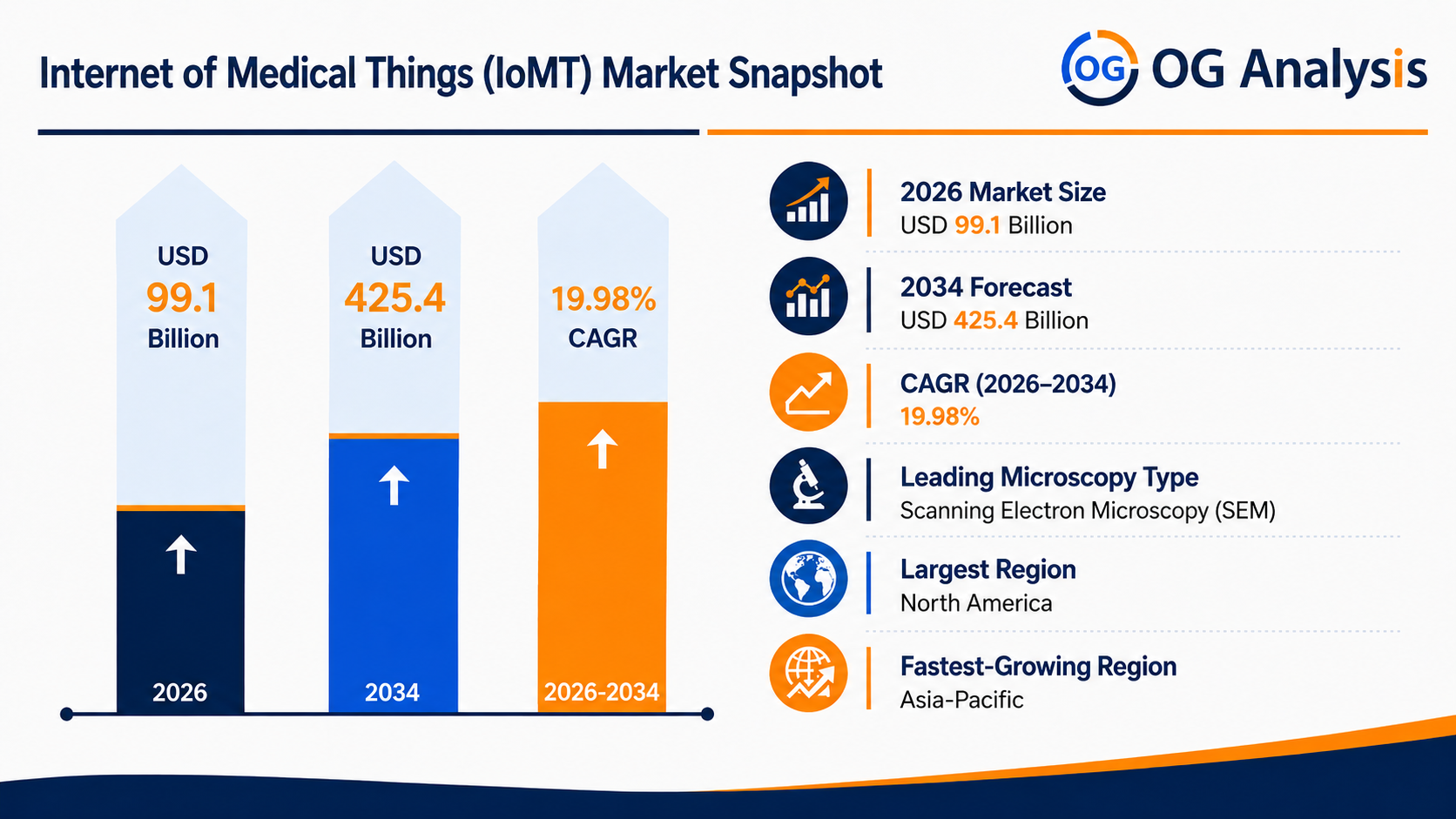
The Internet of Medical Things refers to connected medical devices, software platforms, sensors, wearables, and healthcare applications that collect, transmit, analyze, and share medical data across healthcare IT systems. These solutions are used in remote patient monitoring, chronic disease management, hospital asset tracking, smart diagnostics, medication adherence, telehealth, emergency care, and connected clinical workflows. Market growth is supported by rising chronic disease prevalence, aging populations, demand for home healthcare, expansion of telemedicine, hospital digitalization, and the need for real-time patient data. IoMT enables healthcare providers to monitor vital signs, detect health risks earlier, improve treatment adherence, reduce unnecessary hospital visits, and support value-based care. Adoption is increasing across hospitals, clinics, homecare providers, patients, insurers, and connected medical device manufacturers, while cybersecurity, data privacy, interoperability, and regulatory compliance remain critical success factors.
Get Your Free Sample Report for In-Depth Market Insights :
https://www.oganalysis.com/industry-reports/internet-of-medical-things-iomt-market
1. What is the latest trend in the Internet of Medical Things (IoMT) Market?
The latest trend is the rapid adoption of connected wearables, remote patient monitoring platforms, smart hospital systems, and AI-enabled clinical analytics.
Healthcare providers are using IoMT devices to capture real-time patient data and support early intervention for chronic and high-risk patients.
Remote monitoring, telehealth integration, and virtual care models are expanding the role of IoMT beyond hospitals into homecare settings.
Cybersecurity and secure medical data transmission are becoming major priorities as connected device networks expand.
2. What are the key challenges in the Internet of Medical Things (IoMT) Market?
Key challenges include cybersecurity risk, patient data privacy, interoperability issues, device reliability, regulatory compliance, and integration with hospital IT systems.
Connected medical devices must exchange data securely with EHR, cloud, mobile, and clinical decision-support platforms.
Hospitals also need to manage device authentication, software updates, network security, and data accuracy.
Adoption can be slowed by high implementation cost, workflow disruption, reimbursement uncertainty, and lack of standardization.
3. What is the major driving factor for the Internet of Medical Things (IoMT) Market?
The major driving factor is the growing need for continuous, real-time, and remote patient monitoring.
IoMT enables providers to track vital signs, chronic conditions, medication adherence, and patient recovery outside traditional care settings.
This helps improve care coordination, reduce hospital readmissions, and support faster clinical decision-making.
Demand is especially strong in chronic disease management, elderly care, post-acute care, and connected hospital environments.
4. What is the major segment in the Internet of Medical Things (IoMT) Market and why?
Wearable medical devices are a major segment because they support continuous monitoring of heart rate, glucose levels, ECG, oxygen saturation, blood pressure, sleep, and activity.
These devices are widely used by patients, healthcare providers, fitness users, and chronic disease management programs.
Stationary connected devices are also important in hospitals and clinics for patient monitoring, diagnostics, imaging, and smart care delivery.
Implantable devices are gaining importance as connected pacemakers, glucose monitors, neurostimulators, and drug-delivery systems become more advanced.
5. Which application or end-user is driving more demand?
Remote patient monitoring, chronic disease management, connected hospitals, telehealth, emergency care, and home healthcare are driving strong demand.
Healthcare providers use IoMT to improve patient visibility, monitor treatment response, and manage clinical workflows more efficiently.
Patients benefit from home-based monitoring, alerts, connected apps, and more personalized care engagement.
Hospitals and clinics remain major users, while homecare and virtual care providers are becoming faster-growing demand areas.
6. Which region offers the highest growth potential and why?
North America remains a leading market due to advanced healthcare IT infrastructure, strong digital health adoption, chronic disease burden, and connected device usage.
Asia Pacific offers strong growth potential due to rising healthcare investment, large patient populations, telehealth adoption, and expanding smartphone and internet access.
Europe is supported by digital health strategies, aging populations, connected care models, and remote monitoring adoption.
Growth in emerging markets is supported by healthcare access needs, mobile health platforms, and government digital-health initiatives.
7. What strategies are major companies adopting in the market?
Major companies are focusing on connected medical devices, cloud-based monitoring platforms, AI analytics, cybersecurity, interoperability, and remote-care ecosystems.
They are integrating IoMT solutions with electronic health records, telehealth platforms, mobile apps, and hospital information systems.
Partnerships with hospitals, payers, technology providers, and cloud companies are becoming central to market expansion.
Companies are also investing in FDA-compliant devices, secure data platforms, predictive analytics, and patient-friendly wearable designs.
8. What are the leading companies in the Internet of Medical Things (IoMT) Market?
Leading companies include Medtronic, GE HealthCare, Philips, Siemens Healthineers, Johnson & Johnson, Abbott, Boston Scientific, Dexcom, ResMed, Masimo, Baxter, B. Braun, Omron Healthcare, BioTelemetry, AliveCor, iRhythm Technologies, and Honeywell Life Sciences.
These companies compete through connected device portfolios, clinical reliability, data platforms, monitoring accuracy, regulatory approvals, cybersecurity, and hospital relationships.
Major market coverage identifies GE HealthCare, Medtronic, Johnson & Johnson, Philips, and Siemens Healthineers among key IoMT participants.
Specialized digital health and remote monitoring companies compete through software, patient engagement, analytics, and disease-specific monitoring programs.
9. Why is IoMT strategically important for healthcare systems?
IoMT is strategically important because it connects patients, devices, clinicians, and data into a more responsive healthcare ecosystem.
It supports early detection, remote monitoring, chronic disease management, hospital efficiency, and personalized care delivery.
For healthcare providers, IoMT can reduce manual monitoring burden and improve visibility into patient status.
For patients, it improves convenience, continuity of care, and access to medical support outside hospitals.
10. What is the future outlook for the Internet of Medical Things (IoMT) Market?
The market outlook remains positive as healthcare delivery shifts toward connected, preventive, remote, and data-driven care models.
Future growth will be supported by wearable medical devices, AI-enabled monitoring, smart hospitals, connected diagnostics, digital therapeutics, and home healthcare platforms.
Cybersecurity, interoperability, data governance, and regulatory compliance will become increasingly important as device networks expand.
Companies offering secure, clinically reliable, easy-to-integrate, and patient-centered IoMT solutions are expected to gain market share.
Browse Related Reports
https://www.oganalysis.com/industry-reports/artificial-intelligence-ai-in-cybersecurity-market
https://www.oganalysis.com/industry-reports/teleradiology-market
https://www.oganalysis.com/industry-reports/longterm-care-market
https://www.oganalysis.com/industry-reports/ambulatory-ehr-market
https://www.oganalysis.com/industry-reports/digital-health-market
Stay Connected With Us
