Light Therapy Market Outlook 2026–2034: Emerging Trends, Growth Drivers, Leading Companies, and Future Opportunities
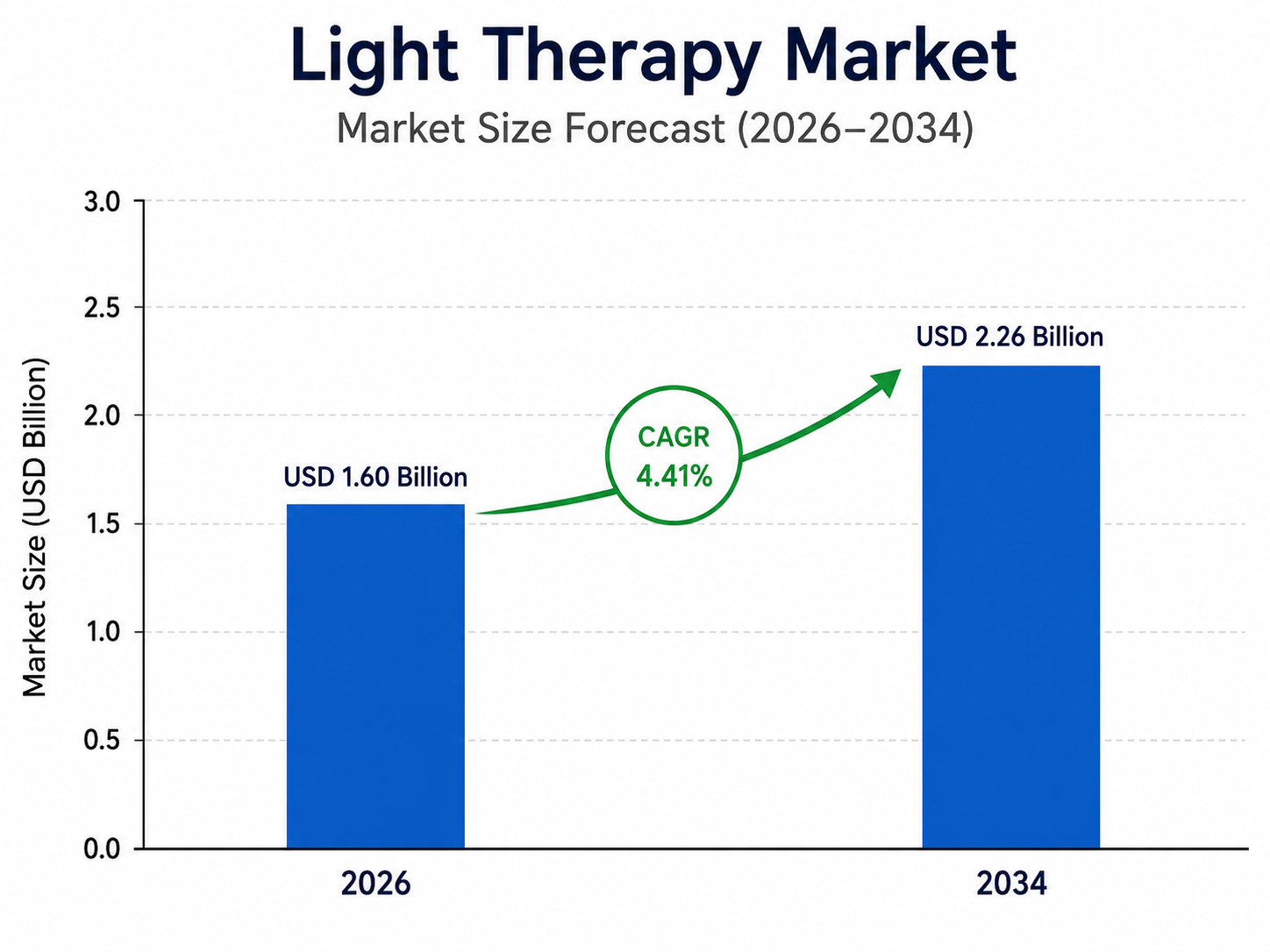
The Light Therapy Market is expected to grow from $ 1.60 in 2026 to $ 2.26 billion by 2034, registering a CAGR of 4.41%.
During the forecast period. Light therapy uses controlled exposure to specific wavelengths of visible, red, blue, white, and near-infrared light to help manage a wide range of conditions, including skin disorders, sleep disturbances, seasonal affective disorder, neurological conditions, and neonatal health issues. The market includes products such as light boxes, LED panels, handheld devices, wearable glasses, facial masks, floor lamps, and clinical phototherapy systems designed for both professional and home use. Growth is being driven by increasing awareness of non-invasive treatment options, the rising prevalence of dermatological conditions, growing demand for home-based healthcare, and the expanding popularity of aesthetic and wellness treatments. Hospitals, dermatology clinics, wellness centers, behavioral health providers, and homecare users continue to be the key end users. In addition, manufacturers are focusing on portable and user-friendly devices, personalized treatment programs, connected digital features, multi-wavelength technologies, and clinically validated home-use solutions to meet evolving consumer and healthcare needs.
1. What is the latest trend in the Light Therapy Market?
The latest trend is the rapid expansion of portable, wearable, and home-use LED light therapy devices.
Red and near-infrared systems are gaining attention for skin rejuvenation, recovery, inflammation management, and general wellness.
Smart devices increasingly include mobile applications, adjustable wavelengths, automated timers, and personalized treatment programs.
Wearable glasses and flexible facial masks are also improving convenience and consumer adoption.
2. What are the key challenges in the Light Therapy Market?
Key challenges include inconsistent product quality, limited standardization, uncertain treatment claims, and differences in clinical evidence across applications.
Incorrect wavelength, intensity, treatment distance, or exposure duration may reduce effectiveness or create safety concerns.
Premium clinical and home-use devices can also be expensive for price-sensitive consumers.
Manufacturers must clearly differentiate medically validated products from general wellness devices.
3. What is the major driving factor for the Light Therapy Market?
The major driving factor is rising demand for non-invasive, drug-free, and convenient treatment options.
Light therapy is increasingly used for seasonal mood disorders, sleep regulation, acne, psoriasis, vitiligo, neonatal jaundice, and cosmetic skin care.
Growing consumer awareness and the expansion of home-based healthcare are supporting device adoption.
Demand is also strengthened by interest in preventive wellness, self-care, and personalized treatment.
4. What is the major segment in the Light Therapy Market and why?
LED-based light therapy devices represent a major segment because they offer energy efficiency, compact design, wavelength flexibility, and relatively long operating life.
LEDs can deliver red, blue, white, and near-infrared light for dermatology, aesthetic, circadian, and wellness applications.
Their suitability for both clinical and home-use products supports broad commercial adoption.
Declining component costs are also enabling more portable and affordable device formats.
5. Which application or end-user is driving more demand?
Dermatology and aesthetic applications are driving substantial demand for light therapy devices.
Red and blue light systems are widely marketed for acne management, skin rejuvenation, inflammation reduction, and collagen-supporting treatments.
Homecare consumers are increasingly adopting masks, panels, and handheld devices for convenient personal use.
Hospitals and clinics remain important for psoriasis, vitiligo, neonatal jaundice, and supervised phototherapy.
6. Which region offers the highest growth potential and why?
Asia Pacific offers strong growth potential due to rising disposable income, expanding aesthetic services, increasing skin-care awareness, and improving healthcare access.
China, Japan, South Korea, India, and Australia represent important markets for dermatology and consumer wellness devices.
North America remains an established market due to high home-use adoption and strong interest in non-invasive therapies.
Europe also benefits from awareness of seasonal affective disorder and mature medical-device markets.
7. What strategies are major companies adopting in the Light Therapy Market?
Major companies are focusing on portable designs, multiple wavelengths, improved irradiance control, and clinically supported treatment protocols.
They are expanding direct-to-consumer sales, e-commerce distribution, professional-clinic partnerships, and home-use product portfolios.
Product differentiation increasingly centers on comfort, treatment speed, app connectivity, safety controls, and ease of use.
Companies are also pursuing regulatory clearances and clinical studies to strengthen credibility.
8. What are the leading companies in the Light Therapy Market?
Leading companies include Philips, Beurer, Verilux, Northern Light Technologies, BioPhotas, Lucimed, Lumie, LightStim, Joovv, Carex, Natus Medical, Atom Medical, Bistos, Lumenis, and Zepter International.
These companies compete through product design, wavelength performance, clinical validation, safety, pricing, and distribution reach.
Consumer-focused brands emphasize portability and home convenience, while medical suppliers prioritize clinical reliability.
Companies with broad portfolios spanning dermatology, neonatal care, circadian health, and wellness hold advantages.
9. Why is light therapy strategically important for healthcare and wellness providers?
Light therapy expands treatment options without requiring surgery or continuous pharmaceutical intervention.
It can support clinics in offering dermatology, aesthetic, circadian, behavioral health, and recovery-focused services.
Home-use devices may also improve treatment convenience, patient engagement, and continuity between clinical visits.
For wellness providers, light therapy creates opportunities for differentiated and recurring service offerings.
10. What is the future outlook for the Light Therapy Market?
The market outlook remains positive as non-invasive therapies, home-use devices, and preventive wellness continue to gain acceptance.
Future growth will be supported by wearable formats, AI-assisted personalization, connected monitoring, and combined-wavelength systems.
Clinical validation and clearer regulatory positioning will become increasingly important as competition expands.
Companies offering safe, convenient, evidence-supported, and affordable devices are expected to gain market share.
Browse Related Reports:
https://www.oganalysis.com/industry-reports/iot-medical-devices-market
https://www.oganalysis.com/industry-reports/clinical-trial-imaging-market
https://www.oganalysis.com/industry-reports/clinical-decision-support-systems-market
https://www.oganalysis.com/industry-reports/advance-directives-market
https://www.oganalysis.com/industry-reports/artificial-intelligence-ai-in-medical-diagnostics-market
