Medium and Large Satellite Market Outlook 2026–2034: Growth Drivers, Strategic Applications, Leading Companies, and Regional Opportunities
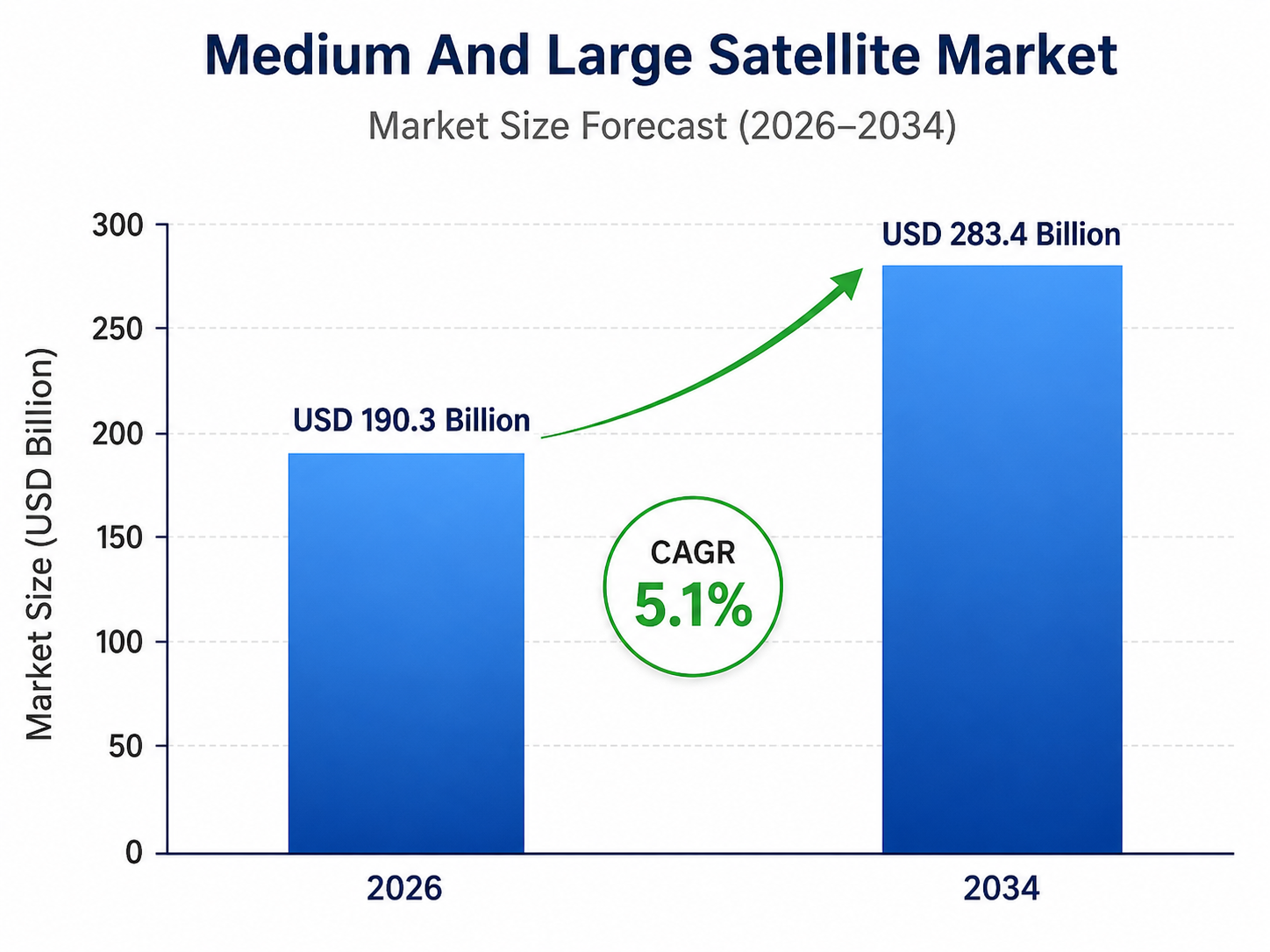
The Medium and Large Satellite Market is estimated to be valued at $ 190.3 billion in 2026 and is projected to reach $ 283.4 billion by 2034, expanding at a CAGR of 5.1% from 2026 to 2034.
In the industry, the thresholds for classifying satellites vary from source to source. Medium satellites weigh around 500-1,000 kg, and large satellites weigh over 1,000 kg. These spacecraft provide communications, broadcasting, navigation, Earth observation, weather monitoring, scientific research, defense surveillance and deep space exploration.
The market is growing as a result of increasing demand for secure connectivity, high resolution imagery, climate intelligence, missile warning, navigation resilience and high throughput communication capacity. Although the use of small-satellite constellations is growing, medium and large platforms are still relevant for missions that require high power payloads, long operational life, wide geographic coverage, large energy capacity, and advanced sensors. Investments in digital payloads, electric propulsion, modular satellite buses and in-orbit reconfiguration are further strengthening the market outlook.
1. What is the latest trend in the Medium and Large Satellite Market?
The latest trend is the adoption of software-defined and fully reconfigurable satellites that can adjust coverage, bandwidth, capacity, and frequency while in orbit.
Manufacturers are combining digital payloads with electric propulsion, advanced processors, flexible antennas, and autonomous onboard systems.
This allows operators to respond to changing traffic patterns, customer requirements, and security conditions without replacing the spacecraft.
Standardized platforms and modular production are also reducing customization time and improving manufacturing efficiency.
2. What are the key challenges in the Medium and Large Satellite Market?
Key challenges include high development and launch costs, lengthy production cycles, component shortages, mission failure risks, and complex regulatory approvals.
Large spacecraft require extensive testing, specialized manufacturing facilities, insurance coverage, and reliable access to heavy-lift launch vehicles.
Cybersecurity threats, orbital congestion, space debris, and spectrum coordination add further operational complexity.
Competition from smaller, lower-cost satellite constellations can also affect demand for traditional large satellite platforms.
3. What is the major driving factor for the Medium and Large Satellite Market?
The major driving factor is rising demand for space-based communication, Earth observation, navigation, weather forecasting, and national security services.
Governments and commercial operators require satellites capable of carrying powerful sensors, high-capacity transponders, and complex mission payloads.
Growing demand for broadband connectivity, climate monitoring, disaster management, and defense intelligence is supporting procurement.
Large platforms remain valuable where coverage, payload performance, reliability, and long operational life are critical.
4. What is the major segment in the Medium and Large Satellite Market and why?
Earth observation represents a major application segment due to growing demand for high-resolution imagery, radar data, weather intelligence, and environmental monitoring.
Medium and large satellites can carry advanced optical, hyperspectral, infrared, and synthetic aperture radar payloads.
Their capabilities support defense surveillance, agriculture, mapping, climate research, maritime monitoring, and disaster response.
Communication satellites also maintain substantial demand through broadcasting, broadband, aviation, maritime, and government connectivity applications.
5. Which application or end-user is driving more demand?
Government and defense organizations are major demand drivers because they invest in secure communication, missile warning, navigation, surveillance, and intelligence missions.
Commercial satellite operators also generate strong demand for high-throughput broadband, broadcasting, mobility connectivity, and enterprise communication services.
Meteorological agencies and research institutions use larger platforms for weather, climate, astronomy, and planetary science missions.
Demand is strongest where mission complexity and strategic importance justify high satellite development and launch expenditure.
6. Which region offers the highest growth potential and why?
Asia Pacific offers strong growth potential due to expanding national space programs, defense modernization, communication demand, and Earth observation investments.
China, India, Japan, South Korea, and Australia are strengthening domestic satellite manufacturing and mission capabilities.
North America remains the leading market because of high government expenditure, established manufacturers, and extensive defense and commercial space activity.
Europe also presents opportunities through climate missions, secure communications, navigation programs, and regional space-sovereignty initiatives.
7. What strategies are major companies adopting in the market?
Major companies are developing modular satellite buses, software-defined payloads, electric propulsion systems, lighter structures, and digitally enabled manufacturing processes.
They are standardizing platforms to shorten production schedules while retaining flexibility for communication, observation, navigation, and defense missions.
Partnerships with governments, launch providers, telecom operators, research agencies, and payload specialists are central to winning contracts.
Companies are also investing in cybersecurity, autonomous operations, additive manufacturing, and resilient satellite architectures.
8. What are the leading companies in the Medium and Large Satellite Market?
Leading companies include Lockheed Martin, Northrop Grumman, Boeing, Airbus, Thales Alenia Space, Maxar Space Systems, L3Harris Technologies, OHB SE, Mitsubishi Electric, NEC Corporation, and Israel Aerospace Industries.
These companies compete through satellite platform heritage, payload capability, mission reliability, manufacturing scale, and government relationships.
Their portfolios cover communication, Earth observation, navigation, weather, scientific, and military satellite systems.
Players offering flexible platforms, secure technologies, and complete mission integration hold a strong competitive position.
9. Why are medium and large satellites strategically important?
Medium and large satellites provide the payload capacity, electrical power, communication bandwidth, and operational endurance required for complex missions.
They support critical infrastructure including navigation networks, weather forecasting, defense surveillance, broadcasting, and secure government communications.
Their wide coverage and advanced sensing capabilities can reduce the number of spacecraft required for certain missions.
For governments and operators, these platforms remain strategic assets despite the rapid growth of small-satellite constellations.
10. What is the future outlook for the Medium and Large Satellite Market?
The market outlook remains positive as governments and commercial operators invest in advanced communication, observation, defense, and scientific missions.
Future demand will increasingly favor software-defined, cyber-resilient, fuel-efficient, and modular spacecraft with flexible in-orbit capabilities.
Medium and large satellites will coexist with smaller constellations through hybrid architectures designed around mission-specific requirements.
Companies combining platform reliability, digital payload innovation, faster production, and lifecycle support are expected to gain market share.
Browse Related Reports
https://www.oganalysis.com/industry-reports/offshore-mooring-systems-market
https://www.oganalysis.com/industry-reports/aircraft-turbofan-engine-market
https://www.oganalysis.com/industry-reports/more-electric-aircraft-market
https://www.oganalysis.com/industry-reports/antiice-valves-market
https://www.oganalysis.com/industry-reports/landing-gear-control-systems-market
