Military Drone (UAV) Market Outlook 2026–2034: Tactical UAV Trends, Defense Modernization, Leading Companies, and Future Opportunities
The Military Drone (UAV) Market is expected to grow from $ 33.6 billion in 2026 to $ 62.2 billion by 2034, registering a CAGR of 8.0%.
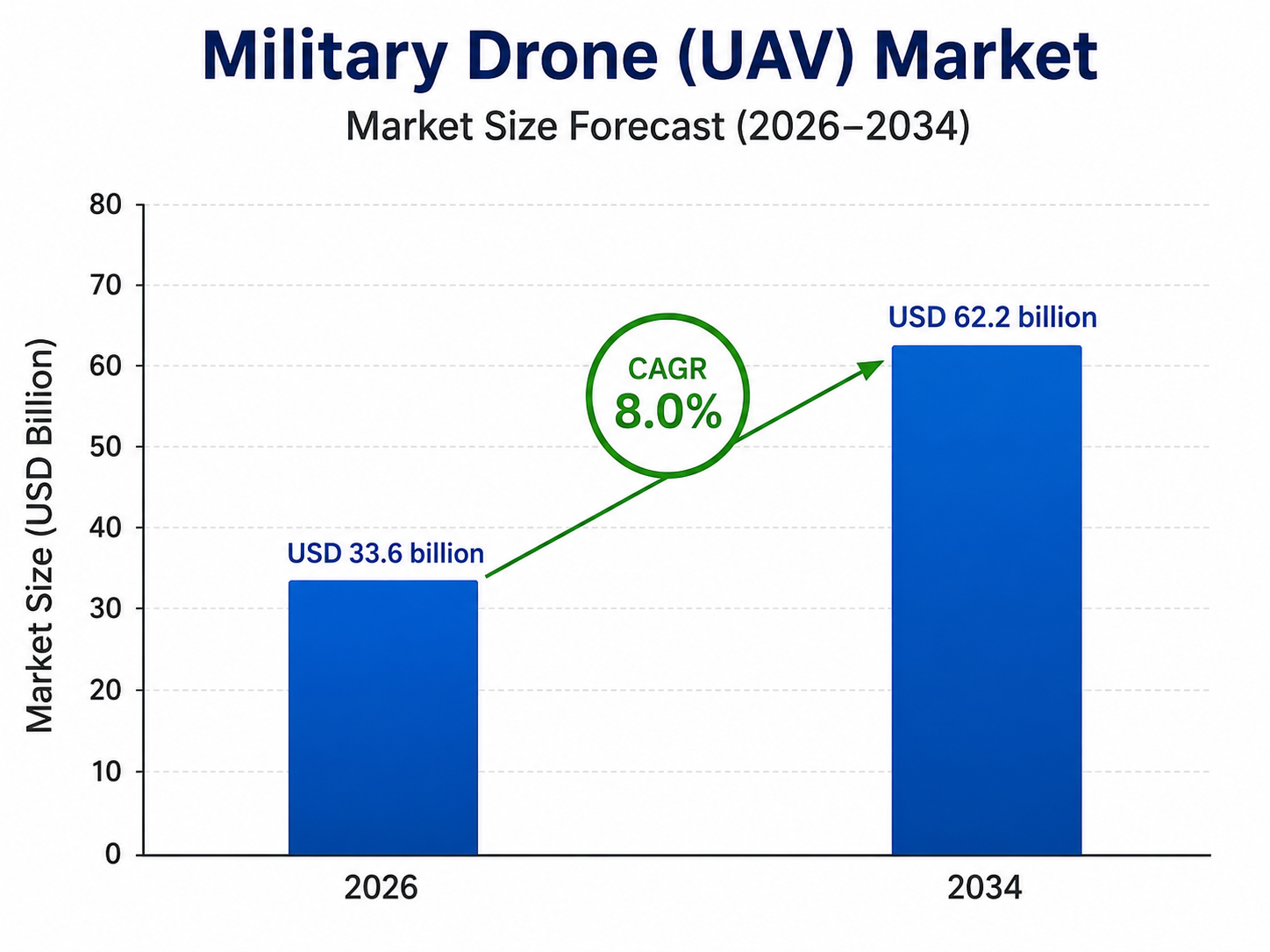
During the forecast period. Military drones have become an essential component of modern defense operations, supporting missions such as intelligence, surveillance, reconnaissance (ISR), target acquisition, precision strikes, logistics support, electronic warfare, border security, maritime patrol, and battlefield communications. The market includes a wide range of platforms, including mini UAVs, small tactical drones, tactical UAVs, medium-altitude long-endurance (MALE) systems, high-altitude long-endurance (HALE) platforms, unmanned combat aerial vehicles (UCAVs), loitering munitions, and fiber-optic first-person view (FPV) drones. Market growth is being driven by increasing defense modernization programs, evolving asymmetric warfare strategies, rising demand for real-time situational awareness, and the need to reduce operational risks for military personnel. In addition, continuous advancements in artificial intelligence, autonomous flight, drone swarming, stealth technologies, secure communication systems, anti-jamming capabilities, extended flight endurance, and cost-effective expendable drone platforms are enhancing mission effectiveness and supporting the widespread adoption of military UAVs across defense forces worldwide.
1. What is the latest trend in the Military Drone (UAV) Market?
The latest trend is the rapid adoption of low-cost, AI-enabled, and mission-specific drones for tactical battlefield use.
Loitering munitions, FPV drones, drone swarms, and autonomous ISR platforms are reshaping modern combat operations.
Defense forces are prioritizing drones that can operate in contested electronic warfare environments.
There is also growing focus on rapid production, modular payloads, and battlefield-adaptable drone designs.
2. What are the key challenges in the Military Drone (UAV) Market?
Key challenges include electronic warfare threats, GPS jamming, cyber vulnerability, air-defense exposure, limited battery endurance, and regulatory restrictions.
Military drones must operate reliably in hostile environments with secure command, control, and data transmission.
High-end UAVs also involve long development cycles, certification complexity, and expensive payload integration.
Counter-drone technologies are improving, forcing UAV manufacturers to strengthen survivability and mission flexibility.
3. What is the major driving factor for the Military Drone (UAV) Market?
The major driving factor is increasing demand for real-time intelligence, surveillance, reconnaissance, and precision-strike capability.
Drones allow defense forces to monitor hostile areas, identify targets, support troops, and conduct missions without exposing pilots.
Rising geopolitical tensions, border disputes, and modernization of armed forces are strengthening procurement.
The lower operating cost of many UAVs compared with manned platforms also supports adoption.
4. What is the major segment in the Military Drone (UAV) Market and why?
Tactical UAVs represent a major segment because they are widely used for battlefield surveillance, target acquisition, artillery support, and short- to medium-range missions.
They provide commanders with real-time intelligence and can be deployed closer to operational units.
Their balance of cost, mobility, endurance, and mission flexibility makes them attractive across army, navy, and special forces operations.
MALE UAVs and loitering munitions are also expanding rapidly due to long-endurance and strike requirements.
5. Which application or end-user is driving more demand?
Intelligence, surveillance, and reconnaissance remains the largest demand application because every military operation depends on timely battlefield awareness.
Army, air force, navy, border security, and special operations units are major end users of military drones.
Strike, electronic warfare, communication relay, maritime patrol, and logistics support applications are also gaining traction.
Demand is strongest where drones can reduce personnel risk and improve mission speed, accuracy, and persistence.
6. Which region offers the highest growth potential and why?
Asia Pacific offers strong growth potential due to rising defense spending, border security needs, maritime disputes, and military modernization programs.
India, China, Japan, South Korea, Australia, and Southeast Asian countries are investing in UAV procurement and domestic drone manufacturing.
North America remains a leading established market due to advanced defense technology and large UAV procurement budgets.
Europe is also accelerating drone investment due to security concerns and lessons from recent conflicts.
7. What strategies are major companies adopting in the market?
Major companies are focusing on AI autonomy, modular payloads, long endurance, stealth, secure datalinks, and electronic warfare resilience.
They are developing drones for ISR, strike, surveillance, loitering, maritime, and swarm-based missions.
Partnerships with defense agencies, local manufacturers, and technology firms are central to winning procurement contracts.
Companies are also investing in lower-cost systems that can be produced quickly and deployed at scale.
8. What are the leading companies in the Military Drone (UAV) Market?
Leading companies include General Atomics Aeronautical Systems, Northrop Grumman, Lockheed Martin, Boeing, RTX, AeroVironment, Textron Systems, L3Harris Technologies, Israel Aerospace Industries, Elbit Systems, Baykar Technologies, Turkish Aerospace Industries, Leonardo, Thales, Airbus Defence and Space, Saab, BAE Systems, Rheinmetall, Kratos, and Anduril Industries.
These companies compete through endurance, payload capacity, autonomy, mission reliability, combat performance, and defense customer relationships.
Established aerospace players dominate high-end UAV platforms, while newer defense-tech firms are gaining ground in autonomous and low-cost systems.
Regional players are also expanding through indigenous military drone programs and export-focused platforms.
9. Why are military drones strategically important for defense forces?
Military drones are strategically important because they improve situational awareness, operational reach, precision targeting, and force protection.
They allow commanders to conduct surveillance, reconnaissance, and strike missions with reduced human exposure.
UAVs also support network-centric warfare by feeding real-time data into command-and-control systems.
For defense ministries, drones offer a scalable way to strengthen capability across land, air, sea, and border operations.
10. What is the future outlook for the Military Drone (UAV) Market?
The market outlook remains strong as defense forces increase investment in unmanned, autonomous, and networked combat systems.
Future growth will be supported by AI-enabled drones, swarming, loitering munitions, stealth UAVs, and resilient communication systems.
Fiber-optic FPV drones, expendable UAVs, and counter-EW technologies are expected to gain importance in tactical operations.
Companies offering cost-effective, combat-proven, scalable, and interoperable drone solutions are expected to gain market share.
Browse Related Reports:
https://www.oganalysis.com/industry-reports/military-vetronics-market
https://www.oganalysis.com/industry-reports/antitank-missile-market
https://www.oganalysis.com/industry-reports/military-satellite-market
https://www.oganalysis.com/industry-reports/nonlethal-weapons-market
https://www.oganalysis.com/industry-reports/modular-weapon-storage-systems-market
