Modular Bridges Market Outlook 2026–2034: Infrastructure Renewal, Rapid Deployment, Leading Companies, and Growth Opportunities
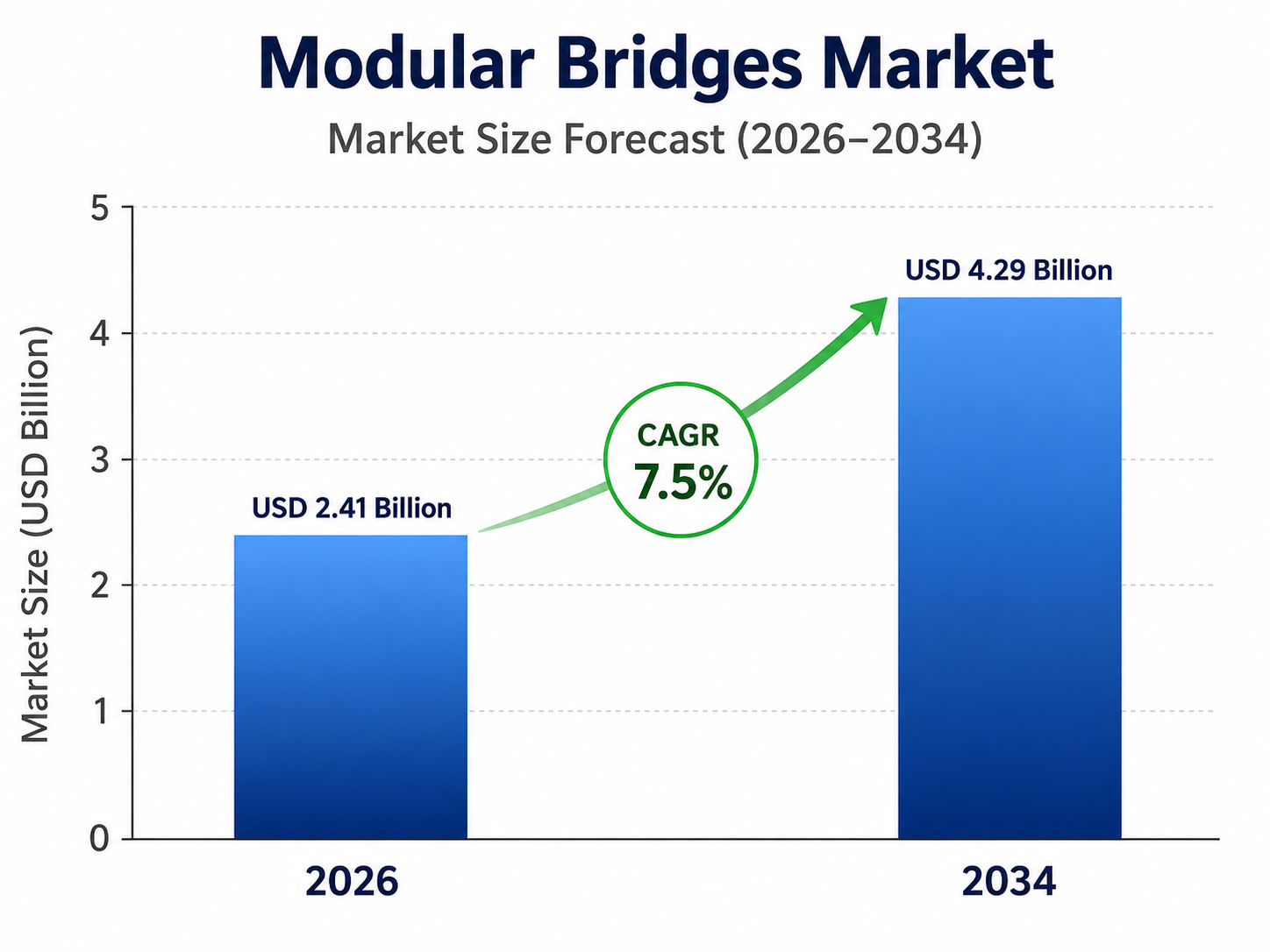
The Modular Bridges Market is estimated to be valued at $ 2.41 billion in 2026 and is projected to reach $ 4.29 billion by 2034, expanding at a CAGR of 7.5% from 2026 to 2034.
Modular bridges are prefabricated bridge systems made from standardized steel, concrete, aluminum, or composite components that can be quickly assembled to provide temporary or permanent crossings. They are commonly used for highway detours, rural road connectivity, emergency bridge replacement, military operations, construction site access, mining projects, pedestrian crossings, and railway infrastructure.
The modular bridge market is expanding due to the growing need to replace aging bridges, increased investment in infrastructure development, rising demand for rapid disaster recovery, and the need to minimize traffic disruptions during construction. Their ability to be transported easily, installed quickly with relatively limited equipment, dismantled, relocated, or expanded makes them an attractive solution for governments and contractors. Ongoing advancements in corrosion-resistant materials, digital design technologies, longer-span bridge systems, reusable components, and accelerated bridge construction techniques are further enhancing the efficiency and adoption of modular bridges worldwide.
1. What is the latest trend in the Modular Bridges Market?
The latest trend is the adoption of longer-span, permanent modular bridges supported by digital design, high-strength steel, and accelerated construction methods.
Manufacturers are also developing reusable rental systems, modular piers, customized deck configurations, and corrosion-resistant components.
Digital twins, structural monitoring sensors, and prefabricated foundations are emerging across advanced projects.
These innovations help reduce installation time, lifecycle maintenance, and disruption to existing transport networks.
2. What are the key challenges in the Modular Bridges Market?
Key challenges include transportation limitations, site-specific engineering requirements, material costs, regulatory approvals, and public perceptions regarding temporary structures.
Complex terrain, heavy loading, long spans, seismic conditions, and extreme weather may require customized foundations and reinforcements.
Manufacturers must also satisfy different national bridge codes, fatigue standards, and environmental requirements.
Local contractor experience and access to specialized installation equipment can further influence project schedules.
3. What is the major driving factor for the Modular Bridges Market?
The major driving factor is the need to replace aging bridges and restore transport connectivity more quickly than conventional construction permits.
Modular systems can reduce road closures, traffic diversion periods, labor requirements, and on-site fabrication activity.
Natural disasters, infrastructure failures, and major roadworks are also increasing demand for rapidly deployable crossings.
Government investment in rural roads, highways, railways, and resilient infrastructure provides additional market support.
4. What is the major segment in the Modular Bridges Market and why?
Modular steel bridges represent a major product segment because steel offers high load-bearing strength, design flexibility, durability, and ease of prefabrication.
Standardized steel panels and beams can be transported efficiently and assembled into different lengths, widths, and load configurations.
Steel systems are suitable for both temporary and permanent vehicular, pedestrian, railway, and industrial crossings.
Galvanization and protective coatings also help extend service life in demanding environments.
5. Which application or end-user is driving more demand?
Government transportation agencies and civil infrastructure contractors are driving significant demand for highway detours, bridge replacement, and rural connectivity.
Construction firms use temporary bridges to maintain traffic flow and provide access across active project sites.
Defense organizations require rapidly deployable systems for wet-gap, dry-gap, and logistical mobility applications.
Mining, oil and gas, forestry, and humanitarian agencies also create demand in remote or emergency locations.
6. Which region offers the highest growth potential and why?
Asia Pacific offers strong growth potential due to extensive road development, rapid urbanization, rural connectivity programs, and disaster-resilient infrastructure investment.
China, India, Japan, Southeast Asia, and Australia provide opportunities across highways, railways, mining, and emergency reconstruction.
North America remains important because of aging bridges and accelerated replacement programs.
Europe also supports demand through infrastructure renewal, temporary detours, military mobility, and flood-recovery projects.
7. What strategies are major companies adopting in the market?
Major companies are focusing on longer spans, higher load capacity, modular customization, corrosion protection, and faster assembly methods.
They are expanding rental fleets and offering engineering, logistics, installation supervision, training, and project-financing support.
Partnerships with governments, contractors, military agencies, and disaster-response organizations are central to market expansion.
Companies are also strengthening regional manufacturing and inventory networks to shorten emergency deployment times.
8. What are the leading companies in the Modular Bridges Market?
Leading companies include Acrow, Mabey Bridge, Janson Bridging, U.S. Bridge, Algonquin Bridge, Pioneer Bridges, Bridge Brothers, Matière, Waagner Biro Bridge Systems, and AIL Group.
These companies compete through engineering capability, span range, load performance, rapid delivery, rental availability, and global project experience.
Acrow and Mabey Bridge are particularly prominent in prefabricated modular steel bridging for permanent, temporary, military, and emergency applications.
Regional suppliers compete through customization, fabrication capacity, installation support, and competitive project costs.
9. Why are modular bridges strategically important for infrastructure owners?
Modular bridges enable infrastructure owners to restore connectivity quickly while reducing traffic disruption and construction-related economic losses.
They can be used as temporary assets and later dismantled, relocated, stored, or converted into permanent crossings.
Standardized components improve procurement flexibility and emergency preparedness across multiple locations.
For governments, modular inventories can form part of broader disaster-response and infrastructure-resilience strategies.
10. What is the future outlook for the Modular Bridges Market?
The market outlook remains positive as governments prioritize bridge renewal, resilient infrastructure, rapid disaster recovery, and rural connectivity.
Future systems will increasingly incorporate high-strength materials, modular foundations, structural sensors, digital engineering, and lower-carbon fabrication.
Permanent modular bridges are expected to gain wider acceptance alongside established temporary and emergency applications.
Companies providing complete engineering, supply, installation, financing, and lifecycle support are likely to gain market share.
LinkedIn | Twitter
