Orthokeratology Lens Market Outlook 2026–2034: Myopia Management Trends, Leading Companies, and Growth Opportunities
The Orthokeratology Lens Market is estimated to be valued at $ 3.49 billion in 2026 and is projected to reach $ 6.06 billion by 2034, expanding at a CAGR of 7.13% from 2026 to 2034.
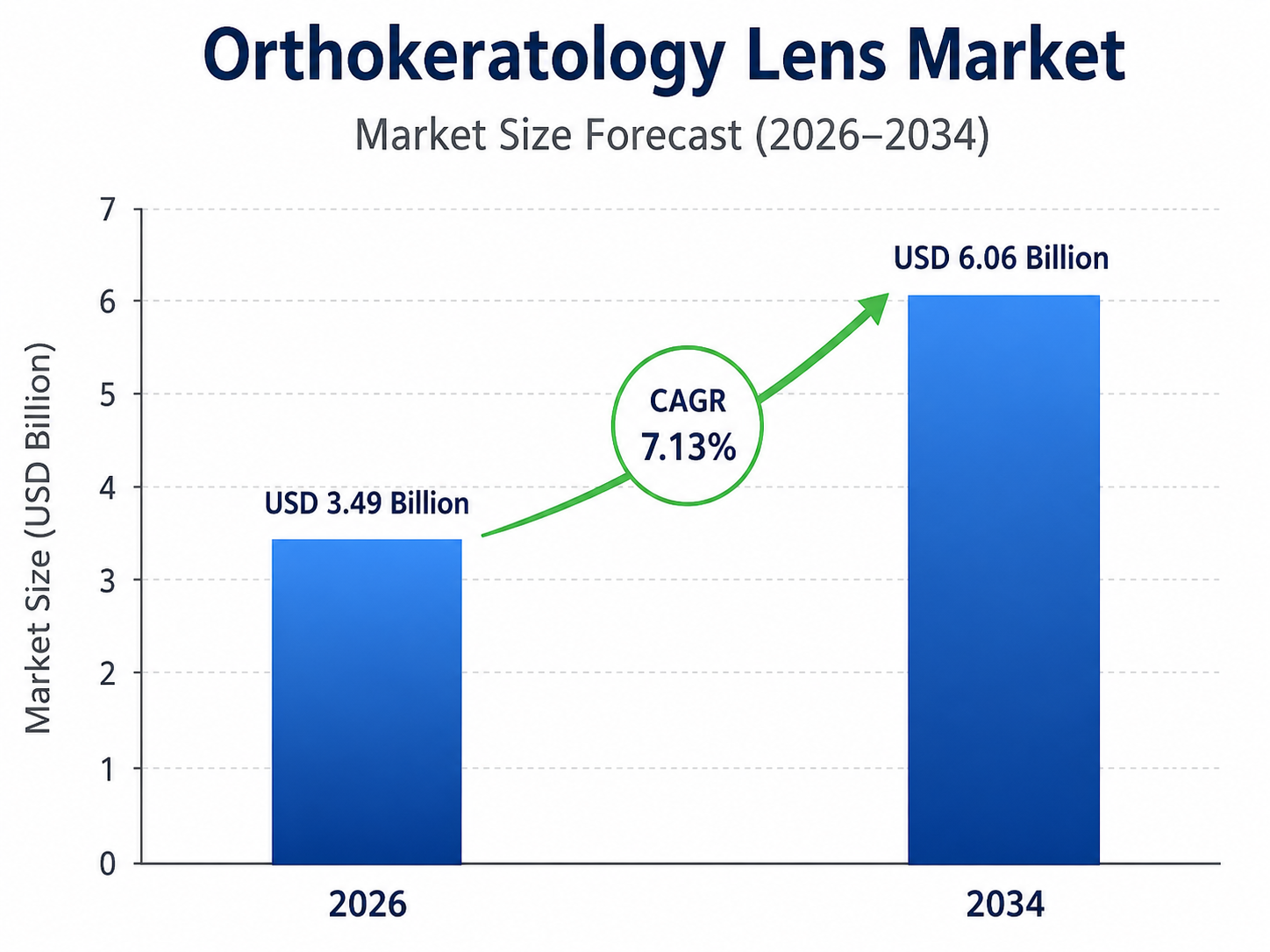
Orthokeratology lenses are specially designed rigid gas-permeable contact lenses worn mainly overnight to temporarily reshape the cornea and provide clearer daytime vision without spectacles or conventional contact lenses. They are primarily used for myopia correction and management, with additional applications in astigmatism, hyperopia, and presbyopia. Market growth is supported by the increasing prevalence of childhood myopia, demand for non-surgical vision correction, advances in corneal topography, and expanding optometrist training. Improved oxygen permeability, customized fitting software, and broader awareness among parents and eye-care professionals are strengthening adoption.
1. What is the latest trend in the Orthokeratology Lens Market?
The latest trend is the development of highly customized overnight lenses designed using corneal topography, digital fitting platforms, and advanced simulation software.
Manufacturers are improving treatment-zone control, peripheral defocus profiles, oxygen permeability, and first-fit success rates.
Toric and multifocal Ortho-K designs are also expanding treatment options for more complex refractive conditions.
Combination approaches involving Ortho-K and other myopia-management methods are attracting clinical interest.
2. What are the key challenges in the Orthokeratology Lens Market?
Key challenges include high fitting costs, limited availability of trained practitioners, lens-care compliance, and the need for regular clinical monitoring.
Improper cleaning or handling can increase the risk of corneal infection, irritation, or treatment discontinuation.
Results may vary depending on corneal shape, refractive error, age, and patient adherence.
Competition from myopia-control spectacles, soft contact lenses, and pharmaceutical approaches also affects adoption.
3. What is the major driving factor for the Orthokeratology Lens Market?
The major driving factor is the rapidly increasing prevalence of myopia, particularly among children and adolescents.
Parents and practitioners are seeking non-surgical solutions that provide daytime freedom from spectacles while supporting myopia management.
Greater screen use, intensive near-work activities, and reduced outdoor time are increasing concern about refractive progression.
Rising awareness of long-term myopia-related eye risks is further supporting early intervention.
4. What is the major segment in the Orthokeratology Lens Market and why?
Overnight Ortho-K lenses represent the major product segment because they reshape the cornea during sleep and provide functional daytime vision.
This format eliminates the need to wear corrective lenses during school, sports, work, or outdoor activities.
It is widely recommended in specialized myopia-management and optometry practices.
Convenience, reversibility, and growing clinical evidence support the segment’s strong market position.
5. Which application or end-user is driving more demand?
Myopia management is driving the strongest demand, particularly among children experiencing progressive refractive error.
Optometry and ophthalmology clinics are the primary end users because Ortho-K requires topography, customized fitting, and follow-up care.
Specialty contact-lens practices account for significant adoption due to their fitting expertise and patient-support capabilities.
Adult demand also exists among athletes and users seeking daytime freedom from spectacles or contact lenses.
6. Which region offers the highest growth potential and why?
Asia Pacific offers strong growth potential due to high myopia prevalence, large pediatric populations, and increasing awareness of myopia management.
China, Japan, South Korea, Singapore, Australia, and other regional markets have expanding specialty eye-care networks.
North America remains a major established market supported by product availability and trained optometrists.
Regional growth will depend on affordability, practitioner education, regulation, and access to corneal-topography equipment.
7. What strategies are major companies adopting in the market?
Major companies are investing in customized lens designs, high-oxygen-permeable materials, digital fitting software, and practitioner certification programs.
They are developing toric, multifocal, and broader-prescription products to expand the addressable patient population.
Clinical research, professional education, and partnerships with optometry practices are central to market development.
Companies are also integrating corneal topography, ordering platforms, and patient-management support into their offerings.
8. What are the leading companies in the Orthokeratology Lens Market?
Leading companies include CooperVision through Paragon Vision Sciences, Euclid Vision, Menicon, Bausch + Lomb, Art Optical Contact Lens, GP Specialists, TruForm Optics, Visionary Optics, Brighten Optix, and MiracLens.
These companies compete through lens-design accuracy, material quality, fitting systems, clinical evidence, and practitioner support.
Established players benefit from recognized brands and broad eye-care distribution networks.
Specialized manufacturers compete through custom designs and expertise in complex corneal profiles.
9. Why are orthokeratology lenses strategically important for eye-care providers?
Orthokeratology lenses enable providers to offer a differentiated, recurring, and clinically monitored myopia-management service.
They strengthen long-term patient relationships through fitting, replacement, monitoring, and ongoing corneal assessment.
For practices, Ortho-K can support premium positioning and expansion into pediatric myopia care.
It also provides a reversible alternative for patients who are unsuitable for or unwilling to undergo refractive surgery.
10. What is the future outlook for the Orthokeratology Lens Market?
The market outlook remains positive as myopia management becomes a larger priority within pediatric and preventive eye care.
Growth will be supported by advanced lens geometries, automated fitting, improved topography, and greater practitioner training.
Regulatory acceptance and stronger long-term clinical evidence are expected to improve parent and patient confidence.
Companies offering comfortable, predictable, personalized, and clinically supported products are likely to gain market share.
Browse Related Reports
https://www.oganalysis.com/industry-reports/disposable-mixing-bag-market
https://www.oganalysis.com/industry-reports/iliac-stent-market
https://www.oganalysis.com/industry-reports/orthopedic-biomaterial-market
https://www.oganalysis.com/industry-reports/neurostimulation-devices-market
https://www.oganalysis.com/industry-reports/neurovascular-catheters-market
