Ozone Generation Market Outlook 2026–2034: Advanced Water Treatment, Smart Systems, Leading Companies, and Growth Opportunities
The Ozone Generation Market is estimated to be valued at $ 2.03 billion in 2026 and is projected to reach $ 3.44 billion by 2034, expanding at a CAGR of 6.82% from 2026 to 2034.
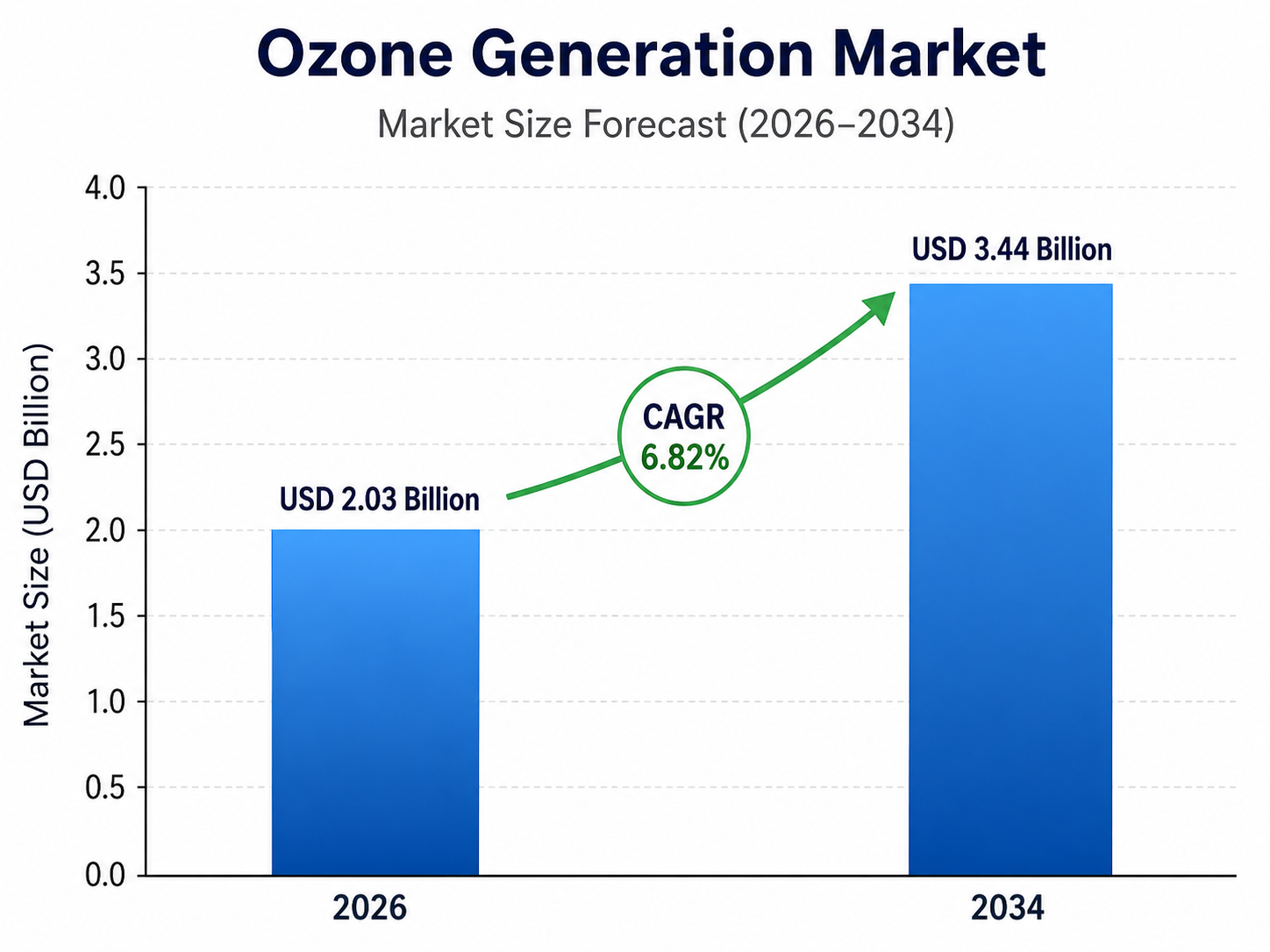
Ozone generation systems produce ozone onsite from air, oxygen, or water through corona discharge, ultraviolet radiation, or electrolysis. These systems are used for drinking-water purification, wastewater treatment, industrial process water, air treatment, food sanitation, pharmaceutical manufacturing, aquaculture, swimming pools, pulp bleaching, and semiconductor cleaning. Market growth is supported by stricter water-quality requirements, increasing industrial wastewater volumes, demand for chemical-free disinfection, water-reuse investment, and concern over emerging contaminants. Manufacturers are developing modular, energy-efficient, digitally monitored systems with improved ozone concentration, mass-transfer efficiency, safety controls, and automated operation.
1. What is the latest trend in the Ozone Generation Market?
The latest trend is the adoption of intelligent, modular ozone systems for advanced oxidation, micropollutant removal, water reuse, and critical infrastructure.
Manufacturers are integrating automated dosing, remote monitoring, built-in redundancy, energy optimization, and predictive maintenance.
High-concentration and compact systems are also gaining demand where space, operating continuity, and treatment efficiency are important.
Onsite generation reduces chemical storage and transportation requirements.
2. What are the key challenges in the Ozone Generation Market?
Key challenges include high initial investment, electricity consumption, complex gas handling, equipment maintenance, and occupational-safety requirements.
Ozone is unstable and must generally be generated onsite, requiring reliable feed-gas preparation, contacting equipment, controls, and off-gas destruction.
Treatment efficiency can vary with water chemistry, contaminant load, temperature, humidity, and mass-transfer performance.
Skilled system design and continuous monitoring are therefore essential.
3. What is the major driving factor for the Ozone Generation Market?
The major driving factor is rising demand for effective disinfection and oxidation without persistent chemical residues.
Ozone can destroy microorganisms and oxidize compounds responsible for taste, odor, color, and other water-quality problems.
Municipalities and industries are increasing treatment investment as water scarcity, pollution, and reuse requirements intensify.
Demand is also supported by the need to reduce dependence on conventional chemical disinfectants.
4. What is the major segment in the Ozone Generation Market and why?
Water and wastewater treatment represents a major application segment because ozone provides both disinfection and oxidation within treatment processes.
It is used across drinking water, municipal wastewater, industrial process water, ultrapure water, and reuse facilities.
The technology can treat microorganisms, odors, colors, and difficult organic contaminants while decomposing back into oxygen.
Its broad municipal and industrial applicability supports sustained equipment demand.
5. Which technology or end-user is driving more demand?
Corona-discharge ozone generators drive substantial demand because they can produce relatively high ozone concentrations for medium- and large-scale applications.
Municipal water utilities, industrial treatment plants, food processors, pharmaceutical companies, and electronics manufacturers are important users.
Electrolytic systems are gaining relevance in ultrapure-water applications where direct ozone generation and high cleanliness are required.
Demand varies according to required output, feed gas, purity, and operating environment.
6. Which region offers the highest growth potential and why?
Asia Pacific offers strong growth potential due to urbanization, industrial expansion, water-quality challenges, and investment in municipal and industrial treatment capacity.
China, India, Japan, South Korea, and Southeast Asia present opportunities across water reuse, electronics, food processing, and environmental infrastructure.
The region also includes established ozone-system manufacturers and advanced engineering capabilities.
Demand is expected to strengthen as treatment standards and industrial water requirements become more demanding.
7. What strategies are major companies adopting in the market?
Major companies are focusing on lower energy consumption, higher ozone concentration, modular capacity expansion, and automated process control.
They are combining generators with oxygen preparation, injection, contact, advanced oxidation, sensors, and ozone-destruction equipment.
Remote diagnostics, lifecycle services, and performance-based upgrades are becoming important competitive differentiators.
Companies are also developing application-specific systems for municipal, pharmaceutical, semiconductor, and food-processing users.
8. What are the leading companies in the Ozone Generation Market?
Leading companies include Veolia through Ozonia, Xylem through Wedeco, Mitsubishi Electric, Toshiba Infrastructure Systems & Solutions, Primozone, Ozone Tech Systems, METAWATER, DEL Ozone, Ozone Solutions, and OTSIL.
These companies compete through ozone-output capacity, energy efficiency, system reliability, process integration, safety, and after-sales service.
Large suppliers benefit from municipal and industrial project experience, while specialized companies compete through compact and customized systems.
Application engineering and installed-base support remain important advantages.
9. Why are ozone generation systems strategically important for organizations?
Ozone systems allow organizations to generate a powerful treatment agent onsite and reduce reliance on transported or stored disinfectant chemicals.
They support water-quality improvement, process sanitation, odor control, contaminant oxidation, and regulatory compliance.
For industrial users, ozone can improve product quality and enable water recycling or reuse.
For utilities, it can strengthen treatment performance against changing source-water conditions and emerging contaminants.
10. What is the future outlook for the Ozone Generation Market?
The market outlook remains positive as investment increases in water reuse, advanced oxidation, ultrapure water, industrial sanitation, and resilient infrastructure.
Future systems will increasingly incorporate intelligent dosing, modular redundancy, high-efficiency power supplies, advanced sensors, and digital service platforms.
Demand is expected to expand across municipal water, pharmaceuticals, semiconductors, food processing, aquaculture, and environmental remediation.
Companies offering efficient, safe, scalable, and application-specific systems are likely to gain market share.
Browse Related Reports
https://www.oganalysis.com/industry-reports/din-rail-terminal-blocks-market
https://www.oganalysis.com/industry-reports/floormounted-commercial-sauna-heater-market
https://www.oganalysis.com/industry-reports/ambient-lighting-market
https://www.oganalysis.com/industry-reports/emergency-lighting-market
https://www.oganalysis.com/industry-reports/high-brightness-led-market
