Population Health Management Market Outlook 2026–2034: Value-Based Care Trends, Growth Drivers, Leading Companies, and Future Opportunities
The Population Health Management Market is expected to grow from $ 72.72 billion in 2026 to $ 261.3 billion by 2034, registering a CAGR of 17.33%.
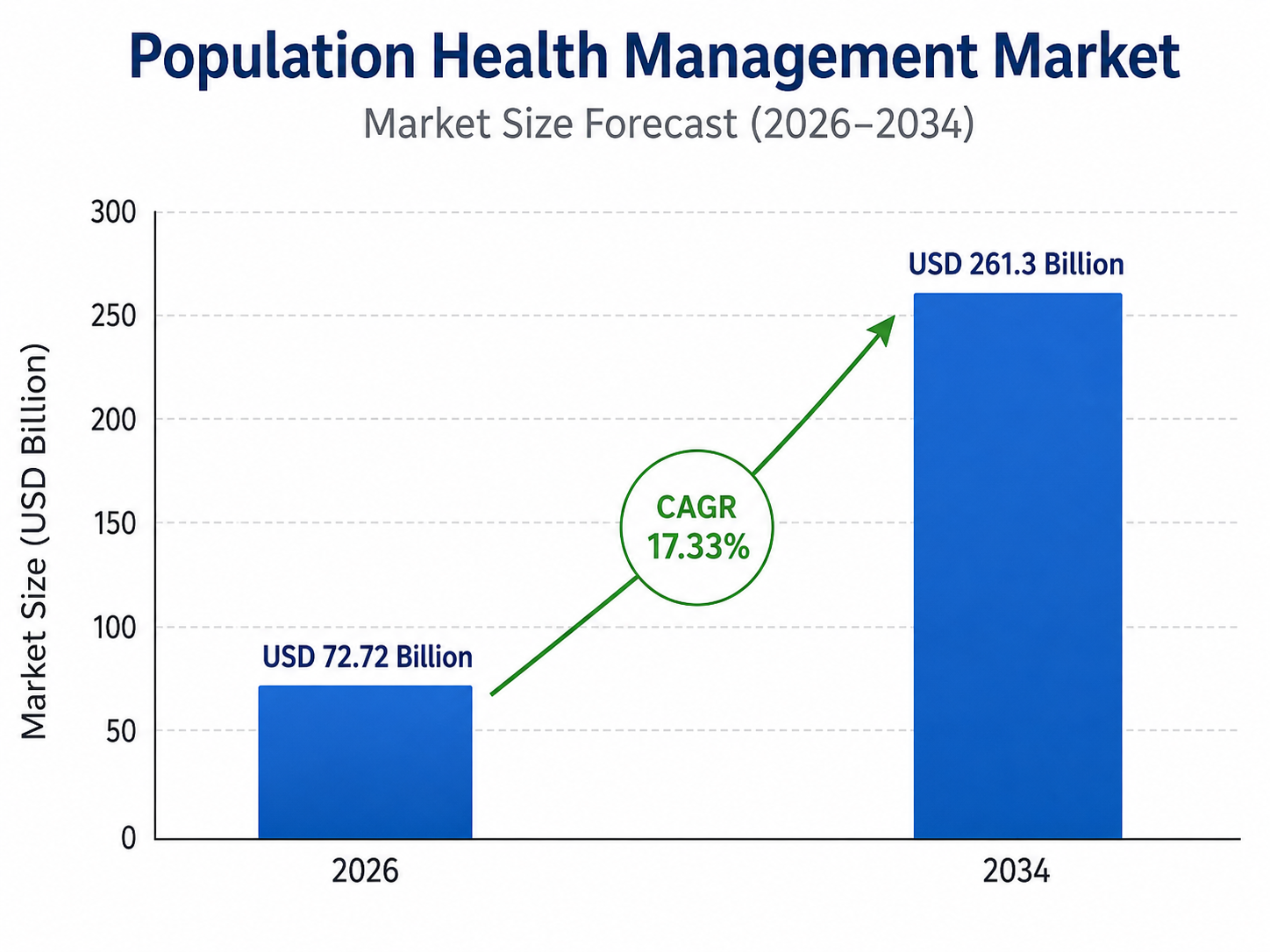
During the forecast period. Population health management (PHM) encompasses software platforms, advanced analytics, care coordination solutions, risk stratification tools, patient engagement technologies, and consulting services designed to improve health outcomes across defined patient populations. These solutions enable healthcare providers, payers, government agencies, and accountable care organizations to identify high-risk individuals, manage chronic diseases more effectively, close gaps in care, and reduce overall healthcare costs. Market growth is being driven by the ongoing transition from fee-for-service to value-based care, the rising prevalence of chronic diseases, increasing healthcare spending, and the widespread adoption of electronic health records. In addition, advances in artificial intelligence, predictive analytics, interoperability, remote patient monitoring, and digital patient engagement platforms are enhancing care delivery, improving clinical decision-making, and accelerating the adoption of population health management solutions across healthcare systems.
1. What is the latest trend in the Population Health Management Market?
The latest trend is the integration of AI, predictive analytics, and real-time clinical data into population health platforms.
Healthcare organizations are using these tools to identify high-risk patients, predict hospital readmissions, and personalize care interventions.
PHM platforms are also being connected with remote monitoring, telehealth, and digital patient-engagement systems.
This shift is moving the market from retrospective reporting toward proactive and preventive care management.
2. What are the key challenges in the Population Health Management Market?
Key challenges include data fragmentation, poor interoperability, privacy concerns, workflow integration issues, and inconsistent data quality.
Healthcare providers often struggle to combine claims, clinical, pharmacy, laboratory, social, and behavioral health data into one usable platform.
Smaller providers may face cost barriers and limited analytics expertise.
Measuring return on investment can also be difficult because population health outcomes often improve over longer time periods.
3. What is the major driving factor for the Population Health Management Market?
The major driving factor is the global shift toward value-based healthcare and outcome-based reimbursement models.
Hospitals, payers, and care networks are under pressure to reduce avoidable admissions, improve preventive care, and manage chronic disease costs.
PHM solutions help organizations track performance, close care gaps, and coordinate treatment across patient populations.
Rising healthcare costs and aging populations are further strengthening demand for data-driven care management.
4. What is the major segment in the Population Health Management Market and why?
Software platforms represent a major segment because they provide the core analytics, dashboards, risk scoring, care-gap identification, and patient-management tools.
These platforms support providers and payers in monitoring populations, stratifying risk, and coordinating care programs.
Cloud-based software is gaining adoption due to scalability, lower infrastructure requirements, and easier integration across locations.
Services remain important because implementation, data integration, training, and consulting are critical for successful deployment.
5. Which application or end-user is driving more demand?
Healthcare providers and payers are driving strong demand for population health management solutions.
Providers use PHM platforms to manage chronic disease, reduce readmissions, improve quality scores, and support accountable care models.
Payers use these tools for member risk assessment, care management, cost control, and preventive health programs.
Government health agencies and employer health programs are also adopting PHM to improve outcomes at population scale.
6. Which region offers the highest growth potential and why?
North America remains a leading market due to strong adoption of value-based care, accountable care organizations, and advanced healthcare IT systems.
The United States has high demand for PHM platforms because of chronic disease burden, reimbursement reform, and payer-provider integration.
Asia Pacific offers strong growth potential as healthcare systems digitize and governments invest in preventive care.
China, India, Japan, South Korea, and Australia are expected to expand PHM adoption through digital health and public-health modernization.
7. What strategies are major companies adopting in the market?
Major companies are focusing on AI-enabled analytics, cloud-based platforms, interoperability, patient engagement, and chronic care management modules.
They are integrating claims data, EHR data, remote monitoring data, and social determinants of health into unified population-health dashboards.
Partnerships with hospitals, payers, government programs, and technology vendors are central to market expansion.
Companies are also using acquisitions and platform upgrades to strengthen analytics, care coordination, and value-based care capabilities.
8. What are the leading companies in the Population Health Management Market?
Leading companies include Optum, Oracle Health, Epic Systems, Veradigm, Health Catalyst, Arcadia, Innovaccer, Medecision, Lightbeam Health Solutions, Cotiviti, Philips, IBM, athenahealth, eClinicalWorks, and ZeOmega.
These companies compete through analytics capabilities, interoperability, customer scale, workflow integration, and payer-provider data connectivity.
Large healthcare technology vendors benefit from established EHR, claims, and enterprise software relationships.
Specialized PHM providers compete through advanced risk models, care management tools, and faster implementation.
9. Why is population health management strategically important for healthcare organizations?
Population health management helps healthcare organizations shift from reactive treatment to proactive prevention and coordinated care.
It allows providers and payers to identify high-risk patients earlier, reduce unnecessary utilization, and improve quality outcomes.
PHM also supports performance tracking under value-based contracts and shared-savings models.
For leadership teams, it is a strategic tool for cost control, patient retention, quality improvement, and long-term system efficiency.
10. What is the future outlook for the Population Health Management Market?
The market outlook remains strong as healthcare systems continue moving toward value-based, digital, and preventive care models.
Future growth will be supported by AI risk prediction, remote patient monitoring, social determinants analytics, and integrated care-management platforms.
Interoperability, cybersecurity, data governance, and measurable outcomes will become increasingly important purchasing criteria.
Companies offering scalable, secure, clinically integrated, and analytics-driven PHM solutions are expected to gain market share.
Browse Related Reports:
https://www.oganalysis.com/industry-reports/data-acquisition-daq-system-market
https://www.oganalysis.com/industry-reports/graphical-user-interface-design-software-market
https://www.oganalysis.com/industry-reports/inspection-management-software-market
https://www.oganalysis.com/industry-reports/intelligent-document-processing-market
https://www.oganalysis.com/industry-reports/devsecops-market
