Rechargeable Poly Lithium-Ion Battery Market Outlook 2026–2034: Advanced Materials, Fast Charging, Leading Companies, and Growth Opportunities
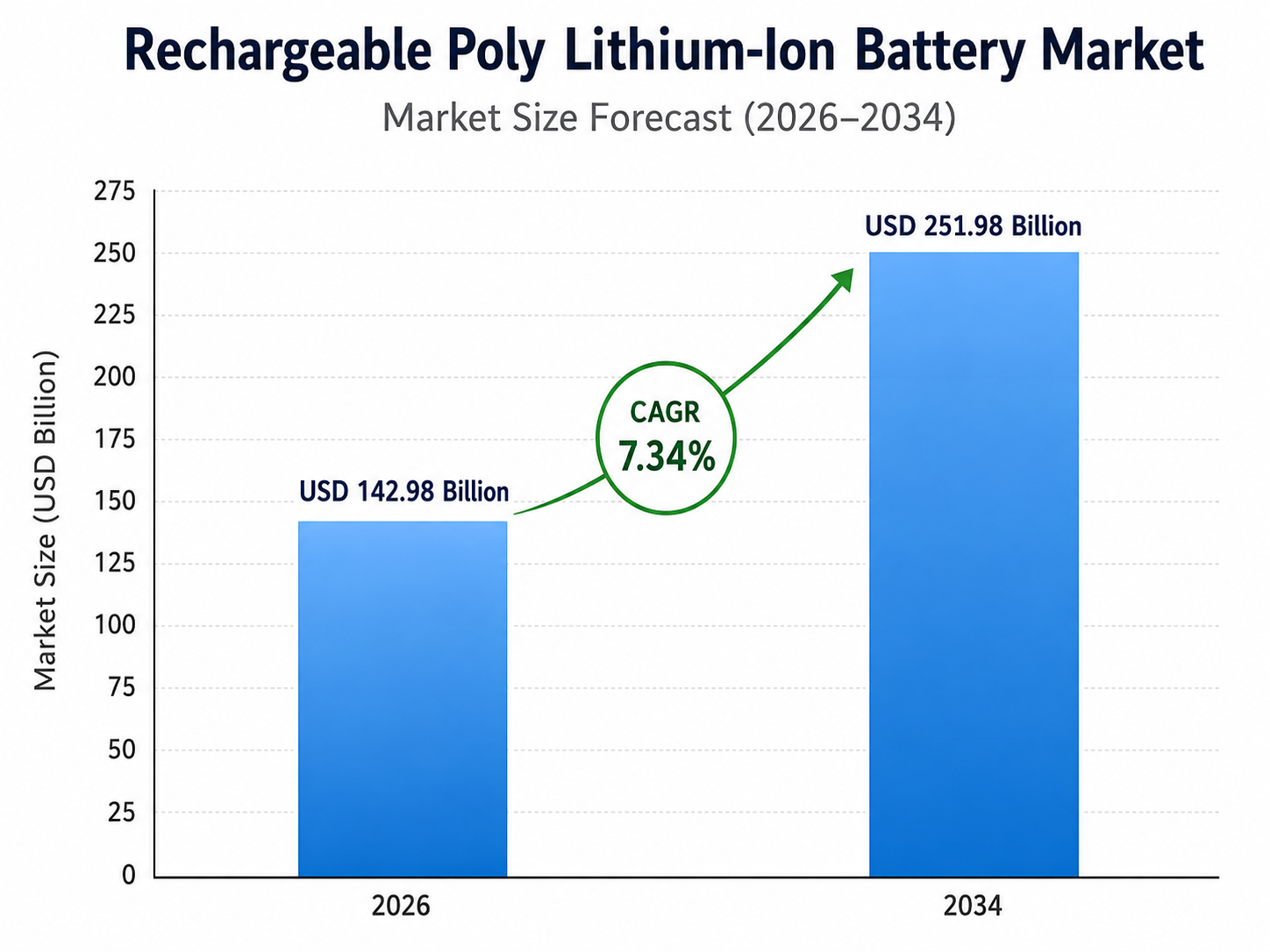
The Rechargeable Poly Lithium-Ion Battery Market is estimated to be valued at $ 142.98 billion in 2026 and is projected to reach $ 251.98 billion by 2034, expanding at a CAGR of 7.34% from 2026 to 2034.
Rechargeable lithium-ion polymer batteries use lightweight laminated or pouch packaging and polymer-based electrolyte systems to deliver compact, flexible, and high-energy-density power solutions. They are widely used in smartphones, tablets, laptops, wearable devices, wireless accessories, drones, medical equipment, electric mobility, and portable industrial electronics. Market growth is supported by device miniaturization, expanding consumer-electronics production, electric-vehicle adoption, and demand for thinner, lighter batteries with customizable shapes. Manufacturers are investing in higher-voltage cells, silicon-enhanced anodes, faster charging, improved thermal management, advanced battery-management systems, and safer pouch construction.
1. What is the latest trend in the Rechargeable Poly Lithium-Ion Battery Market?
The latest trend is the development of thinner, higher-energy-density pouch cells with faster charging, improved thermal stability, and longer cycle life.
Manufacturers are adopting advanced stacking processes, silicon-based anodes, high-voltage cathodes, and intelligent battery-management systems.
Flexible and custom-shaped batteries are gaining importance in wearables, foldable devices, medical products, and compact IoT equipment.
Improved production methods are also helping increase safety, consistency, and manufacturing yield.
2. What are the key challenges in the Rechargeable Poly Lithium-Ion Battery Market?
Key challenges include thermal runaway risk, swelling, puncture sensitivity, limited cycle life, raw-material volatility, and difficult recycling.
Pouch cells require careful mechanical protection because their laminated packaging is less rigid than cylindrical or prismatic metal cases.
Manufacturers must tightly control moisture, electrode alignment, electrolyte distribution, and sealing quality during production.
Competition from solid-state, sodium-ion, and other emerging battery technologies may influence long-term investment.
3. What is the major driving factor for the market?
The major driving factor is rising demand for lightweight, compact, and rechargeable power sources across portable electronics and electric mobility.
Smartphones, laptops, tablets, wireless earbuds, wearables, drones, and medical devices require batteries suited to increasingly thin designs.
Polymer pouch cells provide greater dimensional flexibility than conventional rigid battery formats.
Growing electrification and continuous device usage further support original-equipment and replacement demand.
4. What is the major segment in the market and why?
The 3.7-volt battery segment represents a major category because it is widely used across smartphones, tablets, wearables, portable electronics, and small mobility devices.
This voltage provides a practical balance between energy density, operating compatibility, cell size, and charging requirements.
Standardized voltage architecture also simplifies integration with common electronic circuits and battery-management systems.
Higher-voltage cells are gaining adoption as manufacturers seek additional energy within limited device space.
5. Which application or end-user is driving more demand?
Consumer electronics is driving substantial demand through smartphones, laptops, tablets, smartwatches, earbuds, cameras, and portable gaming devices.
Drone and wearable-device manufacturers also favor lithium-polymer cells because of their lightweight construction and customizable shape.
Electric motorcycles, power tools, medical devices, and compact industrial systems provide additional growth opportunities.
Applications where low weight and limited installation space are critical show particularly strong adoption.
6. Which region offers the highest growth potential and why?
Asia Pacific offers the highest growth potential due to its concentration of consumer-electronics production, battery manufacturing, and electric-vehicle supply chains.
China, South Korea, Japan, India, and Southeast Asia support large-scale production of smartphones, wearables, drones, and mobility products.
The region benefits from substantial manufacturing capacity, technical expertise, and proximity to major device assemblers.
Continued electrification and local battery investment are expected to reinforce its leading position.
7. What strategies are major companies adopting in the market?
Major companies are focusing on higher energy density, safer pouch structures, faster charging, advanced materials, and improved manufacturing yields.
They are expanding production capacity and forming long-term supply partnerships with electronics, automotive, drone, and energy-storage manufacturers.
Vertical integration into cathodes, anodes, separators, battery-management systems, and recycling is becoming increasingly important.
Companies are also investing in solid-state, silicon-anode, lithium-sulfur, and sodium-ion technologies.
8. What are the leading companies in the Rechargeable Poly Lithium-Ion Battery Market?
Leading companies include Amperex Technology Limited, LG Energy Solution, Samsung SDI, Panasonic Energy, Murata Manufacturing, CATL, BYD, EVE Energy, SK On, Gotion High-Tech, and Grepow.
These companies compete through energy density, safety, cycle life, charging speed, customized cell dimensions, and manufacturing scale.
Large manufacturers benefit from established OEM relationships and broad lithium-ion technology portfolios.
Supplier qualification, product reliability, manufacturing yield, and long-term customer agreements remain key competitive factors.
9. Why are rechargeable poly lithium-ion batteries strategically important for device manufacturers?
These batteries allow manufacturers to create thinner, lighter, and more ergonomically designed products without relying on rigid cylindrical cell dimensions.
Their customizable pouch construction helps maximize battery capacity within irregular or tightly constrained internal spaces.
Higher energy density can support longer operating time, enhanced product functionality, and premium device positioning.
Battery performance therefore directly influences product design, reliability, safety, and consumer experience.
10. What is the future outlook for the market?
The market outlook remains positive as portable devices, drones, wearables, electric mobility, and connected equipment continue to expand.
Future products will increasingly incorporate silicon-rich anodes, high-voltage chemistry, advanced separators, smarter thermal controls, and rapid charging.
Safety, recycling, supply-chain localization, and lower material intensity will become more important purchasing considerations.
Companies offering thin, customized, high-performance, and reliably manufactured pouch cells are expected to strengthen their market position.
Browse Related Reports
https://www.oganalysis.com/industry-reports/encoder-market
https://www.oganalysis.com/industry-reports/agricultural-machinery-ecu-market
https://www.oganalysis.com/industry-reports/highpower-transformers-market
https://www.oganalysis.com/industry-reports/display-driver-market
https://www.oganalysis.com/industry-reports/led-drivers-market
