Respiratory Disposables Market Outlook 2026–2034: Infection Control Demand, Oxygen Delivery Products, Growth Drivers, Leading Companies, and Future Opportunities
The Respiratory Disposables Market is estimated to be valued at $ 4.88 billion in 2026 and is projected to reach $ 10.38 billion by 2034, expanding at a CAGR of 9.9% from 2026 to 2034.
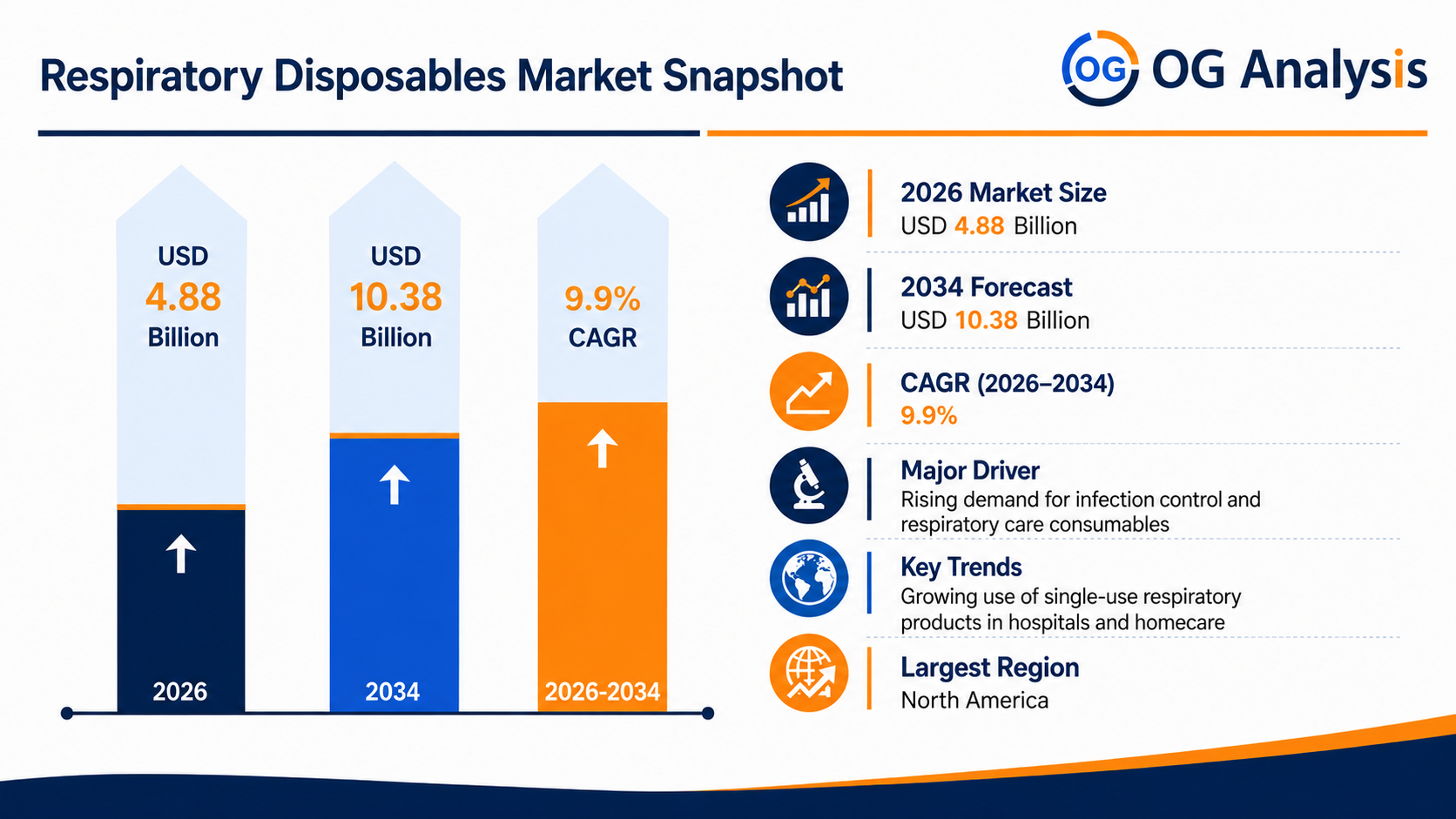
Respiratory disposables are single-use medical products used to support oxygen delivery, airway management, ventilation, anesthesia, nebulization, suction, humidification, and infection control. Key products include oxygen masks, nebulizer masks, nasal cannulas, endotracheal tubes, tracheostomy tubes, breathing circuits, filters, resuscitators, humidifiers, airways, suction catheters, and related accessories. Market growth is supported by rising prevalence of COPD, asthma, sleep apnea, pneumonia, chronic respiratory disorders, surgical procedures, emergency care requirements, and post-acute home respiratory care. Hospitals and intensive care units remain major users due to high procedure volumes and strict infection-prevention protocols, while homecare demand is increasing with long-term oxygen therapy, remote monitoring, and chronic respiratory disease management. Product innovation is focused on patient comfort, antimicrobial materials, improved fit, better oxygen delivery, lower contamination risk, and sustainable disposable materials.
Get Your Free Sample Report for In-Depth Market Insights :
https://www.oganalysis.com/industry-reports/respiratory-disposables-market
1. What is the latest trend in the Respiratory Disposables Market?
The latest trend is rising demand for single-use respiratory products that reduce cross-contamination risk in hospitals, ICUs, emergency departments, and homecare settings.
Manufacturers are improving masks, cannulas, filters, breathing circuits, and airway devices with better comfort, safety, and ease of use.
Home-based oxygen therapy and chronic respiratory disease management are also increasing the use of disposable respiratory supplies.
Sustainable materials and lower-plastic disposable product designs are gaining attention as healthcare systems focus on waste reduction.
2. What are the key challenges in the Respiratory Disposables Market?
Key challenges include pricing pressure, hospital procurement cost control, waste-management concerns, product-quality variation, and supply-chain dependence.
Single-use respiratory products must meet strict safety, biocompatibility, sterility, and infection-control requirements.
Manufacturers also face pressure to balance affordability with product performance, patient comfort, and regulatory compliance.
Environmental concerns around disposable plastics are pushing companies to explore recyclable, lower-waste, and eco-conscious alternatives.
3. What is the major driving factor for the Respiratory Disposables Market?
The major driving factor is the rising burden of respiratory diseases and the growing need for safe oxygen delivery and airway-management products.
COPD, asthma, sleep apnea, pneumonia, aging populations, pollution exposure, and hospital-acquired infection concerns are strengthening demand.
Respiratory disposables are widely used in emergency care, surgery, intensive care, neonatal care, and chronic disease management.
Their single-use nature supports infection prevention and reduces cleaning, sterilization, and reuse-related risks.
4. What is the major segment in the Respiratory Disposables Market and why?
Masks and oxygen-delivery products represent a major segment because they are widely used across hospitals, emergency care, clinics, and homecare.
Oxygen masks, nebulizer masks, non-rebreather masks, and NIV masks are essential for respiratory support and therapy delivery.
Nasal cannulas and tubing are also important due to their frequent use in oxygen therapy and long-term home respiratory care.
Breathing circuits and filters are critical in anesthesia, ventilation, and ICU settings where infection control is highly important.
5. Which application or end-user is driving more demand?
Hospitals, nursing homes, clinics, trauma centers, ambulatory care centers, and homecare providers are driving strong demand.
Hospitals remain the leading users because of surgery, emergency admissions, ICU care, respiratory therapy, and infection-control requirements.
Homecare demand is expanding as more patients receive oxygen therapy, nebulization support, and chronic respiratory treatment outside hospitals.
Adult and geriatric patients account for strong demand due to higher prevalence of chronic respiratory and cardiopulmonary conditions.
6. Which region offers the highest growth potential and why?
Asia Pacific offers strong growth potential due to rising air pollution, expanding healthcare infrastructure, increasing hospital admissions, and improving access to respiratory care.
China, India, Japan, South Korea, and Southeast Asia are important markets due to large patient populations and growing healthcare spending.
North America remains a leading market due to advanced healthcare infrastructure, high chronic respiratory disease prevalence, and strong infection-control standards.
Europe is supported by aging populations, hospital hygiene protocols, and increased use of respiratory support products in acute and long-term care.
7. What strategies are major companies adopting in the market?
Major companies are focusing on safer single-use designs, improved patient comfort, antimicrobial features, better filtration, and user-friendly respiratory products.
They are expanding product portfolios across masks, cannulas, breathing circuits, filters, resuscitators, and airway-management accessories.
Companies are strengthening hospital supply contracts, distributor networks, homecare partnerships, and regulatory approvals across key regions.
Sustainability, cost-efficient manufacturing, packaging optimization, and supply-chain resilience are becoming important strategic priorities.
8. What are the leading companies in the Respiratory Disposables Market?
Leading companies include Medtronic, Teleflex, ICU Medical, Fisher & Paykel Healthcare, Ambu, Smiths Medical, Vyaire Medical, ResMed, Philips, Getinge, Drägerwerk, GE HealthCare, BD, Cardinal Health, Intersurgical, AirLife, Flexicare, and Hamilton Medical.
These companies compete through product quality, safety standards, clinical reliability, hospital relationships, regulatory approvals, and distribution strength.
Large medical device companies benefit from broad respiratory-care portfolios and strong institutional procurement networks.
Specialized suppliers compete through application-specific disposables, cost-effective products, and strong after-sales support.
9. Why are respiratory disposables strategically important for healthcare providers?
Respiratory disposables are strategically important because they support safe breathing assistance, oxygen delivery, ventilation, anesthesia, and infection control.
They help healthcare providers reduce cross-contamination risk and improve workflow efficiency in high-volume care environments.
In critical care and emergency settings, reliable disposable respiratory products are essential for rapid patient stabilization.
For homecare providers, they support long-term respiratory therapy while reducing the need for repeated sterilization.
10. What is the future outlook for the Respiratory Disposables Market?
The market outlook remains positive as respiratory disease burden, hospital infection-control needs, emergency care demand, and home respiratory therapy continue to expand.
Future growth will be supported by patient-friendly masks, improved cannulas, advanced filters, efficient breathing circuits, and sustainable disposable materials.
Homecare and chronic disease management are expected to create additional demand for oxygen-delivery and respiratory-support disposables.
Companies offering reliable quality, affordable products, strong distribution, and regulatory-compliant designs are expected to gain market share.
Browse Related Reports
https://www.oganalysis.com/industry-reports/sleep-positioning-system-market
https://www.oganalysis.com/industry-reports/iot-medical-devices-market
https://www.oganalysis.com/industry-reports/point-of-care-molecular-diagnostics-market
https://www.oganalysis.com/industry-reports/bronchodilators-market
https://www.oganalysis.com/industry-reports/medical-gas-pipeline-system-market
Stay Connected With Us
