Ring Fixation System Market Analysis: Key Trends, Companies, Applications, and Regional Outlook
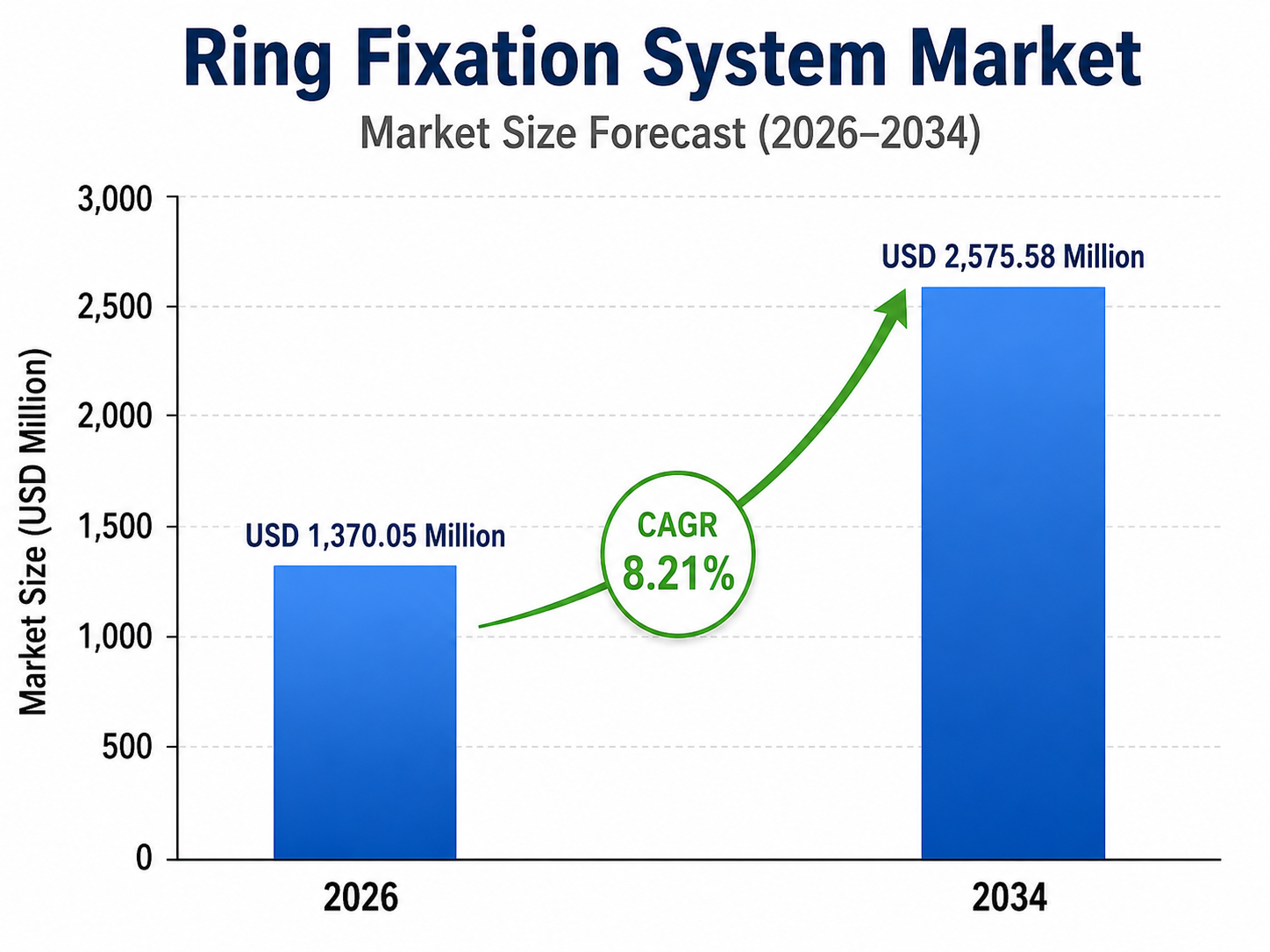
The Ring Fixation System Market is estimated to be valued at $ 1370.05 million in 2026 and is projected to reach $ 2575.58 million by 2034, expanding at a CAGR of 8.21% from 2026 to 2034.
For fracture stabilization, limb lengthening, deformity correction, non-union treatment, and complex bone reconstruction in orthopedic surgery, ring fixation systems are used as circular external fixation devices. Ring fixation systems utilize rings, wires, pins, rods, and adjustable struts to stabilize bones while enabling controlled correction and gradual healing.
Market growth is driven by the increasing incidence of trauma cases, a rising number of orthopedic procedures, growing adoption of limb reconstruction techniques, and demand for advanced fixation solutions for complex fractures. Hospitals, orthopedic specialty centers, and trauma care facilities represent key end users, while ongoing advancements in lightweight frames, computer-assisted correction technologies, and modular fixation systems are further contributing to market expansion.
1. What is the latest trend in the Ring Fixation System Market?
The latest trend is the shift toward computer-assisted and hexapod ring fixation systems that improve accuracy in deformity correction and limb reconstruction.
Surgeons are increasingly using digital planning tools, adjustable struts, and patient-specific correction protocols to improve treatment outcomes.
Lightweight materials, modular designs, and improved patient comfort features are also gaining importance.
This trend is moving the market from conventional fixation toward more precise and programmable orthopedic correction systems.
2. What are the key challenges in the Ring Fixation System Market?
Key challenges include patient discomfort, pin-site infection risk, long treatment duration, complex frame management, and the need for highly skilled orthopedic surgeons.
Ring fixation systems require careful planning, regular follow-up, and strong patient compliance throughout the treatment period.
Competition from internal fixation devices, intramedullary nails, and minimally invasive orthopedic solutions can also limit adoption.
Cost sensitivity and limited access to advanced orthopedic care remain concerns in developing healthcare markets.
3. What is the major driving factor for the Ring Fixation System Market?
The major driving factor is the rising number of complex fractures, road accident injuries, orthopedic deformities, and limb reconstruction procedures.
Ring fixation systems are widely preferred in cases where conventional fixation may not provide sufficient stability or correction flexibility.
Growing demand for limb salvage, deformity correction, and treatment of non-union or infected fractures is supporting adoption.
Advances in trauma care and reconstructive orthopedics are further strengthening market growth.
4. What is the major segment in the Ring Fixation System Market and why?
Orthopedic surgery and trauma surgery represent major application segments because ring fixation systems are mainly used for complex bone stabilization and correction.
These systems are highly effective in treating open fractures, limb length discrepancies, angular deformities, non-unions, and bone defects.
Their ability to provide stable fixation while allowing gradual adjustment makes them valuable in difficult orthopedic cases.
Demand is strongest in procedures requiring precision, flexibility, and long-term external support.
5. Which application or end-user is driving more demand?
Hospitals and orthopedic specialty centers are driving strong demand because most ring fixation procedures require surgical expertise, imaging support, and continuous follow-up care.
Trauma centers are also important users due to the high need for external fixation in severe fractures and complex injury cases.
Limb reconstruction, pediatric orthopedics, and deformity correction applications are creating specialized demand.
Growing orthopedic infrastructure and surgeon training are supporting wider use across advanced care facilities.
6. Which region offers the highest growth potential and why?
Asia Pacific offers strong growth potential due to rising trauma incidence, expanding orthopedic procedures, improving hospital infrastructure, and growing access to advanced surgical care.
Countries such as China, India, Japan, and South Korea are witnessing increasing demand for trauma fixation and limb reconstruction solutions.
North America and Europe remain important markets due to advanced orthopedic practices, specialist surgeons, and established trauma care systems.
Emerging markets are expected to benefit from healthcare modernization and rising awareness of advanced external fixation techniques.
7. What strategies are major companies adopting in the Ring Fixation System Market?
Major companies are focusing on modular product design, surgeon training programs, clinical education, improved frame materials, and procedure-specific fixation systems.
They are developing lightweight, adjustable, and easier-to-assemble ring fixation solutions to improve surgical efficiency and patient comfort.
Partnerships with hospitals, orthopedic centers, and distributors are helping companies expand regional access.
Companies are also strengthening portfolios through trauma fixation, limb reconstruction, and specialty orthopedic product expansion.
8. What are the Major companies in the Ring Fixation System Market?
Leading companies include Smith & Nephew, Orthofix Medical, Johnson & Johnson MedTech/DePuy Synthes, Stryker, Zimmer Biomet, OrthoPediatrics, Citieffe, Response Ortho, Auxein Medical, Double Medical, WishBone Medical, and Mikai.
These players compete through product reliability, frame stability, surgeon familiarity, clinical support, and breadth of orthopedic fixation portfolios.
Companies with established trauma networks and strong surgeon education programs hold a competitive advantage.
Specialized players are also gaining attention through limb reconstruction and deformity correction-focused solutions.
9. Why are ring fixation systems strategically important for orthopedic care providers?
Ring fixation systems are strategically important because they address complex cases that cannot always be managed effectively with standard internal fixation.
They support limb salvage, gradual deformity correction, bone transport, and fracture stabilization in difficult clinical conditions.
For hospitals, these systems improve the ability to treat severe trauma and advanced reconstructive cases.
For manufacturers, they represent a specialized orthopedic segment with strong clinical value and recurring demand from trauma and reconstruction centers.
10. What is the future outlook for the Ring Fixation System Market?
The market outlook remains positive as demand increases for advanced orthopedic reconstruction, complex fracture care, and deformity correction procedures.
Growth will be supported by digital planning, hexapod fixation systems, improved materials, modular designs, and better patient-management tools.
Emerging markets are expected to create new opportunities as trauma care and orthopedic infrastructure expand.
Companies that combine clinical education, product reliability, affordability, and advanced correction capabilities are expected to gain market share.
Browse Related Report
https://www.oganalysis.com/industry-reports/industrial-control-systems-ics-market
https://www.oganalysis.com/industry-reports/industrial-burner-market
https://www.oganalysis.com/industry-reports/micro-and-nano-plc-market
https://www.oganalysis.com/industry-reports/industrial-sensors-market
https://www.oganalysis.com/industry-reports/cryocooler-market
