School and Employee Bus Services Market Outlook 2026–2034: Fleet Electrification, Safety Technology, Growth Drivers, and Future Opportunities
The School and Employee Bus Services Market is expected to grow from $ 65.2 billion in 2026 to $ 134 billion by 2034, registering a CAGR of 9.4%
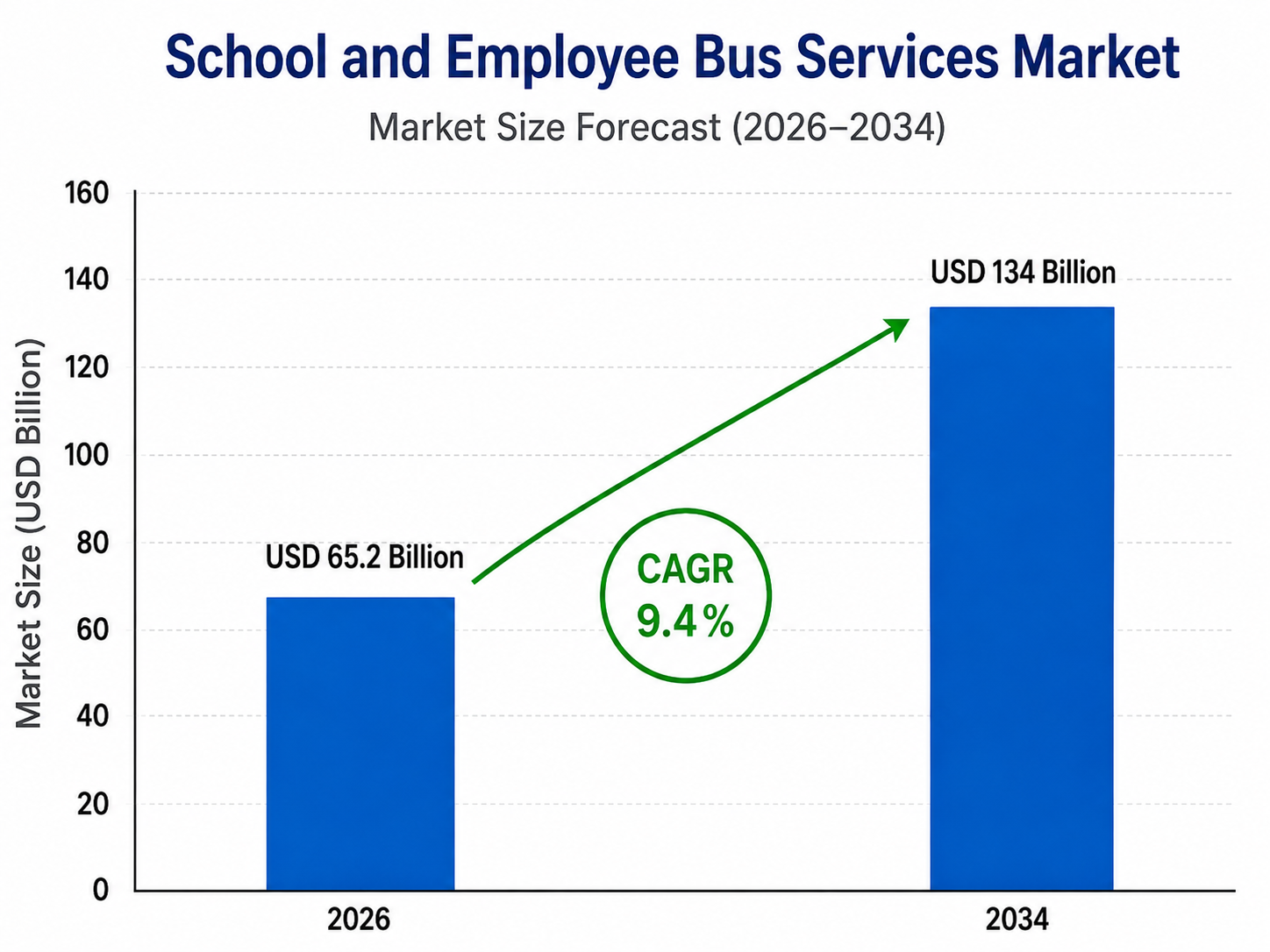
During the forecast period. The market includes contracted transportation services for school students, corporate employees, industrial workers, university campuses, healthcare institutions, government organizations, and other institutional staff. These services cover route planning, fleet management, driver administration, vehicle maintenance, GPS tracking, safety monitoring, scheduling, and specialized transportation for passengers with additional mobility needs. Market growth is being driven by the increasing outsourcing of transportation operations, rising demand for reliable student and employee commuting solutions, growing urbanization and traffic congestion, and a stronger focus on safe and cost-effective shared mobility. In addition, service providers are investing in electric bus fleets, AI-enabled route optimization, real-time vehicle tracking, driver behavior monitoring systems, and mobile communication platforms to enhance operational efficiency, improve passenger safety, and deliver a better commuting experience, supporting the market's long-term growth.
1. What is the latest trend in the School and Employee Bus Services Market?
The latest trend is the shift toward connected, technology-enabled, and lower-emission transportation services.
Operators are adopting GPS tracking, parent and employee mobile apps, route optimization, digital attendance, and driver-behavior monitoring.
Electric school buses and corporate shuttle fleets are also gaining attention as customers pursue sustainability targets.
This is transforming bus services from basic transportation contracts into managed mobility solutions.
2. What are the key challenges in the School and Employee Bus Services Market?
Key challenges include driver shortages, rising fuel and maintenance costs, vehicle availability, insurance expenses, and strict safety requirements.
Service providers must also manage route disruptions, traffic congestion, changing school schedules, and fluctuating employee attendance patterns.
Contract pricing pressure can affect margins, particularly where labor and compliance costs are increasing.
Fleet electrification also requires charging infrastructure, higher upfront investment, and operational planning.
3. What is the major driving factor for the School and Employee Bus Services Market?
The major driving factor is the increasing outsourcing of transportation by schools, corporations, universities, and institutions.
Outsourcing allows customers to reduce fleet-management complexity while improving safety, reliability, and route efficiency.
Demand is also supported by urban congestion, corporate sustainability programs, and the need for organized daily commute solutions.
Schools and employers are prioritizing dependable transport services that improve access, punctuality, and user convenience.
4. What is the major segment in the School and Employee Bus Services Market and why?
School bus services represent a major segment because student transportation is a recurring, essential, and highly regulated service.
Public and private schools depend on scheduled bus services for daily home-to-school transport, special-needs routes, and activity trips.
Long-term contracts, predictable route structures, and safety mandates create stable demand.
Employee bus services are also expanding as companies improve workforce mobility and reduce private-vehicle dependence.
5. Which application or end-user is driving more demand?
Educational institutions are driving strong demand due to daily student transport requirements and increasing focus on safe, monitored mobility.
Corporates, IT parks, industrial plants, healthcare campuses, and universities are important users of employee and institutional shuttle services.
Large employers use bus services to improve employee punctuality, reduce parking pressure, and support commute benefits.
Demand is strongest where public transit coverage is limited or commute distances are high.
6. Which region offers the highest growth potential and why?
Asia Pacific offers strong growth potential due to urbanization, expanding school enrollment, large corporate campuses, and growing organized transport demand.
India, China, Southeast Asia, Japan, and South Korea are seeing rising demand for school transport, employee shuttles, and app-enabled mobility.
North America remains a leading established market due to large school-bus fleets and strong outsourced transportation networks.
Europe also offers opportunities through sustainable mobility programs, safety regulations, and electric fleet adoption.
7. What strategies are major companies adopting in the market?
Major companies are focusing on fleet modernization, electric buses, route optimization, safety systems, and digital customer communication.
They are investing in GPS platforms, real-time tracking, driver training, predictive maintenance, and mobile applications.
Long-term contracts with school districts, corporations, universities, and public agencies remain central to growth.
Companies are also expanding through acquisitions, regional partnerships, and specialized services such as special-needs transportation.
8. What are the leading companies in the School and Employee Bus Services Market?
Leading companies include First Student, Durham School Services, Student Transportation of America, Transdev, Kelsian Group, ComfortDelGro, DATTCO, North America Central School Bus, Zum, WeDriveU, Swvl, and Reliance Transport.
These providers compete through safety record, route reliability, fleet scale, driver availability, technology platforms, and regional coverage.
Large operators benefit from long-term institutional contracts and maintenance infrastructure.
Technology-led providers are gaining attention through app-based tracking, optimized routing, and flexible shuttle management.
9. Why are school and employee bus services strategically important for institutions?
School and employee bus services improve access, safety, punctuality, and operational continuity for schools and workplaces.
For educational institutions, reliable transport supports attendance, parental confidence, and student safety.
For employers, organized bus services can reduce parking demand, improve workforce retention, and support sustainability objectives.
For service providers, recurring contracts create stable revenue and opportunities for technology-led service differentiation.
10. What is the future outlook for the School and Employee Bus Services Market?
The market outlook remains positive as institutions continue outsourcing transportation and demand more reliable, safe, and sustainable mobility solutions.
Future growth will be supported by electric buses, connected fleet platforms, dynamic routing, safety analytics, and mobile user applications.
Employee shuttle demand is expected to grow with hybrid work patterns, large campuses, and corporate mobility benefits.
Companies offering cost-efficient, technology-enabled, low-emission, and safety-focused services are expected to gain market share
Browse Related Reports:
https://www.oganalysis.com/industry-reports/ebike-drive-unit-market
https://www.oganalysis.com/industry-reports/electric-car-rental-market
https://www.oganalysis.com/industry-reports/allwheel-drive-market
https://www.oganalysis.com/industry-reports/shared-mobility-market
https://www.oganalysis.com/industry-reports/invisible-car-cover-market
