Sepsis Diagnostics Market Outlook 2026–2034: Rapid Testing Trends, Growth Drivers, Leading Companies, and Future Opportunities
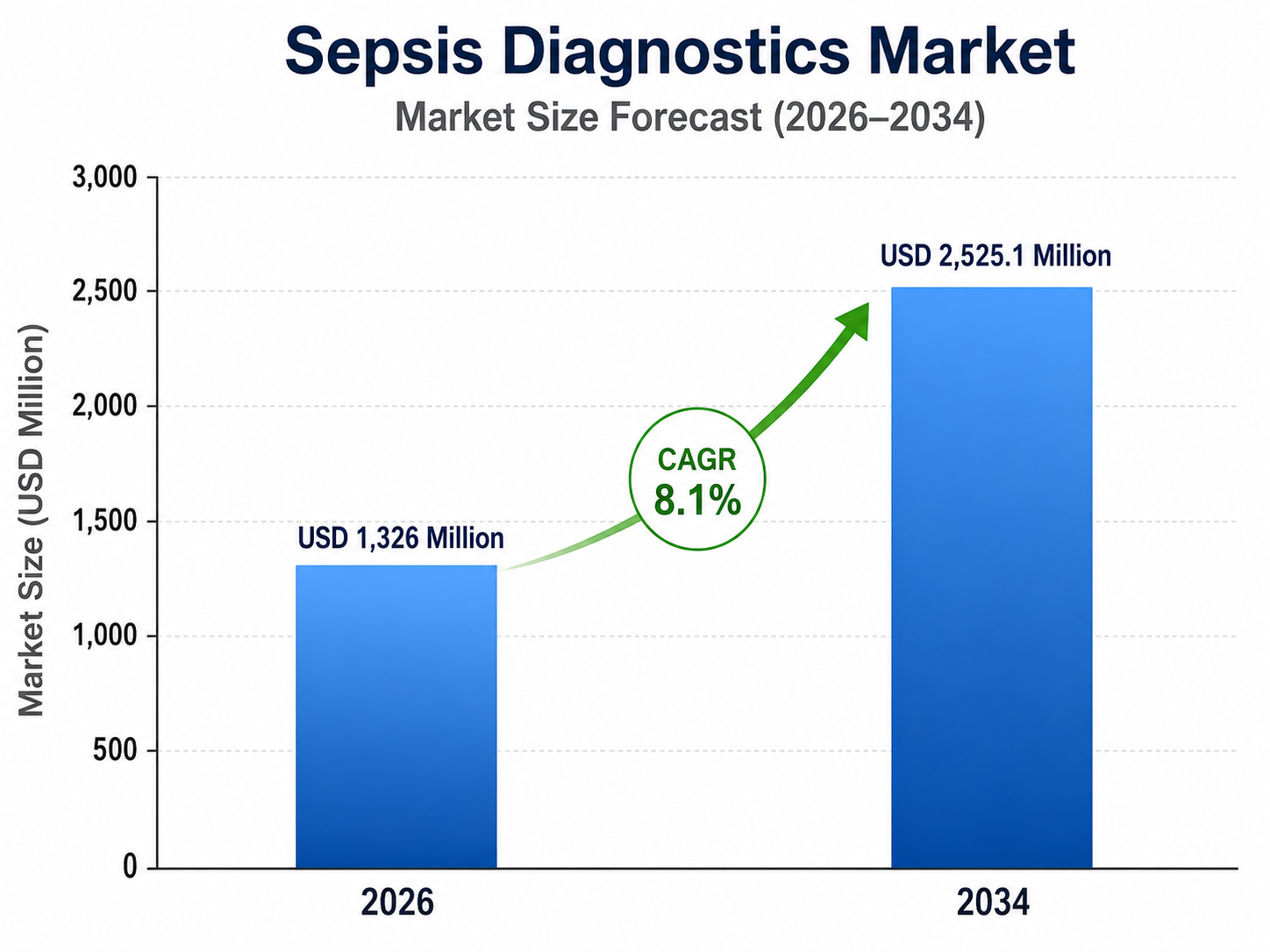
The Sepsis Diagnostics Market is expected to grow from $ 1,326 million in 2026 to $ 2,525.1 million by 2034, registering a CAGR of 8.1%.
During the forecast period. Sepsis diagnostics play a vital role in the early detection of bloodstream infections by using technologies such as blood culture systems, molecular assays, biomarker tests, immunoassays, microbiology instruments, and point-of-care testing platforms. These diagnostic solutions help healthcare providers identify infections quickly, enabling timely treatment and improving patient outcomes. Market growth is being driven by the rising incidence of hospital-acquired infections, increasing admissions to intensive care units, the growing challenge of antimicrobial resistance, and the need for faster and more accurate diagnostic results. At the same time, healthcare facilities are placing greater emphasis on reducing sepsis-related mortality and improving antimicrobial stewardship. Ongoing advancements in automated laboratory workflows, multiplex testing, host-response biomarkers, and rapid detection of bacterial, fungal, and antimicrobial resistance markers are further enhancing the effectiveness of sepsis diagnostics and supporting wider adoption across healthcare settings.
1. What is the latest trend in the Sepsis Diagnostics Market?
The latest trend is the adoption of rapid molecular testing, multiplex panels, host-response biomarkers, and AI-supported diagnostic interpretation.
Hospitals are seeking platforms that identify pathogens and resistance markers faster than conventional culture-based workflows.
Point-of-care and cartridge-based systems are also gaining attention for emergency and intensive care settings.
These technologies support earlier targeted therapy and more effective antimicrobial stewardship.
2. What are the key challenges in the Sepsis Diagnostics Market?
Key challenges include high test costs, limited sensitivity at low pathogen concentrations, complex clinical validation, and reimbursement uncertainty.
Sepsis can present with nonspecific symptoms, making accurate differentiation from other inflammatory conditions difficult.
Advanced molecular systems also require skilled personnel, laboratory infrastructure, and workflow integration.
False-negative or inconclusive results can delay treatment and reduce clinician confidence in newer technologies.
3. What is the major driving factor for the Sepsis Diagnostics Market?
The major driving factor is the urgent need for earlier sepsis recognition and faster initiation of appropriate treatment.
Delayed pathogen identification can increase mortality, hospitalization duration, intensive care use, and overall treatment costs.
Rising antimicrobial resistance is also increasing demand for tests that identify organisms and resistance markers rapidly.
Hospital quality programs and sepsis-management protocols are further strengthening diagnostic adoption.
4. What is the major segment in the Sepsis Diagnostics Market and why?
Blood culture remains a major technology segment because it is widely established, clinically accepted, and capable of confirming viable bloodstream pathogens.
Hospitals and diagnostic laboratories routinely use automated blood culture systems as an initial sepsis-testing method.
Its broad organism coverage and compatibility with downstream identification and susceptibility testing support continued demand.
Molecular diagnostics are growing rapidly because they provide faster and more targeted results.
5. Which application or end-user is driving more demand?
Hospitals are the leading end users because emergency departments, intensive care units, and inpatient wards manage most suspected sepsis cases.
Hospital laboratories require continuous access to blood culture, molecular, immunoassay, and antimicrobial-susceptibility testing.
Diagnostic laboratories also contribute through centralized pathogen identification and confirmatory testing.
Demand is particularly strong in critical care, neonatal care, oncology, transplant, and immunocompromised patient settings.
6. Which region offers the highest growth potential and why?
Asia Pacific offers strong growth potential due to expanding hospital infrastructure, rising infection burden, and improving access to advanced diagnostics.
China, India, Japan, South Korea, and Southeast Asia are increasing investments in laboratory automation and critical-care capacity.
North America remains a leading established market because of advanced healthcare systems and strong adoption of rapid diagnostics.
Europe also benefits from antimicrobial stewardship programs and well-developed clinical laboratory networks.
7. What strategies are major companies adopting in the Sepsis Diagnostics Market?
Major companies are focusing on faster time-to-result, multiplex testing, automation, biomarker innovation, and antimicrobial-resistance detection.
They are integrating instruments, reagents, software, and laboratory information systems into complete diagnostic workflows.
Partnerships with hospitals, research institutions, and clinical laboratories support validation and market adoption.
Acquisitions and product launches are also being used to expand molecular and point-of-care portfolios.
8. What are the leading companies in the Sepsis Diagnostics Market?
Leading companies include bioMérieux, Becton Dickinson, Danaher through Cepheid and Beckman Coulter, Roche, Thermo Fisher Scientific, Abbott, DiaSorin, Bruker, T2 Biosystems, Cytovale, and Seegene.
These companies compete through diagnostic speed, assay breadth, automation, clinical accuracy, and installed laboratory networks.
Large diagnostics companies benefit from integrated microbiology, molecular, and immunoassay portfolios.
Specialized firms compete through rapid pathogen detection, host-response testing, and sepsis-focused technologies.
9. Why are sepsis diagnostics strategically important for healthcare providers?
Sepsis diagnostics support earlier clinical decisions, more appropriate antibiotic selection, and improved patient-management pathways.
Faster diagnosis can help reduce unnecessary broad-spectrum antibiotic use and support antimicrobial stewardship.
For hospitals, effective testing may lower intensive care utilization, treatment delays, and avoidable costs.
It also supports quality improvement, infection control, and clinical outcome measurement.
10. What is the future outlook for the Sepsis Diagnostics Market?
The market outlook remains positive as healthcare systems prioritize rapid infection diagnosis and improved sepsis outcomes.
Growth will be supported by multiplex molecular assays, host-response biomarkers, automated microbiology, and decentralized testing.
Future platforms are expected to combine pathogen identification, resistance detection, and clinical-risk assessment in shorter workflows.
Companies offering clinically validated, affordable, and easily integrated solutions are likely to gain market share.
Browse Related Reports:
https://www.oganalysis.com/industry-reports/hdpe-high-density-polyethylene-market
https://www.oganalysis.com/industry-reports/aromatic-secondary-amines-market
https://www.oganalysis.com/industry-reports/biphenyl-diphenyl-ether-market
https://www.oganalysis.com/industry-reports/random-tower-packing-market
https://www.oganalysis.com/industry-reports/polypropylene-twine-market
