Space Propulsion Market Outlook 2026–2034: Electric Propulsion Trends, Growth Drivers, Leading Companies, and Future Opportunities
The Space Propulsion Market is expected to grow from $ 14.1 billion in 2026 to $ 48.6 billion by 2034, registering a CAGR of 16.7%
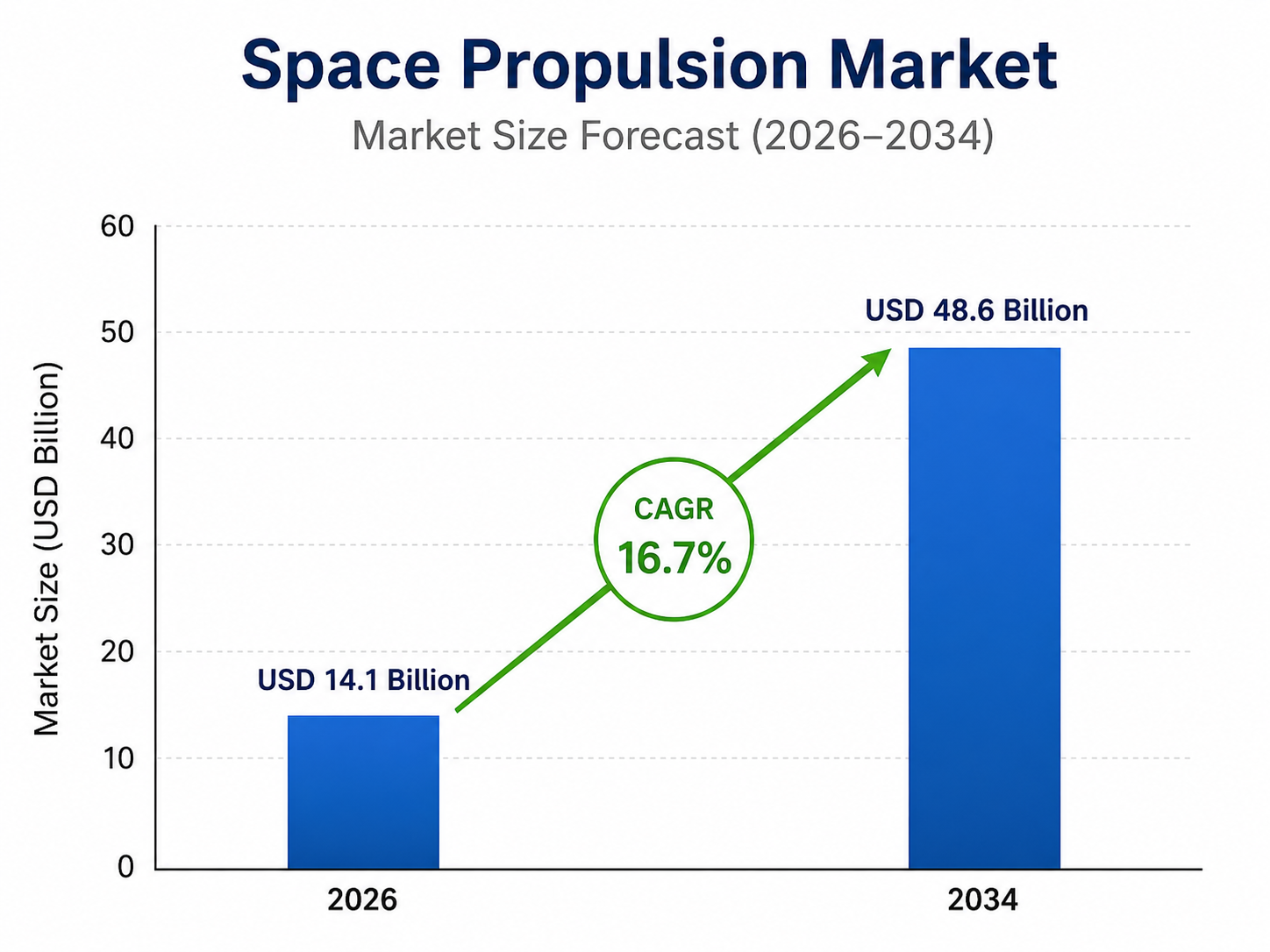
During the forecast period. Space propulsion systems play a vital role in powering launch vehicles, satellites, spacecraft, space probes, landers, and orbital transfer vehicles by providing the thrust required for launch, maneuvering, orbit maintenance, and deep-space missions. The market includes a wide range of propulsion technologies, such as chemical propulsion, electric propulsion, hybrid propulsion, cold gas thrusters, ion thrusters, Hall-effect thrusters, green propulsion systems, and emerging nuclear and solar-electric propulsion concepts. Market growth is being driven by the increasing number of satellite launches, expanding commercial space activities, rising investments in defense and national space programs, growing interest in deep-space exploration, and the adoption of reusable launch vehicles. In addition, the need for efficient satellite orbit-raising, station-keeping, collision avoidance, and end-of-life deorbiting is accelerating demand for advanced propulsion technologies. Continuous innovation in high-efficiency, low-cost, and environmentally sustainable propulsion systems is further enhancing mission flexibility, extending spacecraft operational life, improving payload capacity, and supporting the long-term growth of the global space industry.
1. What is the latest trend in the Space Propulsion Market?
The latest trend is the rising adoption of electric propulsion for satellites and spacecraft due to its higher fuel efficiency and suitability for long-duration missions.
Hall-effect thrusters, ion propulsion, and solar-electric systems are increasingly used for orbit raising, station-keeping, and deep-space applications.
Green propulsion and reusable launch propulsion are also gaining momentum as operators focus on cost, safety, and sustainability.
Small-satellite propulsion is emerging as a major innovation area as constellations require precise maneuvering and deorbiting capability.
2. What are the key challenges in the Space Propulsion Market?
Key challenges include high development cost, long qualification cycles, launch-risk exposure, propulsion reliability, and strict mission-performance requirements.
Space propulsion systems must operate in extreme conditions with limited maintenance or repair options after deployment.
Electric systems face limitations related to thrust levels, power availability, and mission duration trade-offs.
Supply-chain constraints, component testing, regulatory approvals, and export controls also affect commercialization.
3. What is the major driving factor for the Space Propulsion Market?
The major driving factor is the rapid expansion of satellite launches, space exploration programs, and commercial space missions.
Satellites require propulsion for orbit insertion, station-keeping, attitude control, collision avoidance, and end-of-life disposal.
Growing demand for communication, Earth observation, navigation, defense, and scientific missions is strengthening propulsion demand.
Reusable launch systems and small-satellite constellations are further increasing the need for efficient and reliable propulsion technologies.
4. What is the major segment in the Space Propulsion Market and why?
Chemical propulsion remains a major segment because it provides high thrust and is widely used in launch vehicles, spacecraft maneuvers, and major orbital transfer operations.
It is preferred where rapid acceleration, heavy payload movement, and high-energy mission phases are required.
Established infrastructure, proven reliability, and extensive launch-vehicle use support its strong market position.
Electric propulsion is growing faster in satellite and deep-space applications because it offers superior fuel efficiency.
5. Which application or end-user is driving more demand?
Satellite operators and launch vehicle manufacturers are driving major demand for space propulsion systems.
Commercial satellite constellations require propulsion for deployment, orbit maintenance, maneuvering, and controlled deorbiting.
Government and defense agencies are also major users through national security satellites, space exploration, and scientific missions.
Demand is strongest where mission life, maneuverability, fuel efficiency, and payload optimization are critical.
6. Which region offers the highest growth potential and why?
North America remains a leading market due to strong commercial space activity, defense spending, launch infrastructure, and advanced propulsion development.
The United States has a deep ecosystem of launch providers, satellite manufacturers, defense agencies, and space technology startups.
Asia Pacific offers strong growth potential through expanding national space programs, satellite launches, and lunar and planetary missions.
Europe also remains important through ArianeGroup, Airbus, Safran, OHB, and increasing investment in satellite and launcher technologies.
7. What strategies are major companies adopting in the market?
Major companies are focusing on electric propulsion, reusable engines, green propellants, modular thrusters, and propulsion systems for small satellites.
They are investing in higher efficiency, longer mission life, lower mass, and better integration with spacecraft power systems.
Partnerships with satellite manufacturers, launch providers, defense agencies, and space research organizations are central to growth.
Companies are also expanding testing, qualification, and production capacity to support increasing launch and satellite volumes.
8. What are the leading companies in the Space Propulsion Market?
Leading companies include SpaceX, Safran, IHI Corporation, Northrop Grumman, L3Harris Technologies, Aerojet Rocketdyne, ArianeGroup, Airbus, Lockheed Martin, Moog, Busek, ENPULSION, Orbion Space Technology, Thales, and VACCO Industries.
These companies compete through thrust performance, reliability, efficiency, mission heritage, system integration, and production scalability.
Established aerospace players benefit from government and defense contracts, while newer firms focus on small-satellite and electric propulsion.
Technology differentiation is increasingly linked to fuel efficiency, reusability, reduced system mass, and mission flexibility.
9. Why is space propulsion strategically important for space operators?
Space propulsion is strategically important because it determines how spacecraft reach, maintain, adjust, and exit their operational orbits.
Reliable propulsion extends satellite life, improves mission flexibility, supports collision avoidance, and enables controlled deorbiting.
For launch providers, propulsion performance directly affects payload capacity, reusability, and launch cost competitiveness.
For governments and defense agencies, propulsion capability is central to national space access and strategic mission readiness.
10. What is the future outlook for the Space Propulsion Market?
The market outlook remains strong as satellite constellations, reusable launch systems, lunar missions, and deep-space exploration continue to expand.
Future growth will be supported by electric propulsion, green propellants, advanced chemical engines, nuclear propulsion research, and in-orbit servicing.
Small-satellite propulsion and autonomous maneuvering systems are expected to create significant commercial opportunities.
Companies offering reliable, efficient, scalable, and mission-specific propulsion solutions are expected to gain market share
Browse Related Reports:
https://www.oganalysis.com/industry-reports/military-aircraft-avionics-market
https://www.oganalysis.com/industry-reports/more-electric-aircraft-market
https://www.oganalysis.com/industry-reports/military-satellite-market
https://www.oganalysis.com/industry-reports/airport-passenger-screening-systems-market
https://www.oganalysis.com/industry-reports/maritime-security-market
