Water and Wastewater Treatment Market Outlook 2026–2034: Reuse Technologies, Infrastructure Investment, Leading Companies, and Growth Opportunities
The Water and Wastewater Treatment Market is estimated to be valued at $ 328.81 billion in 2026 and is projected to reach $ 590.80 billion by 2034, expanding at a CAGR of 7.12% from 2026 to 2034.
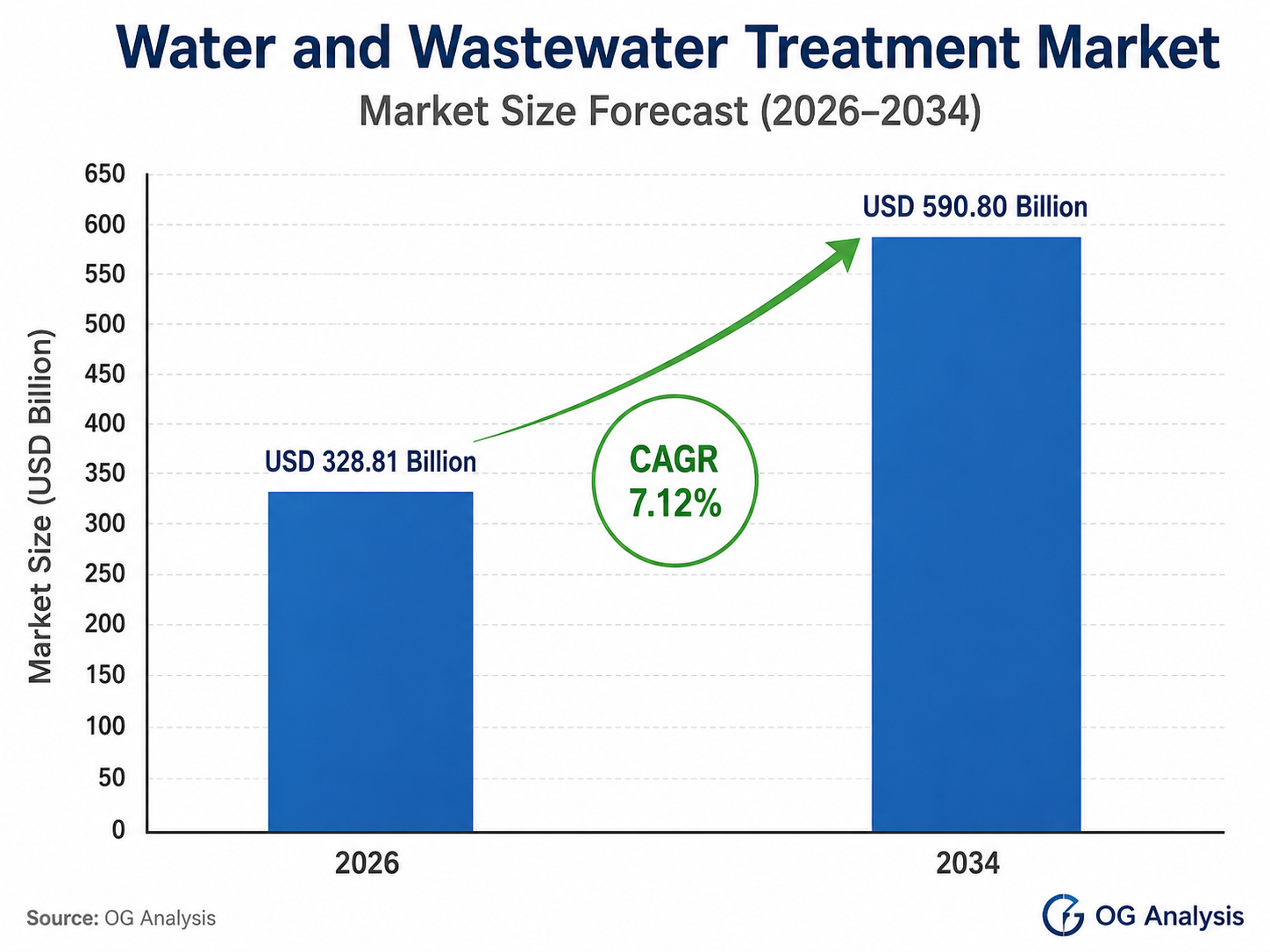
The market includes treatment equipment, chemicals, membranes, filtration systems, biological processes, disinfection technologies, digital monitoring platforms, and operational services used across municipal and industrial facilities. Growth is driven by water scarcity, rapid urbanization, industrial expansion, tighter discharge regulations, and rising demand for water reuse. Utilities and industries are investing in advanced treatment to improve water quality, reduce environmental impact, recover valuable resources, and strengthen long-term water security.
1. What is the latest trend in the Water and Wastewater Treatment Market?
The latest trend is the shift toward water reuse, zero-liquid-discharge systems, advanced membranes, and digitally monitored treatment facilities.
Operators are integrating sensors, AI analytics, remote monitoring, and predictive maintenance to improve plant efficiency.
Energy-efficient desalination, nutrient recovery, and decentralized treatment systems are also gaining attention.
These trends are transforming treatment plants into more intelligent water-resource recovery facilities.
2. What are the key challenges in the Water and Wastewater Treatment Market?
Key challenges include high capital expenditure, energy consumption, aging infrastructure, sludge disposal, and shortage of skilled operators.
Advanced treatment systems can also involve membrane fouling, chemical usage, maintenance complexity, and variable influent quality.
Municipal projects may face funding constraints, lengthy approvals, and tariff affordability concerns.
Industrial users must balance compliance requirements with operating cost and production continuity.
3. What is the major driving factor for the Water and Wastewater Treatment Market?
The major driving factor is increasing pressure to address water scarcity, pollution, and stricter wastewater-discharge standards.
Municipalities require additional capacity as urban populations and water consumption continue to rise.
Industries are investing in treatment and reuse to secure water supply, lower discharge costs, and meet sustainability targets.
Climate change and recurring drought conditions are further strengthening investment in resilient water infrastructure.
4. What is the major segment in the Water and Wastewater Treatment Market and why?
Municipal water and wastewater treatment represents a major segment because cities require continuous drinking-water supply and sewage management.
Municipal facilities handle large volumes and require filtration, biological treatment, disinfection, sludge management, and network services.
Population growth and aging infrastructure create recurring demand for upgrades, replacement, and capacity expansion.
Industrial treatment is also expanding as manufacturers adopt reuse and stricter effluent-control systems.
5. Which application or end-user is driving more demand?
Municipal utilities are driving substantial demand, followed by power generation, chemicals, food and beverage, pharmaceuticals, mining, and semiconductors.
These industries require reliable process water, ultrapure water, cooling-water treatment, and compliant wastewater discharge.
Semiconductor and pharmaceutical facilities generate particularly strong demand for high-purity treatment technologies.
Food processing and power plants also invest heavily in reuse, filtration, and water-efficiency solutions.
6. Which region offers the highest growth potential and why?
Asia Pacific offers strong growth potential due to rapid urbanization, industrialization, water stress, and large infrastructure requirements.
China, India, Southeast Asia, Japan, and Australia are investing in sewage treatment, desalination, reuse, and industrial water systems.
North America remains a major established market because of aging infrastructure and strict environmental standards.
The Middle East also presents significant opportunities through desalination and water-security investments.
7. What strategies are major companies adopting in the market?
Major companies are focusing on water reuse, membrane technologies, digital platforms, energy-efficient treatment, and lifecycle service contracts.
They are expanding through acquisitions, public-private partnerships, municipal concessions, and industrial outsourcing agreements.
Integrated offerings combining equipment, chemicals, automation, operation, and maintenance are becoming increasingly important.
Companies are also investing in PFAS removal, desalination, sludge recovery, and circular-water solutions.
8. What are the leading companies in the Water and Wastewater Treatment Market?
Leading companies include Veolia, SUEZ, Xylem, Ecolab, DuPont, Pentair, Kurita Water Industries, Aquatech International, Thermax, Solenis, Kemira, and Alfa Laval.
These companies compete through technology breadth, project execution, installed base, service capability, and geographic coverage.
Large participants provide integrated municipal and industrial solutions across the full water cycle.
Specialized companies compete through membranes, chemicals, filtration, pumps, automation, and niche treatment expertise.
9. Why is water and wastewater treatment strategically important for organizations?
Effective treatment protects public health, maintains regulatory compliance, secures water availability, and reduces environmental risk.
For industries, water reuse can lower freshwater dependence, discharge volumes, production interruptions, and operating costs.
For municipalities, reliable treatment supports urban growth, ecosystem protection, and climate resilience.
Water management is therefore becoming a central component of operational continuity and sustainability strategy.
10. What is the future outlook for the Water and Wastewater Treatment Market?
The market outlook remains positive as governments and industries increase investment in resilient, circular, and digitally enabled water systems.
Future growth will be supported by advanced membranes, reuse, desalination, decentralized plants, and contaminant-removal technologies.
Treatment facilities will increasingly incorporate automation, resource recovery, energy optimization, and predictive analytics.
Companies offering scalable, energy-efficient, and integrated solutions are expected to strengthen their market position.
Browse Related Reports
https://www.oganalysis.com/industry-reports/biomass-boilers-market
https://www.oganalysis.com/industry-reports/water-utility-management-systems-market
https://www.oganalysis.com/industry-reports/water-desalination-market
https://www.oganalysis.com/industry-reports/heavy-metal-testing-market
https://www.oganalysis.com/industry-reports/aeration-systems-for-wastewater-treatment-market
