Aerospace Fluid Conveyance Systems Market Analysis and Outlook Report: Industry Size, Share, Growth Trends, and Forecast (2026-2034)

Published On: Jan, 2026
|
Pages: 150+

"The Aerospace Fluid Conveyance Systems Market was valued at $ 4.68 billion in 2026 and is projected to reach $ 11.19 billion by 2034, growing at a CAGR of 11.5%."

The Aerospace Fluid Conveyance Systems Market is a critical segment of the aerospace components and systems industry, driven by the need for safe, lightweight, reliable, and high-performance movement of fluids across aircraft, spacecraft, defense platforms, and propulsion systems. Aerospace fluid conveyance systems include hoses, tubes, ducts, couplings, fittings, manifolds, seals, valves, rigid and flexible assemblies, and integrated distribution systems used to transport fuel, hydraulic fluids, lubricants, coolant, air, oxygen, water, wastewater, and other mission-critical fluids. These systems are used across commercial aircraft, regional jets, business aircraft, military aircraft, helicopters, unmanned aerial vehicles, satellites, launch vehicles, and space exploration platforms. Demand is supported by aircraft production, fleet modernization, rising defense aviation programs, engine efficiency improvements, electrification of aircraft systems, and the need for lighter and more durable fluid transfer solutions.

The competitive landscape of the Aerospace Fluid Conveyance Systems Market includes aerospace component manufacturers, hose and tubing suppliers, precision fitting companies, fluid control system providers, engine component suppliers, defense contractors, MRO service providers, and material technology companies. Companies compete through weight reduction, pressure resistance, temperature performance, vibration durability, corrosion resistance, leak prevention, certification compliance, system integration capability, and long lifecycle reliability. Latest trends include lightweight titanium and composite tubing, flexible high-pressure hose assemblies, advanced thermal management fluid systems, electric aircraft cooling loops, improved quick-disconnect couplings, additive-manufactured manifolds, and fluid conveyance systems designed for sustainable aviation fuel compatibility. Growth is driven by commercial aircraft deliveries, aging fleet replacement, rising MRO activity, defense modernization, space launch demand, and increasing fluid system complexity in next-generation aircraft. However, challenges include strict certification requirements, material cost pressure, long qualification cycles, supply-chain constraints, and the need to meet extreme performance standards. The outlook remains positive as aerospace platforms continue evolving toward lighter, safer, more efficient, and more integrated fluid management architectures.

Key Insights

  • Commercial aircraft production remains one of the strongest demand drivers for aerospace fluid conveyance systems, as every aircraft requires extensive hydraulic, fuel, lubrication, potable water, environmental control, and cooling fluid pathways. New aircraft platforms increasingly require lighter and more compact assemblies that improve fuel efficiency and reduce maintenance burden. Suppliers capable of meeting aircraft OEM specifications and production schedules are well positioned.
  • Hydraulic systems continue to represent a major application area because flight controls, landing gear, brakes, actuation systems, and other aircraft functions depend on reliable high-pressure fluid transfer. Aerospace hydraulic conveyance components must withstand pressure cycling, vibration, temperature variation, and long service intervals. This creates steady demand for certified hoses, tubes, fittings, couplings, and seals.
  • Fuel conveyance systems are becoming more technically demanding as aircraft designs focus on efficiency, safety, and compatibility with evolving fuel types. Fuel lines, connectors, pumps, valves, and transfer assemblies must prevent leaks, resist corrosion, and maintain performance under changing thermal and pressure conditions. Sustainable aviation fuel adoption is increasing the importance of material compatibility and validation.
  • Thermal management is creating new opportunities as aircraft electronics, avionics, batteries, electric propulsion systems, and high-power components require efficient cooling. Fluid conveyance systems used for coolant circulation are becoming more important in hybrid-electric aircraft, advanced avionics bays, and defense electronics. This trend supports demand for leak-tight, lightweight, and thermally stable fluid routing solutions.
  • Defense aviation remains a significant market segment because military aircraft, helicopters, UAVs, and mission systems operate in harsh environments and require highly durable fluid conveyance components. These platforms demand resistance to vibration, shock, temperature extremes, chemicals, and contamination. Suppliers with defense-grade engineering and long-term program support capabilities can capture high-value opportunities.
  • Space and launch vehicle applications are expanding demand for specialized fluid conveyance systems used in propulsion, cryogenic fuel transfer, thermal control, pressurization, and life-support systems. These applications require extreme reliability, low leakage, lightweight construction, and compatibility with demanding fluids and operating conditions. Space commercialization is broadening the customer base for advanced conveyance technologies.
  • Lightweight materials are a major innovation focus because reducing aircraft weight directly supports fuel efficiency, payload capability, and emissions reduction. Titanium, aluminum alloys, composites, advanced polymers, and optimized hose constructions are being adopted to replace heavier legacy components. Material selection must balance weight savings with strength, durability, fire resistance, and certification requirements.
  • MRO and aftermarket demand is important because fluid conveyance components require inspection, replacement, repair, and lifecycle management due to wear, fatigue, corrosion, and seal degradation. Airlines, defense operators, and MRO providers rely on dependable replacement parts to maintain aircraft safety and availability. Aftermarket support, documentation, and global service networks are key competitive factors.
  • Certification and qualification requirements create high entry barriers in the market, as aerospace fluid conveyance systems must meet strict safety, performance, material, fire, pressure, and environmental standards. Product validation can require extensive testing and long approval timelines. Established suppliers with proven quality systems and OEM relationships hold a competitive advantage.
  • Competition is shifting toward integrated fluid management solutions that combine hoses, tubes, fittings, couplings, valves, manifolds, sensors, and system-level engineering support. Aerospace customers increasingly prefer suppliers that can reduce complexity, improve installation efficiency, support platform-specific design, and deliver long-term reliability. Companies offering lightweight, certified, and application-specific solutions are expected to remain strongly positioned.

Global airline passengers (billion), 2018–2024E
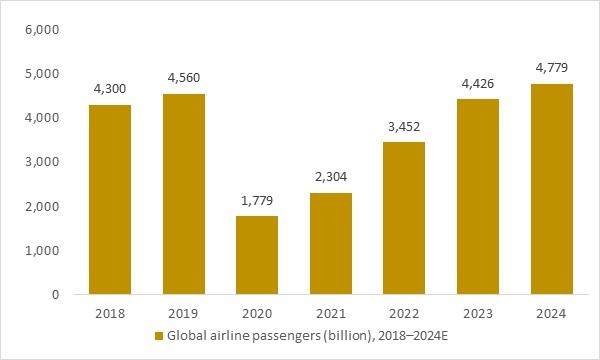
Bar chart showing global airline passengers from 2018 to 2024, highlighting the sharp 2020 downturn and strong recovery that drives demand for aerospace fluid conveyance systems and airport radiation detection equipment.

Figure: Global airline passenger traffic fell sharply in 2020 and then rebounded above pre-disruption levels by 2023, with further growth expected in 2024. This trend underpins rising aircraft utilisation, new narrowbody and widebody deliveries, and higher MRO activity, all of which drive demand for advanced aerospace fluid conveyance systems and airport radiation detection and security solutions.

  • Global airline passenger traffic collapsed in 2020 but recovered to more than 4.4 billion passengers by 2023, with further growth expected in 2024. This rebound underpins renewed demand for aerospace fluid conveyance systems in new aircraft and MRO, while also driving higher investment in airport radiation detection and security screening infrastructure worldwide.

Regional Analysis

North America Aerospace Fluid Conveyance Systems Market

North America Aerospace Fluid Conveyance Systems Market is driven by strong commercial aircraft production, defense aviation programs, space launch activity, aircraft MRO demand, and advanced aerospace component manufacturing. Market dynamics are shaped by the presence of major aircraft OEMs, engine manufacturers, defense contractors, space companies, and certified aerospace suppliers requiring high-performance hoses, tubes, ducts, fittings, couplings, manifolds, and fluid control assemblies. Lucrative opportunities exist for suppliers offering lightweight titanium tubing, flexible hose assemblies, thermal management fluid systems, fuel conveyance solutions, hydraulic lines, and sustainable aviation fuel-compatible components. Latest trends include lightweight material adoption, additive-manufactured manifolds, electric aircraft cooling loops, advanced quick-disconnect couplings, and integrated fluid management systems. The forecast outlook remains favorable as aircraft production, fleet upgrades, defense modernization, and space exploration programs continue supporting demand for safe, certified, and reliable fluid conveyance technologies.

Asia Pacific Aerospace Fluid Conveyance Systems Market

Asia Pacific Aerospace Fluid Conveyance Systems Market is expanding due to rising aircraft deliveries, airline fleet growth, regional aviation expansion, defense aircraft procurement, MRO development, and increasing aerospace manufacturing localization. Market dynamics are supported by strong demand from commercial airlines, aircraft component manufacturers, military aviation programs, and emerging space and UAV sectors across China, India, Japan, South Korea, and Southeast Asia. The region presents strong opportunities for aerospace tubing suppliers, hose assembly manufacturers, fluid control system providers, MRO firms, and local component partners capable of meeting global aerospace certification standards. Latest trends include localized aerospace supply chains, lightweight fluid routing systems, hydraulic and fuel system upgrades, thermal management solutions for advanced avionics, and increased use of high-reliability components in new aircraft platforms. The forecast remains positive as regional aviation demand, defense spending, and aircraft maintenance activity continue expanding.

Europe Aerospace Fluid Conveyance Systems Market

Europe Aerospace Fluid Conveyance Systems Market is shaped by strong commercial aerospace manufacturing, defense aviation, helicopter production, aircraft engine programs, space systems, and sustainability-focused aircraft innovation. Market dynamics are influenced by demand for lightweight, fuel-efficient, low-emission, and certified fluid transfer systems used in fuel, hydraulic, lubrication, coolant, environmental control, and thermal management applications. Lucrative opportunities exist for aerospace component suppliers, precision tube manufacturers, advanced material companies, coupling and fitting producers, and MRO providers supporting OEM and aftermarket requirements. Latest trends include sustainable aviation fuel compatibility, lightweight titanium and composite tubing, fluid systems for hybrid-electric aircraft, advanced thermal control loops, and high-performance conveyance assemblies for next-generation engines. The forecast outlook remains steady as European aerospace companies continue investing in aircraft efficiency, defense readiness, space technology, and long-life component reliability.

Middle East & Africa Aerospace Fluid Conveyance Systems Market

Middle East & Africa Aerospace Fluid Conveyance Systems Market is developing through airline fleet expansion, long-haul aviation growth, defense aircraft procurement, MRO investment, airport infrastructure development, and regional aerospace service capability building. Market dynamics vary across the region, with Gulf countries showing stronger demand from large airline fleets, premium aviation maintenance hubs, military aircraft programs, and business aviation, while African markets present opportunities through fleet renewal, regional connectivity, and aircraft maintenance modernization. Companies can benefit by offering certified replacement hoses, hydraulic assemblies, fuel system components, cooling lines, couplings, and maintenance support suited to harsh operating environments. Latest trends include expansion of aerospace MRO facilities, demand for lightweight replacement components, defense aircraft support programs, and improved aftermarket supply reliability. The forecast remains constructive as regional aviation networks, defense requirements, and aircraft maintenance ecosystems continue strengthening.

South & Central America Aerospace Fluid Conveyance Systems Market

South & Central America Aerospace Fluid Conveyance Systems Market is supported by regional aircraft operations, defense aviation, business jets, commercial fleet maintenance, helicopter usage, and aerospace manufacturing capabilities in selected markets. Market dynamics are shaped by demand for reliable fluid conveyance components in hydraulic systems, fuel lines, lubrication circuits, environmental control systems, and aftermarket replacement applications. Opportunities exist for certified component suppliers, MRO providers, hose and tubing manufacturers, aerospace distributors, and fluid system service companies offering cost-effective and compliant solutions for airlines, defense operators, and regional aircraft manufacturers. Latest trends include fleet maintenance optimization, replacement of aging fluid system components, lightweight materials for aircraft efficiency, and stronger demand for reliable spare parts supply. The forecast outlook remains positive as regional operators continue focusing on aircraft safety, maintenance efficiency, and modernization of aviation support infrastructure.

Market Scope

Parameter

Aerospace Fluid Conveyance Systems Market Detail

Base Year

2025

Estimated Year

2026

Forecast Period

2026-2034

Market Size-Units

USD billion

Market Splits Covered

By Product Type, By Aircraft Type, By Material Type, By Application Type

Countries Covered

North America (USA, Canada, Mexico)
Europe (Germany, UK, France, Spain, Italy, Rest of Europe)
Asia-Pacific (China, India, Japan, Australia, Rest of APAC)
The Middle East and Africa (Middle East, Africa)
South and Central America (Brazil, Argentina, Rest of SCA)

Analysis Covered

Latest Trends, Driving Factors, Challenges, Trade Analysis, Price Analysis, Supply-Chain Analysis, Competitive Landscape, Company Strategies

Customization

10% free customization (up to 10 analyst hours) to modify segments, geographies, and companies analyzed

Post-Sale Support

4 analyst hours, available up to 4 weeks

Delivery Format

The Latest Updated PDF and Excel Data file

Aerospace Fluid Conveyance Systems Market Segmentation

By Product Type
- Hoses
- Low-Pressure Ducts
- High-Pressure Ducts

By Aircraft Type
- Commercial Aircraft
- Regional Aircraft
- Helicopter
- Other Aircraft Types

By Material Type
- Nickel And Alloys
- Titanium And Alloys
- Stainless Steel And Alloys
- Composites
- Other Material Types

By Application Type
- Fuel
- Air
- Hydraulic)
- By End User (General Aviation
- Civil Aviation
- Military Aircraft

By Geography
- North America (USA, Canada, Mexico)
- Europe (Germany, UK, France, Spain, Italy, Rest of Europe)
- Asia-Pacific (China, India, Japan, Australia, Vietnam, Rest of APAC)
- The Middle East and Africa (Middle East, Africa)
- South and Central America (Brazil, Argentina, Rest of SCA)

Key Companies Analysed

General Electric Company, Lockheed Martin Corporation, AIM Industries Inc., Safran SA, Eaton Corporation PLC, TE Connectivity Ltd., SKF AB, Arconic Corporation, Precision Castparts Corp, TransDigm Group Incorporated, GKN Aerospace Services Limited, Crane Co, Smiths Group PLC, ITT Corporation, Woodward Inc., Stelia Aerospace, Triumph Group Inc., Senior PLC, Kaman Corporation, PFW Aerospace GmbH, Arrowhead Products Corporation, SEKISUI Aerospace Inc., Hutchinson S.A., Titeflex Corporation, Flexfab LLC, CFM S.r.l., Seginus Aerospace LLC, Amcraft Manufacturing Inc.

Recent Developments

  • May 2026 - Collins Aerospace announced an investment to expand its Largo, Florida facility, supporting higher production capacity for advanced aerospace and defense systems. While the investment is not limited to fluid conveyance, it reflects broader aerospace supplier capacity expansion as aircraft systems become more complex and production demand rises.
  • April 2026 - Safran Aircraft Engines announced a major forging capability upgrade at its Gennevilliers site to manufacture strategic parts for commercial and military aircraft engines. The investment supports next-generation engine production, supply-chain resilience, and advanced aerospace component manufacturing, which indirectly strengthens demand for associated fluid, thermal, and propulsion system components.
  • March 2026 - Collins Aerospace completed the Clean Aviation HECATE project, achieving a technology readiness milestone for high-voltage electric power systems supporting future hybrid-electric aircraft. The development is relevant to aerospace fluid conveyance systems because more-electric and hybrid-electric platforms are increasing demand for advanced thermal management, cooling loops, and integrated system architectures.
  • March 2026 - Safran Aircraft Engines launched the Clean Aviation TAKE OFF project with partners to advance open fan engine flight demonstration activity. The project supports future propulsion architectures, where lighter, more efficient thermal, fuel, lubrication, and fluid routing systems will remain critical to engine integration and performance.
  • February 2026 - Japan Airlines and Safran signed a long-term Support By the Hour agreement covering Airbus A350 aircraft, bringing together multiple Safran companies under one support model. The agreement includes maintenance, component pooling, logistics, and data-driven service support, reinforcing aftermarket demand for reliable aircraft systems and replacement components.
  • December 2025 - Senior plc secured a multi-year Airbus contract to design, qualify, and manufacture highly engineered aerospace standard parts for fluid conveyance applications. Initial production will support both single-aisle and twin-aisle commercial aircraft platforms, with deliveries beginning from Senior’s European facilities.
  • November 2025 - Eaton joined the HYLENA hydrogen-electric propulsion research project led by Airbus and other European partners. The project is focused on hydrogen-powered electric propulsion and supports long-term demand for advanced aerospace systems capable of safely managing power, heat, and next-generation fuel architectures.
  • October 2025 - Eaton extended its global exclusive distribution agreement with Satair for commercial aircraft fuel components and piece parts from Eaton’s Titchfield facility. The agreement supports aircraft operators with improved component availability, supply-chain efficiency, and aftermarket access for critical fuel-system products.
  • September 2025 - Bell selected Eaton to design, develop, and certify the aerial refueling retractable probe for the MV-75 Future Long Range Assault Aircraft program. The award reinforces Eaton’s position in advanced fuel-transfer and mission-critical aerospace fluid system technologies for next-generation military platforms.
  • June 2025 - Eaton signed an agreement to acquire Ultra PCS Limited to strengthen its position in aerospace markets. The acquisition broadens Eaton’s safety-critical aerospace systems portfolio and supports demand for integrated aircraft technologies across military and commercial platforms.
  • April 2025 - Eaton appointed VSE Aviation as its first authorized aerospace service center in the Americas for repair and overhaul of hydraulic components used on large commercial transport and regional aircraft. The move supports localized MRO capacity and faster turnaround for hydraulic system components.
  • April 2025 - Eaton appointed Air Support as its first aerospace authorized service center in Europe, the Middle East, and Africa for local repair and overhaul of engine fuel components. The development strengthens regional aftermarket support for fuel-system products and reduces repair lead times for airline and MRO customers.
You can purchase individual sections of this report. Explore pricing options for specific sections.

FAQ's

The Aerospace Fluid Conveyance Systems Market is estimated to generate $ 4.68 billion in revenue in 2026.

The Aerospace Fluid Conveyance Systems Market is expected to grow at a Compound Annual Growth Rate (CAGR) of 11.54% during the forecast period from 2026 to 2034.

The Aerospace Fluid Conveyance Systems Market is estimated to reach $ 11.19 billion by 2034.

License

Didn’t find what you’re looking for? TALK TO OUR ANALYST TEAM

Need something within your budget? NO WORRIES! WE GOT YOU COVERED!

Related Products

Offshore Mooring Systems Market Analysis and Outlook Report: Industry Size, Share, Growth Trends, and Forecast (2026-2034)

The Offshore Mooring Systems Market is a critical component of offshore energy infrastructure, providing essential anchoring and positioning solutions for floating structures such as oil rigs, production platforms, floating storage units, and increasingly, offshore renewable installations. Mooring systems are designed to ensure stability and safety in challenging marine environments, using combinations of chains, ropes, anchors, and connectors to secure floating assets against environmental forces such as waves, wind, and currents. Key applications and end-use sectors include offshore oil and gas exploration and production, floating liquefied natural gas units, offshore wind farms, and marine infrastructure projects. Recent trends indicate a growing shift toward advanced mooring technologies that support deeper water operations, higher load capacities, and improved durability. Additionally, the expansion of floating renewable energy projects, particularly offshore wind, is creating new demand for innovative and adaptable mooring solutions. Market growth is driven by increasing offshore exploration activities, rising investments in deepwater and ultra-deepwater projects, and expanding adoption of floating production systems. The competitive landscape is characterized by specialized engineering companies, offshore equipment manufacturers, and integrated service providers offering customized mooring solutions. Technological advancements in materials such as synthetic ropes, corrosion-resistant alloys, and advanced anchoring systems are enhancing system performance and lifecycle efficiency. However, the market faces challenges including high installation and maintenance costs, complex engineering requirements, and exposure to harsh environmental conditions. Despite these challenges, the market outlook remains strong, supported by ongoing energy demand, growth in offshore renewable projects, and continuous innovation in mooring system design and materials that improve reliability and operational efficiency. Regional Insights North America Offshore Mooring Systems Market North America represents a technologically advanced and well-established market, driven by offshore oil and gas activities in regions such as the Gulf of Mexico and increasing interest in offshore renewable energy projects. The region is witnessing growing adoption of advanced mooring systems designed for deepwater and ultra-deepwater operations, supported by strong engineering capabilities and technological innovation. Recent trends include integration of digital monitoring systems, use of high-performance synthetic materials, and expansion of floating production infrastructure. Opportunities lie in modernization of existing offshore assets, development of floating wind projects, and adoption of smart mooring solutions. The market outlook remains strong, supported by energy demand and continuous advancements in offshore technologies. Europe Offshore Mooring Systems Market Europe demonstrates a sustainability-driven and innovation-focused market, characterized by strong growth in offshore wind energy and advanced marine engineering capabilities. The region is experiencing increasing demand for mooring systems in floating wind farms, particularly in deeper waters where traditional fixed structures are not viable. Recent developments include advancements in environmentally friendly materials, integration of mooring systems with renewable energy platforms, and expansion of offshore infrastructure. Opportunities are emerging in renewable energy projects, hybrid offshore systems, and advanced anchoring technologies. The market is expected to evolve steadily, supported by regulatory support for clean energy and ongoing investment in offshore development. Asia Pacific Offshore Mooring Systems Market Asia Pacific is the fastest-growing and most dynamic market, driven by expanding offshore exploration activities, increasing energy demand, and rising investments in both oil and gas and renewable energy projects. The region is witnessing strong demand for mooring systems in deepwater projects and floating production units. Recent trends include growth in offshore wind installations, adoption of cost-effective mooring solutions, and expansion of local manufacturing capabilities. Significant opportunities exist in large-scale offshore projects, infrastructure development, and integration of advanced technologies. The market outlook is highly promising, supported by economic growth, government initiatives, and increasing offshore investments. Middle East & Africa Offshore Mooring Systems Market The Middle East & Africa market is heavily driven by offshore oil and gas exploration and production activities, with increasing focus on deepwater and ultra-deepwater developments. The region requires robust and high-performance mooring systems capable of operating in harsh marine environments. Recent developments include expansion of offshore projects, adoption of advanced materials for durability, and integration of digital monitoring solutions. Opportunities lie in large-scale energy projects, development of specialized mooring systems, and technology partnerships. Future growth will depend on energy investments, technological adoption, and expansion of offshore infrastructure. South & Central America Offshore Mooring Systems Market South & Central America is an emerging market characterized by significant offshore oil and gas activities, particularly in deepwater regions. The region is experiencing increasing demand for mooring systems to support floating production units and offshore infrastructure. Recent trends include expansion of offshore exploration, adoption of advanced mooring technologies, and growing interest in offshore renewable energy. Opportunities are centered around development of deepwater projects, modernization of existing infrastructure, and integration of innovative mooring solutions. The market outlook remains positive, driven by resource development, investment in offshore energy, and increasing focus on operational efficiency and safety. Key Market Insights The offshore oil and gas sector has historically been the primary driver of mooring system demand, particularly for floating production, storage, and offloading units operating in deepwater environments. These systems are essential for maintaining stability and operational safety. Continued exploration activities are sustaining demand in this segment. The transition toward deeper and more complex offshore environments is increasing the need for advanced mooring systems capable of handling higher loads and extreme conditions. Innovations in engineering design and materials are enabling operations in ultra-deepwater regions. This trend is expanding the technical capabilities of mooring solutions. Floating offshore wind projects are emerging as a significant growth driver, requiring specialized mooring systems to support turbines in deeper waters where fixed foundations are not feasible. This segment is creating new opportunities for innovation and market expansion. Renewable energy integration is reshaping market dynamics. Synthetic ropes and advanced materials are gaining traction due to their lightweight properties, high strength, and resistance to corrosion. These materials offer advantages over traditional steel chains in certain applications. Their adoption is improving performance and reducing operational challenges. Customization and project-specific design are critical in the mooring systems market, as each offshore installation requires tailored solutions based on environmental conditions and operational requirements. Engineering expertise plays a key role in system development. This trend is driving demand for specialized service providers. Technological advancements in monitoring and maintenance systems are enhancing the reliability and safety of mooring systems. Real-time monitoring and predictive maintenance capabilities are helping operators reduce downtime and operational risks. Digital integration is becoming increasingly important in system management. High installation and lifecycle costs remain a key challenge, particularly for complex offshore projects requiring specialized equipment and expertise. Cost optimization and efficiency improvements are becoming important considerations for operators. This is driving innovation in design and materials. The future of the market will be shaped by the convergence of traditional offshore energy and renewable projects, with increasing emphasis on sustainability, durability, and operational efficiency. Companies that can deliver advanced, cost-effective, and adaptable mooring solutions will gain a competitive advantage. As offshore activities expand, mooring systems will remain essential for safe and efficient operations. Report Scope Parameter Offshore Mooring Systems Market Detail Base Year 2025 Estimated Year 2026 Forecast Period 2026-2034 Market Size-Units USD billion Market Splits Covered By Type,By Anchorage,By Depth Of Operation,By Application Countries Covered North America (USA, Canada, Mexico) Europe (Germany, UK, France, Spain, Italy, Rest of Europe) Asia-Pacific (China, India, Japan, Australia, Rest of APAC) The Middle East and Africa (Middle East, Africa) South and Central America (Brazil, Argentina, Rest of SCA) Analysis Covered Latest Trends, Driving Factors, Challenges, Trade Analysis, Price Analysis, Supply-Chain Analysis, Competitive Landscape, Company Strategies Customization 10% free customization (up to 10 analyst hours) to modify segments, geographies, and companies analyzed Post-Sale Support 4 analyst hours, available up to 4 weeks Delivery Format The Latest Updated PDF and Excel Data file

Published:Mar-2026

Satellite Based Augmentation Systems Market Analysis and Outlook Report: Industry Size, Share, Growth Trends, and Forecast (2026-2034)

The satellite-based augmentation systems (SBAS) market is a crucial segment within the global navigation and satellite communication industry, focused on enhancing the accuracy, integrity, and availability of satellite-based navigation systems, such as GPS, for various applications. SBAS provides corrections and improvements to satellite navigation signals by using ground stations and geostationary satellites to augment the positioning accuracy, especially in areas with limited or unreliable satellite coverage. These systems are primarily used in aviation for precise navigation and landing, but they also have applications in land transportation, marine navigation, agriculture, surveying, and geospatial mapping. The market's growth is driven by the increasing adoption of GPS and other satellite navigation systems across industries, as well as the demand for high-precision, real-time location data for improved decision-making and operational efficiency. North America and Europe are the leading regions in the SBAS market, supported by strong regulatory frameworks, widespread adoption of satellite navigation systems in aviation, and major investments in infrastructure development. The Asia-Pacific region is experiencing significant growth due to the expanding aviation sectors in countries like China and India, as well as the growing need for accurate navigation systems in land and marine transport. Key trends in the market include the increasing integration of SBAS with unmanned aerial systems (UAS) for autonomous operations, advancements in regional SBAS networks, and the growing demand for seamless, global positioning systems that provide reliable, high-precision data for commercial and government applications. However, challenges such as high infrastructure costs, the need for ongoing maintenance of ground stations, and regulatory complexities in certain regions may impede market growth. Despite these challenges, the satellite-based augmentation systems market is expected to continue its growth trajectory, driven by the increasing need for enhanced positioning and navigation systems across industries. Regional Insights North America Satellite Based Augmentation Systems Market Analysis The North American satellite-based augmentation systems (SBAS) market is driven by the increasing demand for precise, reliable navigation and positioning services across various sectors such as aviation, maritime, agriculture, and defense. The U.S. government plays a significant role in driving the market with ongoing investments in the development and enhancement of SBAS technologies for air traffic management and national security applications. Opportunities in this market lie in the expansion of SBAS solutions to support emerging technologies like autonomous vehicles and unmanned aerial systems (UAS), as well as the integration of SBAS with advanced satellite constellations for better coverage and enhanced precision. The growing demand for high-accuracy GPS and real-time data in sectors such as logistics, agriculture, and emergency response also presents substantial growth opportunities. Asia Pacific Satellite Based Augmentation Systems Market Analysis The Asia Pacific SBAS market is expanding rapidly due to the increasing adoption of advanced navigation systems in countries like China, India, Japan, and South Korea. The region’s growing infrastructure projects, air traffic, and maritime activities are key drivers for the adoption of SBAS solutions. Moreover, the region’s increasing reliance on GPS for agriculture, transportation, and emergency services creates significant demand for enhanced accuracy and real-time positioning data. Opportunities in this market include developing region-specific SBAS solutions that cater to the needs of local industries, integrating SBAS with emerging technologies such as drones and autonomous vehicles, and improving cross-border cooperation for global satellite navigation systems to ensure seamless navigation and positioning services across countries in the region. Europe Satellite Based Augmentation Systems Market Analysis Europe’s satellite-based augmentation systems market is shaped by the growing demand for enhanced GPS accuracy in aviation, transportation, and agriculture, as well as the region’s strong commitment to maintaining high standards of safety and operational efficiency. The European Union’s Galileo program, designed to provide an independent and secure global navigation satellite system, is a key driver in the adoption of SBAS solutions in Europe. Opportunities in Europe include integrating SBAS with new applications such as autonomous vehicle navigation and smart city infrastructure, expanding SBAS services for maritime and aviation sectors, and developing multi-constellation SBAS solutions that combine Galileo, GPS, and other satellite systems to offer better precision and reliability. The emphasis on sustainability also presents opportunities for energy-efficient SBAS technologies in the transportation and logistics sectors. Key Market Insights North America and Europe dominate the SBAS market due to established satellite navigation infrastructure, regulatory support, and significant adoption in aviation and other sectors. SBAS enhances the accuracy, integrity, and availability of satellite navigation systems, improving positioning precision for a wide range of applications. SBAS is widely used in aviation for precise navigation, landing, and air traffic management, ensuring the safety and efficiency of flight operations. The Asia-Pacific region is experiencing rapid growth, driven by expanding aviation industries and the increasing demand for accurate navigation systems in land and marine transport. The integration of SBAS with unmanned aerial systems (UAS) is a key trend, allowing for autonomous navigation and improving the safety of drone operations. Regional SBAS networks are improving the accessibility and reliability of high-precision navigation data in areas with limited satellite coverage. The growing need for high-precision, real-time location data in industries such as agriculture, surveying, and geospatial mapping is driving the adoption of SBAS technologies. High infrastructure costs, including the setup and maintenance of ground stations, and regulatory complexities in some regions pose challenges for market growth. The market is expected to expand as the demand for accurate positioning and navigation systems increases across both developed and emerging economies. Technological advancements in SBAS capabilities, such as the integration of multi-frequency GNSS signals and the development of global augmentation systems, will continue to drive the market's growth. Report Scope Parameter satellite-based augmentation systems (SBAS) market scope Detail Base Year 2024 Estimated Year 2025 Forecast Period 2026-2032 Market Size-Units USD billion Market Splits Covered By Type ,By Component ,By Application Countries Covered North America (USA, Canada, Mexico) Europe (Germany, UK, France, Spain, Italy, Rest of Europe) Asia-Pacific (China, India, Japan, Australia, Rest of APAC) The Middle East and Africa (Middle East, Africa) South and Central America (Brazil, Argentina, Rest of SCA) Analysis Covered Latest Trends, Driving Factors, Challenges, Trade Analysis, Price Analysis, Supply-Chain Analysis, Competitive Landscape, Company Strategies Customization 10% free customization (up to 10 analyst hours) to modify segments, geographies, and companies analyzed Post-Sale Support 4 analyst hours, available up to 4 weeks Delivery Format The Latest Updated PDF and Excel Data file

Published:Mar-2026

Border Security Market Analysis and Outlook Report: Industry Size, Share, Growth Trends, and Forecast (2026-2034)

The border security market is a rapidly expanding segment within the global security and defense industry, focused on the deployment of technologies and solutions to protect and monitor national borders from a wide range of threats, including illegal immigration, human trafficking, drug smuggling, and terrorism. These systems include surveillance tools such as cameras, drones, radar, sensors, biometric identification systems, and advanced access control solutions to secure border checkpoints, ports, and other entry points. The market is driven by rising security concerns, increasing geopolitical tensions, and the growing need for more efficient and integrated solutions to protect national security and maintain border integrity. North America and Europe are key players in the border security market, with countries like the United States, Canada, the United Kingdom, and France investing heavily in advanced security technologies to secure their borders. The Asia-Pacific region is also experiencing significant growth due to rising border security threats and increasing defense spending in countries such as India, China, and Japan. Key trends in the market include the integration of artificial intelligence (AI), machine learning, and biometric technologies for real-time threat detection and decision-making, as well as the increasing use of unmanned aerial vehicles (UAVs) for surveillance and monitoring of border regions. However, challenges such as high implementation costs, privacy concerns, and the complexity of coordinating cross-border security efforts may hinder market growth. Despite these challenges, the border security market is expected to grow steadily, supported by the need for advanced security measures, technological innovation, and the continued focus on national defense and public safety. Regional Insights North America Border Security Market Analysis The North American border security market is driven by increasing concerns over national security, illegal immigration, human trafficking, and cross-border crimes. The United States, with its significant defense and homeland security budgets, is heavily investing in advanced border surveillance technologies such as drones, sensors, and biometric identification systems. The rising demand for integrated border security systems that combine physical barriers with advanced technologies is creating lucrative opportunities for companies. Furthermore, the ongoing focus on securing both land and maritime borders, alongside the need for enhanced data analytics and real-time monitoring, presents substantial growth potential. The market is also seeing a rise in the adoption of automated border control systems and AI-driven solutions for predictive security measures. Asia Pacific Border Security Market Analysis The Asia Pacific border security market is witnessing rapid growth due to increasing regional security concerns, cross-border terrorism, and the rise in illegal immigration. Countries like China, India, and Japan are significantly investing in border security infrastructure, including surveillance systems, facial recognition technologies, and advanced monitoring systems. The market is also driven by the expanding use of smart border solutions and the growing adoption of automated border control systems to streamline security processes and improve efficiency. Opportunities in Asia Pacific include the development of cost-effective, scalable border security solutions for emerging markets, and the integration of AI and machine learning technologies for threat detection and risk assessment. Additionally, as the region focuses on enhancing regional cooperation and security infrastructure, there is an increased demand for cross-border security initiatives and technologies. Europe Border Security Market Analysis Europe’s border security market is shaped by the region's focus on maintaining the safety and integrity of both internal and external borders, particularly with the ongoing migration challenges and the rising threat of cross-border terrorism. The European Union is investing heavily in integrated border security solutions, which include advanced surveillance, biometric identification systems, and real-time data analytics to monitor and control border crossings. Opportunities in Europe include expanding the use of AI-driven technologies for border control and security operations, enhancing cooperation between EU member states for joint security initiatives, and developing solutions for smart borders that ensure compliance with privacy laws while improving efficiency. The market is also driven by the demand for solutions that integrate physical and digital security measures to ensure comprehensive protection and operational effectiveness. Key Market Insights North America and Europe dominate the market due to high investments in border security technologies, strong regulatory frameworks, and increasing demand for advanced surveillance and detection systems. Border security systems include surveillance cameras, drones, biometric identification systems, radar, and sensors to monitor and control movement across borders and checkpoints. Asia-Pacific is seeing rapid growth, driven by rising border security threats, increasing defense spending, and the adoption of advanced technologies in countries like China, India, and Japan. AI, machine learning, and biometric systems are playing a major role in enhancing the effectiveness of border security systems by automating threat detection and analysis. Unmanned aerial vehicles (UAVs) are gaining popularity in border security for providing real-time aerial surveillance, particularly in remote or difficult-to-access border areas. Advancements in smart access control systems, including facial recognition and fingerprint scanning, are improving border security and reducing human error. Cross-border cooperation and data-sharing between neighboring countries and security agencies are becoming increasingly important to address transnational security threats effectively. Challenges in the market include the high costs of implementing advanced security technologies, concerns over privacy and civil liberties, and the need for seamless integration of various security systems across borders. The demand for integrated, multi-layered border security solutions, which combine physical, technological, and intelligence capabilities, is growing to address complex threats. The border security market is expected to continue growing as nations prioritize protecting their borders, ensuring the safety of citizens, and mitigating the increasing number of security risks. Report Scope Parameter border security market scope Detail Base Year 2024 Estimated Year 2025 Forecast Period 2026-2032 Market Size-Units USD billion Market Splits Covered By Component ,By System ,By Platform Countries Covered North America (USA, Canada, Mexico) Europe (Germany, UK, France, Spain, Italy, Rest of Europe) Asia-Pacific (China, India, Japan, Australia, Rest of APAC) The Middle East and Africa (Middle East, Africa) South and Central America (Brazil, Argentina, Rest of SCA) Analysis Covered Latest Trends, Driving Factors, Challenges, Trade Analysis, Price Analysis, Supply-Chain Analysis, Competitive Landscape, Company Strategies Customization 10% free customization (up to 10 analyst hours) to modify segments, geographies, and companies analyzed Post-Sale Support 4 analyst hours, available up to 4 weeks Delivery Format The Latest Updated PDF and Excel Data file

Published:Mar-2026