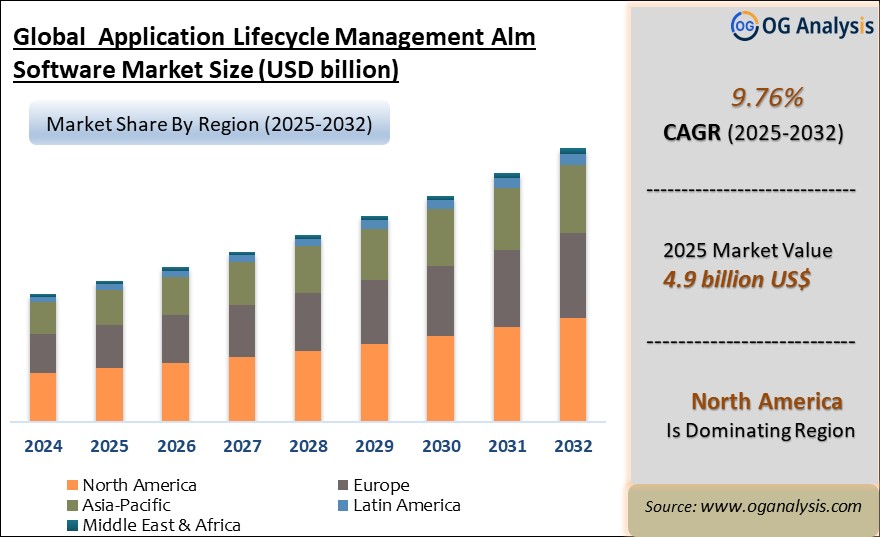
"The Application Lifecycle Management (ALM) Software Market valued at $ 5.4 billion in 2026, is expected to grow by 9.76% CAGR to reach market size worth $ 11.7 billion by 2034."
The Application Lifecycle Management Software Market is gaining strong momentum as enterprises modernize software development, delivery, and governance across increasingly complex digital environments. ALM software enables organizations to manage the complete application lifecycle, including requirements planning, design, development, testing, deployment, maintenance, version control, compliance tracking, and collaboration. Demand is being driven by the rising adoption of agile, DevOps, cloud-native development, microservices, and continuous integration and delivery practices. Businesses are using ALM platforms to improve software quality, accelerate release cycles, reduce project risk, and enhance visibility across development teams.
The market is also being shaped by growing demand for integrated platforms that connect developers, testers, product managers, security teams, and business stakeholders. Organizations are prioritizing tools that support automation, traceability, real-time reporting, workflow management, defect tracking, and regulatory compliance. AI-enabled code assistance, predictive analytics, test automation, and security integration are further strengthening the role of ALM software in enterprise technology operations. However, market adoption can be challenged by legacy system integration, toolchain fragmentation, migration complexity, user resistance, and data security concerns. Overall, ALM software is becoming a core foundation for digital transformation, helping enterprises deliver reliable, secure, and scalable applications with greater speed and control.
Regional Analysis
North America Application Lifecycle Management (ALM) Software Market
North America remains a leading market for Application Lifecycle Management software, supported by mature enterprise IT spending, strong adoption of agile and DevOps practices, and widespread use of cloud-native development environments. The United States and Canada show strong demand across IT services, telecom, banking, healthcare, retail, manufacturing, aerospace, and government sectors. Enterprises are increasingly using ALM platforms to improve software delivery visibility, automate workflows, manage compliance, and integrate development with CI/CD pipelines. The region also benefits from the presence of major software vendors, cloud providers, and technology innovators, which strengthens adoption of integrated ALM, DevSecOps, and AI-assisted development tools.
Europe Application Lifecycle Management (ALM) Software Market
Europe is a significant ALM software market, driven by digital transformation, regulatory compliance, data privacy requirements, and demand for secure software development governance. Germany, the UK, France, the Netherlands, Italy, Spain, and Nordic countries are key adopters due to strong manufacturing, automotive, banking, healthcare, telecom, and public-sector digitalization. European organizations are prioritizing ALM platforms that provide traceability, audit trails, requirements management, release control, and quality assurance. The European Commission’s Digital Decade agenda also emphasizes business digitalization, cloud uptake, AI adoption, cybersecurity, and digital skills, supporting broader demand for structured software lifecycle management.
Asia-Pacific Application Lifecycle Management (ALM) Software Market
Asia-Pacific is expected to remain a high-growth region for ALM software, supported by rapid digitalization, expanding software development teams, cloud adoption, outsourcing activity, and startup ecosystem growth. India, China, Japan, South Korea, Australia, and Southeast Asia are key markets, with demand rising across IT services, fintech, telecom, e-commerce, automotive, electronics, and public-sector modernization. Enterprises are adopting ALM platforms to manage distributed development teams, improve product release speed, standardize testing, and support DevOps transformation. India’s expanding developer base and strong software engineering ecosystem are particularly supportive of ALM adoption across enterprise and outsourced development environments.
Middle East & Africa Application Lifecycle Management (ALM) Software Market
The Middle East & Africa market is gradually expanding as governments and enterprises invest in digital transformation, cloud infrastructure, smart services, fintech, telecom modernization, and enterprise software development. Gulf countries such as the UAE, Saudi Arabia, Qatar, and Oman are key demand centers, supported by smart government initiatives, banking modernization, energy-sector digitalization, and large enterprise IT programs. In Africa, demand is emerging through banking, telecom, e-commerce, public services, and regional cloud infrastructure growth. However, adoption can be restrained by limited digital skills, integration complexity, cybersecurity concerns, and uneven cloud maturity across countries. World Bank research highlights that cloud adoption can support digital transformation and cyber resilience, although adoption remains slower in many developing markets.
South & Central America Application Lifecycle Management (ALM) Software Market
South & Central America is an emerging market for ALM software, supported by digital transformation in banking, telecom, retail, government, healthcare, logistics, and manufacturing. Brazil, Mexico, Chile, Colombia, and Argentina are key adopters due to growing enterprise software development, fintech innovation, cloud migration, and demand for better IT project governance. ALM adoption is increasing as organizations seek improved collaboration, faster release cycles, quality control, and compliance management across distributed teams. Growth remains gradual due to budget limitations, fragmented IT environments, uneven cloud readiness, and shortage of specialized software lifecycle talent. IDB research notes that advanced digital technologies such as cloud computing and AI are spreading across Latin American economies, supporting long-term software modernization opportunities.
Key Insights
- ALM software demand is supported by the need for end-to-end visibility across software planning, development, testing, deployment, and maintenance. Enterprises use these platforms to improve coordination, reduce delays, and strengthen software delivery governance.
- Agile and DevOps adoption is a major growth driver for the market. ALM tools help teams manage sprints, backlogs, builds, releases, feedback loops, and continuous improvement workflows.
- Cloud-based ALM platforms are gaining preference due to easier deployment, scalability, remote access, and lower infrastructure burden. These solutions support distributed development teams and faster collaboration across business units.
- Integration with CI/CD pipelines is becoming essential for modern software teams. ALM platforms increasingly connect with build tools, testing frameworks, repositories, containers, and deployment automation systems.
- Quality assurance and testing remain important application areas for ALM software. Test case management, defect tracking, automated testing, and release validation help organizations improve application reliability.
- Regulatory compliance is strengthening ALM adoption in industries such as healthcare, banking, automotive, aerospace, defense, and life sciences. Traceability, audit trails, documentation control, and approval workflows are critical for regulated software environments.
- AI and analytics are improving the value of ALM platforms. Predictive insights, code review support, test optimization, workload forecasting, and risk detection help teams make faster and more informed decisions.
- Security integration is becoming a core requirement as enterprises shift toward DevSecOps practices. ALM platforms are increasingly connected with vulnerability scanning, access control, compliance checks, and secure development workflows.
- Toolchain consolidation is a key market trend as enterprises move away from disconnected development tools. Integrated ALM platforms reduce duplication, improve collaboration, and provide a single source of project truth.
- High customization needs and migration complexity remain key challenges for adoption. Organizations must align ALM workflows with existing development practices, legacy systems, user roles, and enterprise governance requirements.
Market Scope
| Parameter | Application Lifecycle Management (ALM) Software Market Detail |
| Base Year | 2025 |
| Estimated Year | 2026 |
| Forecast Period | 2026-2034 |
| Market Size-Units | USD billion |
| Market Splits Covered | By product Type, By Application, By End user |
| Countries Covered | North America (USA, Canada, Mexico) |
| Analysis Covered | Latest Trends, Driving Factors, Challenges, Trade Analysis, Price Analysis, Supply-Chain Analysis, Competitive Landscape, Company Strategies |
| Customization | 10% free customization (up to 10 analyst hours) to modify segments, geographies, and companies analyzed |
| Post-Sale Support | 4 analyst hours, available up to 4 weeks |
| Delivery Format | The Latest Updated PDF and Excel Data file |
Application Lifecycle Management Alm Software Market Segmentation
By Type
- Single Function
- Multiple Functions
By Component
- Software
- Services
- By Platform
- Web based
- Mobile based
By Deployment Model
- On-Premise
- Cloud-Based
- Others
By Application
- Automotive and Transportation
- Aerospace and Defense
- BFSI, Energy and Utilities
- Retail
- Healthcare
- IT and Telecom
- Others
By Geography
- North America (USA, Canada, Mexico)
- Europe (Germany, UK, France, Spain, Italy, Rest of Europe)
- Asia-Pacific (China, India, Japan, Australia, Vietnam, Rest of APAC)
- The Middle East and Africa (Middle East, Africa)
- South and Central America (Brazil, Argentina, Rest of SCA)
Key Market Players
- IBM Corporation
- Atlassian Corporation Plc
- Microsoft Corporation
- Micro Focus International plc
- Digital.ai
- Siemens AG
- PTC Inc.
- Rocket Software, Inc.
- Kovair Software
- Perforce Software, Inc.
- Digité, Inc.
- Inflectra Corporation
Recent Developments
May 2026: Siemens released Polarion ALM 2606, adding extended AI integration through a new Copilot API, custom LLM connectors, improved test management, expanded REST APIs, multilingual support, stronger security logging, and Simulink integration. This strengthens Polarion’s position in regulated, traceability-heavy ALM environments.
May 2026: Jama Connect v9.35 introduced Model Context Protocol support to extend governed, traceable product data into AI-enabled development environments. The update supports spec-driven development, compliant automation, and AI-assisted engineering workflows for regulated product teams.
May 2026: PTC Codebeamer was selected by Hamilton Medical to replace its legacy ALM system and paper-based processes. The deployment is aimed at improving collaboration, validation, traceability, and regulatory compliance across product development workflows.
April 2026: Microsoft added new security capabilities to Azure DevOps Advanced Security, including CodeQL default setup and an org-wide combined alerts experience. These features simplify application security enablement and improve vulnerability triage across repositories.
April 2026: Atlassian made Rovo Dev directly available inside Jira, enabling simpler development work items to move from Jira tasks to merge-ready pull requests. This reflects the shift toward AI-assisted ALM workflows that connect planning, coding, review, and delivery.
April 2026: BMW Group implemented PTC Codebeamer as an enterprise-wide requirements management solution. The move supports a unified data model, stronger traceability, and digital continuity across mechanical, electrical, and software development disciplines.
March 2026: GitLab released GitLab 18.10, expanding access to the GitLab Duo Agent Platform and making agentic false-positive detection for security scanning generally available. The update supports AI-powered development, security review, and remediation across the software lifecycle.
March 2026: Perforce ALM 2026.1 was released, with Helix ALM renamed as Perforce ALM and updates covering dashboards, Visual Studio integration, bug fixes, and security upgrades. The release reflects continued modernization of requirements, testing, and issue management capabilities.
January 2026: PTC released Codebeamer 3.2, Codebeamer AI 1.0, and Pure Variants 7.2. Codebeamer AI introduced requirements and test case assistants to improve requirement quality, test generation, traceability, and compliance in regulated software-driven product development.
FAQ's
The Application Lifecycle Management (ALM) Software Market is estimated to reach USD 11.7 billion by 2034.
The Global Application Lifecycle Management (ALM) Software Market is expected to grow at a Compound Annual Growth Rate (CAGR) of 9.76% during the forecast period from 2025 to 2034.
The Global Application Lifecycle Management (ALM) Software Market is estimated to generate USD 4.9 billion in revenue in 2025
Didn’t find what you’re looking for? TALK TO OUR ANALYST TEAM
Need something within your budget? NO WORRIES! WE GOT YOU COVERED!


