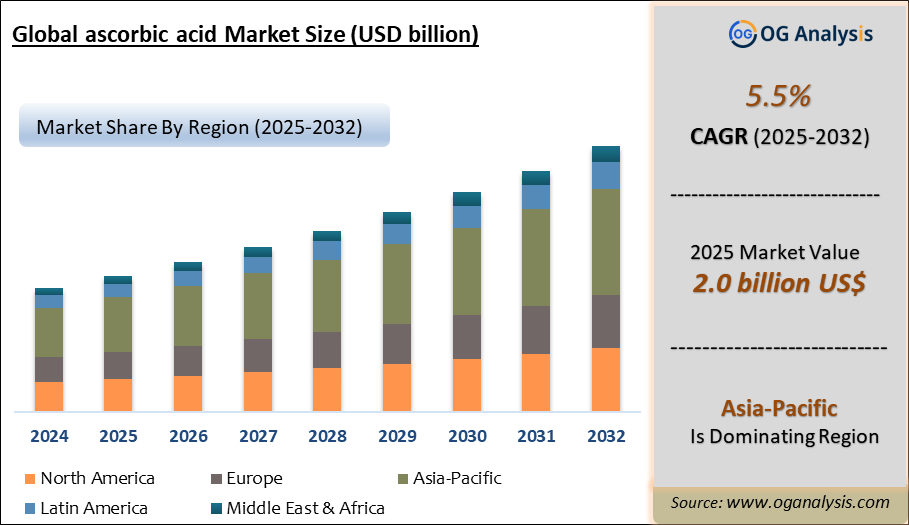
"The Global Ascorbic Acid Market is valued at USD 1.9 billion in 2024 and is projected to reach USD 2.0 billion in 2025. Worldwide sales of Ascorbic Acid are expected to grow at a significant CAGR of 5.5%, reaching USD 3.3 billion by the end of the forecast period in 2034."
The Ascorbic Acid market, commonly known as the Vitamin C market, plays a crucial role in the global health, food, and cosmetics industries. Ascorbic acid is a powerful antioxidant used extensively in dietary supplements, functional foods, beverages, pharmaceuticals, and personal care products. Its proven benefits in boosting immunity, supporting collagen synthesis, aiding iron absorption, and combating oxidative stress have made it a cornerstone ingredient in health-focused formulations. Rising health awareness, increasing demand for preventive healthcare, and growing consumer preference for fortified and natural products are major factors propelling the market. Moreover, the post-COVID-19 surge in immunity-boosting supplements has accelerated product development and global consumption, particularly in emerging markets. China remains the dominant producer and exporter of ascorbic acid, supplying both raw material and finished formulations across regions including North America, Europe, and Asia-Pacific.
The market is experiencing a transition from traditional synthetic ascorbic acid to natural and plant-derived variants due to clean-label trends and growing skepticism around artificial additives. Regulatory bodies in major markets continue to reinforce the permissible usage and health claims of ascorbic acid, enabling widespread inclusion in functional product lines. Key manufacturers are expanding their production capacities, optimizing fermentation processes, and investing in sustainable sourcing to maintain cost-efficiency and ensure supply stability amid price volatility. The pharmaceutical segment is increasingly utilizing ascorbic acid in injectable and oral therapeutic formats, while food and beverage companies are launching Vitamin C-enriched products ranging from juices to energy bars. Additionally, the cosmetic industry is leveraging its skin-brightening and anti-aging properties to formulate serums, creams, and facial cleansers. With innovations in encapsulation and bioavailability enhancement, the market is poised for steady growth driven by health-conscious consumers, evolving formulations, and strategic distribution networks across retail, online, and clinical channels.
The powder form is the largest segment in the Ascorbic Acid market due to its versatility, long shelf life, and wide usage across food, pharmaceutical, and nutraceutical applications. It is preferred in bulk manufacturing, easy to handle in formulations, and allows accurate dosing, making it the most commercially adopted form globally.
Calcium Ascorbate leads among derivatives as it offers a buffered, non-acidic form of Vitamin C, ideal for consumers with sensitive stomachs. It is widely used in dietary supplements and fortified foods due to its gentle absorption and dual benefit of calcium and ascorbic acid, driving its popularity in health-conscious formulations.
Key insights
-
The global demand for ascorbic acid has risen sharply due to its well-documented role in supporting immune health, enhancing iron absorption, and reducing oxidative stress. Consumers increasingly prefer daily supplementation, especially in the form of chewable tablets, powders, or gummies, as a proactive approach to boosting overall wellness and resilience against infections.
-
China dominates the global ascorbic acid supply, accounting for the majority of manufacturing due to cost-effective production and strong industrial capacity. However, concerns about dependency and recent supply chain volatility have prompted other regions to explore alternative sourcing and local production facilities to ensure uninterrupted supply and pricing stability.
-
Food and beverage manufacturers rely heavily on ascorbic acid as both a nutritional additive and preservative. It enhances the shelf life of juices, processed fruits, dairy alternatives, and meat products while providing an added functional health appeal, making it a dual-benefit ingredient in clean-label formulations.
-
Pharmaceutical companies use ascorbic acid across various formulations including oral tablets, injectable solutions, and wound healing therapies. It is particularly essential in treating scurvy, strengthening immune function in chronic illness, and supporting iron absorption in anemic patients, making it a key vitamin in clinical use.
-
The shift toward clean-label and natural ingredients is accelerating the use of naturally derived ascorbic acid from sources like acerola cherry and amla. Consumers increasingly scrutinize ingredient labels and prefer plant-based vitamins over synthetically produced alternatives, influencing new product development and marketing strategies.
-
The cosmetics industry is leveraging ascorbic acid’s antioxidant and skin-brightening capabilities in serums, masks, and moisturizers. Its popularity stems from proven efficacy in reducing pigmentation, smoothing skin tone, and stimulating collagen production, particularly in premium and anti-aging skincare segments.
-
Technological advancements in microencapsulation and liposomal delivery are improving the bioavailability and shelf stability of ascorbic acid. These innovations allow gradual absorption, minimize degradation, and support more efficient delivery in both food supplements and therapeutic applications.
-
E-commerce and direct-to-consumer channels have transformed the sales dynamics of Vitamin C supplements. The convenience of online access, customizable product forms, and subscription models have attracted health-conscious consumers and expanded global reach for nutraceutical brands.
-
Regulatory approvals by global health agencies continue to support widespread use of ascorbic acid across industries. Agencies such as the FDA and EFSA recognize its safety and efficacy, allowing fortified products to enter the market confidently under established health claims.
-
Environmental and sustainability concerns are encouraging ascorbic acid manufacturers to adopt green production methods such as bio-fermentation and use of renewable raw materials. This trend is shaping corporate strategies and helping align product development with global ESG goals.
Competitive Landscape and Key Strategies
The competitive landscape of the Ascorbic Acid Market is marked by the presence of several global and regional players, with companies focusing on innovation, sustainability, and expanding their product portfolios to maintain a competitive edge. Key strategies employed by leading companies include investing in research and development to create novel ascorbic acid formulations that cater to diverse consumer preferences, such as vegan, organic, and non-GMO products. Additionally, partnerships and collaborations with food & beverage and pharmaceutical companies are common, allowing for the development of fortified foods and new medicinal applications.
Sustainability is also a major focus for many companies, with efforts to reduce the environmental impact of ascorbic acid production. This includes investments in green manufacturing processes and eco-friendly packaging solutions. Furthermore, companies are leveraging e-commerce platforms to reach a broader consumer base and capitalize on the growing trend of online health and wellness shopping. By adopting these strategies, market leaders are positioning themselves to capture a larger share of the growing ascorbic acid market.
Market Players
Key companies operating in the Ascorbic Acid Market include:
1. Koninklijke DSM N.V.
2. BASF SE
3. Northeast Pharmaceutical Group Co., Ltd.
4. CSPC Pharmaceutical Group
5. Shandong Luwei Pharmaceutical
6. Nestle S.A.
7. Nutraceutical Corporation
8. GlaxoSmithKline plc
9. Bayer AG
10. Aland Nutraceuticals Group
11. DuPont Nutrition & Biosciences
12. Pfizer Inc.
13. Jiangsu Jiangshan Pharmaceutical Co., Ltd.
14. North China Pharmaceutical Co., Ltd.
15. Zhejiang Tianxin Pharmaceutical Co., Ltd.
Market Scope
| Parameter | Detail |
| Base Year | 2024 |
| Estimated Year | 2025 |
| Forecast Period | 2026-2032 |
| Market Size-Units | USD billion |
| Market Splits Covered | By Product, By Application, By End-User |
| Countries Covered | North America (USA, Canada, Mexico) |
| Analysis Covered | Latest Trends, Driving Factors, Challenges, Trade Analysis, Price Analysis, Supply-Chain Analysis, Competitive Landscape, Company Strategies |
| Customization | 10% free customization (up to 10 analyst hours) to modify segments, geographies, and companies analysed |
| Post-Sale Support | 4 analyst hours, available up to 4 weeks |
| Delivery Format | The Latest Updated PDF and Excel Data file |
Market Segmentation
By Form
- Granular
- Powder
- Liquid
- Other
By Derivative
- Calcium Ascorbate
- Sodium Ascorbate
- Potassium Ascorbate
- Others
By End-Use
- Fruit Juices
- Confectionary
- Bakery
- Pharmaceutical
- Personal care
- Others
By Geography
- North America (USA, Canada, Mexico)
- Europe (Germany, UK, France, Spain, Italy, Rest of Europe)
- Asia-Pacific (China, India, Japan, Australia, Rest of APAC)
- The Middle East and Africa (Middle East, Africa)
- South and Central America (Brazil, Argentina, Rest of SCA)
Recent Developments
-
July 11, 2025: NOW Foods expanded the scope of its ISO 17025 accreditation to include quantitative testing of ascorbic acid, enhancing its in-house laboratory’s capabilities for product quality and safety assurance across supplements and natural products.
-
May 28, 2025: genXtraits Inc. finalized an exclusive license with New Zealand’s Institute for Plant & Food Research to develop vitamin C–enhanced crops, including corn and soybean, showcasing a move toward biofortified agricultural applications.
-
June 2025: A global AI-powered ingredient innovation platform reported rising demand for vitamin C in snacks, functional beverages, and baby-care products, highlighting market growth driven by consumer wellness trends and multi-category applications.
-
June 2023: DSM‑Firmenich began exploring strategic options for its Jiangshan vitamin C plant in China, signaling potential restructuring or divestment that may impact global production dynamics and supply chain alignment.
FAQ's
The Global Ascorbic Acid Market is estimated to generate USD 1.9 billion in revenue in 2024.
The Global Ascorbic Acid Market is expected to grow at a Compound Annual Growth Rate (CAGR) of 5.5% during the forecast period from 2025 to 2032.
The Ascorbic Acid Market is estimated to reach USD 2.9 billion by 2032.
Didn’t find what you’re looking for? TALK TO OUR ANALYST TEAM
Need something within your budget? NO WORRIES! WE GOT YOU COVERED!


