Home Industry Reports Automotive and Transport Automotive Automotive Automatic Tire Inflation System Market

Automotive Automatic Tire Inflation System Market Outlook Report: Latest Trends and Growth Opportunities by Region

Published On: Feb, 2026
|
Pages: 151

"The Automotive Automatic Tire Inflation System Market Size was valued at $917 million in 2024 and is projected to reach $990 million in 2025. Worldwide sales of Automotive Automatic Tire Inflation System are expected to grow at a significant CAGR of 9.3%, reaching USD 2,255 million by the end of the forecast period in 2034."

Introduction and Overview of the Automotive Automatic Tire Inflation System Market

The Automotive Automatic Tire Inflation System (ATIS) market is rapidly gaining prominence due to the increasing demand for safety, fuel efficiency, and vehicle performance optimization in the automotive industry. ATIS technology allows vehicles to automatically maintain the correct tire pressure, which directly impacts fuel economy, tire lifespan, and vehicle handling. With the growing awareness of the benefits of well-maintained tire pressure, including reducing carbon emissions and improving road safety, ATIS has become a sought-after feature in both commercial and passenger vehicles. Moreover, the rise in long-haul transportation, coupled with stringent government regulations on vehicle safety and fuel efficiency, is driving the adoption of ATIS solutions globally.

The market has witnessed significant growth as manufacturers incorporate ATIS into their vehicle portfolios, particularly in trucks, buses, and heavy-duty vehicles. The increasing focus on reducing vehicular downtime, improving fleet management efficiency, and enhancing tire life expectancy further bolsters the demand for ATIS systems. In addition, the push towards smart vehicles and the integration of advanced technologies such as the Internet of Things (IoT) in automotive systems are contributing to the expansion of the ATIS market. Key players in the market are continuously innovating to improve product reliability and cost-effectiveness, making ATIS solutions more accessible to a broader range of vehicles.

North America is the leading region in the automotive automatic tire inflation system market, powered by stringent vehicle safety regulations, high adoption of advanced commercial vehicle technologies, and the presence of key industry players focused on fleet efficiency and tire performance optimization.
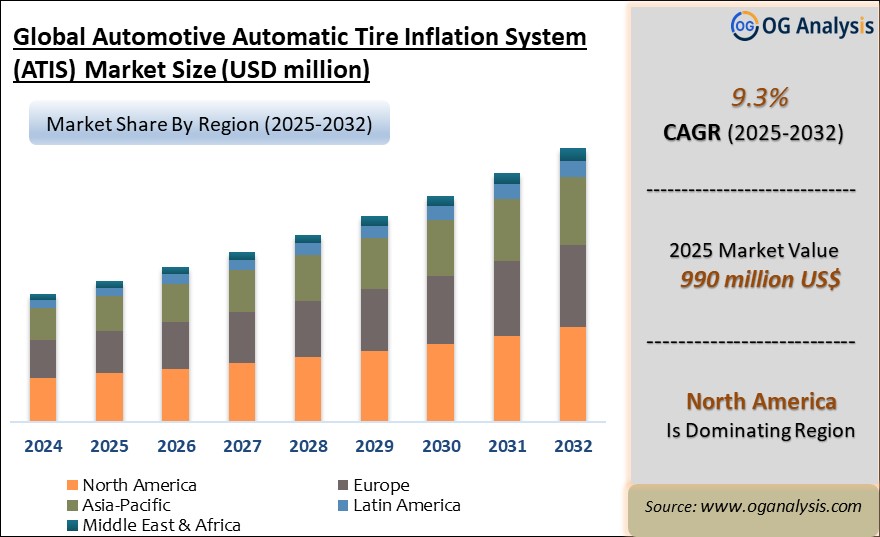
Global Automotive Automatic Tire Inflation System (ATIS) Market  Analysis 2025-2032: Industry Size, Share, Growth Trends, Competition and Forecast Report

Key Insights

  • Automatic tire inflation systems emerged first in demanding off-highway and defense environments, where vehicles operate on rough terrain and tire failures are especially costly. This heritage shaped expectations for ruggedness, redundancy, and fail-safe operation, which now carry over into mainstream commercial road transport applications.
  • Fuel savings and lower rolling resistance represent a core economic driver, as even modest underinflation can increase energy consumption and emissions. By maintaining pressure close to optimal targets, these systems support fleet sustainability goals, reduce fuel spend, and complement broader aerodynamics and powertrain efficiency measures.
  • Tire life extension is another critical factor, since underinflated or unevenly inflated tires wear faster and are more prone to blowouts. Automatic inflation helps equalize pressure across axles and vehicle combinations, reducing irregular wear patterns and improving casing quality, which is particularly important for retreading strategies.
  • Safety and compliance are growing in importance as regulators and insurers pay closer attention to tire condition in heavy commercial fleets. Automatic tire inflation, combined with pressure and temperature monitoring, provides traceable data that can support preventive maintenance, reduce roadside incidents, and demonstrate due diligence in fleet safety management.
  • OEMs increasingly view automatic tire inflation systems as an integrated element of chassis and axle design rather than a bolt-on accessory. Dedicated channels in axles and hubs, optimized routing of air lines, and harmonized electronic interfaces support better reliability, shorter installation times, and easier service throughout the vehicle life.
  • The aftermarket remains a significant channel, especially for large fleets seeking to retrofit existing assets to capture efficiency gains without waiting for new vehicle purchases. Retrofit kits, modular control units, and standardized installation procedures lower adoption barriers for operators with mixed fleets and varying duty cycles.
  • Digitalization and connectivity are reshaping value propositions, as automatic tire inflation systems feed data into telematics, fleet platforms, and maintenance management tools. Fleet managers can monitor pressure trends, identify recurring issues on specific routes or vehicles, and schedule service proactively rather than reacting to breakdowns and roadside repairs.
  • Product development is moving toward lighter, more compact components that fit within tight packaging envelopes and are compatible with electric axles and hub motors. Lower parasitic losses, minimized noise, and optimized power consumption are key design considerations as electrified commercial vehicles and trailers gain share.
  • Regional dynamics matter, with adoption strongest in markets where long-haul trucking, strict safety and emission rules, and high labor costs amplify the benefits of automation. In emerging markets, awareness building, local service networks, and financing solutions play important roles in accelerating uptake among cost-sensitive operators.
  • Looking forward, the Global Automotive Automatic Tire Inflation System Market is expected to benefit from broader trends in smart mobility, autonomous trucking, and connected fleets. Suppliers that combine robust mechanical designs with strong electronics, software integration capabilities, and lifecycle support services are best positioned to capture long-term growth and participate in evolving vehicle platform strategies.

Global motor vehicle production, 2018–2024 (in million units)

Figure: Global motor vehicle production (million units), 2018–2024 – a key parc and tire-volume driver supporting adoption of automotive automatic tire inflation systems.
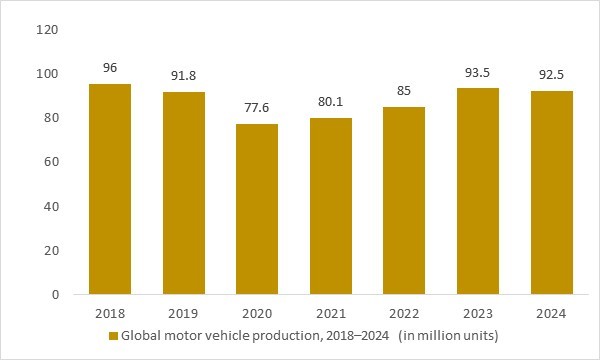
Global motor vehicle production 2018–2024 as a key parc driver for automotive automatic tire inflation systems

  • Rising global motor vehicle production from 2018 to 2024 expands the active vehicle parc and associated tire volumes. This structural increase in commercial trucks, trailers and buses is encouraging OEMs and fleet operators to adopt automatic tire inflation systems to improve safety, uptime and fuel efficiency.

Regional Insights

North America Automotive Automatic Tire Inflation System Market

In North America, the automotive automatic tire inflation system market is anchored by a large heavy-duty trucking and trailer base, long-haul freight corridors, and strong fleet focus on fuel savings and uptime. Adoption is most advanced on trailers and vocational trucks, where automatic inflation has been proven to cut fuel consumption, extend tire life, and reduce roadside breakdowns. OEMs integrate systems at the axle and suspension level, while retrofit kits target mixed and aging fleets looking for fast payback on operating expenses. Tight safety and emissions regulations, together with widespread TPMS mandates, help create awareness of tire pressure management and support complementary adoption of ATIS solutions. Partnerships between tire makers, telematics providers, and ATIS specialists are expanding, enabling connected offerings that blend real-time pressure control with analytics and predictive maintenance for large fleets.

Europe Automotive Automatic Tire Inflation System Market

In Europe, demand for automatic tire inflation systems is shaped by dense freight networks, high fuel and labor costs, and stringent safety and CO₂ reduction targets. While regulatory focus has historically centered on TPMS for heavy commercial vehicles, fleets are increasingly exploring ATIS as a way to go beyond monitoring and actively control tire pressure across complex truck–trailer combinations. Regional OEMs and Tier-1 suppliers integrate tire pressure control into advanced chassis, axle, and braking platforms, aligning with EU rules on tire performance, rolling resistance, and emissions. Cross-border operations and tight delivery windows emphasize reliability and reduced downtime, making automated inflation attractive for long-haul, tanker, and high-value cargo fleets. As low-emission zones, toll differentiation, and fuel-efficiency initiatives expand, ATIS is gaining recognition as part of broader eco-driving and fleet-optimization strategies.

Asia-Pacific Automotive Automatic Tire Inflation System Market

Asia-Pacific is a fast-growing region for automatic tire inflation systems, driven by rising freight activity, expanding logistics networks, and modernization of commercial vehicle fleets. Large markets such as China and India are upgrading truck and trailer specifications, with attention to fuel economy, tire costs, and safety on increasingly congested highways. International and regional suppliers are targeting OEM fitment on premium tractors and trailers, as well as aftermarket retrofits for long-haul and mining fleets that operate under harsh conditions. As regional TPMS and safety regulations evolve, fleets are beginning to pair monitoring with active inflation to stabilize performance over long routes and variable loading. Growing interest in connected fleet platforms and telematics in key APAC economies also supports adoption of smarter ATIS solutions that integrate pressure data, alerts, and maintenance workflows.

Rest of the World Automotive Automatic Tire Inflation System Market

In the rest of the world, including Latin America, the Middle East, and Africa, the market for automotive automatic tire inflation systems is at an earlier but steadily developing stage. Heavy-duty fleets in oil and gas, mining, construction, and cross-border logistics are early adopters, as they face extreme operating conditions, long distances, and costly downtime. Much of the current activity is concentrated in high-spec fleets and international operators that import trucks and trailers already equipped with ATIS or retrofit systems from global suppliers. Local awareness of tire-related fuel and safety losses is increasing, prompting interest in technologies that can stabilize tire pressures when service infrastructure is sparse. Over time, as road networks, regulatory frameworks, and digital fleet-management tools expand, ATIS is expected to move from niche to more broadly accepted efficiency equipment in targeted segments.

Market Scope

Parameter

Global Automotive Automatic Tire Inflation System Market scope Detail

Base Year

2024

Estimated Year

2025

Forecast Period

2026-2034

Market Size-Units

USD billion

Market Splits Covered

By Product, By Application, By End User and By Technology

Countries Covered

North America (USA, Canada, Mexico)
Europe (Germany, UK, France, Spain, Italy, Rest of Europe)
Asia-Pacific (China, India, Japan, Australia, Rest of APAC)
The Middle East and Africa (Middle East, Africa)
South and Central America (Brazil, Argentina, Rest of SCA)

Analysis Covered

Latest Trends, Driving Factors, Challenges, Trade Analysis, Price Analysis, Supply-Chain Analysis, Competitive Landscape, Company Strategies

Customization

10% free customization (up to 10 analyst hours) to modify segments, geographies, and companies analyzed

Post-Sale Support

4 analyst hours, available up to 4 weeks

Delivery Format

The Latest Updated PDF and Excel Data file

Market Segmentation

By Type

  • Central Tire Inflation
  • Continuous Tire Inflation
  • Others

By Technology Node

  • 10/7/5 nm
  • 16/14 nm
  • 20 nm
  • 28 nm
  • 45/40 nm
  • Others

By Component

  • Rotary Union
  • Compressor
  • Pressure Sensor
  • Air Delivery System
  • Other

By Foundry Type

  • Pure Play Foundry
  • IDMs

By Vehicle Type

  • On-Highway Vehicle(Light Duty and Heavy Duty Vehicle)
  • Off-Highway Vehicle(Agriculture tractors and Construction Vehicle)
  • Electric heavy-duty vehicles(Battery Electric Vehicle,Plug-In Hybrid Electric Vehicle and Fuel Cell Electric Vehicle)

By Application

  • Communication
  • Consumer Electronics
  • Computer
  • Automotive
  • Others

By Sales Channel

  • OEM
  • Aftermarket

By Geography

  • North America (USA, Canada, Mexico)
  • Europe (Germany, UK, France, Spain, Italy, Rest of Europe)
  • Asia-Pacific (China, India, Japan, Australia, Rest of APAC)
  • The Middle East and Africa (Middle East, Africa)
  • South and Central America (Brazil, Argentina, Rest of SCA)

Key Companies Covered

  • Michelin
  • Goodyear
  • Bridgestone
  • Continental AG
  • Dana Incorporate
  • Hendrickson
  • Pressure Systems International (PSI)
  • Nexter Group
  • Meritor, Inc.
  • Aperia Technologies, Inc.
  • STEMCO (EnPro Industries)
  • Haldex AB
  • WABCO (ZF Group)


You can purchase individual sections of this report. Explore pricing options for specific sections.

FAQ's

The Global Automotive Automatic Tire Inflation System Market is estimated to generate USD 917 million in revenue in 2024.

The Global Automotive Automatic Tire Inflation System Market is expected to grow at a Compound Annual Growth Rate (CAGR) of 9.3% during the forecast period from 2025 to 2032.

The Automotive Automatic Tire Inflation System Market is estimated to reach USD 1867.8 million by 2032.

License

Didn’t find what you’re looking for? TALK TO OUR ANALYST TEAM

Need something within your budget? NO WORRIES! WE GOT YOU COVERED!

Related Products

E-Bike Drive Unit Market Analysis and Outlook Report: Industry Size, Share, Growth Trends and Forecast (2026-2034)

Market Overview An e-bike drive unit system is the core component that powers an electric bicycle (or simply e-bike), providing electric assistance to enhance the rider's pedaling in crucial moments. It consists of three main elements motor, battery, and controller, which work together seamlessly to ensure a smooth, efficient ride. The motor, the heart of the e-bike available in two main types such as mid-drive (located near the crankset) and hub-drive (built into the wheel), converts electrical energy into mechanical power. The battery supplies this energy, while the controller manages power distribution based on real-time sensor data. These sensors monitor factors like pedaling force, speed, and cadence, enabling the system to adjust the level of assistance accordingly. This coordinated operation delivers the right amount of support when needed, making cycling easier on hills, over long distances and across various terrains. The advanced technology of e-bike drive units improves performance, making cycling more accessible, efficient, and enjoyable. The market is also witnessing rising interest in specialized e-bike applications, such as off-road and adventure models, which cater to niche segments like outdoor enthusiasts and sports professionals. Meanwhile, government initiatives such as tax rebates, subsidies, and infrastructure development (e.g., dedicated cycling lanes and charging stations) are strengthening the market's foundation. Countries like Japan and Germany are leading examples of how policy interventions can foster an environment conducive to e-bike adoption. The competitive landscape of the e-bike drive unit market is characterized by a mix of established players and emerging startups vying for market share through innovation and strategic collaborations. Industry leaders are investing heavily in R&D to create differentiated offerings, while smaller players focus on niche markets and regional expansion. Partnerships, acquisitions, and joint ventures are common strategies, as demonstrated by recent developments like Royal Enfield’s expansion into electric bikes and EV Manufacturing’s acquisition of Serial 1 Cycle Company. Looking ahead, the market is likely to experience consolidation as key players expand their product portfolios and enhance global distribution networks. This trend, combined with increasing consumer awareness of environmental issues, positions the e-bike drive unit market as a vital component in the future of sustainable urban transportation E-Bike Drive Unit MarketLatest Trends to 2034 Tailored Drive Systems for Specific Applications such as Cargo and Mountain Travel The e-bike market is witnessing robust growth, driven by innovations in tailored drive systems designed for specific applications like cargo transportation and mountain biking. These specialized e-bikes integrate purpose-built motors, batteries, and frames to enhance performance, reliability, and adaptability. Cargo e-bikes, featuring high-torque motors and reinforced frames, are becoming indispensable for urban and suburban delivery services. Their ability to handle heavy loads while maintaining efficiency and durability positions them as a cost-effective, eco-friendly alternative to traditional delivery vehicles. These innovations are revolutionizing logistics by addressing challenges like last-mile delivery, emissions reduction, and operational costs. In the mountain biking segment, tailored drive systems are enhancing off-road capabilities with powerful motors, adaptive power delivery, and lightweight designs. Electric mountain bikes (eMTBs) are increasingly appealing to professionals and enthusiasts, offering customizable features that adapt to varying terrains and preferences. Smart technologies further enrich the user experience by providing real-time adjustments. Infrastructure investments, such as expanded bike lanes and charging stations, along with favorable regulations, are catalyzing adoption. By offering sustainable alternatives to conventional transportation, tailored e-bike systems are reducing emissions and alleviating urban congestion. As demand grows, these innovations are reshaping both urban mobility and recreational cycling landscapes. Integration of Smart Technology Driving the E-Bike Market The rapid growth of the e-bike market is significantly fueled by the integration of advanced smart technologies, which enhance performance, efficiency, and overall user experience. Features such as IoT connectivity allow users to synchronize e-bikes with smartphones for route tracking, battery monitoring, and performance optimization. Personalized riding experiences are enabled through apps that tailor motor assistance based on rider preferences and terrain. Smart safety features like GPS tracking, anti-theft systems, and adaptive lighting improve security and visibility, addressing key consumer concerns. The inclusion of AI-driven predictive maintenance systems preempts mechanical issues, minimizing downtime and costs. Additionally, integration with fitness and health apps provides users with performance tracking, further broadening the market appeal. Future advancements promise autonomous riding capabilities, solidifying e-bikes as a cornerstone of sustainable urban transportation. Surging Demand for Modular Drive Systems A major emerging trend in the e-bike drive unit market is the increasing focus on modular drive systems. These systems allow manufacturers and users to customize motor and battery configurations based on specific performance requirements, offering unmatched flexibility. Innovations in wireless connectivity are enabling seamless integration with navigation systems, fitness apps, and traffic management platforms, creating a fully connected e-bike ecosystem. Enhanced waterproofing and durability standards are expanding the utility of e-bikes in challenging environments, such as extreme weather or rugged terrains. Additionally, the adoption of high-efficiency brushless motors and gearless designs is minimizing maintenance needs while improving energy conversion efficiency. Another notable trend is the rise of lightweight hub-drive units that provide a discreet and aesthetically pleasing alternative to mid-drive systems. The adoption of hybrid charging technologies, combining solar and grid-based systems, is also gaining momentum, further boosting sustainability. As manufacturers continue to innovate, these trends are set to redefine the capabilities and applications of e-bike drive units, expanding their reach into untapped markets and user segments. Battery Technology Innovations Propelling the E-Bike Drive Unit Market Advancements in battery technology are instrumental in driving the growth of the e-bike drive unit market, with significant progress in capacity, efficiency, and charging speed. Enhanced battery capacities now support longer rides, making e-bikes more practical for daily commutes and recreational activities. Fast-charging technologies improve convenience, reducing downtime and promoting widespread adoption. Lightweight, compact batteries, utilizing materials like lithium iron phosphate (LiFePO4) and solid-state technologies, are transforming the market by improving portability, ride handling, and comfort. Advanced battery management systems (BMS) further optimize charging cycles, extend battery life, and offer real-time monitoring via connected apps. Innovations like regenerative braking systems and swappable batteries are enhancing energy efficiency and user convenience, making e-bikes an increasingly sustainable and accessible mode of transportation. Improved Performance and Reduced Bike Weight Ongoing innovations in performance optimization and weight reduction are making e-bikes more efficient and user-friendly. Advances in lightweight materials such as carbon fiber and high-strength alloys, combined with compact and efficient motors, are transforming the riding experience. These innovations improve acceleration, handling, and ride comfort, while also extending battery life through efficient energy utilization. Smart technology integration further enhances performance, adapting motor output based on rider input and terrain. The rising popularity of folding e-bikes, known for their compact designs and portability, is another transformative trend. These models cater to urban commuters and travelers, offering the convenience of a traditional bike with electric assistance. By addressing a broader range of consumer needs, these developments are fueling market growth and solidifying e-bikes as a mainstream mode of transport. E-Bike Drive Unit Market Drivers to 2034 Rising Demand for E-Bike Drive Units Amid Global Energy Transition Goals Electric vehicles (EVs) are pivotal in addressing global carbon emissions, with the transport sector accounting for approximately 15% of global energy-related emissions in 2023. Countries worldwide are committing to net-zero carbon emission goals, aiming for a sustainable future. For instance, the US, Canada, and Chile target net zero by 2050, while China and India have set 2060 and 2070, respectively. China, with its high population density, is adopting electric vehicles, including e-bikes, e-cars, and e-trucks, as sustainable solutions to achieve these targets. E-bikes offer numerous advantages, such as eco-friendly commuting, long-lasting battery life, and alleviating traffic congestion, promoting sustainable urban mobility. Regulatory Support and Policy Incentives Driving E-Bike Adoption Government policies and incentives significantly boost the e-bike market. Europe leads with strong infrastructure and favorable policies, supported by environmental consciousness. For example, Austria provides financial aid for e-bike purchases through February 2025. France offers purchasing discounts between €300 and €2,000, alongside long-term lease programs in regions like Île-de-France. Similarly, Belgium supports regional e-bike purchases with financial assistance ranging from 550 to 1,350. The US offers a tax credit of up to 1,500 per e-bike, while Australia introduced a short-term rebate scheme providing 500 for e-bikes. These incentives highlight global regulatory efforts to encourage e-bike adoption. Technological Advancements Fueling E-Bike Drive Units Technological progress, such as smart connectivity, lightweight materials, and advanced battery systems, is enhancing e-bike performance and accessibility. Innovations like regenerative braking, compact designs, and intelligent controllers are redefining the market. Prominent companies like Bosch eBike Systems, Shimano, Yamaha, Brose, and Bafang Electric are at the forefront. Lithium-ion battery advancements have extended range and reduced charging times while emerging solid-state battery technology offers improved energy density, safety, and longevity. Smart battery management systems (BMS) further optimize performance and reliability, catering to diverse consumer needs. Urbanization and Traffic Congestion Driving Market Growth Rapid urbanization and worsening traffic congestion are reshaping urban transportation dynamics, with e-bikes emerging as a practical alternative to traditional vehicles. Advanced drive units provide electric assistance, ensuring smooth navigation in congested areas and on steep terrains. E-bikes offer cost-effective, flexible, and eco-friendly mobility solutions, encouraging healthier lifestyles and solving urban parking challenges. Investments in cycling infrastructure across cities, particularly in the US, coupled with government incentives, are further bolstering e-bike adoption. This focus on sustainable urban mobility propels substantial growth in the e-bike drive unit market. Regional Insights North America North America’s e-bike drive unit market is driven by growing commuter and recreational e-bike adoption, expanding trail and cargo-bike use, and rising interest from delivery and fleet operators seeking low-cost last-mile mobility. Market dynamics favor reliable, serviceable systems with strong dealer support, warranty coverage, and firmware diagnostics, as buyers increasingly compare total ride experience rather than motor wattage alone. Lucrative opportunities are strongest in mid-drive systems for performance and cargo applications, integrated drive + battery ecosystems for OEM partnerships, and fleet-focused solutions that prioritize durability, parts availability, and fast turnaround service. Latest trends include higher torque tuning for hill and load use, better thermal management for sustained output, quieter drivetrains, and tighter integration with apps, anti-theft features, and connectivity. The forecast is positive as infrastructure improves and employers/cities support micromobility, with recent developments emphasizing modular platforms that let brands scale across commuter, cargo, and off-road categories with shared components. Asia Pacific Asia Pacific is shaped by high-volume e-bike usage in several countries, fast-growing urban mobility demand, and a broad range of price tiers from entry commuter models to premium mid-drive bikes. Market dynamics revolve around cost-performance optimization, large-scale OEM supply relationships, and rapid model refresh cycles, with strong emphasis on manufacturing scale, localized supply chains, and consistent quality control. Lucrative opportunities sit in mass-market hub-drive systems for affordable commuting, mid-drive growth in premium segments, and integrated drivetrains for branded OEM ecosystems that lock in battery, controller, and display compatibility. Trends include improved torque sensing and smoother cadence response, rising use of compact mid-drive units in city bikes, and increasing adoption of connected features for fleet tracking and theft deterrence. The outlook remains robust where urban congestion and short-trip mobility needs are rising, with recent developments focused on higher integration, improved efficiency, and expanding service networks to support wider adoption. Europe Europe’s e-bike drive unit market is strongly influenced by high penetration of e-bikes for commuting and touring, strict product and safety expectations, and a premium-leaning customer base that values ride feel, reliability, and service support. Market dynamics favor mid-drive systems due to their natural pedaling performance and strong torque characteristics, while OEMs compete through integrated ecosystems, long-term parts availability, and dealer-based diagnostics. Lucrative opportunities are strongest in mid-drive platforms for trekking and urban mobility, cargo-bike drivetrains engineered for higher loads, and lightweight drive units for premium city and performance segments. Latest trends include quieter motors, refined torque sensing, improved heat handling for long climbs, and more sophisticated software modes that balance range and performance. The forecast remains healthy as cycling infrastructure expands and consumers replace older bikes, with recent developments emphasizing integrated displays, anti-theft/locking features, and ecosystem partnerships across batteries, chargers, and connectivity. Middle East & Africa Middle East & Africa is in an earlier adoption phase overall, but demand is building in select urban centers, tourism hubs, and delivery corridors where short-distance mobility and cost efficiency matter. Market dynamics emphasize robustness, heat and dust tolerance, and serviceability, with buyers and importers prioritizing durable components, simple maintenance, and reliable supply for spares. Lucrative opportunities exist in practical commuter e-bikes, delivery-focused models, and fleet deployments where standardized drive units simplify maintenance and training. Trends include rising interest in hub-drive systems for affordability and ease of service, plus growing demand for better range, stronger hill performance, and theft deterrence as usage increases. The outlook improves where cycling infrastructure and policy support develop, with recent developments centered on expanding distributor/service footprints and offering more rugged configurations suited to local operating conditions. South & Central America South & Central America’s e-bike drive unit market is influenced by affordability constraints, the need for durable urban commuting solutions, and growing usage in delivery and informal logistics where uptime matters. Market dynamics focus on value-for-money, reliable parts availability, and service networks that can support repairs quickly, making standardized components and simpler architectures attractive for fleets and budget-conscious consumers. Lucrative opportunities are strongest in commuter and utility e-bikes, hub-drive systems positioned for cost-sensitive buyers, and cargo/delivery platforms where torque, durability, and battery compatibility are key purchase drivers. Latest trends include gradual upgrades in torque sensing and controller tuning for smoother starts, increasing attention to range and battery quality, and adoption of connected features where fleets require tracking and theft mitigation. The forecast is steady to positive as micromobility adoption rises, with recent developments emphasizing stronger aftermarket support, better component standardization, and more utility-focused product designs. Report Scope Parameter E-Bike Drive Unit Market Scope Detail Base Year 2024 Estimated Year 2025 Forecast Period 2026-2032 Market Size-Units USD billion Market Splits Covered By Product Type, By Diagnostic Method, By End User Countries Covered North America (USA, Canada, Mexico) Europe (Germany, UK, France, Spain, Italy, Rest of Europe) Asia-Pacific (China, India, Japan, Australia, Rest of APAC) The Middle East and Africa (Middle East, Africa) South and Central America (Brazil, Argentina, Rest of SCA) Analysis Covered Latest Trends, Driving Factors, Challenges, Trade Analysis, Price Analysis, Supply-Chain Analysis, Competitive Landscape, Company Strategies Customization 10% free customization (up to 10 analyst hours) to modify segments, geographies, and companies analyzed Post-Sale Support 4 analyst hours, available up to 4 weeks Delivery Format The Latest Updated PDF and Excel Data file

Published:Feb-2026

Automotive Emission Analyzer Market Analysis and Outlook Report: Industry Size, Share, Growth Trends, and Forecast (2026-2034)

Market Overview The automotive emission analyzer market is focused on tools and technologies used to measure the pollutants emitted by vehicles. These analyzers are crucial in ensuring compliance with environmental standards and regulations. The market's value chain includes manufacturers of emission testing equipment, software developers, and service providers, all working together to offer comprehensive solutions. Key applications include use in vehicle manufacturing, repair workshops, and government testing centers. As environmental awareness grows, the industry is seeing a trend towards more portable and efficient analyzers. Demand is driven by stricter regulations and an increasing focus on sustainability, with challenges such as high costs and the need for technical expertise hindering some market growth. The competitive landscape features a mix of established players and innovative startups, each vying to offer the latest technology. Regionally, the market dynamics vary, with North America and Europe leading due to stringent emission norms and enforcement. In contrast, developing regions are gradually catching up as awareness and regulation grow. Asia Pacific is emerging as a significant market due to the rapid growth of the automotive industry in countries like China and India, alongside increasing regulatory pressure. In these regions, the challenge remains the balance between cost-efficiency and compliance. Overall, the market is poised for growth as global emission standards become more rigorous, pushing manufacturers to innovate and offer more reliable and user-friendly solutions. Key Insights Recent advancements in emission analyzer technologyhave led to more accurate and portable devices,making them more attractive to smaller repair shopsand independent garages. The shift towards electric vehicles is reshapingthe landscape, as traditional emission analyzersfind new applications in hybrid diagnostics. Regulatory changes in Europe are drivingsignificant market growth, with manufacturersracing to comply with the latest standards. In North America, the focus is on innovationand integration, with manufacturers developingsmarter solutions that link seamlessly withexisting automotive diagnostic systems. Emerging markets in Asia are seeing increaseddemand due to rapid urbanization andgovernment initiatives to reduce pollution.This is fostering local industry growth. Competition is heating up as new entrantsintroduce cost-effective solutions, challengingestablished players to innovate or reduce prices. Technological integration, such as IoT andcloud-based analytics, is becoming more prevalent,offering enhanced data accuracy andoperational efficiency. Environmental awareness is a major demand driver,pushing industries to adopt cleaner technologiesand adhere to stringent emission norms. Challenges such as high initial investment andmaintenance costs continue to deter smallerbusinesses from adopting advanced analyzers. Increasing partnerships between car manufacturersand emission analyzer producers are being observed,aiming to streamline compliance processesand foster innovation. Report Scope Parameter Detail Base Year 2025 Estimated Year 2026 Forecast Period 2027-2034 Market Size-Units USD Billion/Million Market Segmentation By Product Type Non-dispersive Infrared (NDIR) Analyzers Fourier Transform Infrared (FTIR) Analyzers Electrochemical Gas Analyzers Others By Application Passenger Vehicles Commercial Vehicles Motorcycles Off-road Vehicles By End User Automotive Manufacturers Service Stations Government Bodies Research Institutions By Technology Portable Emission Analyzers Stationary Emission Analyzers Countries Covered North America USA Canada Mexico Europe: Germany UK France Spain Italy Rest of Europe Asia-Pacific: China India Japan Australia South Korea Rest of APAC Middle East and Africa: Saudi Arabia UAE Iran South Africa Vietnam Rest of MEA South and Central America: Brazil Argentina Chile Rest of SCA Analysis Covered Latest Trends, Driving Factors, Challenges, Supply-Chain Analysis, Competitive Landscape, Company Strategies Customization 10% free customization(up to 10 analyst hours) to modify segments, geographies, and companies analyzed Post-Sale Support 4 analyst hours, available up to 4 weeks Delivery Format The Latest Updated PDF and Excel Datafile

Published:Jan-2026

Automobile Front Caliper Market Analysis and Outlook Report: Industry Size, Share, Growth Trends, and Forecast (2026-2034)

Market Overview The automobile front caliper market is a critical segment within the broader automotive components industry. This market focuses on the production and distribution of calipers, which are essential for the braking systems of vehicles, ensuring safety and control. The value chain encompasses raw material suppliers, manufacturers, and aftermarket service providers. Key applications include passenger cars, commercial vehicles, and high-performance vehicles. Recent trends highlight a shift towards lightweight materials and advanced technologies to enhance performance and efficiency. Demand is driven by the increasing production of vehicles globally and the push for enhanced safety standards. However, challenges such as fluctuating raw material prices and stringent regulatory requirements pose hurdles. The competitive landscape is characterized by a mix of established players and emerging companies, all striving for innovation and market share. Regionally, dynamics vary with mature markets focusing on replacement demand and emerging markets experiencing robust growth due to urbanization and rising disposable incomes. In recent years, the automobile front caliper market has witnessed significant technological advancements, including the integration of electronic systems for enhanced braking performance. The rise of electric vehicles has also impacted the market, as these vehicles require specialized calipers to accommodate unique design and performance needs. Competition is intense, with companies investing in research and development to introduce next-generation products. Regulatory standards, particularly in developed regions, are becoming increasingly stringent, pushing manufacturers to innovate while adhering to environmental and safety regulations. The aftermarket segment is gaining traction, driven by the growing demand for replacement parts in high-mileage vehicles. The Asia-Pacific region is experiencing a surge in demand due to rapid vehicle production and a burgeoning automotive sector. Conversely, the North American and European markets are focusing on technological innovations and sustainability. Overall, the market is poised for steady growth, fueled by technological advancements and evolving consumer preferences. Key Insights The integration of electronic systems in front calipers is reshaping the market, offering enhanced braking performance and safety features. This trend is gaining traction as automakers seek to differentiate their vehicles with advanced technologies. Electric vehicles are influencing the design and functionality of front calipers, requiring adaptations to meet the unique demands of these vehicles. This shift is driving innovation and creating opportunities for specialized component manufacturers. Regulatory standards are tightening, particularly in developed regions, pushing manufacturers to comply with environmental and safety requirements. This trend is encouraging the adoption of sustainable materials and eco-friendly production processes. The Asia-Pacific region is witnessing robust growth in the automobile front caliper market, driven by increased vehicle production and urbanization. This momentum is attracting investments from global players seeking to capitalize on the expanding market. In North America and Europe, the focus is on technological innovation and sustainability, with companies investing in research and development to create next-generation products. These regions are leading the way in eco-friendly and high-performance caliper designs. The aftermarket segment is growing as vehicle owners increasingly seek replacement parts for high-mileage vehicles. This trend is propelling demand for durable and cost-effective caliper solutions in various markets. Fluctuating raw material prices pose a challenge for manufacturers, impacting profit margins and production costs. Companies are exploring alternative materials and supply chain strategies to mitigate these challenges. Competition in the market is fierce, with established players and new entrants striving for market share. Innovation and product differentiation are key strategies being employed to stay competitive in a dynamic environment. The push for lightweight automotive components is influencing the design of front calipers, as manufacturers seek to reduce vehicle weight and improve fuel efficiency. This trend is driving the adoption of advanced materials and manufacturing techniques. Emerging markets are becoming key growth drivers for the automobile front caliper industry, with increasing vehicle ownership and infrastructure development creating demand. These regions offer potential for expansion and market penetration. Report Scope Parameter Detail Base Year 2025 Estimated Year 2026 Forecast Period 2027-2034 Market Size-Units USD Billion/Million Market Segmentation By Vehicle Type Passenger Cars Light Commercial Vehicles Heavy Commercial Vehicles By Material Type Aluminum Cast Iron Stainless Steel By Sales Channel OEM (Original Equipment Manufacturer) Aftermarket By Application Disc Brakes Drum Brakes Countries Covered North America USA Canada Mexico Europe: Germany UK France Spain Italy Rest of Europe Asia-Pacific: China India Japan Australia South Korea Rest of APAC Middle East and Africa: Saudi Arabia UAE Iran South Africa Vietnam Rest of MEA South and Central America: Brazil Argentina Chile Rest of SCA Analysis Covered Latest Trends, Driving Factors, Challenges, Supply-Chain Analysis, Competitive Landscape, Company Strategies Customization 10% free customization(up to 10 analyst hours) to modify segments, geographies, and companies analyzed Post-Sale Support 4 analyst hours, available up to 4 weeks Delivery Format The Latest Updated PDF and Excel Datafile

Published:Jan-2026