Battery Technology Market Analysis and Outlook Report: Industry Size, Share, Growth Trends, and Forecast (2026-2034)

Published On: Jan, 2026
|
Pages: 147

"The Global Battery Technology Market valued at USD 124. billion in 2024, is expected to grow by 8.3% CAGR to reach market size worth USD 281. billion by 2034."

The battery technology market is experiencing a period of unprecedented growth and innovation, driven by the increasing demand for energy storage solutions across diverse industries. From powering electric vehicles and grid-scale energy storage to enabling portable electronics and medical devices, batteries are becoming increasingly integral to modern life. This surge in demand is pushing the boundaries of battery technology, with researchers and manufacturers continuously striving to improve energy density, lifespan, safety, and cost-effectiveness. In 2024, the market witnessed significant advancements in lithium-ion battery technology, alongside the exploration of alternative battery chemistries like solid-state and sodium-ion batteries. These developments, coupled with growing government support for clean energy initiatives, propelled the battery technology market forward.

Moving into 2025, the battery technology market is poised for continued expansion, fueled by the global transition towards a more sustainable and electrified future. The growing adoption of electric vehicles, coupled with the expanding deployment of renewable energy sources and energy storage systems, will further stimulate demand for advanced battery technologies. The market is expected to witness intensified research and development efforts focused on improving battery performance, reducing costs, and enhancing sustainability. However, the industry will also face challenges related to the availability of raw materials, the need for more sustainable battery chemistries, and the development of safe and reliable manufacturing processes. The battery technology market is therefore at a critical juncture, balancing the drive for innovation with the imperative for sustainable and responsible development.
The Global Battery Technology Market Analysis Report will provide a comprehensive assessment of business dynamics, offering detailed insights into how companies can navigate the evolving landscape to maximize their market potential through 2034. This analysis will be crucial for stakeholders aiming to align with the latest industry trends and capitalize on emerging market opportunities.

Asia-Pacific is the leading region in the Battery Technology market, propelled by rapid electric vehicle adoption, strong government support for clean energy initiatives, and large-scale investments in battery manufacturing facilities.Lithium-ion batteries represent the dominating segment in the Battery Technology market, fueled by their high energy density, declining costs, and widespread use across consumer electronics, electric vehicles, and grid storage systems.
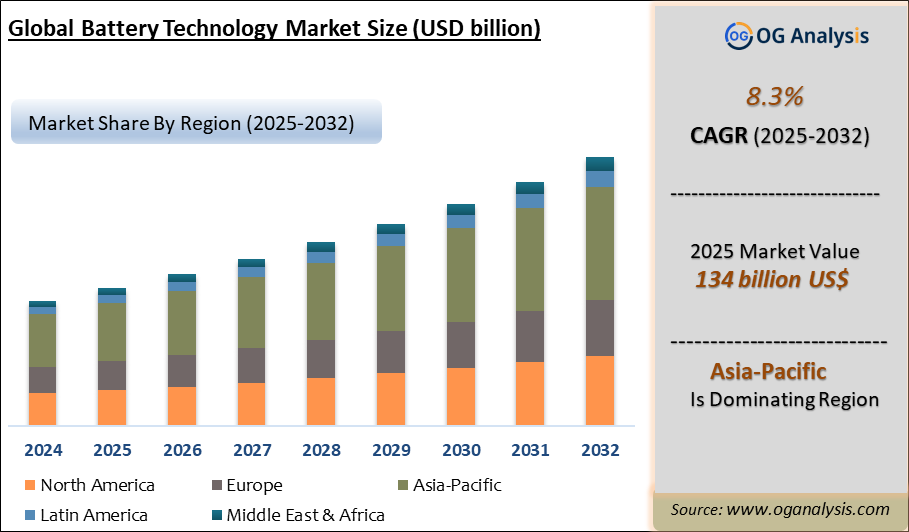
Global Battery Technology Market Analysis 2025-2032: Industry Size, Share, Growth Trends, Competition and Forecast Report

Battery Technology Market Strategy, Price Trends, Drivers, Challenges and Opportunities to 2034

In terms of market strategy, price trends, drivers, challenges, and opportunities from2025 to 2034, Battery Technology market players are directing investments toward acquiring new technologies, securing raw materials through efficient procurement and inventory management, enhancing product portfolios, and leveraging capabilities to sustain growth amidst challenging conditions. Regional-specific strategies are being emphasized due to highly varying economic and social challenges across countries.

Factors such as global economic slowdown, the impact of geopolitical tensions, delayed growth in specific regions, and the risks of stagflation necessitate a vigilant and forward-looking approach among Battery Technology industry players. Adaptations in supply chain dynamics and the growing emphasis on cleaner and sustainable practices further drive strategic shifts within companies.

The market study delivers a comprehensive overview of current trends and developments in the Battery Technology industry, complemented by detailed descriptive and prescriptive analyses for insights into the market landscape until 2034.
 

North America Battery Technology Market Analysis

The North America Battery Technology market experienced notable advancements in 2024, driven by the rapid adoption of cutting-edge technologies, increasing demand for sustainable and energy-efficient solutions, and robust investments in industrial modernization. The shift towards automation and digital transformation across manufacturing and logistics sectors is anticipated to drive significant growth from 2025 onwards, supported by stringent environmental regulations and government incentives promoting cleaner technologies. The competitive landscape remains dynamic, with key players focusing on R&D, product innovation, and strategic collaborations to gain a competitive edge. Moreover, the integration of smart technologies, such as IoT and AI, in industrial operations continues to reshape market dynamics, presenting lucrative opportunities for companies aiming to optimize productivity and sustainability.
 

Europe Battery Technology Market Outlook

In 2024, the Europe Battery Technology market witnessed substantial growth fueled by the region's emphasis on renewable energy adoption, circular economy practices, and green manufacturing initiatives. With a strong policy framework supporting carbon neutrality goals and increasing investments in advanced production technologies, the market is poised for accelerated growth from 2025 onwards. Leading players are prioritizing sustainable product development and regional expansion to meet evolving consumer and industrial demands. Furthermore, the integration of automation in manufacturing and logistics, coupled with advancements in material engineering, is expected to drive innovation and bolster market competitiveness across the region.
 

Asia-Pacific Battery Technology Market Forecast

The Asia-Pacific Battery Technology market demonstrated robust progress in 2024, underpinned by rapid industrialization, infrastructural development, and rising adoption of advanced manufacturing solutions across key economies like China, India, and Japan. Anticipated growth from 2025 will be supported by increasing foreign investments, a burgeoning middle class, and government initiatives to boost domestic manufacturing capabilities. The region's competitive landscape is characterized by the presence of both global and regional players focusing on cost-effective innovations and strategic partnerships to expand their footprint. Key drivers include the rising demand for energy-efficient systems, advancements in material science, and the growing emphasis on digitalization in industrial operations.
 

Middle East, Africa, Latin America Battery Technology Market Overview

The Middle East, Africa, Latin America Battery Technology market displayed steady growth in 2024, primarily driven by infrastructural development and industrial modernization in emerging economies across Latin America, the Middle East, and Africa. From 2025 onwards, growth is anticipated to gain momentum, propelled by rising investments in sustainable industrial solutions and the increasing adoption of automation to enhance operational efficiency. The competitive landscape is evolving, with regional players leveraging partnerships and technological advancements to cater to local demands. Key factors supporting market expansion include government initiatives aimed at industrial diversification, the rising focus on energy-efficient systems, and advancements in supply chain technologies.
 

Battery Technology Market Dynamics and Future Analytics

The research analyses the Battery Technology parent market, derived market, intermediaries’ market, raw material market, and substitute market are all evaluated to better prospect the Battery Technology market outlook. Geopolitical analysis, demographic analysis, and Porter’s five forces analysis are prudently assessed to estimate the best Battery Technology market projections.

Recent deals and developments are considered for their potential impact on Battery Technology's future business. Other metrics analyzed include the Threat of New Entrants, Threat of New Substitutes, Product Differentiation, Degree of Competition, Number of Suppliers, Distribution Channel, Capital Needed, Entry Barriers, Govt. Regulations, Beneficial Alternative, and Cost of Substitute in Battery Technology market.

Battery Technology trade and price analysis helps comprehend Battery Technology's international market scenario with top exporters/suppliers and top importers/customer information. The data and analysis assist our clients in planning procurement, identifying potential vendors/clients to associate with, understanding Battery Technology price trends and patterns, and exploring new Battery Technology sales channels. The research will be updated to the latest month to include the impact of the latest developments such as the Russia-Ukraine war on the Battery Technology market.

Battery Technology Market Structure, Competitive Intelligence and Key Winning Strategies

The report presents detailed profiles of top companies operating in the Battery Technology market and players serving the Battery Technology value chain along with their strategies for the near, medium, and long term period.

OGAnalysis’ proprietary company revenue and product analysis model unveils the Battery Technology market structure and competitive landscape. Company profiles of key players with a business description, product portfolio, SWOT analysis, Financial Analysis, and key strategies are covered in the report. It identifies top-performing Battery Technology products in global and regional markets. New Product Launches, Investment & Funding updates, Mergers & Acquisitions, Collaboration & Partnership, Awards and Agreements, Expansion, and other developments give our clients the Battery Technology market update to stay ahead of the competition.
Company offerings in different segments across Asia-Pacific, Europe, the Middle East, Africa, and South and Central America are presented to better understand the company strategy for the Battery Technology market. The competition analysis enables users to assess competitor strategies and helps align their capabilities and resources for future growth prospects to improve their market share.

Battery Technology Market Research Scope
• Global Battery Technology market size and growth projections (CAGR), 2024- 2034
• Policies of USA New President Trump, Russia-Ukraine War, Israel-Palestine, Middle East Tensions Impact on the Battery Technology Trade and Supply-chain
• Battery Technology market size, share, and outlook across 5 regions and 27 countries, 2023- 2034
• Battery Technology market size, CAGR, and Market Share of key products, applications, and end-user verticals, 2023- 2034
• Short and long-term Battery Technology market trends, drivers, restraints, and opportunities
• Porter’s Five Forces analysis, Technological developments in the Battery Technology market, Battery Technology supply chain analysis
• Battery Technology trade analysis, Battery Technology market price analysis, Battery Technology supply/demand
• Profiles of 5 leading companies in the industry- overview, key strategies, financials, and products
• Latest Battery Technology market news and developments
The Battery Technology Market international scenario is well established in the report with separate chapters on North America Battery Technology Market, Europe Battery Technology Market, Asia-Pacific Battery Technology Market, Middle East and Africa Battery Technology Market, and South and Central America Battery Technology Markets. These sections further fragment the regional Battery Technology market by type, application, end-user, and country.

Market Scope

Parameter

Detail

Base Year

2024

Estimated Year

2025

Forecast Period

2026-2032

Market Size-Units

USD billion

Market Splits Covered

By Product, By Application and By End-User

Countries Covered

North America (USA, Canada, Mexico)
Europe (Germany, UK, France, Spain, Italy, Rest of Europe)
Asia-Pacific (China, India, Japan, Australia, Rest of APAC)
The Middle East and Africa (Middle East, Africa)
South and Central America (Brazil, Argentina, Rest of SCA)

Analysis Covered

Latest Trends, Driving Factors, Challenges, Trade Analysis, Price Analysis, Supply-Chain Analysis, Competitive Landscape, Company Strategies

Customization

10% free customization (up to 10 analyst hours) to modify segments, geographies, and companies analyzed

Post-Sale Support

4 analyst hours, available up to 4 weeks

Delivery Format

The Latest Updated PDF and Excel Data file

Regional Insights
North America Battery Technology market data and outlook to 2034
United States
Canada
Mexico

Europe Battery Technology market data and outlook to 2034
Germany
United Kingdom
France
Italy
Spain
BeNeLux
Russia

Asia-Pacific Battery Technology market data and outlook to 2034
China
Japan
India
South Korea
Australia
Indonesia
Malaysia
Vietnam

Middle East and Africa Battery Technology market data and outlook to 2034
Saudi Arabia
South Africa
Iran
UAE
Egypt

South and Central America Battery Technology market data and outlook to 2034
Brazil
Argentina
Chile
Peru

* We can include data and analysis of additional coutries on demand

Who can benefit from this research
The research would help top management/strategy formulators/business/product development/sales managers and investors in this market in the following ways
1. The report provides 2024 Battery Technology market sales data at the global, regional, and key country levels with a detailed outlook to 2034 allowing companies to calculate their market share and analyze prospects, uncover new markets, and plan market entry strategy.

2. The research includes the Battery Technology market split into different types and applications. This segmentation helps managers plan their products and budgets based on the future growth rates of each segment

3. The Battery Technology market study helps stakeholders understand the breadth and stance of the market giving them information on key drivers, restraints, challenges, and growth opportunities of the market and mitigating risks

4. This report would help top management understand competition better with a detailed SWOT analysis and key strategies of their competitors, and plan their position in the business

5. The study assists investors in analyzing Battery Technology business prospects by region, key countries, and top companies' information to channel their investments.

Available Customizations
The standard syndicate report is designed to serve the common interests of Battery Technology Market players across the value chain and include selective data and analysis from entire research findings as per the scope and price of the publication.
However, to precisely match the specific research requirements of individual clients, we offer several customization options to include the data and analysis of interest in the final deliverable.
Some of the customization requests are as mentioned below –
Segmentation of choice – Our clients can seek customization to modify/add a market division for types/applications/end-uses/processes of their choice.
Battery Technology Pricing and Margins Across the Supply Chain, Battery Technology Price Analysis / International Trade Data / Import-Export Analysis,
Supply Chain Analysis, Supply – Demand Gap Analysis, PESTLE Analysis, Macro-Economic Analysis, and other Battery Technology market analytics
Processing and manufacturing requirements, Patent Analysis, Technology Trends, and Product Innovations
Further, the client can seek customization to break down geographies as per their requirements for specific countries/country groups such as South East Asia, Central Asia, Emerging and Developing Asia, Western Europe, Eastern Europe, Benelux, Emerging and Developing Europe, Nordic countries, North Africa, Sub-Saharan Africa, Caribbean, The Middle East and North Africa (MENA), Gulf Cooperation Council (GCC) or any other.
Capital Requirements, Income Projections, Profit Forecasts, and other parameters to prepare a detailed project report to present to Banks/Investment Agencies.
Customization of up to 10% of the content can be done without any additional charges.

Note: Latest developments will be updated in the report and delivered within 2 to 3 working days

Battery Technology Market Segmentation

By Battery Type
- Lithium-ion Batteries
- Lead-acid Batteries
- Nickel-Cadmium (NiCd) Batteries
- Others

By Application
- Automotive
- Consumer Electronics
- Industrial
- Medical Devices
- Aerospace & Defense
- Others

By Geography
- North America (USA, Canada, Mexico)
- Europe (Germany, UK, France, Spain, Italy, Rest of Europe)
- Asia-Pacific (China, India, Japan, Australia, Vietnam, Rest of APAC)
- The Middle East and Africa (Middle East, Africa)
- South and Central America (Brazil, Argentina, Rest of SCA)

Key Market Players

  • A123 Systems

  • BSLBATT

  • BYD

  • Clarios

  • Crown Battery

  • Discover Battery

  • Duracell

  • East Penn Manufacturing

  • EnerSys

  • Exide Industries

You can purchase individual sections of this report. Explore pricing options for specific sections.

FAQ's

The Battery Technology Market is estimated to reach USD 281.0 billion by 2034.

The Global Battery Technology Market is expected to grow at a Compound Annual Growth Rate (CAGR) of 8.3% during the forecast period from 2025 to 2034.

The Global Battery Technology Market is estimated to generate USD 132.9 billion in revenue in 2025

License

Didn’t find what you’re looking for? TALK TO OUR ANALYST TEAM

Need something within your budget? NO WORRIES! WE GOT YOU COVERED!

Related Products

Octane Improver Fuel Additives Market Analysis and Outlook Report: Industry Size, Share, Growth Trends, and Forecast (2026-2034)

The Octane Improver Fuel Additives market is a specialized but strategically important segment of the broader gasoline additives industry, centered on materials used to raise knock resistance, improve combustion stability, and help refiners or fuel marketers meet target octane specifications across regular, midgrade, and premium gasoline pools. Core applications are concentrated in gasoline blending for passenger vehicles, motorcycles, performance engines, fleet fuels, and selected aftermarket uses, with the greatest relevance in spark-ignition engines where octane quality directly affects drivability and resistance to knocking. The category includes oxygenates such as ethanol and other octane-enhancing blend components, as well as refinery and terminal additives used to improve blending flexibility and finished-fuel performance. One of the most important market trends is the shift away from a simple octane-lift proposition toward broader fuel-quality optimization, where octane improvement is increasingly linked with emissions compliance, refinery efficiency, deposit control, and compatibility with modern engine technologies. Ethanol-blended gasoline remains an important structural influence because it provides strong blending properties and is already widely used in retail gasoline, while fuel-quality regulations continue to shape additive selection and formulation strategy. From a competitive standpoint, the industry is shaped by fuel-additive specialists, integrated chemical suppliers, and refinery-focused solution providers competing on cost-effective octane uplift, blending flexibility, multifunctional performance, and the ability to meet changing local fuel standards. A major growth driver is the continued need for refiners to balance octane requirements, gasoline pool economics, and emissions constraints without relying solely on more expensive refinery process changes. Another notable trend is the increasing importance of additive packages that combine octane improvement with detergency, corrosion protection, oxidation stability, or compatibility with oxygenated fuels, reflecting a market that is becoming more solution-oriented rather than purely volume-driven. Looking ahead, the market outlook remains moderately positive because conventional gasoline vehicles will remain significant for years, premium-fuel demand persists in many regions, and higher-octane fuels continue to support more efficient spark-ignition engine strategies, even as additive portfolios evolve under regulatory and sustainability pressure. Overall, the market continues to offer relevance through its role in refinery optimization, fuel differentiation, and the performance management of modern gasoline systems. Key Market Insights Gasoline blending remains the core demand foundation of the market. Octane improvers are directly tied to the need to raise fuel quality in spark-ignition applications across regular, midgrade, and premium gasoline. Their importance is strongest where refiners and fuel marketers must meet target specifications while maintaining blending flexibility and controlling production cost. This keeps the market closely connected to gasoline pool management rather than a narrow specialty niche. The long-term role of these additives will continue to depend on how fuel-quality requirements evolve across major transportation markets. Even as powertrain options diversify, gasoline remains commercially significant enough to support ongoing demand. Ethanol remains one of the most important structural influences on market behavior. Its high octane value and favorable blending characteristics have made it a central component in gasoline formulation in many regions. This means the octane improver market is shaped not only by specialty additives but also by oxygenate blending strategy and fuel policy. Competitive dynamics are therefore influenced by how much octane value is already supplied through ethanol in the finished fuel pool. In practice, ethanol has become both a core blending component and a benchmark against which other octane-lift solutions are measured. Its continued role will strongly affect future additive positioning and refinery economics. Refinery economics are a major driver of additive adoption. These products are often attractive because they help achieve target octane levels without forcing refiners to depend entirely on more costly processing or blendstock adjustments. Suppliers increasingly position octane improvers as tools for improving blend flexibility, optimizing gasoline yield, and reducing the economic burden of producing higher-octane fuels. This makes the market highly sensitive to refining margins, gasoline grade mix, and local specification changes. Cost-effective performance remains one of the most important value propositions in the category. The strongest suppliers are those that help refiners balance fuel quality, compliance, and profitability at the same time. Premium-fuel demand supports the higher-value end of the market. Retail gasoline is sold across multiple octane levels, and premium segments continue to create demand for stronger octane-management strategies. Higher-octane fuels remain important for engines designed to resist knocking under higher load or compression conditions, which supports continued commercial relevance for premium blending components and additive packages. This is especially important in markets where consumers maintain strong demand for premium fuel or where automakers continue to calibrate engines for higher-octane performance. The premium segment may not define all market volume, but it remains strategically important for product differentiation and margin quality. Its influence will continue to support additive demand where performance branding matters. Modern engine-efficiency trends reinforce the importance of octane quality. Higher octane levels can support knock suppression and help enable engine strategies associated with improved efficiency in spark-ignition systems. This keeps octane improvers relevant not only as blending tools but also as part of the broader relationship between engine design and fuel performance. As vehicle manufacturers continue refining turbocharged and higher-compression gasoline engines, fuel quality remains commercially important. The market therefore benefits from the ongoing technical link between octane level and engine performance potential. Future demand is likely to favor solutions aligned with both fuel economy expectations and evolving emissions targets. Regulation is reshaping formulation strategy across the market. Fuel and additive rules increasingly require suppliers and refiners to consider emissions impact, compatibility with emission-control systems, broader gasoline quality requirements, and the use of cleaner additive chemistry. As a result, octane improvers are no longer judged only by how much they raise octane, but also by how well they fit within regulated fuel systems. Regulatory pressure is encouraging cleaner, compliant, and better-integrated formulations over older, simpler approaches. It also increases the value of suppliers with strong technical documentation and formulation support. Compliance readiness will remain one of the main factors determining long-term product viability. Multifunctional additive packages are becoming more important than single-purpose chemistry. The market is steadily moving toward solutions that combine octane improvement with detergency, corrosion inhibition, oxidation stability, or oxygenate compatibility. This reflects customer demand for broader finished-fuel performance rather than isolated octane uplift alone. Refiners and marketers increasingly prefer packages that help meet multiple operational and quality goals with fewer treatment steps. This trend is commercially important because it favors suppliers with broader formulation capability and stronger application expertise. Over time, multifunctionality is likely to become one of the strongest competitive differentiators in the market. Aftermarket and branded fuel-performance positioning add a secondary layer of demand. While refinery and terminal applications remain the most structurally important, consumer-facing octane boosters and gasoline-performance additives also support category visibility and niche commercial activity. These products are often marketed around combustion quality, engine protection, or performance enhancement, extending the category beyond industrial blending alone. This creates opportunities for premium branding and retail differentiation, especially in performance-oriented segments. Although smaller than refinery use in long-term importance, this layer helps diversify commercial exposure. It also supports product innovation around convenience, claims positioning, and branded fuel enhancement. Regional fuel-policy differences create uneven market opportunity. The importance of oxygenates, ethanol blend levels, octane grade structures, and finished-fuel specifications varies widely from one geography to another, so additive demand is not uniform across markets. Some regions are more influenced by ethanol-rich gasoline pools, while others offer greater room for direct octane-improver chemistry or premium-fuel positioning. This makes regional strategy essential for suppliers and reduces the effectiveness of a one-size-fits-all product approach. Companies that can adapt formulations and economics to local fuel systems are better positioned to gain market share. Geographic variation will remain one of the defining features of competitive strategy. Future growth will depend on balancing octane performance, compliance, and fuel-system integration. The market is no longer driven simply by the need to raise octane numbers. It is increasingly shaped by how well additives fit with oxygenated fuels, modern gasoline standards, engine technology, refinery constraints, and sustainability expectations. This favors suppliers that can deliver cost-effective uplift while also supporting broader fuel-quality objectives. The strongest long-term positions are likely to belong to companies that offer integrated refinery-to-retail solutions rather than standalone chemistry alone. In the next phase of market development, solution depth will matter as much as raw octane-improvement performance. Regional Insights North AmericaOctane Improver Fuel Additives market North America is a mature but commercially important market where demand is increasingly shaped by higher-octane gasoline trends, widespread ethanol blending, and the need for refiners to optimize gasoline pool economics without compromising compliance. The main market dynamic is the shift toward more integrated fuel-quality management, where octane improvement is increasingly combined with detergency, stability, and emissions-system compatibility rather than treated as a single-function requirement. The most attractive opportunities are in refinery and terminal additive packages, premium-grade gasoline support, and solutions that help blenders manage octane targets alongside higher-ethanol fuel formulations. Recent market direction points toward greater emphasis on blend flexibility and multifunctional fuel-performance systems. The forecast remains stable to moderately positive, with the best gains likely in value-added additive solutions aligned with conventional gasoline demand and evolving blend structures. Asia PacificOctane Improver Fuel Additives market Asia Pacific is expected to remain the strongest growth engine because the region combines large gasoline demand, diverse octane-grade structures, uneven ethanol adoption, and active refinery competition across major economies. The core market dynamic is the coexistence of highly mature fuel systems and emerging markets that are still tightening fuel standards or expanding ethanol programs, creating room for both traditional octane improvers and broader fuel-performance packages. Lucrative opportunities are strongest in refinery blending support, premium-gasoline optimization, and additive solutions that help suppliers manage specification changes in markets moving toward cleaner fuels and more complex gasoline pools. Recent developments across the region indicate stronger momentum toward flexible and locally adapted blending strategies. The forecast remains strongly positive, especially for suppliers that can balance cost-effective octane improvement with compatibility across varied fuel-policy environments. EuropeOctane Improver Fuel Additives market Europe presents a selective and regulation-led opportunity profile, where demand is increasingly shaped by higher ethanol blending, tighter fuel rules, and the push toward cleaner, more efficient gasoline formulations. The main market dynamic is that additive suppliers must work within a fuel system already strongly influenced by renewable-fuel policy, which reduces the role of simple octane-lift chemistry and increases the importance of compliant, multifunctional solutions. The best opportunities lie in premium-fuel support, refinery optimization, and additive packages that help marketers improve finished-fuel quality while aligning with emissions and renewable-content requirements. Recent market direction indicates continued support for cleaner gasoline formulations and greater pressure for regulation-compatible additive performance. The forecast is stable to moderately positive, with growth likely to favor integrated and higher-value solutions rather than commodity-style additive sales. Middle East & AfricaOctane Improver Fuel Additives market Middle East & Africa is an uneven but increasingly attractive market, with demand shaped by a mix of export-oriented refining hubs, evolving gasoline specifications, and selected domestic markets upgrading fuel quality. The central market dynamic is the contrast between Gulf suppliers serving large regional and export gasoline flows and African markets where fuel-quality upgrades can create room for more targeted additive demand. Lucrative opportunities are strongest in refinery blending support, premium-gasoline differentiation, and additive packages that help suppliers manage octane, stability, and finished-fuel performance in supply-sensitive markets. Recent developments in regional refining and fuel trade underline the value of flexible blending economics and rapid specification management. The forecast is moderately positive, with the best upside for companies that can serve both large refining centers and emerging fuel-quality upgrade cycles. South & Central AmericaOctane Improver Fuel Additives market South & Central America offers strong but highly country-specific potential, with the clearest opportunities concentrated in markets where ethanol policy, gasoline blending rules, and premium-fuel positioning are actively evolving. The key market dynamic is the strong influence of biofuel blending policy, particularly in major regional markets, where higher ethanol blending changes the balance between oxygenates and other octane-management tools rather than eliminating the need for fuel-performance additives altogether. This creates attractive opportunities in refinery and terminal optimization, branded gasoline packages, and additive solutions that improve finished-fuel quality alongside changing ethanol content. Recent market developments reinforce the region’s importance as an area where octane strategy is closely linked to biofuel policy and supply conditions. The forecast is positive but selective, with the best prospects for suppliers that can adapt formulations to local ethanol economics, fuel specifications, and branded-fuel performance needs. Market Scope Parameter Octane Improver Fuel Additives Market Detail Base Year 2025 Estimated Year 2026 Forecast Period 2026-2034 Market Size-Units USD billion Market Splits Covered By Additive Type, By Fuel Type, By End-User, By End-user Industry Countries Covered North America (USA, Canada, Mexico) Europe (Germany, UK, France, Spain, Italy, Rest of Europe) Asia-Pacific (China, India, Japan, Australia, Rest of APAC) The Middle East and Africa (Middle East, Africa) South and Central America (Brazil, Argentina, Rest of SCA) Analysis Covered Latest Trends, Driving Factors, Challenges, Trade Analysis, Price Analysis, Supply-Chain Analysis, Competitive Landscape, Company Strategies Customization 10% free customization (up to 10 analyst hours) to modify segments, geographies, and companies analyzed Post-Sale Support 4 analyst hours, available up to 4 weeks Delivery Format The Latest Updated PDF and Excel Data file

Published:Mar-2026

Biomass Boilers Market Analysis and Outlook Report: Industry Size, Share, Growth Trends and Forecast (2026-2034)

Market Overview Biomass boilers are engineered combustion systems that convert solid biofuels into usable thermal energy—typically hot water, high-temperature water, or steam—for space heating, district heating networks, industrial process heat, and, in larger configurations, combined heat and power where steam drives a turbine before being cascaded to heat users. The product scope spans compact pellet boilers for buildings, containerized boiler houses for campuses and utilities, and industrial boilers designed for continuous, high-load steam duty in sectors such as pulp and paper, food and beverage, chemicals, textiles, wood products, and municipal heat networks.Buyers adopt biomass boilers to decarbonize “hard-to-electrify” heat, improve energy security through local fuel sourcing, and convert low-value residues—forest thinnings, sawmill byproducts, agricultural husks, and other organic streams—into reliable baseload heat. Key advantages versus many intermittent renewables include dispatchability, high thermal efficiency with proper fuel preparation, and the ability to integrate with existing steam and hydronic infrastructure; in mature deployments, biomass boilers are also paired with thermal storage, economizers, and sophisticated controls to stabilize output, optimize combustion, and reduce operating cost per delivered unit of heat. The market’s current shape is being set by a convergence of industrial decarbonization mandates, volatile fossil fuel economics, and tightening local air-quality expectations. A major trend is the shift from “boiler-only” procurement toward system solutions: fuel reception and handling, metering and moisture management, automated de-ashing, advanced flue-gas cleaning, and digital optimization are increasingly specified as a single performance package. Another is fuel-flexibility engineering—moving beyond clean wood chips and pellets to mixed residues and region-specific biomass streams—driven by fuel availability constraints and the desire to protect project economics from feedstock price swings. At the same time, emissions compliance is becoming a core design differentiator; buyers are demanding robust particulate control, low-NOx combustion strategies, and integration-ready architectures for add-on controls where regulations or permitting conditions evolve. Electrification is not eliminating the need for biomass boilers, but it is changing how projects are scoped: hybrid heat plants that combine biomass with electric boilers or large heat pumps are gaining attention, using biomass for peak, backup, or winter baseload while electrified assets handle shoulder seasons or capture low-cost power periods. Against this backdrop, growth drivers are less about “renewables in general” and more about specific decarbonization pain points—process steam reliability, heat-network modernization, corporate net-zero commitments that require auditable reductions, and the practical limits of grid upgrades in industrial clusters. Biomass Boilers MarketLatest Trends “Future-ready” biomass CHP plants engineered for ultra-low emissions, heat recovery, and carbon-capture integration. Project specifications are shifting from “replace an old boiler” to “design a heat asset that stays compliant and upgradeable for decades.” A clear signal is the way new district heating CHP investments are being packaged with integrated flue-gas treatment and heat recovery to maximize usable output, while explicitly building in pathways for future carbon capture tie-ins. Valmet’s CHP delivery to Kraftringen Energi in Sweden is framed around modernizing aging capacity, extracting more energy via integrated heat recovery, and keeping the plant “carbon capture ready,” reflecting how buyers are now treating decarbonization as a staged journey rather than a single capex decision. The implication for the market is higher average project scope: more engineering hours, more environmental equipment, and more integration with wider grid and heat-network dispatch, which favors OEMs with turnkey capability and strong permitting/commissioning track records. Retrofit-and-convert momentum: coal and multi-fuel assets are being redesigned to run on certified biomass at scale. A large share of near-term activity is moving toward retrofits of existing fluidized bed assets—because grid and heat customers need continuity of supply, and permitting pathways are often clearer when repowering known sites versus starting greenfield. Fortum’s Częstochowa CHP decarbonization project in Poland illustrates the new retrofit blueprint: modernize the CFB boiler and balance-of-plant to convert the fuel mix from coal/biomass blends to 100% certified renewable biomass, while upgrading fuel feeding, ash handling, air systems, automation, and flue-gas cleaning under a turnkey execution scope. This is important commercially: retrofits pull through not only pressure parts, but also deep combustion re-engineering and emissions systems, and they create multi-year service tails (performance tuning, outage planning, and spares). Strategically, it positions fluidized bed OEMs and specialist retrofit houses at the center of Europe’s “fast decarbonization without sacrificing baseload heat” agenda. Pulp & paper is accelerating large-scale biomass boiler investments to boost self-sufficiency and monetize surplus heat. The sector is doubling down on biomass steam generation as a competitiveness lever—reducing exposure to fossil fuels, stabilizing energy costs, and converting internal residues into dependable steam. Sumitomo SHI FW’s selection for Mondi SCP’s EcoPower project in Slovakia is a strong marker of this trend: a new biomass-fueled CFB boiler plant (with flue gas cleaning and training scope) is positioned to replace an existing bark boiler, lift the site’s energy self-sufficiency, and enable fossil-free district heat supply to the surrounding city, while also improving local air-quality performance via reduced NOx and dust. For the market, this reinforces demand for high-availability industrial steam boilers with robust fuel flexibility and emissions compliance, and it underlines the growing overlap between “industrial steam projects” and “municipal heat-network decarbonization,” expanding stakeholder complexity and favoring OEMs that can manage multiple counterparties and long commissioning windows. The business model is shifting toward lifecycle performance: services, upgrades, and “utility-as-a-service” are becoming a core differentiator. Customers increasingly buy outcomes—guaranteed steam delivery, compliance, and uptime—rather than equipment alone, because biomass systems introduce operational variables (fuel quality, ash behavior, seasonal load swings) that can erode performance without continual optimization. Thermax’s annual-report disclosures highlight both ends of this market shift: (a) a BOO-style “green steam supply” case where a global food manufacturer transitioned from natural gas to 100% agro-waste biomass-fired boilers—positioned as the customer’s first global facility on a build-own-operate model—and (b) a deliberate expansion of service propositions, including the launch of “Thermax Serve” for spares and service solutions around process heating equipment. Together, these show how OEMs are building recurring revenue and locking in long-term customer relationships by absorbing technical and operational risk, which in turn raises the strategic value of remote monitoring, guaranteed response times, and modernization packages. Fuel-flexibility and emissions control are being bundled as a single “license to operate,” especially for challenging biomass streams. The market is moving beyond clean wood chips and premium pellets toward broader residue diets—agro-waste blends, variable moisture fuels, and mixed woody fractions—because buyers want lower-cost feedstocks and local supply resilience. This pushes combustion design toward fluidized bed and engineered grate solutions, but the real differentiator is how emissions systems and combustion controls are integrated from day one. Valmet’s annual review explicitly positions its energy solutions for “challenging biomass-based fuels” and pairs that narrative with emission control solutions for low-emission operation, while its Saica project in Spain includes a defined flue-gas cleaning scope featuring a baghouse filter as part of the boiler plant delivery. The competitive takeaway is that compliance is no longer an “add-on”; it is built into the commercial offer, with OEMs increasingly selling a performance envelope across fuel variability, emissions limits, and availability guarantees. Biomass Boilers MarketDrivers Industrial decarbonization commitments are converting into funded capex—especially where grants and policy programs reduce payback friction. Across energy-intensive manufacturing, biomass boilers remain one of the most actionable levers for cutting fossil fuel use in steam and high-temperature heat where electrification is constrained by grid capacity, process requirements, or operating cost volatility. A practical accelerator is public funding tied to decarbonization and industrial competitiveness. Saica’s biomass boiler project in Spain is explicitly framed as part of the group’s decarbonization plan and notes that the investment received a PERTE (Strategic Project for Economic Recovery and Transformation) grant from Spain’s Ministry of Industry and Tourism. That combination—corporate decarbonization roadmap plus institutional funding—reduces financial hurdle rates and speeds up final investment decisions, particularly for first-of-a-kind conversions at large sites. For OEMs, this driver favors those that can navigate grant-linked reporting, compliance documentation, and auditable emissions-reduction pathways as part of the project execution package. Energy security and resiliency needs—especially in district heating—are sustaining demand for dispatchable, local-fuel heat assets. Even where electrification is advancing, heat networks still need reliable baseload and peak capacity through winter conditions, and many utilities are under pressure to replace aging infrastructure while protecting service reliability. Biomass CHP remains attractive because it can deliver predictable heat, provide local power generation where relevant, and anchor a diversified heat portfolio alongside heat pumps and electric boilers. Kraftringen Energi’s decision to build a new biomass CHP plant next to its existing facility in Örtofta is positioned around replacing aging units, ensuring reliable district heating supply, and strengthening regional energy preparedness—language that directly reflects how utilities are now justifying investments: security of supply first, decarbonization and efficiency as tightly linked co-benefits. This driver is particularly strong in regions with developed district heating footprints and local forestry/agro residue supply chains that reduce dependence on imported fuels. Outsourced “green steam” and performance contracting is unlocking projects among corporates that don’t want to own operational complexity. Biomass boilers can deliver strong decarbonization outcomes, but they also introduce fuel procurement, handling, emissions compliance, and maintenance disciplines that many manufacturers don’t want to build in-house. This is pulling the market toward contracting models where a specialist designs, owns, and operates the steam plant, selling heat as a service with defined KPIs. Thermax’s annual-report case study of a global food major moving from natural gas to 100% agro-waste biomass-fired boilers under a build-own-operate arrangement is a concrete example of this shift. The model accelerates adoption by converting capex into contracted opex, de-risking reliability and compliance for the industrial customer, and creating long-duration revenue streams for solution providers. Over time, this driver should expand the addressable market beyond heavy industry to mid-sized plants that previously avoided biomass due to perceived operational burden. Self-sufficiency economics in bio-based industries are making biomass steam a strategic asset, not just an emissions play. For pulp & paper and other residue-rich industries, biomass boilers can sit at the intersection of cost control, circularity, and decarbonization—turning internal byproducts into stable energy and reducing exposure to gas and power price swings. Mondi SCP’s EcoPower project narrative explicitly ties a biomass CFB boiler investment to higher on-site energy self-sufficiency and the ability to supply fossil-free district heat, while also improving environmental performance metrics. This highlights a broader driver: industrial sites are increasingly valuing energy autonomy and optionality, particularly when they can also create a community heat benefit that strengthens permitting and stakeholder acceptance. For OEMs, this driver supports demand for large, high-availability steam plants with sophisticated fuel and emissions systems, and it rewards suppliers that can demonstrate reliable performance on heterogeneous residue mixes while maintaining strict uptime targets in continuous-process industries. Regional Insights North America North America’s biomass boilers market is shaped by decarbonization goals, availability of forestry residues and wood pellets, and strong demand for renewable thermal energy in industrial and institutional settings. Market dynamics favor projects where biomass can displace fuel oil, propane, or coal for process heat and district heating, with procurement heavily influenced by feedstock security, permitting, emissions control requirements, and reliable O&M support. Lucrative opportunities are strongest in pulp and paper, wood products, food processing, universities and hospitals, and municipal district heating where steady heat loads justify investment. Latest trends include higher-efficiency combustion systems, advanced particulate and NOx control, automated fuel handling, and hybrid configurations that integrate biomass with heat pumps or thermal storage to optimize cost and emissions. The outlook is steady to positive as renewable heat incentives and energy security priorities support adoption, while recent developments emphasize turnkey EPC delivery, performance-backed service contracts, and greater interest in pellet-based systems for more predictable fuel quality. Asia Pacific Asia Pacific is driven by industrial steam demand, rising energy security concerns, and increasing policy support for using agricultural residues and biomass to decarbonize thermal loads. Market dynamics emphasize cost-performance, fuel logistics, and the ability to handle variable feedstock quality, with strong demand from agro-processing, textiles, food and beverages, and district energy initiatives in select markets. Lucrative opportunities exist in sugar, rice, palm, and forestry regions where residues are abundant and can be converted into reliable boiler fuel, alongside industrial parks seeking lower-cost, lower-carbon steam. Trends include growth in moving grate and fluidized bed technologies for flexible fuel handling, higher automation to stabilize combustion, and increased integration with CHP for combined heat and power applications. The outlook remains positive where industrial growth and supportive policies align, with recent developments focused on scaling residue supply chains, emissions compliance upgrades, and packaged boiler solutions that reduce installation complexity. Europe Europe’s biomass boilers market is strongly influenced by stringent climate targets, mature district heating networks, and policy frameworks that support renewable heat, alongside increasing scrutiny of sustainability and feedstock sourcing. Market dynamics prioritize high efficiency, low emissions performance, and compliance-ready monitoring, with strong demand in district heating, public buildings, and industrial sites seeking to reduce natural gas exposure. Lucrative opportunities are concentrated in retrofit and conversion projects, expansion of biomass-based district heating, and high-performance systems paired with thermal storage and advanced controls. Latest trends include adoption of ultra-low emission filtration, condensing economizers for higher seasonal efficiency, digital optimization platforms, and hybrid energy centers combining biomass with heat pumps and waste heat recovery. The outlook is steady, supported by energy security considerations and renovation-driven heating upgrades, while recent developments emphasize sustainability certification, improved ash handling and valorization, and more modular plant designs that speed permitting and commissioning. Middle East & Africa Middle East & Africa is an emerging market for biomass boilers, with demand concentrated in agro-industries and regions with accessible residues, alongside industrial users seeking cost-effective steam and heat where fossil fuel prices or supply constraints create pressure. Market dynamics hinge on fuel availability, logistics reliability, and the capability to operate in challenging environments, making robust design, simplified maintenance, and strong local service partnerships critical. Lucrative opportunities are strongest in sugar and ethanol processing, food processing, timber and forestry operations, and industrial clusters where residue streams can be secured under long-term contracts. Trends include growth in modular packaged boilers, increased use of multi-fuel designs to accommodate varying biomass types, and rising interest in CHP where on-site power reliability is a concern. The outlook improves as residue collection and pelletization infrastructure expands, with recent developments centered on turnkey delivery models and compliance-driven upgrades where emissions standards are tightening. South & Central America South & Central America benefits from abundant agricultural and forestry residues and a strong base of industries with continuous heat demand, making biomass boilers attractive for both cost savings and emissions reduction. Market dynamics focus on securing consistent fuel quality, managing seasonal residue availability, and ensuring reliable operations through automation and local service support. Lucrative opportunities are concentrated in sugar and ethanol mills, pulp and paper, sawmills and wood products, food processing, and industrial cogeneration projects that can monetize both heat and power. Latest trends include higher-capacity boiler systems for industrial parks, increased adoption of fluidized bed technology for flexible feedstocks, and modernization of legacy biomass boilers with better controls and emissions equipment. The outlook is positive where policy incentives and grid conditions support CHP, with recent developments emphasizing integrated biomass supply chains, improved ash management, and performance-based O&M services that reduce downtime and stabilize steam output. Market Scope Parameter Biomass Boilers Market Scope Detail Base Year 2024 Estimated Year 2025 Forecast Period 2026-2032 Market Size-Units USD billion Market Splits Covered By Product Type, By Diagnostic Method, By End User Countries Covered North America (USA, Canada, Mexico) Europe (Germany, UK, France, Spain, Italy, Rest of Europe) Asia-Pacific (China, India, Japan, Australia, Rest of APAC) The Middle East and Africa (Middle East, Africa) South and Central America (Brazil, Argentina, Rest of SCA) Analysis Covered Latest Trends, Driving Factors, Challenges, Trade Analysis, Price Analysis, Supply-Chain Analysis, Competitive Landscape, Company Strategies Customization 10% free customization (up to 10 analyst hours) to modify segments, geographies, and companies analyzed Post-Sale Support 4 analyst hours, available up to 4 weeks Delivery Format The Latest Updated PDF and Excel Data file

Published:Feb-2026

Water Utility Management Systems Market Analysis and Outlook Report: Industry Size, Share, Growth Trends and Forecast (2026-2034)

The Water Utility Management Systems market covers the software platforms, analytics layers, and connected field solutions that help water and wastewater utilities monitor, optimize, and govern end-to-end operations. These systems typically integrate SCADA/telemetry data, GIS and asset registries, customer information and billing, work-order management, and network modeling to deliver a single operational view across treatment plants, distribution networks, and service territories. Utilities adopt them to improve service reliability, reduce non-revenue water, extend asset life, and strengthen regulatory reporting and environmental compliance. Core solution areas include asset performance management, leak detection and pressure optimization, smart metering and advanced metering infrastructure (AMI) integration, outage/incident response, and decision support dashboards. Deployment is increasingly hybrid—combining on-premise operational technology with cloud-based analytics—so utilities can modernize while preserving security and continuity for critical infrastructure. Market momentum is shaped by aging water infrastructure, tightening sustainability expectations, and the growing need for data-driven planning under climate variability, drought, and extreme weather disruptions. Digitization programs are pushing utilities toward predictive maintenance, condition-based asset renewal, and real-time visibility into water quality and network performance. Advanced analytics and AI are emerging as differentiators, enabling anomaly detection, demand forecasting, energy optimization, and faster root-cause analysis of bursts and contamination events. At the same time, utilities must address integration complexity across legacy systems, cybersecurity requirements, and change-management challenges for field and control-room teams. Looking ahead, growth is supported by smart city investments, increasing adoption by small and mid-sized utilities via modular SaaS offerings, and stronger collaboration between technology providers, engineering firms, and utilities to deliver interoperable, standards-aligned platforms that improve operational resilience and customer experience. KeyInsights Utilities are shifting from siloed SCADA, GIS, and billing tools toward unified platforms that provide a “single pane of glass” for network health, asset status, and customer service. This integration reduces response time for leaks, bursts, and quality incidents. Over time, it improves coordination between control rooms and field crews. Future roadmaps emphasize open APIs to avoid vendor lock-in. Non-revenue water reduction remains the most ROI-visible driver, pushing adoption of leak analytics, pressure management, and district metered area (DMA) monitoring. Historically, programs were periodic and manual; now they are moving to continuous detection using near real-time telemetry. The next wave combines smart metering data with hydraulic models for faster localization. Vendors that prove measurable NRW savings win multi-year expansions. Predictive maintenance is replacing calendar-based maintenance as utilities digitize asset health for pumps, valves, meters, and treatment equipment. Condition monitoring, failure probability scoring, and risk-based renewal planning are becoming standard features. This improves capital allocation by targeting the highest-risk assets first. Adoption accelerates where utilities face budget constraints and rising service expectations. Smart metering and AMI rollouts are reshaping utility management systems by expanding data volume and enabling granular demand insights. Utilities are using interval data for demand forecasting, customer engagement, and faster detection of backflow or unusual usage. Historically, meter-to-cash was the main focus; now usage analytics is strategic. Future systems will automate “customer exception” workflows to reduce call-center load. Cloud and hybrid deployments are gaining share because they speed upgrades, reduce IT burden, and enable scalable analytics. However, critical operational controls often remain on-premise, driving hybrid architectures that bridge OT and IT securely. Utilities increasingly demand clear segregation of control functions and analytics layers. Providers with strong reference architectures and compliance readiness stand out. Cybersecurity and resilience requirements are moving from “nice to have” to procurement gatekeepers, especially for critical infrastructure operators. Utilities are prioritizing identity and access management, secure remote access, segmentation, and audit-ready logging. The market is seeing tighter alignment with industrial security standards and incident response playbooks. Vendors that embed security-by-design shorten procurement cycles. Digital twins and hydraulic modeling are becoming more operational, not just planning tools, as data quality and telemetry coverage improve. Utilities use models to test pressure changes, predict outage impacts, and optimize pump energy use. Historically, models were updated infrequently; now they are being refreshed continuously where feasible. This trend increases demand for high-quality GIS and asset master data. Workforce productivity is a major adoption lever, with utilities modernizing work-order management, mobile field apps, and dispatch optimization. Real-time crew visibility, guided inspections, and automated documentation improve compliance and reduce repeat truck rolls. Integration with asset health scores helps prioritize jobs with the highest service risk. Future systems will use AI copilots to standardize troubleshooting and reporting. Interoperability is a growing differentiator as utilities run mixed fleets of sensors, meters, and legacy software. Buyers increasingly require standards-friendly integrations and configurable data models to connect SCADA, CMMS/EAM, LIMS, and customer platforms. Migration strategies that minimize downtime and preserve historical data are critical. Vendors offering accelerators and proven connectors gain an edge. Pricing and purchasing are moving toward modular, outcome-oriented contracts tied to NRW savings, energy efficiency, or service-level improvements. Utilities want phased deployments that deliver quick wins before full-scale transformation. This favors vendors with strong professional services ecosystems and measurable KPI frameworks. Long term, marketplaces of add-on analytics and partner apps could expand platform stickiness. Regional Analysis North America Water Utility Management Systems Market North America Water Utility Management Systems Market is driven by aging water infrastructure, rising pressure to reduce non-revenue water, stricter water quality requirements, and growing utility investment in smart metering, asset management, leak detection, billing automation, and digital customer engagement platforms. Market dynamics are shaped by municipal modernization programs, drought resilience planning, cybersecurity needs, and integration of SCADA, GIS, IoT sensors, and analytics into utility operations. Lucrative opportunities exist for software providers, smart meter companies, system integrators, cloud platform vendors, automation firms, and consulting companies offering end-to-end utility transformation solutions. Latest trends include predictive maintenance, AI-based network monitoring, advanced meter infrastructure, digital twins, real-time pressure management, and cloud-based utility management platforms. The forecast outlook remains favorable as utilities continue prioritizing operational efficiency, regulatory compliance, water conservation, and improved service reliability. Asia Pacific Water Utility Management Systems Market Asia Pacific Water Utility Management Systems Market is expanding rapidly due to urbanization, population growth, smart city development, rising water stress, and increasing investment in digital water infrastructure. Market dynamics are supported by demand for automated billing, smart meters, leakage control, distribution network monitoring, wastewater system management, and improved customer service across fast-growing cities and industrial zones. The region presents strong opportunities for smart water technology suppliers, utility software vendors, IoT solution providers, engineering firms, and local system integrators offering scalable and cost-effective platforms. Latest trends include digital water grids, prepaid and remote meter reading systems, mobile-based customer portals, sensor-enabled pipeline monitoring, and utility analytics for demand forecasting. The forecast remains positive as governments and utilities continue strengthening water security, infrastructure resilience, and technology-led urban service delivery. Europe Water Utility Management Systems Market Europe Water Utility Management Systems Market is shaped by mature water networks, strict environmental regulation, sustainability targets, climate adaptation needs, and strong focus on reducing water losses and improving utility efficiency. Market dynamics are influenced by regulatory reporting, smart metering adoption, energy-efficient pumping, wastewater compliance, circular water management, and increased use of digital platforms for network optimization. Lucrative opportunities exist for providers of utility management software, advanced analytics, digital twins, smart meters, cybersecurity solutions, and asset-performance management tools. Latest trends include AI-supported leakage detection, remote operations, integrated water and wastewater data platforms, climate-risk modeling, and customer-facing digital service tools. The forecast outlook remains steady as utilities continue investing in modernization, resource efficiency, carbon reduction, and resilient water system management. Middle East & Africa Water Utility Management Systems Market Middle East & Africa Water Utility Management Systems Market is developing through water scarcity pressures, desalination expansion, urban growth, utility reform, and increasing need for efficient distribution and billing systems. Market dynamics vary across the region, with Gulf countries investing in smart water networks, desalination-linked utility platforms, pressure management, and digital customer systems, while African markets present opportunities through basic metering, revenue collection improvement, leakage reduction, and water access programs. Companies can benefit by offering modular, cloud-based, mobile-enabled, and cost-effective utility management systems suited to diverse infrastructure maturity levels. Latest trends include smart meters, district metered areas, remote monitoring, prepaid billing, GIS-based asset mapping, and digital platforms for water loss control. The forecast remains constructive as water security, utility accountability, and infrastructure investment continue becoming higher priorities. South & Central America Water Utility Management Systems Market South & Central America Water Utility Management Systems Market is supported by utility modernization, urban service expansion, non-revenue water reduction, billing improvement, and increasing demand for better water and wastewater asset management. Market dynamics are shaped by aging pipelines, uneven service coverage, drought risks, public-private utility partnerships, and the need to improve operational visibility across distribution and treatment networks. Opportunities exist for smart meter suppliers, utility software companies, automation providers, leak detection specialists, cloud platform vendors, and local integration partners offering affordable and scalable systems. Latest trends include digital billing, mobile workforce management, pressure monitoring, GIS-based network mapping, customer service portals, and analytics for water loss reduction. The forecast outlook remains positive as utilities and municipalities continue investing in efficiency, transparency, resilience, and improved service quality. Report Scope Parameter Water Utility Management Systems Market scope Detail Base Year 2024 Estimated Year 2025 Forecast Period 2026-2032 Market Size-Units USD billion Market Splits Covered By Solution Type, By Application, By End-User Countries Covered North America (USA, Canada, Mexico) Europe (Germany, UK, France, Spain, Italy, Rest of Europe) Asia-Pacific (China, India, Japan, Australia, Rest of APAC) The Middle East and Africa (Middle East, Africa) South and Central America (Brazil, Argentina, Rest of SCA) Analysis Covered Latest Trends, Driving Factors, Challenges, Trade Analysis, Price Analysis, Supply-Chain Analysis, Competitive Landscape, Company Strategies Customization 10% free customization (up to 10 analyst hours) to modify segments, geographies, and companies analyzed Post-Sale Support 4 analyst hours, available up to 4 weeks Delivery Format The Latest Updated PDF and Excel Data file

Published:Feb-2026