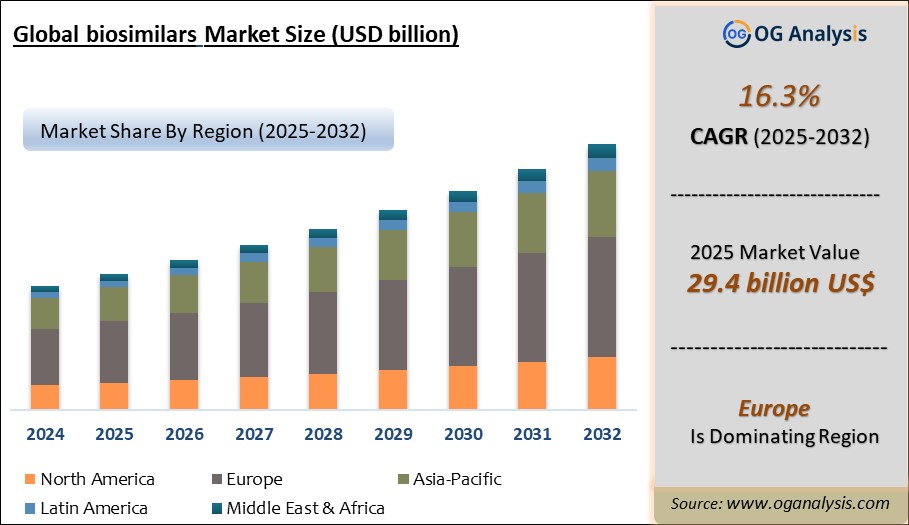
"The Biosimilars Market valued at $ 33.8 billion in 2026, is expected to grow by 16.3% CAGR to reach market size worth $ 117.1 billion by 2034."
The Biosimilars Market is gaining strong momentum as healthcare systems, payers, providers, and patients seek broader access to high-quality biologic therapies at lower treatment costs. Biosimilars are highly similar versions of approved reference biologics, with no clinically meaningful differences in safety, purity, or effectiveness, making them important alternatives across oncology, autoimmune diseases, diabetes, ophthalmology, nephrology, and supportive care. Their adoption is being supported by patent expiries of major biologics, rising biologic medicine spending, physician familiarity, regulatory confidence, and increasing payer preference for cost-efficient treatment options.
The market is also being shaped by expanding product pipelines, stronger interchangeability frameworks, hospital formulary inclusion, tender-based purchasing, and growing confidence in switching from reference biologics to biosimilars. Europe remains a mature adoption hub due to long-standing regulatory experience and pharmacovigilance systems, while the United States is seeing faster uptake as more biosimilars enter competitive therapeutic categories. Emerging markets are also improving access through local manufacturing, regulatory harmonization, and affordability-focused healthcare policies. Competitive intensity is increasing among global biologics manufacturers, specialty pharmaceutical companies, contract development organizations, and regional biosimilar players. However, the market continues to face barriers such as physician hesitation, patient awareness gaps, complex manufacturing, high development costs, litigation from originator companies, pricing pressure, and reimbursement variability. Overall, biosimilars are becoming a central part of biologic therapy access strategies and healthcare cost-containment programs worldwide.
Regional Analysis
North America Biosimilars Market
North America remains a high-potential biosimilars market, led by the United States, where rising biologic drug spending, patent expiries, payer pressure, and healthcare cost-containment efforts are accelerating biosimilar adoption. The region is seeing stronger competition across oncology, immunology, diabetes, ophthalmology, and inflammatory disease therapies. FDA’s biosimilar and interchangeable biosimilar approval pathway continues to support market expansion, while recent regulatory efforts to simplify development requirements may improve launch economics for manufacturers. However, formulary access, physician confidence, pricing negotiations, and reference-product competition remain key factors influencing uptake.
Europe Biosimilars Market
Europe is the most mature biosimilars market, supported by early regulatory adoption, strong physician acceptance, national tendering systems, and established interchangeability practices. Countries such as Germany, the UK, France, Italy, Spain, and the Nordic markets have encouraged biosimilar use through reimbursement policies, hospital procurement models, and treatment-switching programs. The European Medicines Agency has built a long track record in biosimilar evaluation, which has strengthened market confidence among healthcare systems and prescribers. Cost savings from biosimilars continue to support broader patient access to biologic therapies across oncology, autoimmune diseases, diabetes, and supportive care.
Asia-Pacific Biosimilars Market
Asia-Pacific is emerging as one of the fastest-growing regions for biosimilars, driven by large patient populations, rising biologic therapy demand, expanding healthcare access, and strong local manufacturing capabilities. India, China, South Korea, and Japan are key contributors, with companies increasingly focusing on oncology, insulin, monoclonal antibodies, autoimmune therapies, and export-oriented biosimilar development. South Korea has developed a strong global manufacturing and commercialization presence, while India and China are strengthening domestic affordability and access. Regulatory improvement, hospital adoption, and government cost-control initiatives are expected to support further regional growth.
Middle East & Africa Biosimilars Market
The Middle East & Africa biosimilars market is gradually expanding as governments focus on improving access to affordable biologic therapies for cancer, diabetes, autoimmune disorders, and chronic inflammatory diseases. Gulf countries are strengthening regulatory pathways, procurement systems, and hospital adoption, while Saudi Arabia’s biosimilar quality guidance reflects growing regional regulatory maturity. In Africa, biosimilars are gaining relevance as healthcare systems seek lower-cost alternatives to expensive biologics, although adoption remains limited by reimbursement constraints, physician awareness, cold-chain infrastructure, and regulatory capacity. WHO-led biosimilar guidance and training initiatives are expected to support broader adoption across developing markets.
South & Central America Biosimilars Market
South & Central America is witnessing growing biosimilar adoption, led by Brazil, Mexico, Argentina, Chile, and Colombia. Brazil remains the most important regional market due to its large public healthcare system, biologic drug demand, and active regulatory framework. Anvisa’s updated biosimilar registration regulation aims to simplify development requirements where technically justified, while Brazil’s 2026 pricing update set clearer limits for biosimilar pricing relative to original biologics. Regional growth is supported by demand for affordable oncology, immunology, diabetes, and inflammatory disease treatments, though access varies by reimbursement policy, procurement models, and local manufacturing capability.
Key Insights
- Patent expiries of leading biologic drugs are creating strong opportunities for biosimilar launches. This is opening new competition across oncology, immunology, diabetes, ophthalmology, and chronic inflammatory disease therapies.
- Oncology remains one of the most attractive therapeutic areas for biosimilars. Demand is supported by high biologic use, hospital purchasing, payer pressure, and the need to improve access to cancer care.
- Autoimmune disease treatment is a major growth area for biosimilars. Products targeting rheumatoid arthritis, inflammatory bowel disease, psoriasis, and related conditions are seeing wider formulary acceptance.
- Interchangeability and substitution policies are improving biosimilar confidence in key markets. Clearer regulatory pathways are helping pharmacies, physicians, and payers support broader biosimilar adoption.
- Cost savings remain the strongest driver for biosimilar use. Healthcare systems are increasingly using biosimilars to reduce biologic treatment costs while maintaining clinical outcomes.
- Physician and patient education remains critical for adoption. Clear communication on safety, efficacy, switching, and monitoring is needed to reduce hesitation and improve treatment acceptance.
- Manufacturing complexity remains a major entry barrier. Biosimilars require advanced cell-line development, analytical characterization, quality control, and consistent biologic production capabilities.
- Payer and hospital procurement strategies are shaping market access. Tendering, preferred formulary placement, reimbursement incentives, and contracting models strongly influence biosimilar uptake.
- Emerging markets are becoming important growth destinations. Local production, affordability needs, expanding insurance coverage, and biologic access programs are supporting biosimilar penetration.
- Competitive pressure is increasing as more players enter biosimilar development. Companies with strong regulatory expertise, biologics manufacturing capacity, and commercial partnerships are better positioned.
Market Scope
| Parameter | Biosimilars Market Detail |
| Base Year | 2025 |
| Estimated Year | 2026 |
| Forecast Period | 2026-2034 |
| Market Size-Units | USD billion |
| Market Splits Covered | By Product, By Application and By End-User |
| Countries Covered | North America (USA, Canada, Mexico) |
| Analysis Covered | Latest Trends, Driving Factors, Challenges, Trade Analysis, Price Analysis, Supply-Chain Analysis, Competitive Landscape, Company Strategies |
| Customization | 10% free customization (up to 10 analyst hours) to modify segments, geographies, and companies analyzed |
| Post-Sale Support | 4 analyst hours, available up to 4 weeks |
| Delivery Format | The Latest Updated PDF and Excel Data file |
Market Segmentation
By Drug Class
- Monoclonal Antibodies
- Insulin
- G-CSF
- Erythropoietin
- Recombinant Human Growth Hormone
- Etanercept
- Follitropin
- Teriparatide
- Interferons
- Anticoagulants
- Others
By Indication
- Oncology
- Inflammatory & Autoimmune Disorders
- Chronic Diseases
- Blood Disorders
- Growth Hormone Deficiency
- Infectious Diseases
- Others
By Distribution Channel
- Hospital Pharmacies
- Retail Pharmacies
- Online Pharmacies
- Others
By Geography
- North America (USA, Canada, Mexico)
- Europe (Germany, UK, France, Spain, Italy, Rest of Europe)
- Asia-Pacific (China, India, Japan, Australia, South Korea, Rest of APAC)
- The Middle East and Africa (Saudi Arabia, UAE, Iran, South Africa, Rest of MEA)
- South and Central America (Brazil, Argentina, Rest of SCA)
Key Market Players
- Amega Biotech
- Amgen Inc.
- Apotex Inc.
- Biocad
- Biocon
- Boehringer Ingelheim International Gmbh
- Celltrion, Inc.
- Coherus Biosciences
- Dr. Reddy'S Laboratories
- Elli Lilly And Company
- F. Hoffmann-La Roche Ltd
- Fresenius Kabi Ag
- Intas Pharmaceuticals Ltd.
- Mabxience
- Novartis Ag
- Pfizer Inc.
- Probiomed
- Samsung Bioepis Co., Ltd.
- Stada Arzneimittel Ag
- Teva Pharmaceutical Industries
- Viatris
Recent Developments
May 2026: FDA approved Immgolis and Immgolis Intri as biosimilars to Simponi and Simponi Aria, expanding biosimilar competition in rheumatoid arthritis and ulcerative colitis treatment areas.
May 2026: FDA listed Ennumo, a biosimilar to Neulasta, strengthening the pegfilgrastim biosimilar segment used in supportive oncology care.
May 2026: EMA’s CHMP issued a positive opinion for Vislyfa, a ranibizumab biosimilar by Lupin Europe, for age-related macular degeneration and other retinal conditions.
April 2026: FDA listed Langlara, a biosimilar to Lantus, supporting wider insulin glargine biosimilar availability in the diabetes treatment market.
April 2026: Biocon launched Bosaya and Aukelso, denosumab biosimilars to Prolia and Xgeva, in the United States following earlier FDA approval with interchangeable designation.
March 2026: FDA announced new draft guidance to streamline biosimilar development by reducing unnecessary clinical pharmacokinetic testing where scientifically justified. This is expected to lower development cost and shorten approval pathways.
March 2026: FDA listed Ponlimsi, a biosimilar to Prolia, adding another denosumab biosimilar option in osteoporosis-related treatment.
February 2026: EMA’s CHMP adopted positive opinions for six biosimilar medicines, including insulin lispro, insulin aspart, etanercept, pertuzumab, tocilizumab, and teriparatide products.
Early 2026: Zydus launched ANYRA, India’s first indigenously developed aflibercept biosimilar, strengthening domestic biosimilar innovation in ophthalmology.
December 2025: Celltrion received FDA approval for a 300 mg strength of Omlyclo, its interchangeable biosimilar to Xolair, improving dosing flexibility for allergic and inflammatory disease patients.
FAQ's
The Biosimilars Market is estimated to reach USD 117.1 billion by 2034.
The Global Biosimilars Market is expected to grow at a Compound Annual Growth Rate (CAGR) of 16.3% during the forecast period from 2025 to 2034.
The Global Biosimilars Market is estimated to generate USD 29.1 billion in revenue in 2025
Didn’t find what you’re looking for? TALK TO OUR ANALYST TEAM
Need something within your budget? NO WORRIES! WE GOT YOU COVERED!


