"Chocolate Confectionery Market is valued at $173 billion in 2025. Further, the market is expected to grow at a CAGR of 5.9% to reach $289.4 billion by 2034."
The chocolate confectionery market represents one of the most dynamic and diverse segments within the broader confectionery industry. From premium dark chocolate bars to innovative filled chocolates and seasonal treats, the market encompasses a wide variety of products that cater to nearly every consumer segment. Historically viewed as a comfort food, chocolate confectionery has evolved into a sophisticated category that now includes health-oriented options, single-origin products, and artisanal creations. This evolution has allowed the market to expand its reach, appealing not only to traditional chocolate lovers but also to health-conscious and ethically minded consumers.
In recent years, several trends have shaped the chocolate confectionery market. Increasing demand for premium and high-quality chocolates, as well as growing interest in sustainable sourcing practices, have led many brands to highlight bean-to-bar production and fair-trade certification. Moreover, the rise of plant-based and dairy-free chocolates has opened new avenues for innovation, catering to vegans and those with dietary restrictions. As consumers continue to seek unique flavor profiles and experiences, companies are introducing novel combinations such as chocolate with exotic spices, superfoods, or craft spirits. The integration of digital platforms and e-commerce channels has further enabled smaller brands to reach a global audience, intensifying competition and driving innovation.
While the market remains robust, it faces challenges such as fluctuating cocoa prices, supply chain complexities, and evolving consumer expectations around transparency and ethical sourcing. Additionally, the shift towards healthier lifestyles has prompted some consumers to moderate their chocolate consumption or opt for products with reduced sugar content. Despite these challenges, the chocolate confectionery market continues to thrive, driven by its adaptability and enduring appeal across demographics and regions.
Key Insights
- Historically, chocolate confectionery has been anchored in everyday indulgence and gifting, making it resilient across economic cycles. Even when consumers trade down in other categories, they often retain small chocolate treats as accessible luxuries. This entrenched role in emotional reward, celebration, and comfort continues to underpin baseline demand globally.
- Product segmentation remains diverse, with countlines and tablets dominating everyday snacking, while pralines, assortments, and boxed chocolates are strongly linked to seasonal and gifting occasions. Bite-size pieces and sharing bags have gained importance as social and family consumption formats. This blend of everyday, sharing, and gifting products allows manufacturers to target multiple price tiers and usage occasions.
- Premiumization is a key long-term growth driver, reflected in higher cocoa percentages, single-origin and origin-labeled products, filled specialties, and sophisticated flavor pairings. Consumers are willing to pay more for perceived quality, craftsmanship, and provenance. Artisanal, bean-to-bar, and niche regional brands benefit from this trend, while global players expand their premium sub-brands and limited editions.
- Health and wellness considerations increasingly shape innovation, pushing brands to introduce products with reduced sugar, smaller portion sizes, higher cocoa content, and clearer nutritional information. Some offerings integrate nuts, seeds, or functional ingredients to improve perceived nutritional value. The challenge is balancing these changes without compromising taste and indulgence, which remain the category’s core purchase triggers.
- Seasonal and cultural calendars remain critical demand catalysts, with spikes around festivals, national holidays, and gifting occasions across regions. Manufacturers design special packaging, shapes, and assortments to align with these events, creating powerful merchandising and display opportunities. Strong seasonal campaigns help defend shelf space and maintain brand visibility in competitive retail environments.
- Sustainability and responsible sourcing are now central to brand strategies, especially around cocoa cultivation, farmer livelihoods, deforestation, and child labor concerns. Many leading players communicate commitments to certified sourcing, traceability programs, and environmental targets. These initiatives address regulatory and NGO scrutiny while resonating with consumers who increasingly expect ethical credentials from chocolate brands.
- Channel dynamics are evolving, with supermarkets and hypermarkets still dominant, but convenience stores, discounters, and e-commerce gaining relevance for different occasions and price points. Online channels support gifting, personalization, and premium boxes, while discounters and value retailers drive volume in mainstream segments. Direct-to-consumer models and subscription boxes offer additional touchpoints for premium and artisanal players.
- Flavor and texture innovation is a core competitive tool, including inclusions like nuts, caramel, biscuits, fruits, spices, and layered or aerated structures. Co-branded products with biscuits, salty snacks, and dessert brands create novelty and cross-category appeal. Limited-time offerings and regionally inspired flavors encourage impulse purchase and experimentation among established consumer bases.
- Cost and margin management are critical as cocoa, sugar, dairy, and packaging prices fluctuate, prompting manufacturers to adjust pack sizes, pricing, and product mix. “Shrinkflation,” portfolio simplification, and focus on higher-margin SKUs are frequent strategies. Efficient supply chains and scale advantages help leading players manage volatility better than smaller competitors.
- Looking ahead, the market will be shaped by ongoing tension between indulgence and wellness, as well as between affordability and premium experience. Brands that successfully integrate ethical sourcing, cleaner labels, and sensory excitement into compelling storytelling are likely to outperform. Continued investment in innovation, category adjacencies, and experiential retail will be vital to sustain engagement among younger, digitally savvy consumers.
Global cocoa bean production (million tonnes), 2018–2024
Figure: Global cocoa bean production increased modestly between 2018 and 2022 before tightening in 2023–2024. This shifting cocoa supply base directly affects raw material availability, pricing, and margin pressures for chocolate confectionery manufacturers, underlining the importance of supply chain resilience and origin diversification in the global chocolate confectionery market.
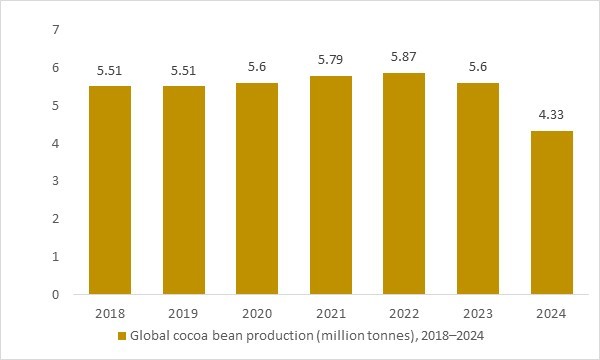
Global cocoa bean production showed steady growth from 2018 to 2022 before tightening in 2023 and 2024 due to weather-driven supply disruptions in key cocoa-producing regions. As cocoa remains the core ingredient for chocolate confectionery, these fluctuations directly influence raw material pricing, manufacturer margins, and premiumization strategies across the global chocolate confectionery market.
Market Scope
| Parameter | Chocolate confectionery Market scope Detail |
| Base Year | 2024 |
| Estimated Year | 2025 |
| Forecast Period | 2026-2032 |
| Market Size-Units | USD billion |
| Market Splits Covered | By Product, By Application, By End User and By Technology |
| Countries Covered | North America (USA, Canada, Mexico) |
| Analysis Covered | Latest Trends, Driving Factors, Challenges, Trade Analysis, Price Analysis, Supply-Chain Analysis, Competitive Landscape, Company Strategies |
| Customization | 10% free customization (up to 10 analyst hours) to modify segments, geographies, and companies analyzed |
| Post-Sale Support | 4 analyst hours, available up to 4 weeks |
| Delivery Format | The Latest Updated PDF and Excel Data file |
Market Segmentation
By Type
- Milk Chocolate
- Dark Chocolate
- White chocolate
By Category
- Premium
- Seasonal
- Everyday
By Distribution Channel
- Supermarkets And Hypermarkets
- Convenience Stores
- Pharmaceutical and drug stores
- Specialty stores
- Duty-free stores
- E-commerce
- Other Distribution Channels
By Geography
- North America (USA, Canada, Mexico)
- Europe (Germany, UK, France, Spain, Italy, Rest of Europe)
- Asia-Pacific (China, India, Japan, Australia, Vietnam, Rest of APAC)
- The Middle East and Africa (Middle East, Africa)
- South and Central America (Brazil, Argentina, Rest of SCA)
Key Market Players
- Barry Callebaut AG
- Mondelez International Inc.
- Nestlé S.A.
- The Hershey Company
- Ferrero Group
- Mars Incorporated
- Meiji Holdings Co. Ltd.
- Grupo Arcor
- Chocoladenfabriken Lindt & Sprüngli AG
- Ghirardelli Chocolate Co.
- Moonstruck Chocolatier Co.
- Chocolaterie Guylian
- Lake Champlain Chocolates
- The Australian Carob Co.
- Archer Daniels Midland Company
- AMCO GmbH
- Cargill Incorporated
- Cocoatrade Limited
- Ecom Cocoa International
- Gerkens Cacao GmbH
- ICAM S.p.A.
- Olam International Limited
- Puratos Group NV
- Alfred Ritter GmbH & Co. KG
- Sarotti AG
- Schachinger GmbH
- August Storck KG
- United Confectioners Group
- Valio Ltd.
- Venchi S.p.A.
- Villars Maître Chocolatier SA
- Wedel S.A. .
Recent Industry Developments
-
Jan 2026 – Nestlé (KitKat): Nestlé announced a global Formula 1 partnership for KitKat, alongside special-edition KitKat products rolling out across multiple markets during 2026. The move is designed to boost brand visibility and drive seasonal/product innovation in chocolate.
-
Jan 2026 – Barry Callebaut: Barry Callebaut announced the appointment of a new CEO (Hein Schumacher) as it navigates demand softness and unprecedented cocoa-price volatility. The leadership change is positioned as part of a broader transformation agenda.
-
Dec 2025 – Mars: Mars completed its acquisition of Kellanova, expanding its global snacking scale and strengthening route-to-market leverage across convenience and modern retail. The combination increases cross-category bundling power for confectionery-led portfolios.
-
Nov 2025 – Barry Callebaut: Opened a new $100M+ chocolate factory in Brantford, Ontario, its first new North American plant in years. The facility expands regional chocolate manufacturing capacity for industrial and branded customers.
-
Nov 2025 – Mondelēz International (Cadbury): Announced its 2026 Easter range, including new Creme Egg and filled-egg innovations and multipacks to capture earlier seasonal shopping. The launch reflects intensified seasonal NPD despite cocoa-driven cost pressure.
-
Aug 2025 – Mondelēz International (Cadbury/Toblerone): Rolled out major holiday-season innovation (including new advent calendars and truffle formats) to drive trade-up and gifting demand. The strategy emphasizes premiumization and limited editions to protect value growth.
-
Jul 2025 – The Hershey Company: Confirmed low double-digit price increases for key chocolate ranges in response to sustained cocoa-cost inflation. The announcement signaled broader industry repricing and pack/assortment optimization to sustain margins.
-
Jun 2024 – Mondelēz International & Lotus Bakeries: Announced a long-term partnership to expand co-branded chocolate + Biscoff products across regions. The collaboration is aimed at faster innovation cycles and global scale-up of proven flavor pairings.
FAQ's
The Global Chocolate Confectionery Market is estimated to generate USD 173 billion in revenue in 2025.
The Global Chocolate Confectionery Market is expected to grow at a Compound Annual Growth Rate (CAGR) of 5.9% during the forecast period from 2025 to 2034.
The Chocolate Confectionery Market is estimated to reach USD 289.4 billion by 2034.
Didn’t find what you’re looking for? TALK TO OUR ANALYST TEAM
Need something within your budget? NO WORRIES! WE GOT YOU COVERED!


