"The Commercial Drones Market was valued at $ 3.3 billion in 2026 and is projected to reach $ 7.2 billion by 2034, growing at a CAGR of 10.3%."
The Commercial Drones Market is expanding rapidly as unmanned aerial systems move beyond recreational use into mainstream enterprise, industrial, public safety, infrastructure, logistics, agriculture, and inspection workflows. Commercial drones are used for aerial imaging, mapping, surveying, asset inspection, precision agriculture, construction monitoring, mining, oil and gas inspection, utilities maintenance, emergency response, security surveillance, environmental monitoring, media production, insurance assessment, and last-mile delivery pilots. Their value proposition lies in reducing manual inspection risks, improving data accuracy, lowering operational costs, accelerating site monitoring, and enabling access to difficult or hazardous locations. Industries such as energy, telecom, construction, agriculture, transportation, and real estate are increasingly adopting drones to gather high-resolution visual, thermal, LiDAR, multispectral, and geospatial data for faster decision-making. Demand is also supported by the growth of cloud-based analytics, AI-enabled image processing, autonomous navigation, and integration of drone data into enterprise asset management and geographic information systems.
The market is evolving from hardware-led adoption toward integrated drone solutions combining aircraft, sensors, software, analytics, pilot services, data platforms, and regulatory compliance support. Key trends include autonomous drone-in-a-box systems, beyond-visual-line-of-sight operations, AI-based defect detection, LiDAR mapping, thermal inspections, swarm capabilities, hybrid drones, longer endurance systems, and enterprise fleet management platforms. Growth is driven by digital transformation across asset-heavy industries, increasing demand for safer inspection methods, smart city projects, disaster management needs, and rising use of drones in agriculture and environmental monitoring. However, the market faces challenges from airspace regulations, privacy concerns, cybersecurity risks, battery limitations, weather dependency, pilot training requirements, and restrictions on autonomous flights in several countries. The competitive landscape includes drone manufacturers, sensor suppliers, software analytics firms, drone service providers, defense-adjacent technology companies, logistics players, and enterprise automation platforms. Future market development will depend on regulatory clarity, automation maturity, reliable data analytics, payload innovation, and stronger integration of drones into routine business operations.
Regional Analysis
North America Commercial Drones Market
The North America Commercial Drones Market is highly advanced, supported by strong adoption across infrastructure inspection, agriculture, construction, energy, public safety, media, logistics, mining, insurance, and utility monitoring. Market dynamics are shaped by enterprise digitization, demand for safer asset inspection, advanced sensor integration, and growing interest in autonomous drone operations. Lucrative opportunities exist for companies offering drone-in-a-box systems, AI-based analytics, LiDAR mapping, thermal inspection, fleet management software, and beyond-visual-line-of-sight operational support. Latest trends include automated site monitoring, drone data integration with GIS and asset management platforms, public safety deployments, and commercial delivery trials. The forecast outlook remains strong as enterprises continue shifting from manual inspection and survey methods toward faster, safer, and data-rich aerial workflows. Recent developments are focused on regulatory progress, enterprise drone fleet expansion, industrial inspection programs, and partnerships between drone manufacturers, software providers, and logistics companies.
Asia Pacific Commercial Drones Market
The Asia Pacific Commercial Drones Market is expanding rapidly due to strong demand from agriculture, infrastructure, construction, mining, logistics, smart cities, disaster management, energy, and public safety applications. Market dynamics are influenced by large agricultural land areas, rapid urban development, rising infrastructure investment, and growing government support for drone-based services. Lucrative opportunities are visible in crop spraying, field mapping, surveying, construction monitoring, warehouse and logistics support, utility inspection, and urban security applications. Latest trends include localized drone manufacturing, affordable enterprise drones, autonomous flight platforms, AI-powered image analytics, and drone service networks for small and medium businesses. The forecast outlook is highly positive as governments and enterprises adopt drones to improve productivity, safety, and monitoring efficiency. Recent developments include expansion of drone pilot training, broader use in agriculture and infrastructure, regulatory framework improvements, and growing deployment of drones in disaster response and environmental monitoring.
Europe Commercial Drones Market
The Europe Commercial Drones Market is shaped by strong regulatory oversight, advanced industrial automation, sustainability goals, and growing use of drones in infrastructure, agriculture, energy, public safety, logistics, environmental monitoring, and surveying. Market dynamics are supported by demand for accurate geospatial data, safer inspection methods, and efficient monitoring of renewable energy assets, transportation networks, utilities, and construction projects. Lucrative opportunities exist for suppliers offering compliant enterprise drones, mapping software, AI-based inspection tools, drone traffic management solutions, and automated monitoring systems. Latest trends include drone use in wind turbine inspection, precision agriculture, railway and bridge monitoring, smart city planning, and emergency response. The forecast outlook remains steady and innovation-led as regulatory clarity and enterprise confidence improve. Recent developments are centered on drone corridor testing, autonomous inspection pilots, sustainable agriculture applications, and integration of drone data into public infrastructure and environmental intelligence platforms.
Middle East & Africa Commercial Drones Market
The Middle East & Africa Commercial Drones Market is developing with rising demand from oil and gas, construction, mining, utilities, agriculture, security, smart cities, disaster management, and infrastructure inspection. Market dynamics are supported by large-scale construction projects, industrial safety requirements, energy asset monitoring, and government-led digital transformation initiatives. Lucrative opportunities exist for companies offering rugged drones, thermal inspection systems, mapping solutions, surveillance drones, agricultural spraying drones, and drone services for remote and harsh environments. Latest trends include drone deployment in oilfield inspection, solar farm monitoring, urban planning, border surveillance, mining surveys, and precision agriculture. The forecast outlook is improving as regional governments and enterprises invest in smart infrastructure and remote monitoring technologies. Recent developments include broader adoption of drone services in construction and energy, public safety applications, regulatory modernization, and demand for local drone training, maintenance, and data analytics capabilities.
South & Central America Commercial Drones Market
The South & Central America Commercial Drones Market is supported by demand from agriculture, mining, oil and gas, construction, forestry, environmental monitoring, public safety, utilities, and infrastructure inspection. Market dynamics are influenced by large agricultural operations, remote resource assets, urban development, and the need for cost-effective monitoring across wide geographic areas. Lucrative opportunities exist in crop health analysis, spraying, livestock monitoring, mine surveying, pipeline inspection, construction progress tracking, and disaster assessment. Latest trends include increasing use of drones in precision farming, forest monitoring, mining operations, and emergency response, along with growing adoption of drone service providers by businesses that do not operate their own fleets. The forecast outlook is moderately positive as commercial users recognize the value of aerial data for productivity, safety, and cost control. Recent developments are focused on drone-based agricultural services, mining and energy inspections, public-sector mapping programs, and gradual improvement in local regulatory and training ecosystems.
Key Insights
- Infrastructure inspection is one of the strongest application areas for commercial drones, especially across bridges, roads, railways, towers, pipelines, wind turbines, solar farms, and industrial facilities. Drones reduce safety risks and provide faster visual access to hard-to-reach assets.
- Agriculture is a major growth segment, with drones used for crop health monitoring, spraying, field mapping, irrigation assessment, pest detection, and yield planning. Multispectral sensors and analytics platforms are improving precision farming decisions.
- Construction and mining companies are adopting drones for site surveys, progress tracking, stockpile measurement, safety audits, and volumetric analysis. Drone-based data improves project visibility, reduces surveying time, and supports better planning.
- Drone-in-a-box systems are gaining traction for automated inspection, security patrols, and remote site monitoring. These systems can launch, land, recharge, and transfer data with minimal human involvement, supporting recurring enterprise operations.
- Beyond-visual-line-of-sight capability is a major future growth enabler because it allows wider-area inspections, delivery operations, corridor monitoring, and emergency response missions. Regulatory approvals will strongly influence adoption speed.
- AI-enabled analytics are becoming central to market value creation. Enterprises increasingly need automated defect detection, change monitoring, object recognition, vegetation analysis, and predictive maintenance insights rather than raw drone imagery alone.
- Public safety and emergency response applications are expanding, including search and rescue, fire monitoring, disaster assessment, crowd management, accident reconstruction, and emergency communication support. Drones improve situational awareness during critical incidents.
- Logistics and delivery applications remain promising but operationally complex. Commercial viability depends on airspace permissions, payload capacity, route automation, safety systems, urban acceptance, and integration with last-mile delivery networks.
- Sensor innovation is strengthening drone adoption across high-value applications. LiDAR, thermal cameras, hyperspectral sensors, gas detection payloads, and high-resolution imaging systems are expanding use cases in energy, utilities, agriculture, and environmental monitoring.
- Future market growth will be shaped by autonomous operations, enterprise software integration, improved battery endurance, safer air traffic management, and stronger regulatory frameworks. Companies offering complete hardware, software, analytics, and compliance support are expected to remain better positioned.
Global lithium mine production (tonnes Li content), 2018–2024
Figure: Global lithium mine production has increased sharply between 2018 and 2024e, expanding the supply of lithium-ion batteries that power electric commercial drones and portable security systems. As more lithium becomes available, drone manufacturers can adopt higher-capacity battery packs that support longer missions, heavier imaging and radiation-detection payloads, and more demanding inspection or surveillance tasks. This strengthening battery raw material base underpins the long-term scalability and cost competitiveness of the commercial drones market.
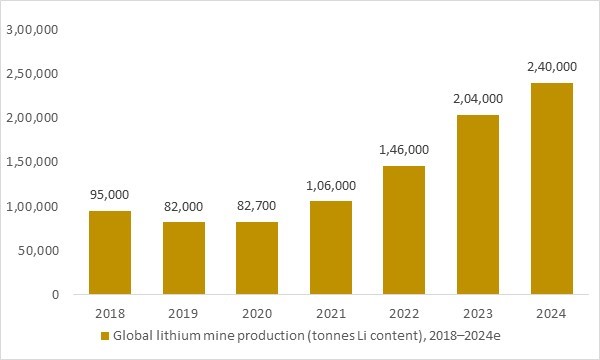
The steady rise in global lithium mine production between 2018 and 2024e highlights the strengthening backbone of the battery supply chain that powers modern commercial drones. With lithium output more than doubling over this period, manufacturers have gained access to higher-performance lithium-ion batteries that enable longer flight endurance, higher payload capacity, and improved sensor integration. This battery advancement directly supports drone adoption across inspection, agriculture, delivery, and security operations, where extended uptime and reliable power are critical. As lithium availability continues to expand, it reinforces the scalability, efficiency, and technological evolution of the commercial drones market.
Report Scope
| Parameter | Commercial Drones Market Detail |
| Base Year | 2025 |
| Estimated Year | 2026 |
| Forecast Period | 2026-2034 |
| Market Size-Units | USD billion |
| Market Splits Covered | By Product Type, By Application, By End User, By Technology, and By Distribution Channel |
| Countries Covered | North America (USA, Canada, Mexico) |
| Analysis Covered | Latest Trends, Driving Factors, Challenges, Trade Analysis, Price Analysis, Supply-Chain Analysis, Competitive Landscape, Company Strategies |
| Customization | 10% free customization (up to 10 analyst hours) to modify segments, geographies, and companies analyzed |
| Post-Sale Support | 4 analyst hours, available up to 4 weeks |
| Delivery Format | The Latest Updated PDF and Excel Data file |
Commercial Drones Market Segmentation
By Type
- Fixed wing drones
- Rotary blade drones
- Hybrid drones
By Technology
- Remotely Operated
- Semi-Autonomous
- Autonomous
By Application
- Agriculture and environment
- Media and entertainment
- Energy
- Government
- Construction & archaeology
- Others
By Geography
- North America (USA, Canada, Mexico)
- Europe (Germany, UK, France, Spain, Italy, Rest of Europe)
- Asia-Pacific (China, India, Japan, Australia, Vietnam, Rest of APAC)
- The Middle East and Africa (Middle East, Africa)
- South and Central America (Brazil, Argentina, Rest of SCA)
Key Companies Analysed
SZ DJI Technology Co. Ltd., Parrot SA, AeroVironment Inc., PrecisionHawk Inc., Draganfly Inc., 3D Robotics Inc., AsTec, XAIRCRAFT Technology Co. Ltd., ZeroTech Robotics, Yamaha Motor Co. Ltd., Lockheed Martin Corporation, Yuneec International Co. Ltd., DroneDeploy Inc., senseFly Ltd., Insitu a Boeing Company, Kespry Inc., LiDARUSA, EHang Holdings Limited, Delair, Nutel Communications Pvt Ltd, CyPhy Works Inc., Aerialtronics (Note: The company is now part of DroneMatrix), GoPro Inc., FLIR Systems Inc., Intel Corporation, Skycatch Inc., Raptor Maps Inc., DroneBase Inc., Cape Analytics Inc., Drone Volt, Cyberhawk Innovations Ltd, Flytrex Aviation Ltd., Volansi Inc., Flirtey, Skyfront, Vaayu Drones
Recent Industry Developments
May 2026 - Wing and Papa Johns partnered to launch an initial drone delivery pilot in Charlotte, North Carolina, focused on hot food delivery and future integration with Papa Johns’ digital ordering platform.
May 2026 - Draganfly and ACSL signed an exclusive Canadian master distributor agreement to bring ACSL’s NDAA-compliant SOTEN drone platform to the Canadian market and pursue technology integration between both companies’ drone systems.
April 2026 - Skydio committed to expand U.S. drone manufacturing, supporting domestic production capacity, research and development, and supply chain scale-up for public safety, critical infrastructure, and national security drone demand.
April 2026 - Zipline expanded autonomous delivery operations in North Texas as new brands joined its network, strengthening commercial drone delivery adoption for retail and on-demand logistics.
March 2026 - Advocate Health announced plans to launch a large hospital-based drone delivery network with Zipline to deliver prescriptions, lab samples, medical supplies, and home health products across selected U.S. markets.
March 2026 - BRINC launched Guardian, a satellite-connected Drone as First Responder platform with robotic battery swapping, payload loading, long flight endurance, and automated emergency response capability.
January 2026 - Wing and Walmart announced a coast-to-coast expansion of drone delivery to additional stores, targeting broader residential access across major U.S. metropolitan markets.
November 2025 - DJI launched Zenmuse L3, its first long-range high-accuracy aerial LiDAR system, targeting geospatial mapping, infrastructure inspection, forestry, emergency response, and surveying applications.
October 2025 - Percepto announced that its autonomous OGI drone system received EPA approval as an Alternative Test Method for federal methane emissions inspection requirements, supporting remote industrial compliance monitoring.
June 2025 - DJI introduced the Matrice 400 enterprise flagship drone platform with extended flight time, higher payload capacity, advanced obstacle sensing, and applications across emergency response, mapping, construction, and power line inspection.
FAQ's
The Global Commercial Drones Market is estimated to generate USD 3.3 billion in revenue in 2026.
The Global Commercial Drones Market is expected to grow at a Compound Annual Growth Rate (CAGR) of 10.34% during the forecast period from 2026 to 2034.
The Commercial Drones Market is estimated to reach USD 7.2 billion by 2034.
Didn’t find what you’re looking for? TALK TO OUR ANALYST TEAM
Need something within your budget? NO WORRIES! WE GOT YOU COVERED!


