Cranberries Market Analysis and Outlook Report: Industry Size, Share, Growth Trends, and Forecast (2025-2034)

Published On: Apr, 2025
|
Pages: 151

"Cranberries Market is valued at $2.9 billion in 2025. Further, the market is expected to grow at a CAGR of 4.2% to reach $4.3 billion by 2034."

The Cranberries Market is witnessing steady growth driven by rising global demand for functional and natural food ingredients with health benefits. Cranberries are widely used in the food and beverage industry for juices, concentrates, dried snacks, sauces, bakery products, and confectionery due to their tart flavour, rich colour, and antioxidant properties. Increasing consumer awareness of cranberries’ role in urinary tract health, cardiovascular health, and immunity boosting is expanding their adoption in functional foods and dietary supplements. Major producers, particularly in the US and Canada, are investing in expanding production capacities and enhancing processing technologies to cater to the rising domestic and international demand. Additionally, innovations in product formats such as sweetened dried cranberries, cranberry powders, and flavoured extracts are expanding application possibilities across sectors.

The market is characterised by strong exports, especially from North America to Europe and Asia Pacific, driven by the rising popularity of superfruits among health-conscious consumers. Companies are focusing on developing organic and sustainably sourced cranberry products to address growing environmental concerns and regulatory requirements. The foodservice and bakery sectors are increasingly incorporating cranberries into recipes to align with consumer preferences for natural and healthier ingredients. However, market challenges include yield fluctuations due to climatic conditions, high production costs, and regulatory complexities in export markets. Moving forward, the market is poised for expansion with trends favouring clean-label, functional, and organic products while companies prioritise strategic partnerships, brand differentiation, and product innovation to strengthen market positions globally.

By Product Type, the largest segment is Fresh Fruits. This is because fresh cranberries are widely used in the production of juices, sauces, and bakery products, and they are preferred by food processors for their natural taste, high nutrient retention, and versatility in applications across food and beverage sectors globally.

By Nature, the fastest-growing segment is Organic. The rising consumer demand for clean-label, chemical-free, and sustainably sourced products is driving rapid growth in organic cranberries, as consumers perceive them to be healthier and environmentally friendly, encouraging manufacturers to expand organic cultivation and certified product offerings.

Key Insights

  • The cranberries market is growing steadily due to increasing demand for functional foods and beverages as consumers seek natural ingredients that offer antioxidant and anti-inflammatory benefits, promoting heart health, urinary tract health, and immunity enhancement globally.
  • Cranberries are widely used in juices, concentrates, sweetened dried cranberries, sauces, bakery items, and confectionery, with manufacturers innovating formats such as infused cranberries, powders, and extracts to diversify product portfolios and applications across food and beverage segments.
  • North America dominates global cranberry production with major cultivation in the United States and Canada, supported by favourable climatic conditions, established farming infrastructure, and significant investments by growers to enhance yields and processing capabilities.
  • Europe and Asia Pacific are witnessing growing consumption driven by increasing awareness of cranberries as superfruits, rising incorporation in functional foods, and expanding distribution networks by North American producers targeting international markets.
  • Key companies in the market are focusing on expanding production capacities, investing in sustainable farming practices, and adopting advanced processing technologies to ensure high-quality, preservative-free, and nutrient-retained cranberry products for global consumers.
  • Rising trends of clean-label, organic, and non-GMO products are encouraging manufacturers to launch certified organic cranberries and develop transparent supply chains that appeal to environmentally and health-conscious consumers worldwide.
  • The foodservice and bakery industries are increasingly using cranberries in salads, sauces, pastries, and desserts, aligning with consumer preferences for natural, nutrient-rich ingredients that enhance flavour and provide functional health benefits.
  • Market challenges include price volatility due to climatic fluctuations affecting crop yields, high production and harvesting costs, and strict regulatory standards in export markets, impacting profitability for growers and processors globally.
  • Companies are adopting strategic partnerships, branding initiatives, and marketing campaigns highlighting the health benefits of cranberries to drive consumer demand and strengthen their competitive positioning in domestic and export markets.
  • Future market growth will be driven by innovations in flavoured extracts, infused cranberries, and dietary supplements, supported by rising consumer focus on preventive healthcare and functional nutrition trends across developed and emerging economies.

Global cranberry production (tonnes), 2018–2024

Figure: Global cranberry production between 2018 and 2024 shows a sizeable yet concentrated raw material base that underpins juice, concentrate, dried cranberry and nutraceutical demand while highlighting year-to-year volatility that influences supply stability, pricing and value chain competitiveness.Global cranberry production (tonnes), 2018–2024
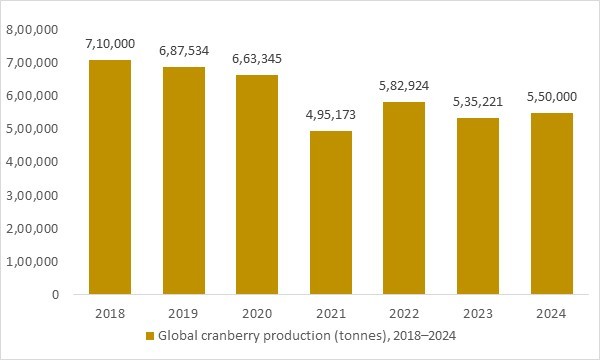
Global cranberry production 2018–2024 in tonnes, showing the raw material base supporting growth of the cranberries market

  • Global cranberry production fluctuated between roughly 0.5 and 0.7 million tonnes from 2018 to 2024, reflecting a sizeable yet geographically concentrated raw material base. As cranberries are increasingly processed into juice, concentrates, sweetened dried cranberries and nutraceutical ingredients, this production trend underpins long-term growth in the cranberries market. OG Analysis estimates, derived from international crop statistics and industry sources, highlight how supply volatility, yield swings and regional concentration can influence pricing, export flows and investment decisions across the cranberry value chain.

Regional Insights

North American Cranberries market

North America dominates the global cranberries market as the primary producer, with extensive cultivation concentrated in the U.S. (notably Wisconsin, Massachusetts) and Canada (mainly Quebec and British Columbia). Processed cranberries form the core of industrial demand, powering strong sales in juices, sauces, sweetened dried cranberries, nutraceuticals, and bakery ingredients. Seasonal consumption spikes during holiday periods are being complemented by year-round demand fueled by the fruit’s recognized health and antioxidant benefits. Cooperative structures and advanced bog management ensure high production efficiency, although growers continue to face challenges from climate variability and pricing pressure. Ongoing product innovation and marketing around immunity and urinary tract health further position the region as a leader in premium and functional cranberry products.

Europe Cranberries market

Europe is a demand-driven market with a high dependency on imports to meet its cranberry consumption needs, especially for industrial processing. Dried cranberries remain the fastest-growing form due to rising use in breakfast cereals, snacks, confectionery, and bakery products. Health and wellness positioning supports strong traction for clean-label, organic, and reduced-sugar offerings. Retailers and manufacturers are actively promoting cranberries in superfruit-themed product lines, broadening consumer exposure beyond seasonal windows. Trade dynamics continue to influence procurement strategies, while diversified food formats such as flavored, chopped, and infused cranberries enhance product differentiation across European markets.

Asia-Pacific Cranberries market

Asia-Pacific represents the most dynamic growth opportunity for the cranberries market, driven by rising incomes, Western-style diets, and increasing interest in functional foods. China, Japan, South Korea, India, and Southeast Asian nations show rapid adoption of dried cranberries in bakery goods, snacks, and beverages. Imports dominate supply, with expanding cold-chain logistics and online grocery channels boosting market accessibility. Cranberry juices and concentrates are gaining relevance in health-focused consumption trends, while supplements and extracts are building presence in nutraceutical categories. With limited domestic production, promotional efforts by global suppliers continue to accelerate demand and boost market penetration.

Reort Scope

Parameter

Cranberries Market scope Detail

Base Year

2024

Estimated Year

2025

Forecast Period

2026-2034

Market Size-Units

USD billion

Market Splits Covered

By Product, By Application, By End User and By Technology

Countries Covered

North America (USA, Canada, Mexico)
Europe (Germany, UK, France, Spain, Italy, Rest of Europe)
Asia-Pacific (China, India, Japan, Australia, Rest of APAC)
The Middle East and Africa (Middle East, Africa)
South and Central America (Brazil, Argentina, Rest of SCA)

Analysis Covered

Latest Trends, Driving Factors, Challenges, Trade Analysis, Price Analysis, Supply-Chain Analysis, Competitive Landscape, Company Strategies

Customization

10% free customization (up to 10 analyst hours) to modify segments, geographies, and companies analyzed

Post-Sale Support

4 analyst hours, available up to 4 weeks

Delivery Format

The Latest Updated PDF and Excel Data file

Market Segmentation


By Product Type
- Fresh Fruits
- Freeze Dried
- Air Dried
- Other Product Types

By Nature
- Conventional
- Organic

By End-User
- Bakery
- Confectionaries
- Dairy Products
- Beverages
- Cereals
- Other End Users

By Geography
- North America (USA, Canada, Mexico)
- Europe (Germany, UK, France, Spain, Italy, Rest of Europe)
- Asia-Pacific (China, India, Japan, Australia, Vietnam, Rest of APAC)
- The Middle East and Africa (Middle East, Africa)
- South and Central America (Brazil, Argentina, Rest of SCA)

Key Market Players

  • Del Monte Foods Inc.
  • Ocean Spray Cranberries Inc.
  • Mariani Packing Co. Inc.
  • Sun-Maid Growers of California
  • Traina Foods Inc.
  • Meduri Farms Inc.
  • Decas Cranberry Products Inc.
  • Eden Foods
  • Citadelle Camp Coop
  • Fruit d'Or Inc.
  • Sisters Fruit Company
  • Royal Nut Company
  • Graceland Fruit Inc.
  • Rostaa Superfoods
  • Stoneridge Orchards
  • Sundance Vitamins LLC
  • Fresh Meadows Cranberries
  • Honestly Cranberry
  • Michigan Cranberry Co.
  • Muskoka Lakes Farm and Winery
  • New England Cranberry
  • Cape Blanco Cranberries Inc.
  • Habelman Bros. Co.
  • Sun Organic Industries Pvt. Ltd.
  • Mitthi Foods

Recent Industry Developments

  • Sep 2025 – Ocean Spray Ingredients: Showcased expanded cranberry-ingredient solutions for bakery and snack applications at a major industry event, highlighting broader use of dried cranberries, blends, and ingredient formats beyond traditional retail products.

  • Jun 2025 – Ocean Spray: Launched new Craisins flavor variants (including sour and “swicy” profiles) and refreshed select packaging, aiming to drive higher snacking occasions and modernize the brand’s dried-cranberry portfolio.

  • Feb 2025 – Fruit d’Or: Announced the acquisition of Decas Cranberry Products (U.S.), expanding Fruit d’Or’s North American footprint and strengthening its supply base and processing scale for cranberry ingredients and dried formats.

  • Dec 2024 – Ocean Spray: Partnered to launch on-the-go powdered drink mixes made with real cranberry juice powder, extending cranberry consumption into convenient single-serve beverage formats with broad retail rollout plans.

  • Oct 2024 – Fruit d’Or: Introduced a new organic wild blueberry + cranberry powder blend positioned for clean-label, antioxidant-focused food, beverage, and supplement applications, expanding value-added cranberry ingredient offerings.

  • Jun 2024 – Ocean Spray & Brightseed: Expanded their partnership to use AI-led discovery and validation of cranberry bioactives, strengthening science-backed positioning for cranberry-derived ingredients and functional nutrition applications.

What You Receive

• Global Cranberries market size and growth projections (CAGR), 2024- 2034
• Impact of recent changes in geopolitical, economic, and trade policies on the demand and supply chain of Cranberries.
• Cranberries market size, share, and outlook across 5 regions and 27 countries, 2025- 2034.
• Cranberries market size, CAGR, and Market Share of key products, applications, and end-user verticals, 2025- 2034.
• Short and long-term Cranberries market trends, drivers, restraints, and opportunities.
• Porter’s Five Forces analysis, Technological developments in the Cranberries market, Cranberries supply chain analysis.
• Cranberries trade analysis, Cranberries market price analysis, Cranberries Value Chain Analysis.
• Profiles of 5 leading companies in the industry- overview, key strategies, financials, and products.
• Latest Cranberries market news and developments.
The Cranberries Market international scenario is well established in the report with separate chapters on North America Cranberries Market, Europe Cranberries Market, Asia-Pacific Cranberries Market, Middle East and Africa Cranberries Market, and South and Central America Cranberries Markets. These sections further fragment the regional Cranberries market by type, application, end-user, and country.

Who can benefit from this research

The research would help top management/strategy formulators/business/product development/sales managers and investors in this market in the following ways
1. The report provides 2024 Cranberries market sales data at the global, regional, and key country levels with a detailed outlook to 2034, allowing companies to calculate their market share and analyze prospects, uncover new markets, and plan market entry strategy.
2. The research includes the Cranberries market split into different types and applications. This segmentation helps managers plan their products and budgets based on the future growth rates of each segment
3. The Cranberries market study helps stakeholders understand the breadth and stance of the market giving them information on key drivers, restraints, challenges, and growth opportunities of the market and mitigating risks
4. This report would help top management understand competition better with a detailed SWOT analysis and key strategies of their competitors, and plan their position in the business
5. The study assists investors in analyzing Cranberries business prospects by region, key countries, and top companies' information to channel their investments.
 

Available Customizations

The standard syndicate report is designed to serve the common interests of Cranberries Market players across the value chain and include selective data and analysis from entire research findings as per the scope and price of the publication.
However, to precisely match the specific research requirements of individual clients, we offer several customization options to include the data and analysis of interest in the final deliverable.

Some of the customization requests are as mentioned below :
Segmentation of choice – Our clients can seek customization to modify/add a market division for types/applications/end-uses/processes of their choice.
Cranberries Pricing and Margins Across the Supply Chain, Cranberries Price Analysis / International Trade Data / Import-Export Analysis
Supply Chain Analysis, Supply–Demand Gap Analysis, PESTLE Analysis, Macro-Economic Analysis, and other Cranberries market analytics
Processing and manufacturing requirements, Patent Analysis, Technology Trends, and Product Innovations
Further, the client can seek customization to break down geographies as per their requirements for specific countries/country groups such as South East Asia, Central Asia, Emerging and Developing Asia, Western Europe, Eastern Europe, Benelux, Emerging and Developing Europe, Nordic countries, North Africa, Sub-Saharan Africa, Caribbean, The Middle East and North Africa (MENA), Gulf Cooperation Council (GCC) or any other.
Capital Requirements, Income Projections, Profit Forecasts, and other parameters to prepare a detailed project report to present to Banks/Investment Agencies.
Customization of up to 10% of the content can be done without any additional charges.
Note: Latest developments will be updated in the report and delivered within 2 to 3 working days.

1. Table of Contents
1.1 List of Tables
1.2 List of Figures

2. Cranberries Market Latest Trends, Drivers and Challenges, 2024- 2034
2.1 Cranberries Market Overview
2.2 Cranberries Market Developments
2.2.1 Cranberries Market -Supply Chain Disruptions
2.2.2 Cranberries Market -Direct/Indirect Impact of Tariff Changes and Trade Restrictions
2.2.3 Cranberries Market -Price Development
2.2.4 Cranberries Market -Regulatory and Compliance Management
2.2.5 Cranberries Market -Consumer Expectations and Trends
2.2.6 Cranberries Market -Market Structure and Competition
2.2.7 Cranberries Market -Technological Adaptation
2.2.8 Cranberries Market -Changing Retail Dynamics

2.3 Cranberries Market Insights, 2025- 2034
2.3.1 Prominent Cranberries Market product types, 2025- 2034
2.3.2 Leading Cranberries Market End-User markets, 2025- 2034
2.3.3 Fast-Growing countries for Cranberries Market sales, 2025- 2034
2.4 Cranberries Market Drivers and Restraints
2.4.1 Cranberries Market Demand Drivers to 2034
2.4.2 Cranberries Market Challenges to 2034
2.5 Cranberries Market- Five Forces Analysis
2.5.1 Cranberries Market Industry Attractiveness Index, 2025
2.5.2 Threat of New Entrants
2.5.3 Bargaining Power of Suppliers
2.5.4 Bargaining Power of Buyers
2.5.5 Intensity of Competitive Rivalry
2.5.6 Threat of Substitutes

3. Global Cranberries Market Value, Market Share, and outlook to 2034
3.1 Global Cranberries Market Overview, 2025
3.2 Global Cranberries Market Revenue and Forecast, 2025- 2034 (US$ Million)
3.3 Global Cranberries Market Size and Share Outlook by Type, 2025- 2034
3.4 Global Cranberries Market Size and Share Outlook by End-User, 2025- 2034
3.5 Global Cranberries Market Size and Share Outlook by Region, 2025- 2034

4. Asia Pacific Cranberries Market Value, Market Share and Forecast to 2034
4.1 Asia Pacific Cranberries Market Overview, 2025
4.2 Asia Pacific Cranberries Market Revenue and Forecast, 2025- 2034 (US$ Million)
4.3 Asia Pacific Cranberries Market Size and Share Outlook by Type, 2025- 2034
4.4 Asia Pacific Cranberries Market Size and Share Outlook by End-User, 2025- 2034
4.5 Asia Pacific Cranberries Market Size and Share Outlook by Country, 2025- 2034
4.6 Key Companies in Asia Pacific Cranberries Market

5. Europe Cranberries Market Value, Market Share, and Forecast to 2034
5.1 Europe Cranberries Market Overview, 2025
5.2 Europe Cranberries Market Revenue and Forecast, 2025- 2034 (US$ Million)
5.3 Europe Cranberries Market Size and Share Outlook by Type, 2025- 2034
5.4 Europe Cranberries Market Size and Share Outlook by End-User, 2025- 2034
5.5 Europe Cranberries Market Size and Share Outlook by Country, 2025- 2034
5.6 Key Companies in Europe Cranberries Market

6. North America Cranberries Market Value, Market Share, and Forecast to 2034
6.1 North America Cranberries Market Overview, 2025
6.2 North America Cranberries Market Revenue and Forecast, 2025- 2034 (US$ Million)
6.3 North America Cranberries Market Size and Share Outlook by Type, 2025- 2034
6.4 North America Cranberries Market Size and Share Outlook by End-User, 2025- 2034
6.5 North America Cranberries Market Size and Share Outlook by Country, 2025- 2034
6.6 Key Companies in North America Cranberries Market

7. South and Central America Cranberries Market Value, Market Share, and Forecast to 2034
7.1 South and Central America Cranberries Market Overview, 2025
7.2 South and Central America Cranberries Market Revenue and Forecast, 2025- 2034 (US$ Million)
7.3 South and Central America Cranberries Market Size and Share Outlook by Type, 2025- 2034
7.4 South and Central America Cranberries Market Size and Share Outlook by End-User, 2025- 2034
7.5 South and Central America Cranberries Market Size and Share Outlook by Country, 2025- 2034
7.6 Key Companies in South and Central America Cranberries Market

8. Middle East Africa Cranberries Market Value, Market Share and Forecast to 2034
8.1 Middle East Africa Cranberries Market Overview, 2025
8.2 Middle East and Africa Cranberries Market Revenue and Forecast, 2025- 2034 (US$ Million)
8.3 Middle East Africa Cranberries Market Size and Share Outlook by Type, 2025- 2034
8.4 Middle East Africa Cranberries Market Size and Share Outlook by End-User, 2025- 2034
8.5 Middle East Africa Cranberries Market Size and Share Outlook by Country, 2025- 2034
8.6 Key Companies in Middle East Africa Cranberries Market

9. Cranberries Market Players Analysis
9.1 Cranberries Market Companies - Key Strategies and Financial Analysis
9.1.1 Snapshot
9.1.2 Business Description
9.1.3 Products and Services
9.1.4 Financial Analysis

10. Cranberries Market Industry Recent Developments

11 Appendix
11.1 Publisher Expertise
11.2 Research Methodology
11.3 Annual Subscription Plans
11.4 Contact Information


Research Methodology

Our research methodology combines primary and secondary research techniques to ensure comprehensive market analysis.

Primary Research

We conduct extensive interviews with industry experts, key opinion leaders, and market participants to gather first-hand insights.

Secondary Research

Our team analyzes published reports, company websites, financial statements, and industry databases to validate our findings.

Data Analysis

We employ advanced analytical tools and statistical methods to process and interpret market data accurately.

Get Free Sample

At OG Analysis, we understand the importance of informed decision-making in today's dynamic business landscape. To help you experience the depth and quality of our market research reports, we offer complimentary samples tailored to your specific needs.

Start Now! Please fill the form below for your free sample.

Why Request a Free Sample?

Evaluate Our Expertise: Our reports are crafted by industry experts and seasoned analysts. Requesting a sample allows you to assess the depth of research and the caliber of insights we provide.

Tailored to Your Needs: Let us know your industry, market segment, or specific topic of interest. Our free samples are customized to ensure relevance to your business objectives.

Witness Actionable Insights: See firsthand how our reports go beyond data, offering actionable insights and strategic recommendations that can drive your business forward.

Embark on your journey towards strategic decision-making by requesting a free sample from OG Analysis. Experience the caliber of insights that can transform the way you approach your business challenges.

You can purchase individual sections of this report. Explore pricing options for specific sections.

FAQ's

The Global Cranberries Market is estimated to generate USD 2.9 billion in revenue in 2025.

The Global Cranberries Market is expected to grow at a Compound Annual Growth Rate (CAGR) of 4.2% during the forecast period from 2025 to 2034.

The Cranberries Market is estimated to reach USD 4.3 billion by 2034.

License

$2900- 30%

$4350- 40%

$5800- 50%

$2150- 20%

Didn’t find what you’re looking for? TALK TO OUR ANALYST TEAM

Need something within your budget? NO WORRIES! WE GOT YOU COVERED!

Related Products

Pineapples Market Analysis and Outlook Report: Industry Size, Share, Growth Trends, and Forecast (2025-2034)

Pineapples Market Overview The global pineapples market is witnessing steady growth, driven by increasing consumer demand for fresh and processed tropical fruits, rising awareness of health benefits, and expanding international trade. Pineapples are widely consumed as fresh fruit, juice, dried snacks, and canned products, making them a crucial commodity in the global fruit industry. The growing popularity of healthy eating, plant-based diets, and natural fruit-based beverages is fueling demand across retail and food service sectors. Additionally, advancements in cold chain logistics and packaging technologies are improving pineapple storage and transportation, expanding market accessibility in regions with limited local production. Countries like Costa Rica, the Philippines, Thailand, and Indonesia dominate global pineapple exports, supplying major markets in North America, Europe, and Asia-Pacific. Sustainability and organic farming practices are becoming key focus areas, as consumers seek pesticide-free and ethically sourced pineapples. Despite fluctuating production due to climate change and supply chain disruptions, the market is expected to continue its growth trajectory as demand for fresh and processed pineapple products rises globally. In 2024, the pineapple market is experiencing significant developments in sustainable farming, organic certification, and export expansion. The increasing shift toward organic and fair-trade-certified pineapples is reshaping supply chains, with more farmers adopting eco-friendly agricultural practices to meet global sustainability standards. The processed pineapple sector is also expanding, with rising consumer demand for premium juices, frozen pineapple chunks, and fruit-based snacks driving innovations in packaging and preservation techniques. Digital marketplaces and e-commerce platforms are playing a vital role in pineapple distribution, allowing farmers and exporters to connect directly with consumers and retailers, reducing dependency on traditional supply chains. Additionally, agritech innovations such as precision irrigation, smart pest control, and genetic improvement of pineapple varieties are enhancing productivity and resilience against climate change impacts. Major pineapple-exporting countries are strengthening their global reach by negotiating new trade agreements and improving logistics networks to reduce post-harvest losses. However, challenges such as fluctuating transportation costs, tariff regulations, and unpredictable weather conditions continue to impact the market, requiring producers to adopt flexible and adaptive strategies. Looking ahead to 2025 and beyond, the pineapple market is expected to witness further technological advancements in farming techniques, digital supply chain integration, and consumer-driven product innovations. AI-powered predictive analytics and smart farming solutions will enable farmers to optimize yield, reduce waste, and manage resources efficiently. The growing demand for plant-based and functional foods will lead to the development of new pineapple-based products, including probiotic-rich fruit beverages, protein-infused pineapple snacks, and sugar-free dried pineapple variants. The expansion of vertical farming and controlled environment agriculture (CEA) will support year-round pineapple production in non-tropical regions, reducing import dependency and enhancing local supply chains. Sustainability efforts will also accelerate, with biodegradable packaging solutions, carbon-neutral farming initiatives, and blockchain-enabled transparency in pineapple sourcing gaining traction. Additionally, the shift toward personalized nutrition and health-conscious diets will drive innovations in pineapple-infused wellness products, positioning the fruit as a staple ingredient in functional food and beverage markets. As consumer preferences evolve, the pineapple market will continue expanding, driven by health trends, sustainability efforts, and digital transformation in the agricultural sector. Key Trends in the Pineapples Market Rising Demand for Organic and Fair-Trade Pineapples: Consumers are increasingly opting for organic and ethically sourced pineapples, driving growth in certified sustainable farming and transparent supply chains. Expansion of Processed Pineapple Products: The demand for premium juices, frozen pineapples, and dried fruit snacks is increasing, leading to innovations in processing, preservation, and packaging solutions. Growth of Digital Marketplaces and Direct-to-Consumer Sales: Online platforms and e-commerce are transforming pineapple distribution, allowing producers to sell directly to consumers and retailers while reducing intermediaries. Adoption of Smart Farming Technologies: Precision irrigation, AI-based pest management, and improved pineapple breeding techniques are enhancing productivity and resilience against climate-related challenges. Increased Focus on Sustainable Packaging and Carbon-Neutral Farming: Companies are investing in biodegradable packaging, carbon offset programs, and eco-friendly farming practices to align with global sustainability goals. Market Drivers Growing Consumer Demand for Healthy and Natural Foods: The increasing preference for fresh fruits, plant-based diets, and natural sweeteners is fueling demand for pineapples in retail and food service sectors. Advancements in Cold Chain Logistics and Export Infrastructure: Improved transportation, refrigeration, and packaging technologies are extending pineapple shelf life and enabling efficient global distribution. Rising Popularity of Functional and Nutritional Fruit-Based Products: The demand for antioxidant-rich, vitamin-packed fruit products is driving innovation in pineapple-based beverages, superfoods, and wellness-focused snacks. Government Support for Agricultural Modernization: Investments in agritech, subsidies for sustainable farming, and trade agreements are fostering the expansion of pineapple production and exports in key producing regions. Market Challenge Climate Change and Weather-Related Uncertainty: Unpredictable weather patterns, extreme temperatures, and natural disasters pose risks to pineapple cultivation, leading to production fluctuations and supply chain disruptions. Market Scope Parameter Detail Base Year 2024 Estimated Year 2025 Forecast Period 2026-2034 Market Size-Units USD billion Market Splits Covered By Type , By Source , By Variety , By Application , By Distribution Channel Countries Covered North America (USA, Canada, Mexico) Europe (Germany, UK, France, Spain, Italy, Rest of Europe) Asia-Pacific (China, India, Japan, Australia, Rest of APAC) The Middle East and Africa (Middle East, Africa) South and Central America (Brazil, Argentina, Rest of SCA) Analysis Covered Latest Trends, Driving Factors, Challenges, Trade Analysis, Price Analysis, Supply-Chain Analysis, Competitive Landscape, Company Strategies Customization 10% free customization (up to 10 analyst hours) to modify segments, geographies, and companies analyzed Post-Sale Support 4 analyst hours, available up to 4 weeks Delivery Format The Latest Updated PDF and Excel Datafile

Published:Apr-2025

Mozzarella Cheese Market Analysis and Outlook Report: Industry Size, Share, Growth Trends, and Forecast (2025-2032)

The mozzarella cheese market is a prominent segment within the global dairy industry, widely recognized for its integral role in numerous food applications, especially in Italian cuisine. Mozzarella’s mild flavour, soft texture, and excellent melting properties make it a favourite ingredient in pizzas, pastas, sandwiches, and salads. This has led to substantial demand from both household consumers and commercial food service providers. The market is also segmented across retail, HoReCa (Hotels, Restaurants, and Cafés), and industrial food processing channels, all of which contribute to the robust growth of mozzarella as a staple cheese variety globally. Key Market Insights,Trends and Drivers from the Report: By region, the study offers market insights across North America, Europe, Asia-Pacific, and the Rest of the World. North America is expected to dominate the mozzarella cheese market, driven by its well-established food industry, diverse culinary culture, and strong supply chain infrastructure. These factors contribute to the widespread availability and consumption of mozzarella across the region. Additionally, the report provides detailed analysis of key countries including the United States, Canada, Germany, France, the United Kingdom, Italy, Spain, China, Japan, India, Australia, South Korea, and Brazil. The mozzarella cheese market is segmented by product form into Blocks, Cubes, Slices, and Spreads & Spray. Among these, sliced mozzarella cheese holds the dominant position. Its widespread popularity is attributed to its convenience and versatility, making it an ideal choice for various culinary uses such as pizzas, sandwiches, and salads. The strong demand for pre-sliced mozzarella reflects the preferences of time-pressed consumers who value ready-to-use, portioned cheese options. The mozzarella cheese market is segmented by type into Mozzarella, Reduced-fat Mozzarella, and Reduced-sodium Mozzarella. Traditional mozzarella leads the market due to its extensive use across a variety of dishes, including pizzas, sandwiches, and salads, securing its strong foothold in both household and foodservice applications. Its familiar taste and texture continue to make it the preferred choice among consumers. Health-Conscious Consumption Driving Demand for Low-Fat and Reduced-Sodium Variants:with increasing awareness of health and wellness, consumers are gravitating towards mozzarella cheese options that align with their dietary preferences. This shift has led to a surge in demand for reduced-fat and reduced-sodium mozzarella products, which offer the nutritional benefits of traditional mozzarella while catering to health-conscious individuals. The cheese's high protein and calcium content further enhances its appeal among consumers seeking healthier dairy alternatives. Expansion of Plant-Based and Specialty Mozzarella Products:the growing interest in plant-based diets and lactose-free options has spurred innovation in the mozzarella cheese segment. Manufacturers are introducing vegan and specialty mozzarella products to cater to diverse consumer needs, including those with dietary restrictions or preferences for sustainable food sources. This diversification is expanding the market reach and offering consumers a wider array of mozzarella cheese options. Expansion of the Global Pizza Industry and Foodservice Sector:Mozzarella cheese remains a fundamental ingredient in pizzas, a staple in both quick-service restaurants (QSRs) and frozen food products. The increasing global appetite for pizza, especially in emerging markets, has significantly boosted mozzarella consumption. Its superior melting properties and mild flavor make it indispensable in various culinary applications, reinforcing its demand across the foodservice industry. Rising Health Consciousness among Consumers:With growing awareness of health and wellness, consumers are seeking healthier dietary options. This shift has led to increased demand for reduced-fat and reduced-sodium mozzarella variants, which offer the nutritional benefits of traditional mozzarella while catering to health-conscious individuals. The cheese's high protein and calcium content further enhances its appeal among consumers aiming for balanced diets. Report Scope Details Base Year 2024 Compound Annual Growth Rate (CAGR) (%) 2025 to 2034 Market Forecast Period 2025 to 2034 Market Forecast Units USD Billion Segments Covered Type, Source, Product Form, Distribution Channel and Region Region Covered North America, Europe, Asia Pacific, South and Central America, and the Middle East and Africa Countries Covered USA, Canada, Mexico Germany, UK, France, Spain, Italy, Rest of Europe China, India, Japan, Australia, South Korea, Rest of Asia Pacific Saudi Arabia, UAE, Iran, South Africa, Rest of Middle East Brazil, Argentina, Rest of South and Central America Key Companies Profiled Leprino Foods, Saputo Inc., BelGioioso Cheese Inc., Lactalis Group, Grande Cheese Company, Tillamook Creamery, Granarolo S.p.A., Ambrosi S.p.A., Caseificio Pugliese F.lli Radicci S.p.A., Mozzarella Company, Sargento Foods, Kraft Heinz Company, Kraft Heinz Company, Calabro Cheese Corporation, DiStefano Cheese Customization Scope 10% Free Customization Post-Sale Analyst Support 4 Weeks Delivery Format PDF and Excel through Email (We can also provide the editable version of the report in PPT/Word format on special request)

Published:Apr-2025

Agricultural Biotechnology Market Analysis and Outlook Report: Industry Size, Share, Growth Trends, and Forecast (2025-2034)

The Agricultural Biotechnology Market is rapidly evolving as technological advancements and global food security concerns reshape modern agriculture. Agricultural biotechnology leverages genetic engineering, molecular markers, and advanced breeding techniques to develop high-yield, pest-resistant, and climate-resilient crops. This sector is increasingly vital for addressing challenges such as population growth, shrinking arable land, and climate change impacts. The market is expanding with the adoption of genetically modified (GM) seeds, bio-pesticides, bio-fertilizers, and precision breeding technologies. Major agricultural economies are investing heavily in R&D, regulatory frameworks are becoming more accommodating, and consumer acceptance is rising for products that offer sustainability, enhanced nutrition, and environmental benefits. Growth in this market is driven by the need to increase productivity, reduce chemical inputs, and promote sustainable farming practices. Biotech innovations are enabling more efficient use of resources, minimizing crop losses, and supporting traceability in the food supply chain. Collaboration among seed companies, research institutions, and agri-tech startups is fostering rapid innovation. However, challenges such as regulatory complexity, ethical concerns, and market access for smallholders persist. Ongoing advances in gene editing, digital agriculture, and climate-smart biotech solutions are expected to unlock new opportunities, positioning agricultural biotechnology as a key enabler of future food systems. Key Market- Takeaways Genetically modified crops with traits such as herbicide tolerance, insect resistance, and drought resilience are driving productivity gains and reducing reliance on chemical pesticides and fertilizers. Precision breeding techniques, including CRISPR gene editing and marker-assisted selection, are accelerating the development of improved crop varieties with higher yields, enhanced nutrition, and better stress tolerance. Bio-pesticides and bio-fertilizers derived from natural sources are gaining traction, supporting sustainable agriculture by minimizing environmental impact and promoting soil health. Advances in molecular diagnostics and plant tissue culture are enabling faster disease detection, pathogen resistance, and large-scale propagation of elite plant varieties. Regulatory support and government initiatives in countries such as the United States, Brazil, India, and China are facilitating the commercialization and adoption of biotech crops and inputs. Consumer demand for non-GMO and organic products is influencing the market, pushing companies to develop biotech solutions that align with clean label and sustainable agriculture trends. Agri-biotech startups are partnering with global seed companies and research organizations to accelerate innovation in gene editing, bioinformatics, and digital crop monitoring tools. Climate change is intensifying the need for climate-smart crops that can withstand heat, drought, flooding, and emerging pests, making biotech solutions crucial for global food security. Digital agriculture and big data analytics are being integrated with biotechnology to optimize crop management, improve traceability, and enable more precise application of inputs. Ongoing debates around intellectual property, ethical considerations, and equitable market access for smallholder farmers highlight the need for transparent regulation and inclusive innovation in agricultural biotechnology.

Published:Apr-2025