"The Global Dispensing Pharmacy Packaging Machine Market was valued at $ 2.91 billion in 2026 and is projected to reach $ 6.65 billion by 2034, growing at a CAGR of 9.61%."
The dispensing pharmacy packaging machine market plays a crucial role in the healthcare and pharmaceutical packaging ecosystem, providing automated solutions to efficiently package and dispense medications. These machines are designed to streamline pharmacy operations by reducing manual handling, minimizing errors, and improving patient safety through accurate drug dispensing. They support various packaging formats such as pouches, blister packs, bottles, and unit-dose packages, making them essential for hospital pharmacies, retail chains, and long-term care facilities. The growing need for precise, efficient, and high-speed dispensing systems is driven by rising prescription volumes, increased demand for personalized medicine, and the growing focus on regulatory compliance in medication labeling and tracking.
The market is undergoing transformation as healthcare providers seek to improve workflow efficiency and reduce operational costs through automation and digital integration. Advancements such as RFID-enabled tracking, barcode scanning, and IoT-based connectivity are being increasingly incorporated into modern dispensing pharmacy packaging machines, ensuring traceability and inventory control. Sustainability is also influencing packaging practices, with manufacturers introducing eco-friendly materials and energy-efficient machinery to meet environmental standards. The expansion of global healthcare infrastructure, coupled with rising awareness about patient safety and medication adherence, is fueling adoption across both developed and emerging markets. As a result, the dispensing pharmacy packaging machine market continues to evolve as a strategic enabler of efficient pharmaceutical distribution and patient-centered care.
Key Market Insights
-
The dispensing pharmacy packaging machine market is witnessing strong growth due to increasing demand for automation in pharmacies and healthcare facilities. Rising prescription volumes and the need to reduce manual handling errors are key factors driving the adoption of these machines across hospital, retail, and clinical settings.
-
Patient safety and adherence to medication schedules are critical priorities, and advanced dispensing machines provide accurate labeling, unit-dose packaging, and clear instructions. This reduces medication errors, enhances compliance, and improves overall treatment outcomes, making them indispensable in modern healthcare systems.
-
Regulatory requirements across different regions mandate strict tracking and labeling standards for pharmaceuticals. Dispensing pharmacy packaging machines are equipped with barcode and RFID technologies that ensure compliance with serialization laws and enhance supply chain transparency.
-
The integration of digital technologies such as IoT, AI, and cloud-based data systems is enhancing the functionality of these machines. Real-time monitoring, predictive maintenance, and automated inventory tracking are becoming standard features, enabling pharmacies to improve efficiency and reduce downtime.
-
Sustainability has become a major trend, with manufacturers innovating packaging machines that use recyclable materials and energy-efficient systems. This shift is aligned with global efforts to reduce environmental impact while maintaining high levels of performance and safety in pharmaceutical packaging.
-
The growing prevalence of chronic diseases and an aging population are increasing the need for accurate and efficient dispensing systems. As the demand for multi-dose and customized medication regimens rises, packaging machines play a key role in ensuring precision and timely availability of medicines.
-
Emerging economies are experiencing rapid adoption of dispensing pharmacy packaging machines, driven by investments in healthcare infrastructure and rising awareness about advanced medication management practices. Local pharmacies and hospitals are upgrading to automated systems to handle increasing patient loads.
-
Competition among manufacturers is intensifying, leading to the development of compact, modular, and cost-efficient machines that can be tailored to different pharmacy sizes. This flexibility allows smaller clinics as well as large healthcare providers to adopt solutions suitable for their operations.
-
Partnerships and collaborations between technology providers, pharmaceutical companies, and healthcare institutions are expanding. Such initiatives aim to integrate dispensing machines into broader digital health ecosystems, supporting telemedicine, home healthcare, and remote patient monitoring services.
-
Future growth in the market will be shaped by innovation in user-friendly interfaces, enhanced connectivity, and smart packaging formats. These advancements will improve patient engagement, streamline pharmacy workflows, and set new standards for safety, efficiency, and sustainability in pharmaceutical dispensing.
Global prescription medicines use (trillion defined daily doses), 2018–2024
Figure: Global prescription medicines use increased steadily between 2018 and 2024, reflecting rising prescription volumes handled by retail, hospital and mail-order pharmacies. This expanding therapy base directly supports investment in automated dispensing pharmacy packaging machines for high-speed counting, filling, blistering and pouch packaging, improving safety and efficiency in medication dispensing. Global prescription medicines use (trillion defined daily doses), 2018–2024
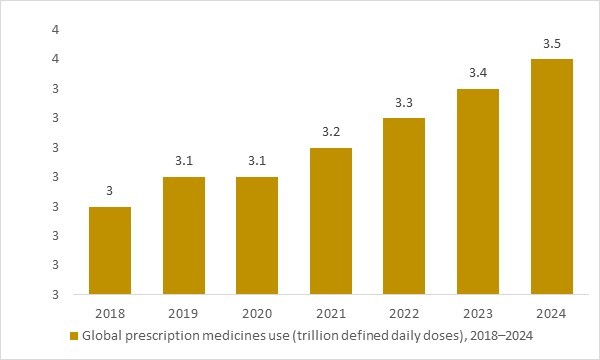
- Global prescription medicines use increased from around 3.0 trillion defined daily doses in 2018 to an estimated 3.5 trillion doses in 2024. As more patients manage chronic conditions and pharmacy networks expand automation, this rising therapy volume directly drives investment in dispensing pharmacy packaging machines for accurate counting, filling, blistering and labeling. OG Analysis estimates, derived from international medicine use data, demonstrate how growing prescription throughput strengthens long-term demand for automated dispensing and adherence packaging solutions in retail and hospital pharmacies.
Regional Insights
North America Dispensing Pharmacy Packaging Machine Market
Market dynamics are shaped by high prescription volumes, consolidation of retail chains, and central-fill/mail-order models that demand speed, accuracy, and traceability across unit-dose and multi-dose formats. Lucrative opportunities include retrofitting legacy lines with vision systems and 2D code verification, integrating pharmacy management software for closed-loop dispensing, and offering outcome-focused service contracts that bundle uptime guarantees with consumables. Latest trends emphasize pouch and blister automation for adherence programs, interoperability with EHR and e-prescribing platforms, cybersecurity-hardened connectivity, and analytics for waste reduction and replenishment planning. The forecast points to continued migration from manual counting to modular robotics in hospital, long-term care, and specialty pharmacy settings, with growth aided by telepharmacy and home-delivery workflows. Recent developments feature vendors adding RFID-ready modules, expanding remote diagnostics, and rolling out compact, ergonomic systems designed to meet pharmacy space constraints while boosting throughput and labeling accuracy.
Asia Pacific Dispensing Pharmacy Packaging Machine Market
Rapid urbanization, expanding healthcare access, and the rise of chain pharmacies underpin market dynamics, with buyers prioritizing cost-efficient automation that withstands high ambient humidity and variable utilities. Opportunities are strongest in scalable, entry-to-mid tier machines for community pharmacies, centralized blister repackaging for hospital networks, and cloud dashboards that enable multi-site performance monitoring. Latest trends include localized UI/UX for multilingual teams, water-based inks and low-energy sealing technologies, and ergonomic pouch designs that support dense multi-pill regimens common in chronic care. The forecast indicates faster adoption of IoT-enabled preventive maintenance and materials-liberal machines that can switch between paper-laminate pouches, bottles, and carded blisters without long changeovers. Recent developments see investments in regional service hubs, partnerships with HIS/PIS vendors for out-of-the-box data exchange, and upgrades to verification cameras and checkweighers to reduce dispensing errors and rework in high-throughput environments.
Europe Dispensing Pharmacy Packaging Machine Market
Europe’s market is steered by rigorous medication safety norms, pharmacy automation incentives, and strong emphasis on recyclability and energy efficiency in packaging operations. Market dynamics favor mono-material pouch solutions, tamper-evident labeling, and full traceability with serialized data capture across hospital and community settings. Lucrative opportunities include retrofits to comply with evolving labeling and audit requirements, premiumization of adherence packs for aging populations, and service models that align machine uptime with pharmacy KPIs. Latest trends feature repulpable or recyclable materials compatibility, low-noise/low-footprint machines suitable for urban pharmacies, and digital twins to simulate throughput and staffing impacts before deployment. The forecast anticipates steady replacement cycles toward modular, interoperable platforms that balance speed with verification rigor. Recent developments highlight vendors introducing high-definition print modules for small-font instructions, expanding European spare-parts logistics, and releasing software updates that harmonize reporting across multi-country pharmacy groups while maintaining data-privacy safeguards.
Report Scope
| Parameter | Dispensing Pharmacy Packaging Machine Market Detail |
| Base Year | 2025 |
| Estimated Year | 2026 |
| Forecast Period | 2026-2034 |
| Market Size-Units | USD billion |
| Market Splits Covered | By Product, By Application, By End User and By Technology |
| Countries Covered | North America (USA, Canada, Mexico) |
| Analysis Covered | Latest Trends, Driving Factors, Challenges, Trade Analysis, Price Analysis, Supply-Chain Analysis, Competitive Landscape, Company Strategies |
| Customization | 10% free customization (up to 10 analyst hours) to modify segments, geographies, and companies analyzed |
| Post-Sale Support | 4 analyst hours, available up to 4 weeks |
| Delivery Format | The Latest Updated PDF and Excel Data file |
Dispensing Pharmacy Packaging Machine Market Segmentation
By Product Type
- Fully Automatic
- Semi-Automatic
By Speed
- Low Speed
- Standard Speed
- High Speed
By Packaging Type
- Blister Packaging
- Bottle Packaging
- Tube Packaging
- Pouch Packaging
By End-User
- Retail Pharmacies
- Hospital Pharmacies
- Online Pharmacies
- Compounding Pharmacies
By Geography
- North America (USA, Canada, Mexico)
- Europe (Germany, UK, France, Spain, Italy, Rest of Europe)
- Asia-Pacific (China, India, Japan, Australia, Vietnam, Rest of APAC)
- The Middle East and Africa (Middle East, Africa)
- South and Central America (Brazil, Argentina, Rest of SCA)
Key Market Players
Bausch+Stroebel, Marchesini Group, Uhlmann Pac-Systeme, Optel Vision, Omnicell, Swisslog Healthcare, ARxIUM, TOSHO, JVM Co. Ltd., SynMed, Kirby Lester, Accutek Packaging, Tishma Technologies, McKesson Automation, Parata Systems
Recent Industry Developments
- July 2025 – A global healthcare automation provider announced expansion of remote diagnostics and RFID-enabled modules in its dispensing machines to enhance uptime and streamline fulfillment workflows in pharmacies.
- February 2025 – Hanmi Pharmaceutical launched Countmate, a fully automated vial dispensing machine for the U.S. and Canadian markets, aimed at expanding its technology footprint beyond pouch-type systems.
- July 2024 – Capsa Healthcare introduced NexPak, an automated strip packaging system for retail and institutional pharmacies, enabling both central pharmacy and in-facility models for patient-specific multi-dose pouches.
- June 2023 – CVS Health unveiled the QuickServe Vitamin Dispensing System, a sleek, fingertip-operated countertop device designed to increase patient adherence and access to over-the-counter supplements.
- July 2022 – BD (Becton Dickinson) acquired Parata Systems, bolstering its portfolio in pharmacy fulfillment and dispensing automation through this strategic takeover.
FAQ's
The Global Dispensing Pharmacy Packaging Machine Market is estimated to generate $ 2.91 billion in revenue in 2026.
The Global Dispensing Pharmacy Packaging Machine Market is expected to grow at a Compound Annual Growth Rate (CAGR) of 9.61% during the forecast period from 2026 to 2034.
The Dispensing Pharmacy Packaging Machine Market is estimated to reach $ 6.65 billion by 2034.
Didn’t find what you’re looking for? TALK TO OUR ANALYST TEAM
Need something within your budget? NO WORRIES! WE GOT YOU COVERED!


