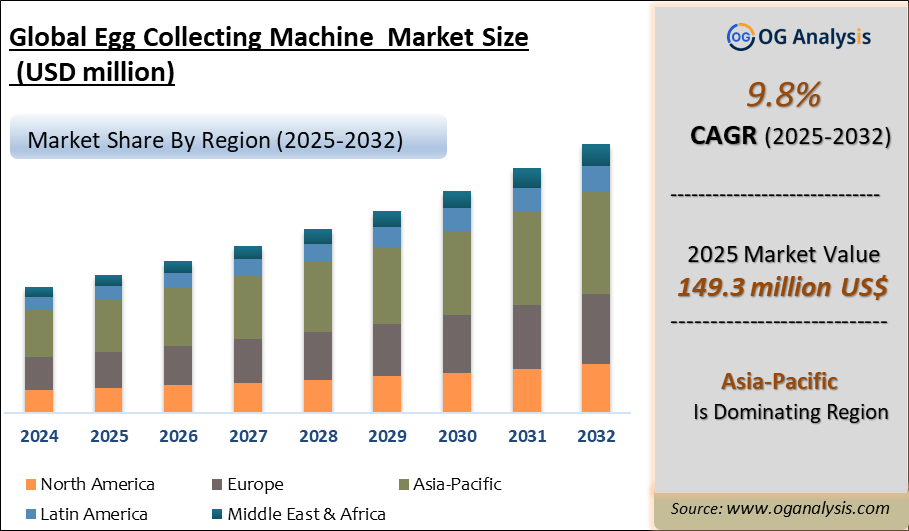
"The Egg Collecting Machine Market Size is valued at $149.3 Million in 2025. Worldwide sales of Egg Collecting Machine Market are expected to grow at a significant CAGR of 9.8%, reaching $ 288 Million by the end of the forecast period in 2032."
The Egg Collecting Machine Market is gaining momentum as poultry farms increasingly adopt automation to enhance productivity, reduce labor dependency, and improve operational hygiene. These machines streamline the egg collection process by minimizing human contact, reducing breakage, and ensuring consistency across commercial and small-scale poultry operations. With rising global demand for eggs, producers are focusing on scalable, reliable, and efficient collection systems to meet output targets. The market includes both automatic and semi-automatic systems, catering to diverse farm sizes and budgets. Growing consumer focus on food safety and traceability is pushing adoption of machines that minimize contamination risks. Integration with farm management software, IoT sensors, and real-time monitoring features is reshaping the industry by enabling remote diagnostics and preventive maintenance. North America and Europe are at the forefront due to higher mechanization levels, while Asia Pacific is expanding rapidly driven by modernizing poultry infrastructure. Sustainability efforts, such as low-energy systems and modular setups, are also influencing buying decisions among farm operators seeking long-term efficiency and compliance.
As the poultry sector evolves to meet increasing global protein demand, egg collecting machines are becoming critical components of farm automation strategies. These systems are designed to ensure gentle egg handling, optimize collection routes, and reduce labor costs. Technological advancements are enabling machines to track egg counts, detect anomalies, and integrate seamlessly with climate control and biosecurity systems. In markets like Japan, semi-automated systems are common in mid-sized farms, while Western markets increasingly adopt fully automated solutions for high-volume operations. Key players are focusing on user-friendly designs, durable materials, and easy-to-clean components to align with hygiene standards and biosecurity protocols. Competitive differentiation is driven by innovations in energy savings, data analytics, and compatibility with other farm automation tools. Government incentives for modernizing agriculture and growing emphasis on animal welfare are further supporting market expansion. The long-term outlook is positive, with consistent investment expected in automation infrastructure, especially in emerging markets transitioning to industrial-scale egg production.
Automatic egg collecting machines are the largest segment by product due to their high efficiency, scalability, and suitability for large commercial poultry farms. These systems significantly reduce labor costs and egg breakage while ensuring consistent and high-throughput operations, making them the preferred choice for industrial-scale production.
Commercial application is the dominant segment as large poultry farms and hatcheries require automated solutions to handle high egg volumes daily. The need for hygiene, speed, and productivity in commercial settings drives widespread adoption of both automatic and semi-automatic systems in this segment.
Key Insights
-
Labor shortages and rising operational costs are prompting poultry farms to automate egg collection, boosting demand for machines that improve efficiency, reduce manual errors, and ensure higher productivity with minimal labor input.
-
Automatic egg collecting machines lead the market, particularly in large-scale commercial farms, due to their ability to handle high throughput with consistent performance, reduced egg damage, and minimal operator intervention.
-
Semi-automatic systems are the fastest-growing segment as they offer a cost-effective solution for small and mid-sized farms transitioning from manual to mechanized collection with partial automation benefits.
-
IoT and sensor-based technologies are enhancing machine functionality, enabling real-time monitoring, predictive maintenance, and performance analytics that support better decision-making and uptime management.
-
Modular and energy-efficient equipment designs are gaining traction, especially in sustainability-focused markets, as they reduce power consumption and allow flexible scaling for farms with varying operational capacities.
-
Asia Pacific is witnessing rapid market growth, driven by expanding poultry operations in countries like India and China, where modernization of agricultural practices is prioritized to meet growing food demand.
-
Europe remains a strong market, supported by automation-friendly policies, high standards of animal welfare, and demand for food safety, pushing adoption of advanced egg collection systems across farms.
-
Major manufacturers are investing in R&D and strategic partnerships to introduce systems with robotics, touch-screen interfaces, and seamless integration into existing farm infrastructure for enhanced usability.
-
Rising consumer concerns over egg hygiene and traceability are pushing producers to adopt equipment that supports clean handling, egg grading, and contamination-free packaging processes at the point of collection.
-
Government subsidies for agricultural automation and modernization programs are encouraging adoption of egg collecting machines, especially in developing regions aiming to boost poultry sector efficiency and biosecurity.
Global hen egg production, 2018–2024 (million tonnes)
Figure: Global hen egg production (million tonnes), 2018–2024, illustrating the expanding raw material base that underpins long-term growth in automated egg collecting machines.

- Global hen egg production has steadily increased between 2018 and 2024, reflecting the expansion and intensification of commercial layer farming worldwide. This rising output underpins the growing need for automated egg collecting machines, as producers seek to handle higher egg volumes efficiently, reduce breakage and labour costs, and maintain consistent product quality in modern poultry operations.
Regional Insights
North America egg collecting machine market
In North America, the egg collecting machine market is driven by large-scale, highly integrated layer farms seeking to cut labour dependence and improve biosecurity. Fully and semi-automatic collection lines are increasingly standard in modern cage, aviary and barn systems, helping reduce breakage, contamination and manual handling. Adoption is reinforced by labour shortages, higher wages and the need for traceable, consistent egg counts feeding farm management and ERP systems. Solutions that integrate conveyors, elevators, counters and data capture into wider house-automation platforms are gaining traction. Interest in robotic and smart-analytics-enabled collection is rising, especially among leading producers focused on long-term efficiency and animal welfare compliance.
Europe egg collecting machine market
In Europe, the market is shaped by stringent animal welfare rules, the transition toward cage-free and barn systems, and tight hygiene expectations from retailers and regulators. Automated egg belts and gentle transfer systems are widely used to handle eggs from multi-tier aviary and floor systems while minimising cracks and dirt. Many farms are upgrading legacy equipment to quieter, energy-efficient drives and low-stress conveyor layouts that align with welfare standards. European OEMs supply integrated lines that connect house belts to central collection, grading and packing facilities, often with sophisticated control software. Sustainability and traceability pressures favour durable machines with easy-clean designs, stainless-steel components and robust safety guarding.
Asia-Pacific egg collecting machine market
Asia-Pacific is the fastest-growing region for egg collecting machines as poultry sectors in China, India and Southeast Asia shift from manual to mechanised operations. Large commercial layer complexes are installing automatic belt, elevator and cross-conveyor systems to support higher stocking densities and branded shell-egg lines. Domestic equipment manufacturers in China and India offer cost-competitive systems tailored to local cage configurations, while global suppliers position higher-spec robotic and smart systems at integrated producers. Governments and investors are encouraging modernisation to improve food safety, egg quality and labour productivity across the value chain. As demand for packaged eggs in supermarkets and modern trade rises, automated egg collection becomes a core feature of new-build layer houses.
Reort Scope
| Parameter | Egg collecting machine Market scope Detail |
| Base Year | 2024 |
| Estimated Year | 2025 |
| Forecast Period | 2026-2034 |
| Market Size-Units | USD billion |
| Market Splits Covered | By Product, By Application, By End User and By Technology |
| Countries Covered | North America (USA, Canada, Mexico) |
| Analysis Covered | Latest Trends, Driving Factors, Challenges, Trade Analysis, Price Analysis, Supply-Chain Analysis, Competitive Landscape, Company Strategies |
| Customization | 10% free customization (up to 10 analyst hours) to modify segments, geographies, and companies analyzed |
| Post-Sale Support | 4 analyst hours, available up to 4 weeks |
| Delivery Format | The Latest Updated PDF and Excel Data file |
Egg Collecting Machine Market Segmentation
By Product
- Automatic
- Semi-Automatic
By Application
- Commercial
- Residential
By End User
- Farmers
- Poultry Companies
By Technology
- Traditional
- Advanced Robotics
By Distribution Channel
- Online
- Offline
By Geography
- North America (USA, Canada, Mexico)
- Europe (Germany, UK, France, Spain, Italy, Rest of Europe)
- Asia-Pacific (China, India, Japan, Australia, Vietnam, Rest of APAC)
- The Middle East and Africa (Middle East, Africa)
- South and Central America (Brazil, Argentina, Rest of SCA)
Top 15 Companies Operating in the Egg Collecting Machine Market
- Big Dutchman
- Salmet
- Vencomatic Group
- Facco
- Hellmann Poultry
- SKA
- VDL Agrotech
- Jansen Poultry Equipment
- Henan Jinfeng Poultry Equipment
- Hebei Weizhengheng Animal Husbandry Machinery Equipment Co., Ltd.
- Guangzhou Huanan Poultry Equipment
- Techin Systems
- Munters
- Roxell
- Big Herdsman Machinery
Recent Industry Developments
-
Jan 2026 – Vencomatic (Prinzen): Vencomatic Poultry UK announced installation of a complete Prinzen egg-packing/handling line for a 64,000-bird free-range farm in the Scottish Highlands. The project highlights continued automation upgrades around egg flow handling to improve gentle transfer and reduce labor.
-
Aug 2025 – Big Dutchman: Big Dutchman highlighted updates to its egg collection portfolio, including an added option for “system egg collection” on elevator-based solutions to capture mislaid eggs while collecting main belt flow. The upgrade targets higher egg recovery, fewer manual interventions, and better overall egg-room efficiency.
-
Jun 2025 – Vencomatic (Meggsius): Vencomatic promoted Meggsius Connect as a real-time egg collection management layer, using dashboards to track egg flow and operational performance. The push reflects growing demand for data-driven control to reduce stoppages and improve consistency across houses.
-
Apr 2025 – Big Dutchman: Big Dutchman showcased newer configurations of automated egg collection systems designed to reduce breakage and labor while improving egg quality across different housing layouts. The company emphasized gentle transport and system flexibility for modern layer operations.
-
Mar 2025 – Vencomatic (Ovoclear): Vencomatic Poultry UK announced Ovoclear, an inspection roller conveyor that automatically removes feathers from the egg flow. The innovation is positioned to improve downstream handling hygiene and reduce manual sorting effort.
-
Oct 2023 – Moba: Moba announced the Mopack EP farmpacker addition to its Mopack family, designed to pack eggs from poultry houses into trays with higher efficiency and gentle handling. The launch targets reduced cracking, fewer interruptions, and lower labor intensity in on-farm egg collection/packing workflows.
What You Receive
• Global Egg Collecting Machine market size and growth projections (CAGR), 2024- 2034
• Impact of recent changes in geopolitical, economic, and trade policies on the demand and supply chain of Egg Collecting Machine.
• Egg Collecting Machine market size, share, and outlook across 5 regions and 27 countries, 2025- 2034.
• Egg Collecting Machine market size, CAGR, and Market Share of key products, applications, and end-user verticals, 2025- 2034.
• Short and long-term Egg Collecting Machine market trends, drivers, restraints, and opportunities.
• Porter’s Five Forces analysis, Technological developments in the Egg Collecting Machine market, Egg Collecting Machine supply chain analysis.
• Egg Collecting Machine trade analysis, Egg Collecting Machine market price analysis, Egg Collecting Machine Value Chain Analysis.
• Profiles of 5 leading companies in the industry- overview, key strategies, financials, and products.
• Latest Egg Collecting Machine market news and developments.
The Egg Collecting Machine Market international scenario is well established in the report with separate chapters on North America Egg Collecting Machine Market, Europe Egg Collecting Machine Market, Asia-Pacific Egg Collecting Machine Market, Middle East and Africa Egg Collecting Machine Market, and South and Central America Egg Collecting Machine Markets. These sections further fragment the regional Egg Collecting Machine market by type, application, end-user, and country.
Who can benefit from this research
The research would help top management/strategy formulators/business/product development/sales managers and investors in this market in the following ways
1. The report provides 2024 Egg Collecting Machine market sales data at the global, regional, and key country levels with a detailed outlook to 2034, allowing companies to calculate their market share and analyze prospects, uncover new markets, and plan market entry strategy.
2. The research includes the Egg Collecting Machine market split into different types and applications. This segmentation helps managers plan their products and budgets based on the future growth rates of each segment
3. The Egg Collecting Machine market study helps stakeholders understand the breadth and stance of the market giving them information on key drivers, restraints, challenges, and growth opportunities of the market and mitigating risks
4. This report would help top management understand competition better with a detailed SWOT analysis and key strategies of their competitors, and plan their position in the business
5. The study assists investors in analyzing Egg Collecting Machine business prospects by region, key countries, and top companies' information to channel their investments.
Available Customizations
The standard syndicate report is designed to serve the common interests of Egg Collecting Machine Market players across the value chain and include selective data and analysis from entire research findings as per the scope and price of the publication.
However, to precisely match the specific research requirements of individual clients, we offer several customization options to include the data and analysis of interest in the final deliverable.
Some of the customization requests are as mentioned below :
Segmentation of choice – Our clients can seek customization to modify/add a market division for types/applications/end-uses/processes of their choice.
Egg Collecting Machine Pricing and Margins Across the Supply Chain, Egg Collecting Machine Price Analysis / International Trade Data / Import-Export Analysis
Supply Chain Analysis, Supply–Demand Gap Analysis, PESTLE Analysis, Macro-Economic Analysis, and other Egg Collecting Machine market analytics
Processing and manufacturing requirements, Patent Analysis, Technology Trends, and Product Innovations
Further, the client can seek customization to break down geographies as per their requirements for specific countries/country groups such as South East Asia, Central Asia, Emerging and Developing Asia, Western Europe, Eastern Europe, Benelux, Emerging and Developing Europe, Nordic countries, North Africa, Sub-Saharan Africa, Caribbean, The Middle East and North Africa (MENA), Gulf Cooperation Council (GCC) or any other.
Capital Requirements, Income Projections, Profit Forecasts, and other parameters to prepare a detailed project report to present to Banks/Investment Agencies.
Customization of up to 10% of the content can be done without any additional charges.
Note: Latest developments will be updated in the report and delivered within 2 to 3 working days.
FAQ's
The Global Egg Collecting Machine Market is estimated to generate USD 149.3 Million in revenue in 2025.
The Global Egg Collecting Machine Market is expected to grow at a Compound Annual Growth Rate (CAGR) of 9.8% during the forecast period from 2025 to 2032.
The Egg Collecting Machine Market is estimated to reach USD 288 Million by 2032.
Didn’t find what you’re looking for? TALK TO OUR ANALYST TEAM
Need something within your budget? NO WORRIES! WE GOT YOU COVERED!


