"The Freight Cars Market was valued at $174.3 billion in 2025 and is projected to reach $261.4 billion by 2034, growing at a CAGR of 4.6%."
The Freight Cars Market is a critical segment of the global transportation industry, primarily serving the movement of goods across rail networks. Freight cars, designed for hauling a wide range of commodities, including bulk materials, consumer goods, and industrial products, play a vital role in the supply chain. These cars are integral to enhancing transportation efficiency and supporting the growth of global trade. With increasing demand for sustainable and cost-effective logistics solutions, rail freight offers a greener alternative to road transportation, which has spurred the market's growth. The market is also benefiting from technological advancements in car design, materials, and automation. As countries and industries focus on reducing carbon footprints and enhancing logistics efficiency, rail freight continues to be a reliable and eco-friendly mode of transportation. Additionally, the rising demand for e-commerce, infrastructure development, and the expansion of industries in emerging economies contribute to the steady growth of the freight car market globally.
In 2024, the Freight Cars Market has experienced significant developments, driven by increased investments in modernizing rail infrastructure and upgrading freight car fleets. The demand for specialized freight cars, such as tank cars for liquids, refrigerated cars for perishable goods, and intermodal freight cars, has surged, particularly in regions with rapidly growing economies. Advances in car design, focusing on weight reduction, increased capacity, and enhanced durability, have resulted in more efficient transportation solutions. Furthermore, the shift toward digitization in logistics has prompted the integration of smart technologies into freight cars, improving fleet management and operational efficiency. The development of autonomous freight trains and innovations in digital tracking systems are expected to increase overall productivity. However, challenges such as fluctuating fuel costs and the need for regulatory compliance in different regions are affecting the pace of market growth. Despite these challenges, the market outlook remains positive, driven by the growing need for sustainable, cost-effective freight solutions and increasing global trade volume.
Looking ahead to 2025 and beyond, the Freight Cars Market is expected to undergo further transformations, primarily driven by advancements in automation and sustainability. The development of electric and hybrid freight cars will play a significant role in reducing emissions and operating costs. Additionally, the increasing adoption of autonomous freight transport systems will revolutionize logistics, reducing labor costs and increasing operational efficiency. Governments and regulatory bodies are likely to introduce stricter environmental policies, prompting the rail industry to further innovate in reducing emissions and increasing fuel efficiency. The continued expansion of the e-commerce sector and the need for faster, more efficient transportation of goods will further fuel market growth. In emerging economies, particularly in Asia-Pacific, the increasing demand for rail transport infrastructure will contribute significantly to the market's expansion. As new materials, smart sensors, and data analytics technologies continue to shape the future of rail transport, freight car manufacturers will prioritize innovations that enhance safety, efficiency, and environmental sustainability.
Key Insights_ Freight Cars Market
-
Adoption of Autonomous Freight Cars: The increasing interest in autonomous trains is shaping the market, promising improved operational efficiency and reduced labor costs by enabling unmanned freight transport.
-
Growth in Intermodal Freight Transportation: The rising demand for intermodal freight solutions, combining rail and road transport, is driving the development of specialized freight cars to improve flexibility and efficiency.
-
Integration of Smart Technologies: The use of sensors, GPS, and real-time data analytics for fleet management is improving monitoring and reducing downtime in the freight car sector.
-
Sustainability and Emission Reduction: The growing emphasis on reducing carbon emissions is pushing for the development of electric and hybrid freight cars, which are more eco-friendly alternatives to traditional diesel-powered models.
-
Rail Infrastructure Upgrades in Emerging Economies: Investment in modernizing rail systems, especially in Asia-Pacific and Latin America, is expanding the freight car market as new rail networks and advanced freight systems are developed.
-
Increased E-Commerce Demand: The growing e-commerce sector has raised the need for efficient and timely transportation, boosting demand for specialized freight cars capable of handling high volumes of goods.
-
Government Investments in Rail Infrastructure: Governments worldwide are investing in upgrading rail infrastructure and transportation networks, which benefits the freight car market by improving rail capacity and efficiency.
-
Sustainability Initiatives: Global pressure to reduce carbon emissions is driving the adoption of green technologies in freight cars, such as electric or hybrid models and low-emission alternatives.
-
Technological Advancements in Automation: The development of autonomous freight trains and smart systems is reducing labor costs and improving the efficiency of rail freight operations, encouraging further market growth.
-
Regulatory Compliance and Safety Standards: Ensuring compliance with varying safety regulations across different regions presents a challenge for manufacturers, as it involves complex certification processes and may increase production costs.
Global EU-27 rail freight transport performance, 2018–2024 (billion tonne-kilometres)
Figure: EU-27 rail freight transport performance has eased from around 410 billion tonne-kilometres in 2018 to about 375 billion tonne-kilometres in 2024, after a temporary COVID-19 dip in 2020 and a rebound in 2021. The resilience of rail tonne-kilometre volumes highlights the structural role of rail in moving bulk commodities and intermodal loads. OG Analysis estimates, based on Eurostat railway freight statistics, underline how these stable traffic flows underpin long-term investment and renewal in the global freight cars market.
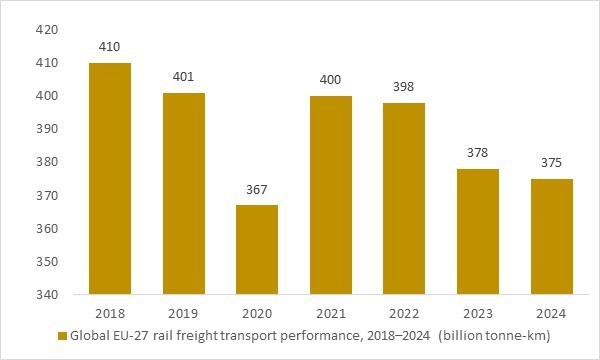
- Global EU-27 rail freight transport performance has eased slightly from about 410 billion tonne-kilometres in 2018 to around 375 billion tonne-kilometres in 2024, after a pandemic-driven dip and subsequent recovery. The resilience of rail freight tonne-kilometres underlines the structural role of wagons in moving bulk commodities and intermodal loads, and highlights how stable traffic volumes continue to support long-term investment and renewal in the global freight cars market, OG Analysis.
Market Scope
| Parameter | Freight Cars Market Scope Detail |
| Base Year | 2024 |
| Estimated Year | 2025 |
| Forecast Period | 2026-2034 |
| Market Size-Units | USD billion |
| Market Splits Covered | By Product, By Application, By End User and By Technology |
| Countries Covered | North America (USA, Canada, Mexico) |
| Analysis Covered | Latest Trends, Driving Factors, Challenges, Trade Analysis, Price Analysis, Supply-Chain Analysis, Competitive Landscape, Company Strategies |
| Customization | 10% free customization (up to 10 analyst hours) to modify segments, geographies, and companies analyzed |
| Post-Sale Support | 4 analyst hours, available up to 4 weeks |
| Delivery Format | The Latest Updated PDF and Excel Data file |
Freight Cars Market Segmentation
By Type
- Intermodals
- Tank Wagons
- Freight Cars
By Application
- Coal
- Petroleum And Chemicals
- Metals And Minerals
- Automobiles
- Agricultural Products
- Other Applications
By End-Use Industries
- Agriculture
- Construction
- Oil & Gas
- Chemical
- Medical & Pharmaceuticals
- Food & Beverages
- Government & Defense
- Automotive & Transportation
- Marine
By Geography
- North America (USA, Canada, Mexico)
- Europe (Germany, UK, France, Spain, Italy, Rest of Europe)
- Asia-Pacific (China, India, Japan, Australia, Vietnam, Rest of APAC)
- The Middle East and Africa (Middle East, Africa)
- South and Central America (Brazil, Argentina, Rest of SCA)
Major Companies Analysed
Canadian National Railway, DB Schenker, SBB Cargo AG, Union Pacific Railroad, Kansas City Southern, CSX Corporation, Norfolk Southern Corporation, Housatonic Railroad Company, Linfox Pty Ltd, Trinity Rail Group LLC, Greenbrier Companies, National Steel Car Ltd., American Railcar Industries Inc., FreightCar America Inc., The Andersons Rail Group, GATX Corporation, Union Tank Car Company, Trinity Industries Inc., CIMC Railcar, GB Railfreight, CRRC Corporation Limited, CSR Corporation Limited, Bombardier Inc., Siemens Mobility, Alstom, Stadler Rail AG, Kawasaki Heavy Industries Ltd., Hitachi Rail Italy SpA, Hyundai Rotem Company, Talgo Group, Newag SA, Skoda Transportation AS, CRRC Changchun Railway Vehicles
Recent Development
-
Jan 2026 — Trinity Industries: Completed a restructuring of key railcar investment partnerships with Napier Park, simplifying ownership across parts of its leasing portfolio and improving capital flexibility for large railcar assets.
-
Dec 2025 — FreightCar America: Acquired Carly Railcar Components to expand its aftermarket and running-repair components distribution, targeting faster lead times and a broader ready-to-ship parts catalog.
-
Nov 2025 — Knorr-Bremse & VTG Rail UK: Signed a long-term framework agreement to supply a minimum of 2,000 FreightControl Sentinel wagon sets through 2029, supporting digital monitoring and defect reduction across new-build and retrofitted wagons.
-
Nov 2025 — GATX Rail Europe & DB Cargo: Announced competition-authority approval for a major sale-and-leaseback covering ~6,000 freight cars, keeping wagons available for DB Cargo operations while expanding GATX’s managed fleet footprint.
-
Oct 2025 — Greenbrier: Reported strong order/backlog momentum and continued European facility rationalization, announcing additional site closures to drive annualized cost savings while maintaining production capacity.
-
Sep 2025 — GATX Rail Europe & DB Cargo: Entered into the underlying sale-and-leaseback agreement for ~6,000 freight cars, enabling DB Cargo to monetize fleet assets while retaining long-term operational access via leaseback.
-
Sep 2025 — VTG: Reorganized its business by establishing dedicated Logistics and Production divisions alongside Leasing, aiming to sharpen accountability, streamline processes, and speed decision-making across fleet services.
-
Jul 2025 — Wabtec & Intermodal Telematics (IMT): Expanded an exclusive distribution agreement to cover major European freight markets, accelerating deployment of railcar telematics for location/condition monitoring and predictive maintenance.
-
Apr 2025 — FreightCar America: Announced orders for ~1,250 railcars (value cited by the company), signaling demand strength across core freight-car types and supporting capacity utilization and backlog build.
FAQ's
The Global Freight Cars Market is estimated to generate USD 174.3 billion in revenue in 2025.
The Global Freight Cars Market is expected to grow at a Compound Annual Growth Rate (CAGR) of 4.61% during the forecast period from 2025 to 2034.
The Freight Cars Market is estimated to reach USD 261.4 billion by 2034.
Didn’t find what you’re looking for? TALK TO OUR ANALYST TEAM
Need something within your budget? NO WORRIES! WE GOT YOU COVERED!


