Home Industry Reports Aerospace & Defense Unmanned & Autonomous System Global Aircraft Lightning Protection Systems Market

Global Aircraft Lightning Protection Systems Market Analysis and Outlook Report: Industry Size, Share, Growth Trends, and Forecast (2026-2034)

Published On: Feb, 2026
|
Pages: 156

"The Aircraft Lightning Protection Systems Market Size was valued at $ 3.4 billion in 2026. Worldwide sales of Aircraft Lightning Protection Systems are expected to grow at a significant CAGR of 3.2%, reaching $ 4.4 billion by the end of the forecast period in 2034."

Aircraft lightning protection systems comprise engineered materials, components, and electrical safeguards designed to control lightning attachment, conduct electrical current safely across the airframe, and protect structures, fuel systems, avionics, flight controls, and onboard electronics. Key solutions include conductive meshes and foils, lightning diverter strips, bonding and grounding components, surge suppression devices, shielding systems, static discharge equipment, and specialized coatings. These systems are installed across commercial aircraft, military platforms, business jets, helicopters, unmanned aerial vehicles, and emerging electric aircraft. Their importance is increasing as manufacturers use greater volumes of lightweight composite materials, which offer lower natural electrical conductivity than traditional metallic airframes.

Market development is supported by expanding aircraft production, fleet modernization, rising avionics content, composite-intensive airframe designs, and stringent airworthiness requirements. Major trends include lighter conductive materials, integrated structural protection, advanced simulation, improved electromagnetic compatibility, and lightning safeguards developed specifically for electric propulsion and high-voltage systems. Competition involves aerospace component manufacturers, material specialists, avionics protection providers, and aircraft-certified engineering companies. Suppliers are pursuing long-term OEM agreements, platform-specific product development, certification support, acquisitions, and collaboration with composite manufacturers. Challenges include complex qualification procedures, weight constraints, inspection requirements, material compatibility, high development costs, and extended aerospace procurement cycles. Trade controls, specialized raw-material availability, and dependence on certified suppliers also influence production planning and supply-chain resilience.

Regional Analysis

North America Aircraft Lightning Protection Systems Market

North America represents a leading market, supported by the presence of major aircraft manufacturers, aerospace material suppliers, defense contractors, and advanced testing facilities. Demand is driven by commercial aircraft production, military fleet modernization, business aviation, unmanned platforms, and emerging electric aircraft programs. Suppliers focus on lightweight conductive materials, electromagnetic protection, platform-specific engineering, certification support, and long-term agreements with aircraft OEMs and maintenance providers.

Europe Aircraft Lightning Protection Systems Market

Europe maintains a strong position through its established commercial aerospace, helicopter, defense aviation, and aircraft-component manufacturing industries. Growing use of composite-intensive airframes is increasing demand for expanded metal foils, conductive meshes, lightning diverters, bonding components, and surge-protection systems. Stringent airworthiness standards, sustainability targets, and collaborative aerospace programs encourage continuous material innovation, although extended certification cycles and supply-chain dependence on specialized aerospace-grade inputs remain important considerations.

Asia-Pacific Aircraft Lightning Protection Systems Market

Asia-Pacific is experiencing expanding demand as regional airlines increase fleet capacity and governments invest in domestic aircraft production, military aviation, maintenance facilities, and aerospace manufacturing ecosystems. China, Japan, India, South Korea, and Southeast Asian countries are strengthening local capabilities in aircraft assembly and component production. International suppliers are pursuing joint ventures, distribution partnerships, technology cooperation, and local manufacturing to meet growing OEM and aftermarket requirements.

Middle East and Africa Aircraft Lightning Protection Systems Market

The Middle East and Africa market is supported by airline fleet expansion, defense procurement, business aviation, airport development, and growing maintenance, repair, and overhaul capabilities. Gulf countries represent important demand centers due to their large commercial fleets and investment in aerospace services. Much of the region depends on imported certified systems and components, while limited local manufacturing, procurement complexity, and extended replacement cycles constrain broader market development.

South and Central America Aircraft Lightning Protection Systems Market

South and Central America demonstrate steady demand across commercial aviation, regional aircraft manufacturing, military modernization, helicopters, agricultural aviation, and aftermarket maintenance. Brazil plays a central role through its established aerospace manufacturing and engineering base, while other countries generate demand through fleet renewal and aviation infrastructure investment. Currency volatility, limited defense budgets, import dependence, and restricted access to specialized testing facilities remain key regional challenges.

Key Takeaways

  • Growing use of carbon-fiber composites is increasing demand for conductive meshes, expanded metal foils, coatings, and bonding solutions capable of safely distributing lightning current across lightweight airframes.
  • Commercial aircraft production and fleet replacement programs remain major demand contributors, supported by higher passenger traffic, airline modernization, and the introduction of more fuel-efficient aircraft platforms.
  • Advanced avionics, digital flight controls, sensors, communication equipment, and electrically actuated systems require stronger transient protection, shielding, grounding, and electromagnetic compatibility management.
  • Electric aircraft and eVTOL platforms are creating new protection requirements due to high-voltage batteries, distributed propulsion, lightweight structures, and densely integrated electronic architectures.
  • Regulatory certification remains a critical market-entry barrier, requiring extensive laboratory testing, simulated lightning strikes, structural verification, and documentation throughout aircraft development programs.
  • Manufacturers are developing lighter, corrosion-resistant, and multifunctional materials that provide lightning protection without significantly increasing aircraft weight or complicating composite manufacturing processes.
  • Long-term relationships with aircraft OEMs, tier suppliers, maintenance providers, and material manufacturers are essential because components must meet platform-specific engineering and qualification requirements.
  • Supply-chain risks include limited availability of aerospace-grade conductive materials, long component lead times, export restrictions, quality-control requirements, and dependence on specialized certified production facilities.
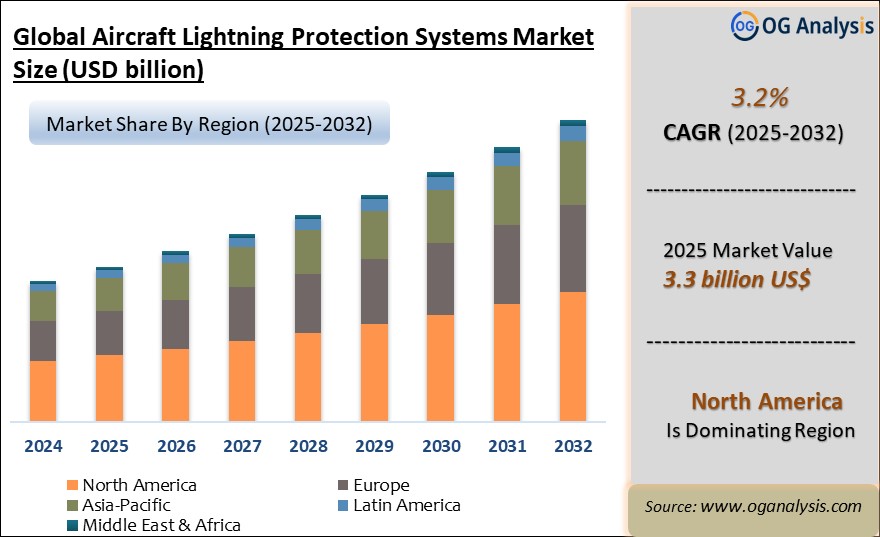
Global Aircraft Lightning Protection Systems Market Analysis 2025-2032: Industry Size, Share, Growth Trends, Competition and Forecast Report

Market Scope

Parameter

Aircraft Lightning Protection Systems Market Detail

Base Year

2025

Estimated Year

2026

Forecast Period

2026-2034

Market Size-Units

USD billion

Market Splits Covered

By protection Type, By Aircraft Type, By End-user and By Fit

Countries Covered

North America (USA, Canada, Mexico)
Europe (Germany, UK, France, Spain, Italy, Rest of Europe)
Asia-Pacific (China, India, Japan, Australia, Rest of APAC)
The Middle East and Africa (Middle East, Africa)
South and Central America (Brazil, Argentina, Rest of SCA)

Analysis Covered

Latest Trends, Driving Factors, Challenges, Trade Analysis, Price Analysis, Supply-Chain Analysis, Competitive Landscape, Company Strategies

Customization

10% free customization (up to 10 analyst hours) to modify segments, geographies, and companies analyzed

Post-Sale Support

4 analyst hours, available up to 4 weeks

Delivery Format

The Latest Updated PDF and Excel Data file

Market Segmentation

By Protection Type

  • Expanded metal foils
  • Interwoven wire
  • Conductive paints and coatings
  • Plated carbon fiber
  • Other

By Aircraft Type

  • Fixed-wing Aircraft
  • Rotorcraft
  • Unmanned Aerial Vehicles

By End User

  • Civil
  • Military

By Fit

  • Line-Fit
  • Retrofit

By Geography

  • North America (USA, Canada, Mexico)
  • Europe (Germany, UK, France, Spain, Italy, Rest of Europe)
  • Asia-Pacific (China, India, Japan, Australia, Rest of APAC)
  • The Middle East and Africa (Middle East, Africa)
  • South and Central America (Brazil, Argentina, Rest of SCA)

Market Players

  • Honeywell International Inc.
  • Parker Hannifin Corporation
  • The Boeing Company
  • L3Harris Technologies, Inc.
  • Cobham Limited
  • Ametek, Inc.
  • Raytheon Technologies Corporation
  • BAE Systems plc
  • Safran S.A.
  • Thales Group
  • Lockheed Martin Corporation
  • Carlisle Interconnect Technologies
  • LORD Corporation

Recent Developments

March 2026 PPG Aerospace showcased engineered-material and conductive-sealant solutions at JEC World, including DEXMET MicroGrid expanded metal foils and electrically conductive, non-chromated aerospace sealants. These technologies support lightning-current distribution, electrical bonding, corrosion resistance, and consistent fastener protection in composite-intensive aircraft.

November 2025 The FAA issued a superseding airworthiness directive covering certain Airbus A350 aircraft after additional areas were identified with potentially missing or incorrectly applied lightning-strike edge-glow sealant. The directive requires inspections and corrective sealant application to maintain independent protection layers around wing-tank structures.

November 2025 Researchers presented a drapable hybrid woven-composite concept integrating stainless-steel yarns into carbon-fiber structures. Testing indicated reduced surface temperatures, material loss, and structural damage following simulated strikes, highlighting potential applications in complex-shaped advanced-air-mobility aircraft.

September 2025 The FAA proposed expanding lightning-protection inspection requirements across additional Boeing 777 variants and engine configurations. The proposal incorporated an updated Boeing requirements bulletin and focused on bonding jumpers and bulkhead fittings within the engine fuel-feed system.

May 2025 The FAA updated its accepted means of compliance for Part 23 aircraft, incorporating revised ASTM standards addressing direct and indirect lightning effects. The guidance specifies differentiated qualification levels for metallic and composite fuselages and reinforces aircraft-level testing of shielding, grounding, and electronic engine-control installations.

May 2025 A DRDO-funded research program was initiated at Motilal Nehru National Institute of Technology to study lightning-induced electrical, thermal, and mechanical damage in composite aircraft panels. The project is using multiphysics modelling to assess material combinations and improve simulation tools for future protection-system development.

May 2025 An aerospace research study examined destructive and non-destructive assessment methods for lightning-damaged protected and painted composite laminates. The findings showed that paint thickness and arc confinement can materially affect the performance of conductive protection layers and the extent of hidden structural damage.

You can purchase individual sections of this report. Explore pricing options for specific sections.

FAQ's

The Aircraft Lightning Protection Systems Market is estimated to reach USD 4.1 billion by 2032.

The Global Aircraft Lightning Protection Systems Market is expected to grow at a Compound Annual Growth Rate (CAGR) of 3.2% during the forecast period from 2026 to 2034.

The Global Aircraft Lightning Protection Systems Market is estimated to generate USD 3.4 billion in revenue in 2026.

License

Didn’t find what you’re looking for? TALK TO OUR ANALYST TEAM

Need something within your budget? NO WORRIES! WE GOT YOU COVERED!

Related Products

Military Drone (UAV) Market Analysis and Outlook Report: Industry Size, Share, Growth Trends, and Forecast (2026-2034)

The Military Drone (UAV) Market is gaining strong strategic importance as armed forces increasingly shift toward unmanned, autonomous, and network-enabled platforms for intelligence, surveillance, reconnaissance, target acquisition, combat support, border security, maritime patrol, logistics, and precision strike missions. Military UAVs allow defense agencies to improve situational awareness, reduce risk to personnel, extend mission endurance, and operate in contested or remote environments where manned platforms may face higher operational risk. Demand is being supported by rising geopolitical tensions, defense modernization programs, cross-border security threats, and the growing need for persistent surveillance across land, air, and maritime domains. Recent battlefield experience has also reinforced the value of low-cost drones, loitering munitions, and attritable systems in modern warfare, pushing militaries to accelerate procurement and deployment cycles. Market growth is being shaped by rapid advances in autonomy, artificial intelligence, sensor payloads, secure communications, swarm coordination, electronic warfare resilience, and counter-UAS integration. Defense buyers are increasingly prioritizing UAVs that can support multi-domain operations, real-time data sharing, precision targeting, and faster decision-making. The competitive landscape includes large defense primes, specialized drone manufacturers, avionics and payload suppliers, AI software developers, and emerging defense technology companies. Procurement is also shifting from a limited number of high-end UAV platforms toward a mixed fleet approach that includes HALE, MALE, tactical, mini, VTOL, naval, combat, and expendable drones. At the same time, the market faces challenges related to airspace regulation, cybersecurity, jamming, supply chain security, export controls, interoperability, and ethical concerns around autonomous weapons. NATO and allied forces are also increasing testing and counter-drone programs, showing that UAV adoption is expanding alongside a parallel need to defend against hostile drone threats. Regional Analysis North AmericaMilitary Drone (UAV) Market North America holds a leading position in the Military Drone (UAV) Market, driven by large defense budgets, advanced aerospace capabilities, strong R&D investment, and early adoption of unmanned platforms across ISR, combat, training, maritime, and logistics missions. The United States remains the key demand center, supported by procurement of tactical UAVs, MALE/HALE platforms, autonomous systems, loitering munitions, and counter-UAS technologies. The region is also witnessing a shift from limited high-value drone platforms toward scalable, lower-cost autonomous systems that can be deployed in larger numbers. Rising investment in AI-enabled autonomy, secure communications, swarm systems, and drone defense solutions is strengthening North America’s role as both a major consumer and technology exporter in the market. U.S. military officials have also pushed for major future spending on drones and air defense systems, reflecting the strategic importance of unmanned warfare. EuropeMilitary Drone (UAV) Market Europe is emerging as one of the most strategically active regions in the military UAV market, largely influenced by the Russia-Ukraine war, rising NATO readiness requirements, and the urgent need for scalable, cost-effective unmanned systems. Countries across Europe are increasing focus on drones for surveillance, border security, battlefield intelligence, electronic warfare, counter-drone defense, and precision strike support. The region is also placing greater emphasis on domestic drone manufacturing, interoperability with NATO systems, and rapid procurement cycles. Ukraine’s battlefield experience has accelerated European interest in low-cost drones, loitering munitions, AI-enabled battlefield systems, and counter-UAS capabilities. European military leaders are increasingly highlighting the need for mass-produced drones and interceptors rather than relying only on expensive, slow-to-build defense platforms. Asia-PacificMilitary Drone (UAV) Market Asia-Pacific is one of the fastest-growing regions for military UAVs, supported by territorial tensions, border disputes, maritime security needs, defense modernization, and rising investment in domestic drone manufacturing. China, India, South Korea, Japan, Australia, and several Southeast Asian countries are strengthening UAV capabilities for ISR, border surveillance, naval monitoring, tactical operations, and armed drone missions. India is accelerating weaponized drone development and domestic procurement, while South Korea has announced plans to expand drone forces and deploy large numbers of unmanned systems to frontline units. The region is also seeing stronger cooperation around drone production and defense supply chains, especially as countries seek to reduce dependence on foreign components and improve resilience against regional security threats. Middle East & AfricaMilitary Drone (UAV) Market The Middle East & Africa region is gaining strong momentum in the Military Drone Market due to persistent regional conflicts, border security concerns, counterterrorism needs, and growing investment in sovereign defense capabilities. The Middle East has become a major adoption hub for armed UAVs, MALE drones, surveillance platforms, and loitering munitions, with Israel, Turkey, Saudi Arabia, and the UAE playing important roles as buyers, developers, or exporters. Turkey’s rise as a drone exporter and Israel’s established UAV capabilities continue to shape regional competition. In Africa, demand is increasing for affordable surveillance and strike drones used for counterinsurgency, border monitoring, and critical infrastructure protection. China, Turkey, and Israel have become important suppliers across African markets, where price, availability, and combat-proven platforms are major purchase factors. South & Central AmericaMilitary Drone (UAV) Market South & Central America represents a smaller but steadily developing market for military UAVs. Demand is mainly supported by border surveillance, anti-narcotics operations, counterinsurgency, maritime monitoring, forest and remote-area surveillance, and internal security missions. Countries such as Brazil, Colombia, Chile, and Argentina are gradually adopting unmanned systems to improve situational awareness and reduce operational risk in difficult terrain. Colombia’s recent experience with rebel and criminal groups using modified commercial drones has increased attention on both UAV deployment and counter-drone systems. Budget limitations, slower procurement cycles, and dependence on imported technologies remain key restraints, but opportunities exist for tactical UAVs, surveillance drones, training systems, and affordable counter-UAS solutions. Key Insights Unmanned warfare is becoming central to defense modernization: Militaries are increasingly using drones for ISR, surveillance, target acquisition, strike support, and battlefield management. UAVs are no longer limited to niche reconnaissance roles but are becoming core assets in tactical and strategic operations. Loitering munitions and attritable drones are reshaping procurement priorities: Defense agencies are showing stronger interest in lower-cost, scalable UAV systems that can be deployed in large numbers. This is changing the competitive balance between traditional high-value platforms and mass-produced unmanned systems. AI-enabled autonomy is emerging as a major technology trend: Artificial intelligence is improving target recognition, navigation, mission planning, swarm coordination, and decision-support capabilities. However, autonomous operations also raise concerns around reliability, accountability, ethical use, and rules of engagement. ISR and border surveillance remain key demand drivers: Persistent monitoring of borders, coastlines, conflict zones, critical infrastructure, and maritime routes continues to support demand for tactical UAVs, MALE UAVs, mini-UAVs, and VTOL drones. Combat UAVs and precision-strike platforms are gaining adoption: Armed drones and UCAVs are increasingly used for strike missions, suppression of enemy positions, and high-risk operations where reducing pilot exposure is a major advantage. Electronic warfare resilience is becoming critical: Modern battlefields expose UAVs to jamming, spoofing, cyberattacks, and communication disruption. This is pushing demand for secure datalinks, anti-jamming systems, encrypted communications, autonomous navigation, and resilient avionics. Counter-UAS demand is rising alongside UAV adoption: As drones become more widely used, defense forces are investing in detection, tracking, interception, electronic attack, directed-energy systems, and layered counter-drone solutions to protect troops, air bases, borders, and critical assets. VTOL and hybrid UAV platforms are gaining traction: Defense users are adopting VTOL and hybrid UAVs because they combine flexible launch and landing with improved range and endurance, making them suitable for naval, mountain, urban, and forward-deployed operations. Logistics and payload delivery applications are expanding: UAVs are increasingly being evaluated for battlefield resupply, medical delivery, ammunition transport, and support to remote military units, especially where manned logistics operations face high risk. Supply chain security and domestic production are becoming strategic priorities: Countries are focusing on local manufacturing, secure components, trusted electronics, and reduced dependence on foreign suppliers, especially for mission-critical UAV systems. Interoperability remains a major challenge: Military drones must integrate with command-and-control systems, satellite communications, intelligence networks, air defense systems, and manned platforms. Lack of standardization can limit operational efficiency across joint and allied forces. Regulatory, ethical, and export-control constraints may affect market growth: UAV exports, autonomous weapon functions, airspace access, and cross-border deployment are subject to strict government oversight, which can delay procurement and limit market access for suppliers. Report Scope Parameter Military Drone (UAV) Market Detail Base Year 2025 Estimated Year 2026 Forecast Period 2026-2034 Market Size-Units USD billion Market Splits Covered By UAV Type, By Platform, By Application, By End User Countries Covered North America (USA, Canada, Mexico) Europe (Germany, UK, France, Spain, Italy, Rest of Europe) Asia-Pacific (China, India, Japan, Australia, Rest of APAC) The Middle East and Africa (Middle East, Africa) South and Central America (Brazil, Argentina, Rest of SCA) Analysis Covered Latest Trends, Driving Factors, Challenges, Trade Analysis, Price Analysis, Supply-Chain Analysis, Competitive Landscape, Company Strategies Customization 10% free customization (up to 10 analyst hours) to modify segments, geographies, and companies analyzed Post-Sale Support 4 analyst hours, available up to 4 weeks Delivery Format The Latest Updated PDF and Excel Data file

Published:Jul-2026

Offshore Mooring Systems Market Analysis and Outlook Report: Industry Size, Share, Growth Trends, and Forecast (2026-2034)

The Offshore Mooring Systems Market is a critical component of offshore energy infrastructure, providing essential anchoring and positioning solutions for floating structures such as oil rigs, production platforms, floating storage units, and increasingly, offshore renewable installations. Mooring systems are designed to ensure stability and safety in challenging marine environments, using combinations of chains, ropes, anchors, and connectors to secure floating assets against environmental forces such as waves, wind, and currents. Key applications and end-use sectors include offshore oil and gas exploration and production, floating liquefied natural gas units, offshore wind farms, and marine infrastructure projects. Recent trends indicate a growing shift toward advanced mooring technologies that support deeper water operations, higher load capacities, and improved durability. Additionally, the expansion of floating renewable energy projects, particularly offshore wind, is creating new demand for innovative and adaptable mooring solutions. Market growth is driven by increasing offshore exploration activities, rising investments in deepwater and ultra-deepwater projects, and expanding adoption of floating production systems. The competitive landscape is characterized by specialized engineering companies, offshore equipment manufacturers, and integrated service providers offering customized mooring solutions. Technological advancements in materials such as synthetic ropes, corrosion-resistant alloys, and advanced anchoring systems are enhancing system performance and lifecycle efficiency. However, the market faces challenges including high installation and maintenance costs, complex engineering requirements, and exposure to harsh environmental conditions. Despite these challenges, the market outlook remains strong, supported by ongoing energy demand, growth in offshore renewable projects, and continuous innovation in mooring system design and materials that improve reliability and operational efficiency. Regional Insights North America Offshore Mooring Systems Market North America represents a technologically advanced and well-established market, driven by offshore oil and gas activities in regions such as the Gulf of Mexico and increasing interest in offshore renewable energy projects. The region is witnessing growing adoption of advanced mooring systems designed for deepwater and ultra-deepwater operations, supported by strong engineering capabilities and technological innovation. Recent trends include integration of digital monitoring systems, use of high-performance synthetic materials, and expansion of floating production infrastructure. Opportunities lie in modernization of existing offshore assets, development of floating wind projects, and adoption of smart mooring solutions. The market outlook remains strong, supported by energy demand and continuous advancements in offshore technologies. Europe Offshore Mooring Systems Market Europe demonstrates a sustainability-driven and innovation-focused market, characterized by strong growth in offshore wind energy and advanced marine engineering capabilities. The region is experiencing increasing demand for mooring systems in floating wind farms, particularly in deeper waters where traditional fixed structures are not viable. Recent developments include advancements in environmentally friendly materials, integration of mooring systems with renewable energy platforms, and expansion of offshore infrastructure. Opportunities are emerging in renewable energy projects, hybrid offshore systems, and advanced anchoring technologies. The market is expected to evolve steadily, supported by regulatory support for clean energy and ongoing investment in offshore development. Asia Pacific Offshore Mooring Systems Market Asia Pacific is the fastest-growing and most dynamic market, driven by expanding offshore exploration activities, increasing energy demand, and rising investments in both oil and gas and renewable energy projects. The region is witnessing strong demand for mooring systems in deepwater projects and floating production units. Recent trends include growth in offshore wind installations, adoption of cost-effective mooring solutions, and expansion of local manufacturing capabilities. Significant opportunities exist in large-scale offshore projects, infrastructure development, and integration of advanced technologies. The market outlook is highly promising, supported by economic growth, government initiatives, and increasing offshore investments. Middle East & Africa Offshore Mooring Systems Market The Middle East & Africa market is heavily driven by offshore oil and gas exploration and production activities, with increasing focus on deepwater and ultra-deepwater developments. The region requires robust and high-performance mooring systems capable of operating in harsh marine environments. Recent developments include expansion of offshore projects, adoption of advanced materials for durability, and integration of digital monitoring solutions. Opportunities lie in large-scale energy projects, development of specialized mooring systems, and technology partnerships. Future growth will depend on energy investments, technological adoption, and expansion of offshore infrastructure. South & Central America Offshore Mooring Systems Market South & Central America is an emerging market characterized by significant offshore oil and gas activities, particularly in deepwater regions. The region is experiencing increasing demand for mooring systems to support floating production units and offshore infrastructure. Recent trends include expansion of offshore exploration, adoption of advanced mooring technologies, and growing interest in offshore renewable energy. Opportunities are centered around development of deepwater projects, modernization of existing infrastructure, and integration of innovative mooring solutions. The market outlook remains positive, driven by resource development, investment in offshore energy, and increasing focus on operational efficiency and safety. Key Market Insights The offshore oil and gas sector has historically been the primary driver of mooring system demand, particularly for floating production, storage, and offloading units operating in deepwater environments. These systems are essential for maintaining stability and operational safety. Continued exploration activities are sustaining demand in this segment. The transition toward deeper and more complex offshore environments is increasing the need for advanced mooring systems capable of handling higher loads and extreme conditions. Innovations in engineering design and materials are enabling operations in ultra-deepwater regions. This trend is expanding the technical capabilities of mooring solutions. Floating offshore wind projects are emerging as a significant growth driver, requiring specialized mooring systems to support turbines in deeper waters where fixed foundations are not feasible. This segment is creating new opportunities for innovation and market expansion. Renewable energy integration is reshaping market dynamics. Synthetic ropes and advanced materials are gaining traction due to their lightweight properties, high strength, and resistance to corrosion. These materials offer advantages over traditional steel chains in certain applications. Their adoption is improving performance and reducing operational challenges. Customization and project-specific design are critical in the mooring systems market, as each offshore installation requires tailored solutions based on environmental conditions and operational requirements. Engineering expertise plays a key role in system development. This trend is driving demand for specialized service providers. Technological advancements in monitoring and maintenance systems are enhancing the reliability and safety of mooring systems. Real-time monitoring and predictive maintenance capabilities are helping operators reduce downtime and operational risks. Digital integration is becoming increasingly important in system management. High installation and lifecycle costs remain a key challenge, particularly for complex offshore projects requiring specialized equipment and expertise. Cost optimization and efficiency improvements are becoming important considerations for operators. This is driving innovation in design and materials. The future of the market will be shaped by the convergence of traditional offshore energy and renewable projects, with increasing emphasis on sustainability, durability, and operational efficiency. Companies that can deliver advanced, cost-effective, and adaptable mooring solutions will gain a competitive advantage. As offshore activities expand, mooring systems will remain essential for safe and efficient operations. Report Scope Parameter Offshore Mooring Systems Market Detail Base Year 2025 Estimated Year 2026 Forecast Period 2026-2034 Market Size-Units USD billion Market Splits Covered By Type,By Anchorage,By Depth Of Operation,By Application Countries Covered North America (USA, Canada, Mexico) Europe (Germany, UK, France, Spain, Italy, Rest of Europe) Asia-Pacific (China, India, Japan, Australia, Rest of APAC) The Middle East and Africa (Middle East, Africa) South and Central America (Brazil, Argentina, Rest of SCA) Analysis Covered Latest Trends, Driving Factors, Challenges, Trade Analysis, Price Analysis, Supply-Chain Analysis, Competitive Landscape, Company Strategies Customization 10% free customization (up to 10 analyst hours) to modify segments, geographies, and companies analyzed Post-Sale Support 4 analyst hours, available up to 4 weeks Delivery Format The Latest Updated PDF and Excel Data file

Published:Mar-2026

Satellite Based Augmentation Systems Market Analysis and Outlook Report: Industry Size, Share, Growth Trends, and Forecast (2026-2034)

The satellite-based augmentation systems (SBAS) market is a crucial segment within the global navigation and satellite communication industry, focused on enhancing the accuracy, integrity, and availability of satellite-based navigation systems, such as GPS, for various applications. SBAS provides corrections and improvements to satellite navigation signals by using ground stations and geostationary satellites to augment the positioning accuracy, especially in areas with limited or unreliable satellite coverage. These systems are primarily used in aviation for precise navigation and landing, but they also have applications in land transportation, marine navigation, agriculture, surveying, and geospatial mapping. The market's growth is driven by the increasing adoption of GPS and other satellite navigation systems across industries, as well as the demand for high-precision, real-time location data for improved decision-making and operational efficiency. North America and Europe are the leading regions in the SBAS market, supported by strong regulatory frameworks, widespread adoption of satellite navigation systems in aviation, and major investments in infrastructure development. The Asia-Pacific region is experiencing significant growth due to the expanding aviation sectors in countries like China and India, as well as the growing need for accurate navigation systems in land and marine transport. Key trends in the market include the increasing integration of SBAS with unmanned aerial systems (UAS) for autonomous operations, advancements in regional SBAS networks, and the growing demand for seamless, global positioning systems that provide reliable, high-precision data for commercial and government applications. However, challenges such as high infrastructure costs, the need for ongoing maintenance of ground stations, and regulatory complexities in certain regions may impede market growth. Despite these challenges, the satellite-based augmentation systems market is expected to continue its growth trajectory, driven by the increasing need for enhanced positioning and navigation systems across industries. Regional Insights North America Satellite Based Augmentation Systems Market Analysis The North American satellite-based augmentation systems (SBAS) market is driven by the increasing demand for precise, reliable navigation and positioning services across various sectors such as aviation, maritime, agriculture, and defense. The U.S. government plays a significant role in driving the market with ongoing investments in the development and enhancement of SBAS technologies for air traffic management and national security applications. Opportunities in this market lie in the expansion of SBAS solutions to support emerging technologies like autonomous vehicles and unmanned aerial systems (UAS), as well as the integration of SBAS with advanced satellite constellations for better coverage and enhanced precision. The growing demand for high-accuracy GPS and real-time data in sectors such as logistics, agriculture, and emergency response also presents substantial growth opportunities. Asia Pacific Satellite Based Augmentation Systems Market Analysis The Asia Pacific SBAS market is expanding rapidly due to the increasing adoption of advanced navigation systems in countries like China, India, Japan, and South Korea. The region’s growing infrastructure projects, air traffic, and maritime activities are key drivers for the adoption of SBAS solutions. Moreover, the region’s increasing reliance on GPS for agriculture, transportation, and emergency services creates significant demand for enhanced accuracy and real-time positioning data. Opportunities in this market include developing region-specific SBAS solutions that cater to the needs of local industries, integrating SBAS with emerging technologies such as drones and autonomous vehicles, and improving cross-border cooperation for global satellite navigation systems to ensure seamless navigation and positioning services across countries in the region. Europe Satellite Based Augmentation Systems Market Analysis Europe’s satellite-based augmentation systems market is shaped by the growing demand for enhanced GPS accuracy in aviation, transportation, and agriculture, as well as the region’s strong commitment to maintaining high standards of safety and operational efficiency. The European Union’s Galileo program, designed to provide an independent and secure global navigation satellite system, is a key driver in the adoption of SBAS solutions in Europe. Opportunities in Europe include integrating SBAS with new applications such as autonomous vehicle navigation and smart city infrastructure, expanding SBAS services for maritime and aviation sectors, and developing multi-constellation SBAS solutions that combine Galileo, GPS, and other satellite systems to offer better precision and reliability. The emphasis on sustainability also presents opportunities for energy-efficient SBAS technologies in the transportation and logistics sectors. Key Market Insights North America and Europe dominate the SBAS market due to established satellite navigation infrastructure, regulatory support, and significant adoption in aviation and other sectors. SBAS enhances the accuracy, integrity, and availability of satellite navigation systems, improving positioning precision for a wide range of applications. SBAS is widely used in aviation for precise navigation, landing, and air traffic management, ensuring the safety and efficiency of flight operations. The Asia-Pacific region is experiencing rapid growth, driven by expanding aviation industries and the increasing demand for accurate navigation systems in land and marine transport. The integration of SBAS with unmanned aerial systems (UAS) is a key trend, allowing for autonomous navigation and improving the safety of drone operations. Regional SBAS networks are improving the accessibility and reliability of high-precision navigation data in areas with limited satellite coverage. The growing need for high-precision, real-time location data in industries such as agriculture, surveying, and geospatial mapping is driving the adoption of SBAS technologies. High infrastructure costs, including the setup and maintenance of ground stations, and regulatory complexities in some regions pose challenges for market growth. The market is expected to expand as the demand for accurate positioning and navigation systems increases across both developed and emerging economies. Technological advancements in SBAS capabilities, such as the integration of multi-frequency GNSS signals and the development of global augmentation systems, will continue to drive the market's growth. Report Scope Parameter satellite-based augmentation systems (SBAS) market scope Detail Base Year 2024 Estimated Year 2025 Forecast Period 2026-2032 Market Size-Units USD billion Market Splits Covered By Type ,By Component ,By Application Countries Covered North America (USA, Canada, Mexico) Europe (Germany, UK, France, Spain, Italy, Rest of Europe) Asia-Pacific (China, India, Japan, Australia, Rest of APAC) The Middle East and Africa (Middle East, Africa) South and Central America (Brazil, Argentina, Rest of SCA) Analysis Covered Latest Trends, Driving Factors, Challenges, Trade Analysis, Price Analysis, Supply-Chain Analysis, Competitive Landscape, Company Strategies Customization 10% free customization (up to 10 analyst hours) to modify segments, geographies, and companies analyzed Post-Sale Support 4 analyst hours, available up to 4 weeks Delivery Format The Latest Updated PDF and Excel Data file

Published:Mar-2026